.png)
 Japanese
  English
  Spanish
  Korean
  Russian
  Chinese
 How PCB Milling Achieves Burr-Free and Precise PCB Separation
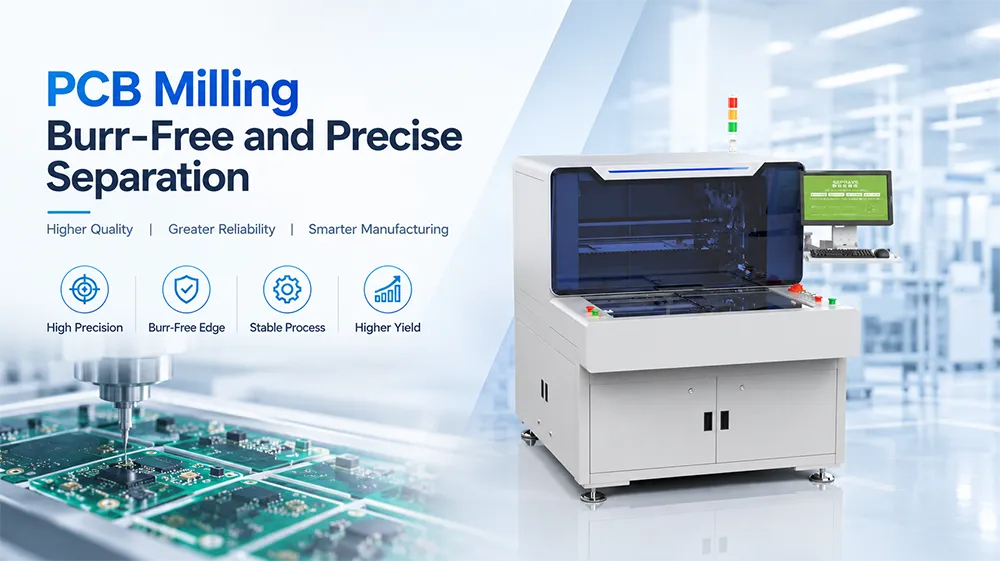
PCB milling sounds straightforward: a rotating cutter follows a programmed path and separates individual boards from a panel. In production, however, getting a clean edge is not simply a matter of increasing spindle speed. The real challenge is controlling cutting force, tool condition, positioning, support, dust, and board movement at the same time. A board can look acceptable after separation but still have small burrs, dimensional variation, lifted traces, or stress around sensitive components. These problems often become expensive later, especially when the PCB enters final assembly. So, what actually makes a milled PCB edge clean and repeatable? 🔍 Why Do Burrs Appear During PCB Separation? Burrs usually come from […]