.png)
 Japanese
  English
  Spanish
  Korean
  Russian
  Chinese
Online PCB Separators are no longer considered optional equipment in many electronics factories. In 2026, manufacturers of display modules, automotive sensors, communication modules, battery management systems, and smart electronic assemblies face a common challenge: increasing output while maintaining cutting-edge quality and reducing labor dependence.
For years, many factories treated PCB depaneling as an isolated process. Boards were cut offline and transferred manually between workstations.
Today, that approach is becoming a bottleneck.
As module products become more complex and production lines become more automated, online PCB separation is increasingly viewed as a key part of smart manufacturing rather than just a cutting operation.
🔍 Why Module Product Cutting Has Become More Challenging
Module-based products are everywhere.
Examples include:
- Automotive TPMS modules
- Camera modules
- Display modules
- Communication modules
- Smart home control modules
- Industrial IoT devices
Compared with traditional PCBs, module products often feature:
- Higher component density
- Smaller board sizes
- More sensitive solder joints
- Higher traceability requirements
- Tighter production schedules
A common issue many engineers encounter is that the depaneling process becomes the weakest link in an otherwise automated SMT line.
The SMT line may be fully automated.
The inspection process may be fully automated.
But depaneling still relies on operators manually loading and unloading boards.
This mismatch creates inefficiencies that become more obvious as production volumes increase.
⚙️ The Shift from Standalone Machines to Connected Production Lines
Five years ago, many factories focused on machine specifications.
Questions typically included:
- How fast is the spindle?
- What is the cutting accuracy?
- How long does the router bit last?
In 2026, the conversation is different.
Manufacturers increasingly ask:
- Can the machine connect directly with the SMT line?
- Can it reduce labor requirements?
- Can it support MES integration?
- Can it improve overall equipment efficiency?
This shift explains why online PCB separators are gaining attention across automotive electronics, industrial controls, and communication equipment manufacturing.
The focus is moving from machine performance to process performance.
📈 What Makes Online PCB Separators Different?
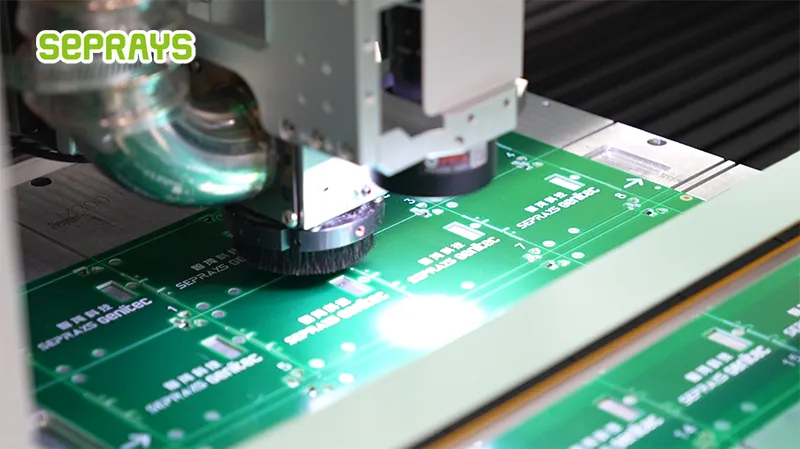
Unlike conventional offline routing systems, online PCB separators become part of the production flow.
Boards move automatically through:
- PCB transfer
- Vision alignment
- Depaneling
- Product unloading
- Downstream processing
This eliminates multiple manual handling steps.
The result is not just labor savings.
It also reduces:
- Product contamination
- Handling damage
- Board mix-ups
- Production interruptions
For high-volume module production, these factors often have a greater impact than cutting speed alone.
🏭 Why GAM360AT Fits Modern Module Manufacturing
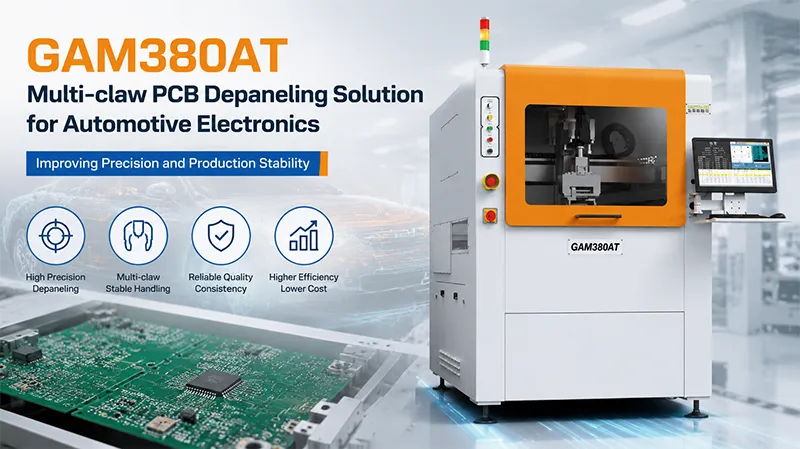
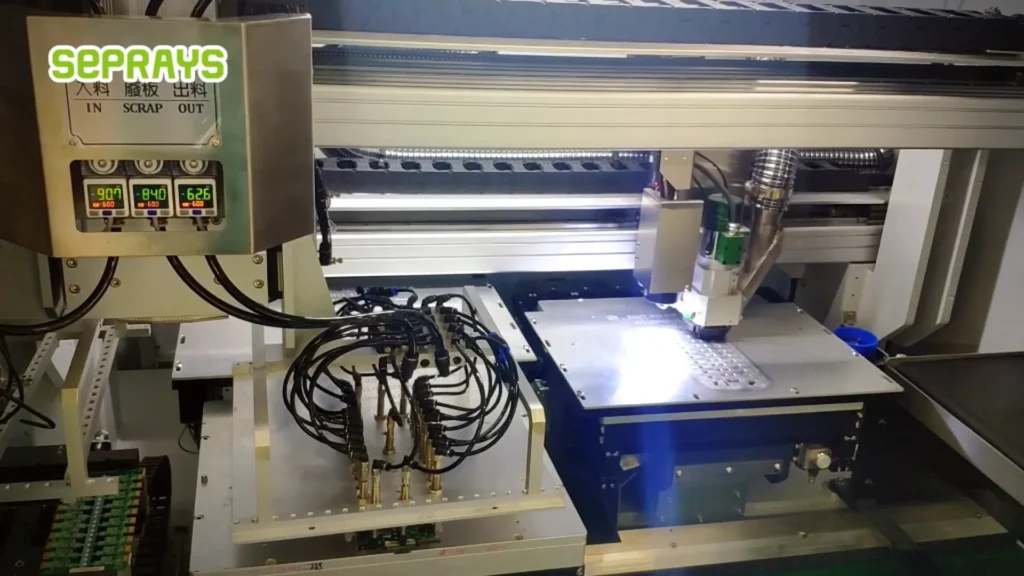
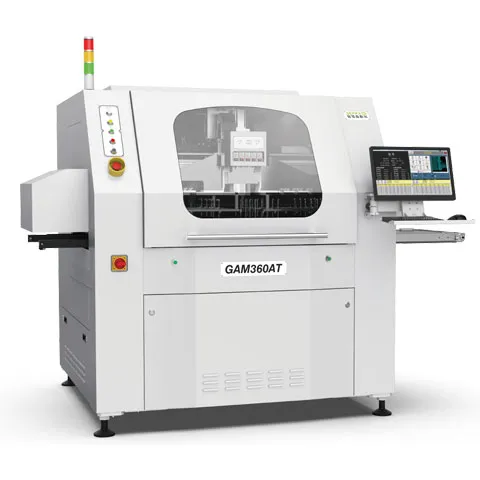
One example is the GAM360AT In-Line Automatic PCB Separator Machine.
The system is designed specifically for automated PCB separation environments where productivity and consistency are equally important. Features include high-definition CCD vision positioning, automatic tool changing, vacuum transfer systems, and seamless in-line integration capabilities. The machine supports loading, cutting, and unloading in a continuous process while maintaining cutting precision of ±0.05 mm.
Key advantages include:
- ✔ Automated loading and unloading
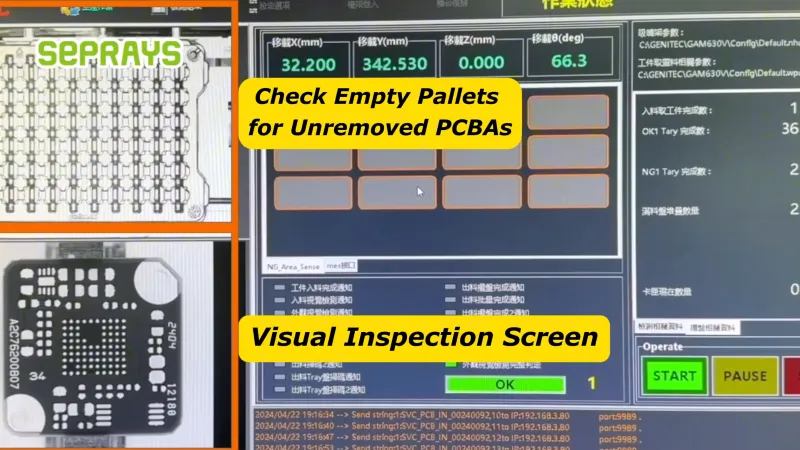
- ✔ CCD vision alignment
- ✔ Auto tool-change spindle
- ✔ Vacuum nozzle board transfer
- ✔ MES compatibility options
- ✔ Support for oversized module PCBs
For factories already operating automated SMT lines, these capabilities help eliminate process interruptions between production stages.
💰 Cost Analysis: Is Automation Really Worth It?
One common concern is investment cost.
Many managers initially compare only machine prices.
However, real operating costs usually tell a different story.
| Cost Factor | Offline Separation | Online Separation |
|---|---|---|
| Labor Requirement | High | Low |
| Manual Handling Risk | High | Low |
| Process Interruptions | Frequent | Minimal |
| Product Traceability | Limited | Strong |
| Production Consistency | 緩やかな | High |
| Scalability | Limited | Excellent |
A surprising observation from many production upgrades is that labor reduction is not always the biggest benefit.
Often, the largest gains come from:
- Reduced waiting time
- Improved line balancing
- Better product consistency
- Fewer handling-related defects
These improvements can create measurable ROI even before labor savings are fully realized.
📊 Real Production Scenario
An automotive electronics supplier producing sensor modules experienced increasing production pressure as vehicle demand grew.
Their SMT line was largely automated.
Depaneling was not.
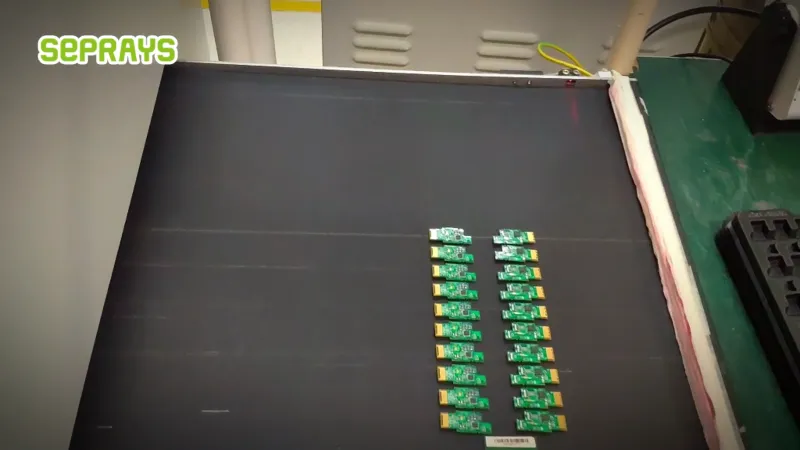
Operators manually collected boards, transferred them to a router machine, and then moved finished products to inspection stations.
Although cutting quality was acceptable, production flow remained inconsistent.
After evaluating several approaches, the manufacturer adopted an automated routing solution similar to the GAM360AT platform.
The goal was not simply faster cutting.
The goal was to eliminate process interruptions.
Results included:
- Reduced operator involvement
- Improved production rhythm
- More predictable throughput
- Easier production planning
This is a pattern increasingly seen across automotive and industrial electronics manufacturing.
🚀 A Counterintuitive Lesson from 2026
Many engineers assume the fastest depaneling machine is automatically the best choice.
In practice, that is often incorrect.
A slightly slower machine that integrates seamlessly with the production line can outperform a faster standalone machine.
Why?
Because overall throughput depends on the entire process.
Not just one station.
The bottleneck is often material handling rather than cutting speed.
This is one reason online systems continue gaining popularity.
🔧 How to Decide Whether an Online PCB Separator Is Right for You
An online solution makes the most sense when:
- ✅ Production volumes are increasing
- ✅ Labor costs are rising
- ✅ SMT lines are already automated
- ✅ Product traceability is important
- ✅ Consistency matters more than operator flexibility
However, offline machines may still be suitable when:
- ✅ Product volumes are low
- ✅ Production changes frequently
- ✅ Floor space is limited
- ✅ Budget constraints are significant
There is no universal answer.
The right choice depends on production goals rather than machine specifications alone.
🌎 Industry Trends Driving Adoption
Several manufacturing trends are accelerating adoption in 2026:
- Smart factory initiatives
- MES integration requirements
- Automotive quality standards
- Labor shortages
- Higher production volumes
- Increased demand for module-based products
As these trends continue, online depaneling systems are becoming part of broader factory automation strategies rather than standalone equipment purchases.
Why Choose Seprays Group?
For more than 30 years, Seprays Group has focused exclusively on PCB and FPC depaneling technologies, helping manufacturers improve cutting quality, automation efficiency, and production consistency.
Seprays Group has been dedicated to PCB/FPC depaneling technology, providing a full range of solutions, including:
- PCB Router Depaneling Machines
- Laser Depaneling Systems
- V-Groove PCB Separators
- PCB/FPC Punching Machines
- Automated Loading & Unloading Systems
- In-Line Production Automation Solutions
Leading global manufacturers and organizations, including Foxconn, Flextronics, State Grid, Luxshare, Compal, Wistron, China Electronics, Quanta, CRRC, China Aerospace, OPPO, ZTE, and Bosch, trust our equipment.
Today, Seprays solutions are operating in factories throughout China, Asia, Europe, and other global manufacturing regions.
Whether you are producing automotive modules, industrial electronics, communication products, medical devices, or consumer electronics, our engineering team can help evaluate the most suitable depaneling solution for your production requirements.
If you would like to discuss your PCB separation process or evaluate whether the GAM360AT is suitable for your application, please feel free to contact Seprays Group.
WhatsApp: +8618929266433
Eメール: sales@seprays.com
FAQ
1. What is an online PCB separator?
An online PCB separator is a depaneling machine integrated directly into an SMT or production line, allowing automatic loading, cutting, and unloading without manual intervention.
2. Which industries benefit most from online PCB separation?
Automotive electronics, communication equipment, industrial control systems, consumer electronics, medical electronics, and IoT module manufacturing are among the most common users.
3. Is the GAM360AT suitable for large PCB panels?
Yes. The GAM360AT supports cutting sizes up to 600 × 500 mm and is suitable for oversized PCBs used in automotive, server, and industrial applications.
4. How does CCD vision improve depaneling quality?
CCD vision systems automatically detect board positions and compensate for alignment deviations, helping maintain cutting accuracy and consistency.
5. Can online PCB separators integrate with MES systems?
Yes. Many advanced in-line depaneling systems, including the GAM360AT platform, support MES integration options for production tracking, traceability, and factory automation management.