.png)
 Japanese
  English
  Spanish
  Korean
  Russian
  Chinese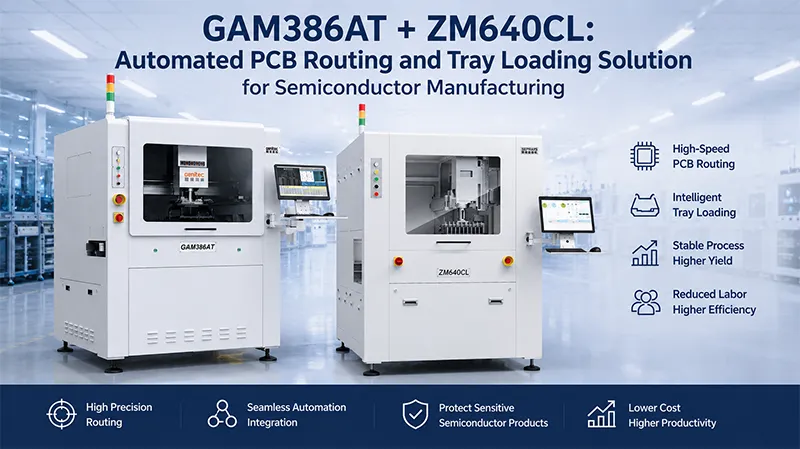
Automated PCB routing and tray loading solutions are becoming a much larger topic inside semiconductor factories than they were just a few years ago. In conversations with production engineers, the discussion is no longer only about cutting precision. More often, it starts with questions like:
“How can we reduce operator dependency?”
“How can we avoid micro-damage during high-volume production?”
“How can routing and material handling work as one process instead of two separate steps?”
Semiconductor manufacturing in 2026 is changing quickly. Package sizes continue shrinking. Product cycles continue to shorten. Yield expectations continue increasing.
Ironically, smaller products are creating bigger manufacturing challenges.
🔍 Why Semiconductor Production Is Creating New Challenges
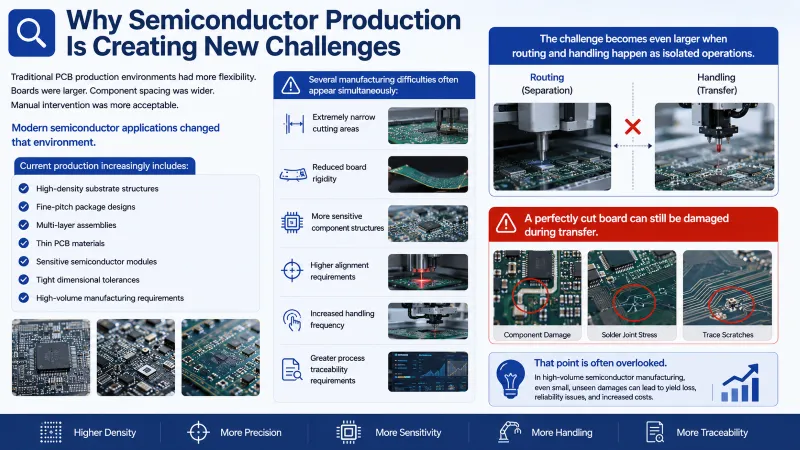
Traditional PCB production environments had more flexibility.
Boards were larger.
Component spacing was wider.
Manual intervention was more acceptable.
Modern semiconductor applications changed that environment.
Current production increasingly includes:
- High-density substrate structures
- Fine-pitch package designs
- Multi-layer assemblies
- Thin PCB materials
- Sensitive semiconductor modules
- Tight dimensional tolerances
- High-volume manufacturing requirements
Several manufacturing difficulties often appear simultaneously:
- Extremely narrow cutting areas
- Reduced board rigidity
- More sensitive component structures
- Higher alignment requirements
- Increased handling frequency
- Greater process traceability requirements
The challenge becomes even larger when routing and handling happen as isolated operations.
A perfectly cut board can still become damaged during transfer.
That point is often overlooked.
⚠️ Common Questions Production Teams Keep Asking
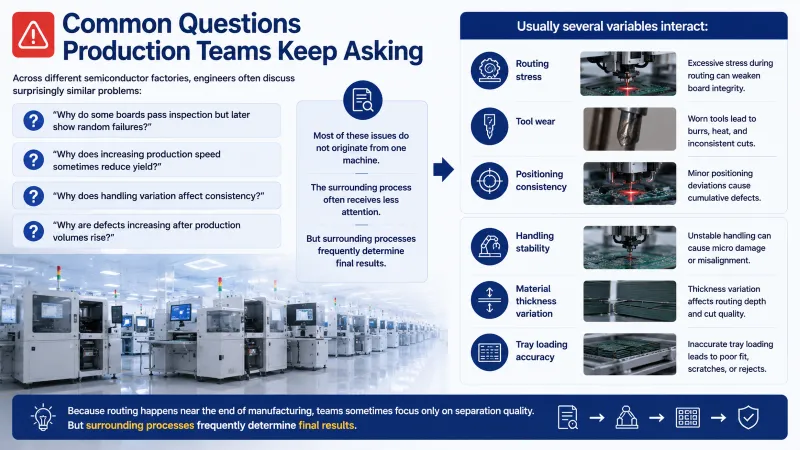
Across different semiconductor factories, engineers often discuss surprisingly similar problems:
“Why do some boards pass inspection but later show random failures?”
“Why does increasing production speed sometimes reduce yield?”
“Why does handling variation affect consistency?”
“Why are defects increasing after production volumes rise?”
Most of these issues do not originate from one machine.
Usually, several variables interact:
- Routing stress
- Tool wear
- Positioning consistency
- Handling stability
- Material thickness variation
- Tray loading accuracy
Because routing happens near the end of manufacturing, teams sometimes focus only on separation quality.
The surrounding process often receives less attention.
But surrounding processes frequently determine final results.
📖 A Story Behind the Development of GAM386AT + ZM640CL
Several years ago, during discussions with customers in Suzhou, China, Seprays engineers noticed a repeating pattern.
Factories were purchasing high-performance routing systems.
Yet some quality problems continued appearing.
The routing itself looked acceptable.
Inspection data initially looked acceptable.
But downstream handling introduced variability.
- Some boards shifted slightly during transfer.
- Some experienced repeated contact.
- Some required additional operator intervention.
The result was small.
But production never operates on only one board.
At hundreds of thousands of units per month, small deviations become expensive problems.
That observation gradually changed the design philosophy.
The goal became larger than building a faster router.
The objective became creating a connected process.
That led to integrating high-speed routing capability with intelligent tray loading automation.
The combination of GAM386AT + ZM640CL reflects that transition.
Not simply separating boards.
But helping the entire production flow operate more consistently.
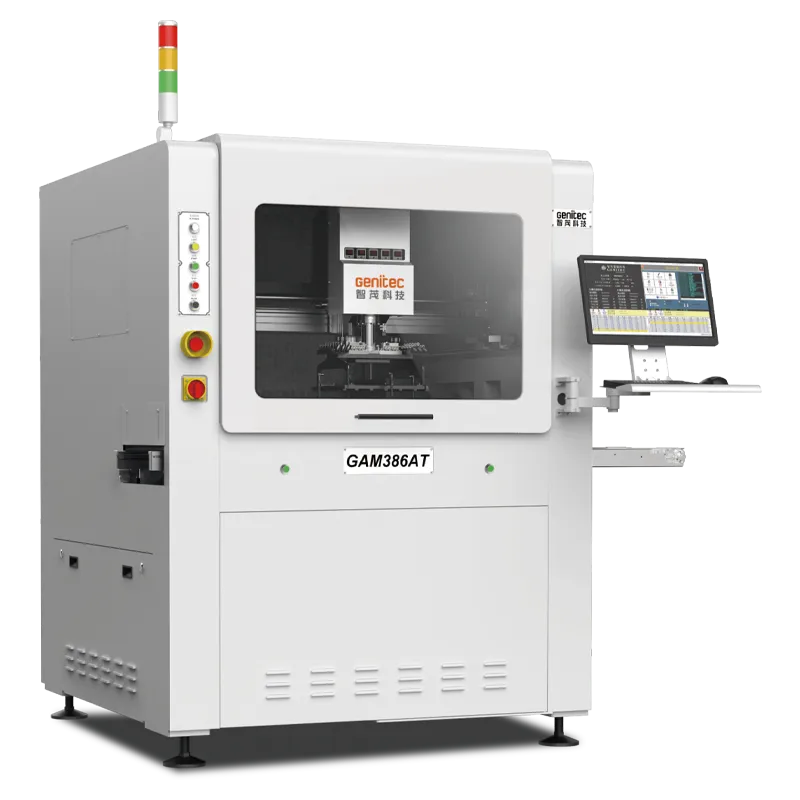
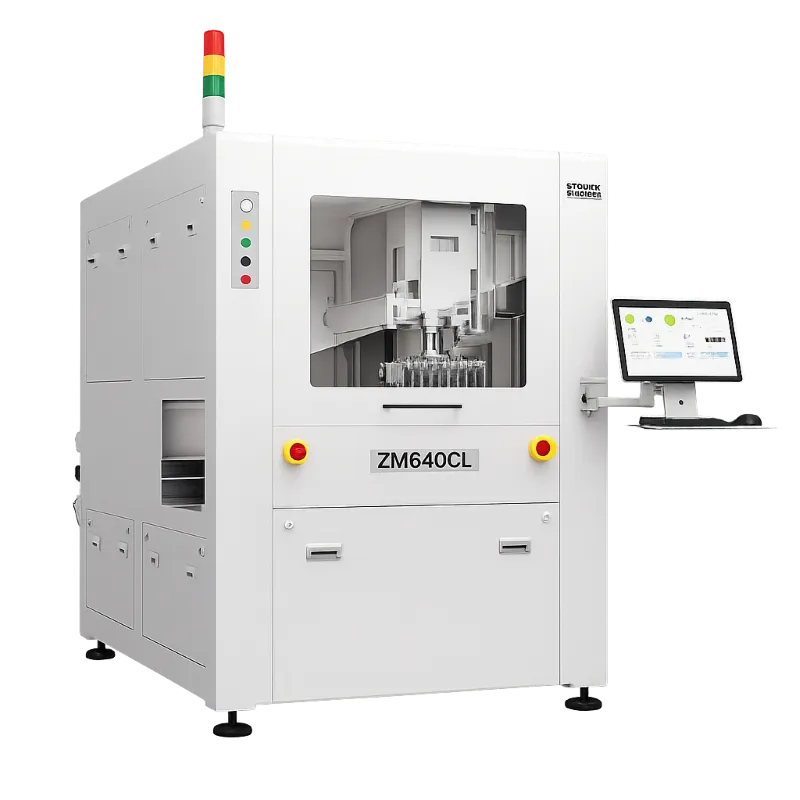
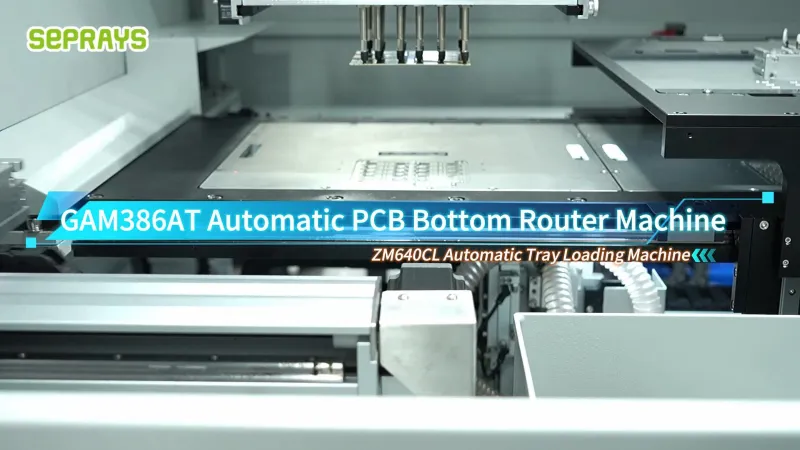
🏭 How GAM386AT + ZM640CL Works Together
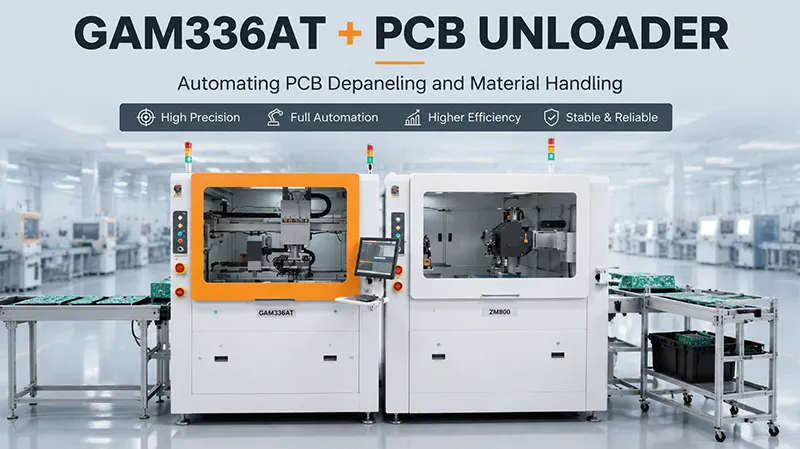
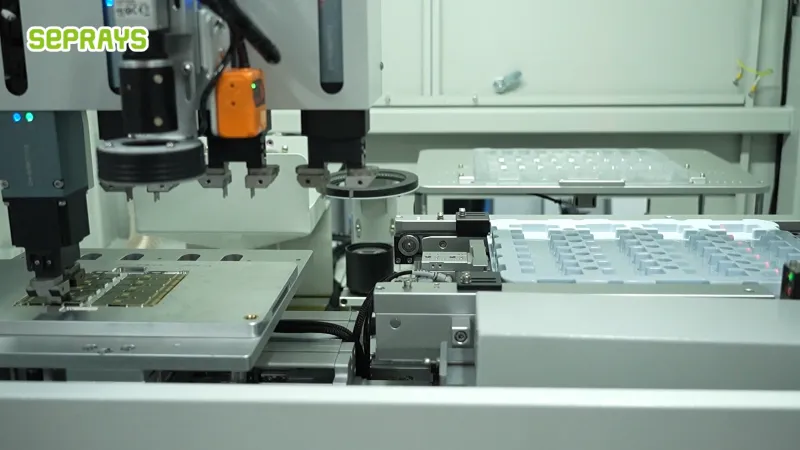
The integrated process supports:
- High-speed PCB bottom routing
- Automatic board transfer
- Intelligent tray loading
- Reduced manual handling
- Stable positioning consistency
- Continuous workflow operation
Instead of creating isolated production islands, routing and handling become connected steps.
This reduces interruptions between operations.
In high-volume semiconductor environments, that difference becomes significant.
📊 Comparing Traditional Workflow vs Automated Routing + Tray Loading
| Factor | Traditional Routing + Manual Handling | GAM386AT + ZM640CL |
|---|---|---|
| Operator involvement | High | Low |
| Positioning consistency | 緩やかな | High |
| Material transfer stability | Variable | Stable |
| Production interruption | Frequent | Lower |
| Yield consistency | 緩やかな | Higher |
| Labor requirement | More operators | Fewer operators |
| Production scalability | Limited | Strong |
| Long-term operating cost | Higher | Lower |
The interesting part:
Lower equipment cost does not always create lower manufacturing cost.
Many hidden expenses appear later.
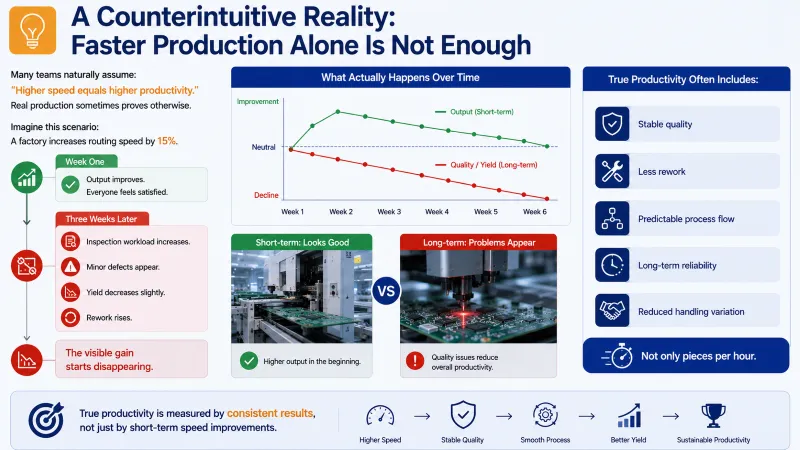
💡 A Counterintuitive Reality: Faster Production Alone Is Not Enough
Many teams naturally assume:
Higher speed equals higher productivity.
Real production sometimes proves otherwise.
Imagine this scenario:
A factory increases routing speed by 15%.
Week one:
Output improves.
Everyone feels satisfied.
Three weeks later:
Inspection workload increases.
Minor defects appear.
Yield decreases slightly.
Rework rises.
The visible gain starts disappearing.
True productivity often includes:
- Stable quality
- Less rework
- Predictable process flow
- Long-term reliability
- Reduced handling variation
Not only pieces per hour.
🚀 Looking Toward Semiconductor Manufacturing in 2026
Manufacturing discussions are becoming broader.
Factories increasingly ask:
How can systems communicate automatically?
How can manual dependence be reduced?
How can process consistency scale globally?
How can sensitive products receive greater protection?
The answer rarely comes from a single machine specification.
It comes from building processes that work together.
Systems like GAM386AT + ZM640CL represent part of that shift.
Not because they simply route faster.
Because they help factories operate more intelligently.
🌟 Real Production Example: A Semiconductor Customer Experience
During a project supporting a semiconductor manufacturer in Shenzhen, China, engineers faced a familiar challenge.
Production demand increased rapidly.
Manual transfer between routing and tray loading created bottlenecks.
Operators were spending significant time handling boards.
Small positioning variations occasionally affected downstream consistency.
After introducing a combined routing and tray automation process similar to the GAM386AT + ZM640CL configuration:
- Manual handling steps were reduced
- Production flow became smoother
- Positioning consistency improved
- Operators could focus on higher-value process tasks
The improvement did not come from cutting faster.
It came from reducing unnecessary variation.
Sometimes the largest gains come from places people initially overlook.
Why Choose Seprays Group?
For over 30 years, Seprays Group has focused on one thing: helping manufacturers solve increasingly complex PCB and FPC depaneling challenges while adapting to evolving production environments.
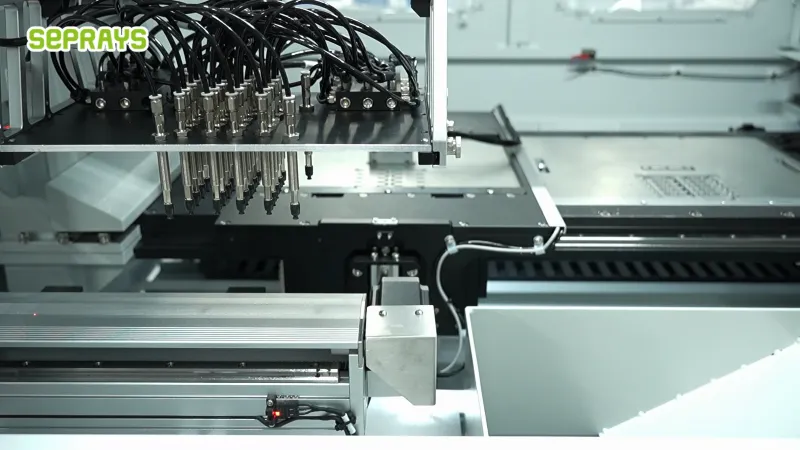
Seprays Group has been dedicated to PCB/FPC depaneling technology, providing a complete range of solutions, including milling-cutter depanelers, laser depanelers, V-groove depanelers, punching depanelers, and automated handling systems.
Our equipment is trusted by global manufacturers, including Foxconn, Flextronics, State Grid, Luxshare, Compal, Wistron, China Electronics, Quanta, CRRC, China Aerospace, OPPO, ZTE, and Bosch, supporting production lines across China and worldwide.
What makes Seprays different is not only equipment performance.
It is the experience gained from decades of real manufacturing environments:
- 30+ years of industry experience
- Complete depaneling and automation ecosystem
- Integration with smart factory workflows
- High-speed precision routing solutions
- Global application experience across industries
- Strong support for semiconductor and high-reliability production environments
If you are exploring automated PCB routing and tray loading solutions for semiconductor manufacturing, please feel free to contact us.
WhatsApp: +8618929266433
Eメール: sales@seprays.com
FAQ
1. What industries can benefit from GAM386AT + ZM640CL?
The system is suitable for semiconductor manufacturing, automotive electronics, industrial electronics, communication products, medical devices, and high-density consumer electronics.
2. Why combine tray loading with PCB routing?
Routing quality alone does not guarantee final product quality. Automated tray loading reduces manual handling variation and improves process consistency.
3. Can GAM386AT support high-volume manufacturing?
Yes. The machine is designed for in-line production environments requiring stable, continuous, high-speed operation.
4. Does automation reduce labor requirements?
Yes. Automated transfer and tray loading reduce repetitive manual handling tasks and improve production efficiency.
5. Is higher routing speed always better?
Not necessarily. Higher speed without process optimization may increase hidden costs such as rework, inspection workload, and yield instability.