.png)
 Japanese
  English
  Spanish
  Korean
  Russian
  Chinese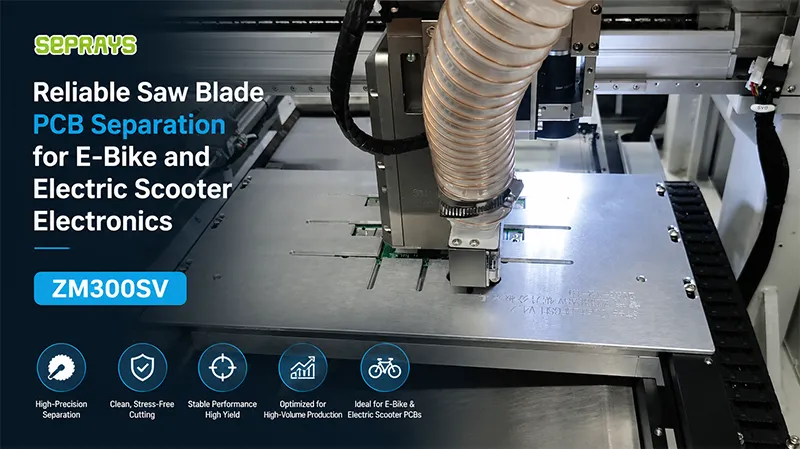
Reliable Saw Blade PCB Separation has become an increasingly important topic as e-bike and electric scooter manufacturers scale production to meet global demand. While battery technology, motor controllers, and smart connectivity continue to improve, many factories are discovering that PCB separation remains one of the final processes capable of influencing overall product reliability.
A board that passes electrical testing today may still develop reliability issues after vibration, thermal cycling, or long-term road use if unnecessary stress is introduced during manufacturing.
This article explores why PCB depaneling deserves more attention in electric two-wheel vehicle manufacturing, shares practical production observations, and discusses how the ZM300SV Offline Saw Blade PCB Separator helps manufacturers achieve stable, repeatable results.
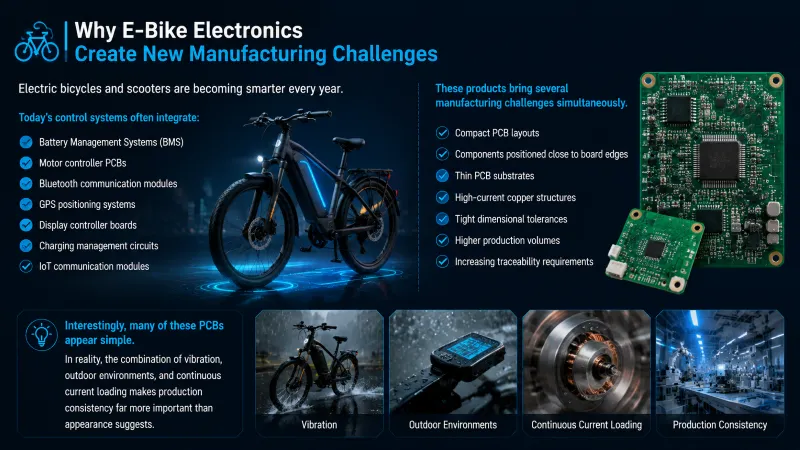
🚲 Why E-Bike Electronics Create New Manufacturing Challenges
Electric bicycles and scooters are becoming smarter every year.
Today’s control systems often integrate:
- ✓ Battery Management Systems (BMS)
- ✓ Motor controller PCBs
- ✓ Bluetooth communication modules
- ✓ GPS positioning systems
- ✓ Display controller boards
- ✓ Charging management circuits
- ✓ IoT communication modules
These products bring several manufacturing challenges simultaneously.
Engineers commonly face:
- ✓ Compact PCB layouts
- ✓ Components positioned close to board edges
- ✓ Thin PCB substrates
- ✓ High-current copper structures
- ✓ Tight dimensional tolerances
- ✓ Higher production volumes
- ✓ Increasing traceability requirements
Interestingly, many of these PCBs appear simple.
In reality, the combination of vibration, outdoor environments, and continuous current loading makes production consistency far more important than appearance suggests.
⚠️ Questions Production Engineers Frequently Ask
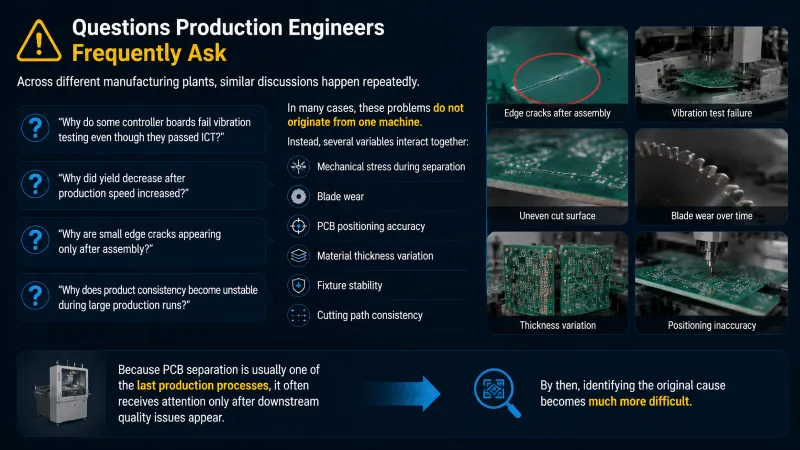
Across different manufacturing plants, similar discussions happen repeatedly.
“Why do some controller boards fail vibration testing even though they passed ICT?”
“Why did the yield decrease after the production speed increased?”
“Why are small edge cracks appearing only after assembly?”
“Why does product consistency become unstable during large production runs?”
In many cases, these problems do not originate from one machine.
Instead, several variables interact together:
- Mechanical stress during separation
- Blade wear
- PCB positioning accuracy
- Material thickness variation
- Fixture stability
- Cutting path consistency
Because PCB separation is usually one of the last production processes, it often receives attention only after downstream quality issues appear.
By then, identifying the original cause becomes much more difficult.
🔬 Why Seprays Developed the ZM300SV
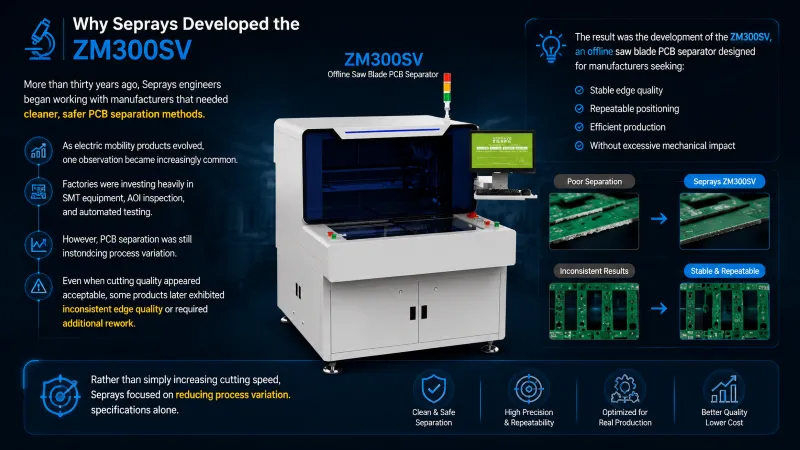
More than thirty years ago, Seprays engineers began working with manufacturers that needed cleaner, safer PCB separation methods.
As electric mobility products evolved, one observation became increasingly common.
Factories were investing heavily in SMT equipment, AOI inspection, and automated testing.
However, PCB separation was still introducing process variation.
Even when cutting quality appeared acceptable, some products later exhibited inconsistent edge quality or required additional rework.
Rather than simply increasing cutting speed, Seprays focused on reducing process variation.
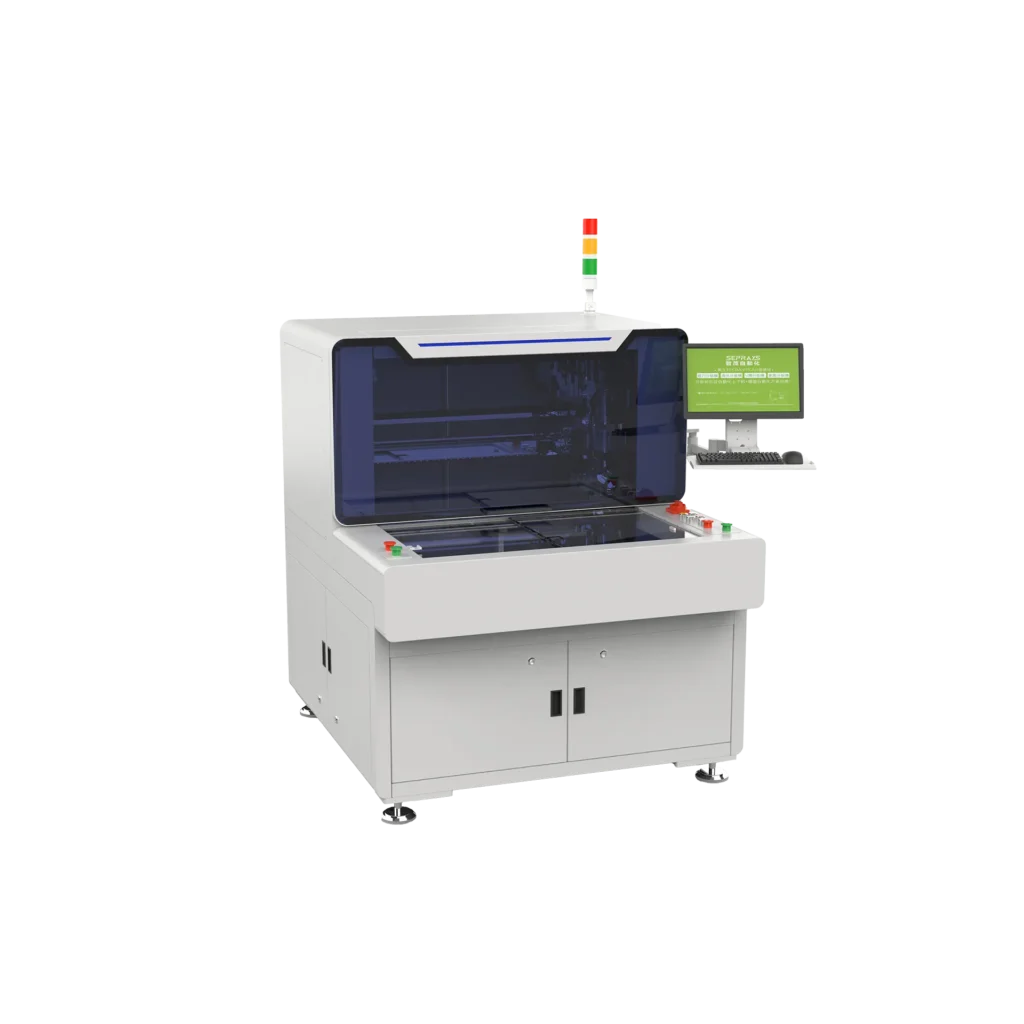
The result was the development of the ZM300SV, an offline saw blade PCB separator designed for manufacturers seeking stable edge quality, repeatable positioning, and efficient production without excessive mechanical impact.
Its development was driven by practical manufacturing requirements—not by the pursuit of higher machine specifications alone.
📊 Comparing Conventional Separation and ZM300SV
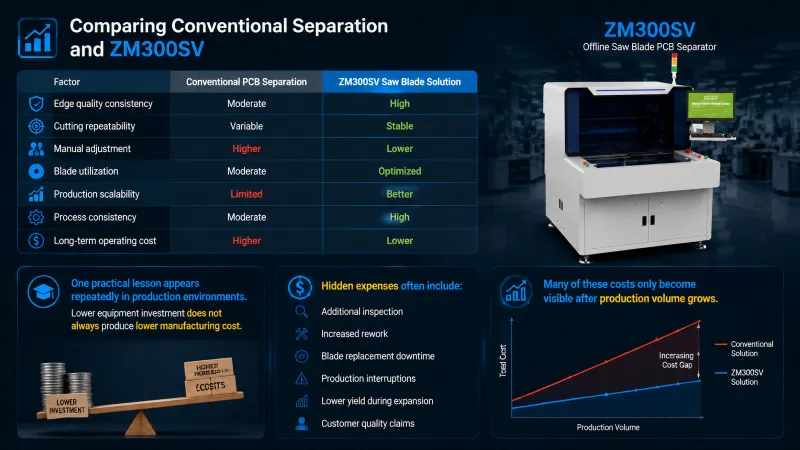
| Factor | Conventional PCB Separation | ZM300SV Saw Blade Solution |
|---|---|---|
| Edge quality consistency | 緩やかな | High |
| Cutting repeatability | Variable | Stable |
| Manual adjustment | Higher | Lower |
| Blade utilization | 緩やかな | Optimized |
| Production scalability | Limited | Better |
| Process consistency | 緩やかな | High |
| Long-term operating cost | Higher | Lower |
One practical lesson appears repeatedly in production environments.
Lower equipment investment does not always produce lower manufacturing costs.
Hidden expenses often include:
- Additional inspection
- Increased rework
- Blade replacement downtime
- Production interruptions
- Lower yield during expansion
- Customer quality claims
Many of these costs only become visible after production volume grows.
💡 A Counterintuitive Reality: Faster Cutting Is Not Always Better
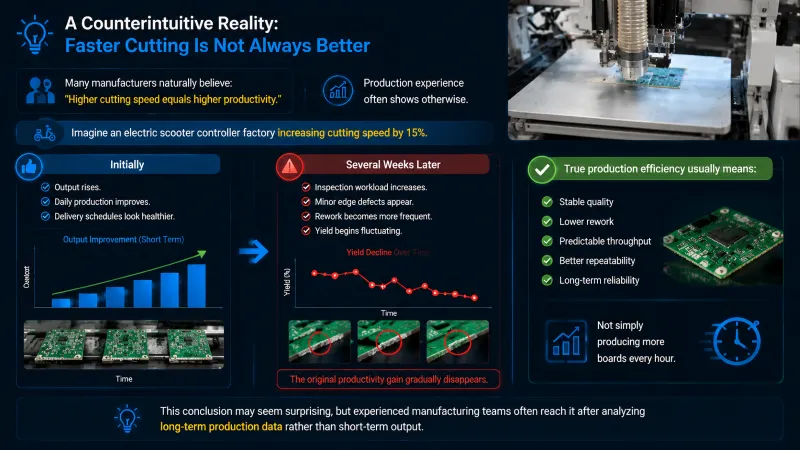
Many manufacturers naturally believe:
Higher cutting speed equals higher productivity.
Production experience often shows otherwise.
Imagine an electric scooter controller factory increasing cutting speed by 15%.
Initially:
- Output rises.
- Daily production improves.
- Delivery schedules look healthier.
Several weeks later:
- Inspection workload increases.
- Minor edge defects appear.
- Rework becomes more frequent.
- Yield begins fluctuating.
The original productivity gain gradually disappears.
True production efficiency usually means:
- ✓ Stable quality
- ✓ Lower rework
- ✓ Predictable throughput
- ✓ Better repeatability
- ✓ Long-term reliability
Not simply producing more boards every hour.
This conclusion may seem surprising, but experienced manufacturing teams often reach it after analyzing long-term production data rather than short-term output.
🌍 Real Production Experience
A manufacturer producing electric scooter controller boards in Ho Chi Minh City, Vietnam, experienced growing pressure after receiving new export orders.
The challenge was not machine capacity.
It was maintaining stable quality while increasing production volume.
Engineers noticed:
- Higher inspection frequency
- Occasional edge chipping
- More operator intervention
- Small yield fluctuations
Rather than focusing only on cutting speed, the production team reviewed the complete depaneling process.
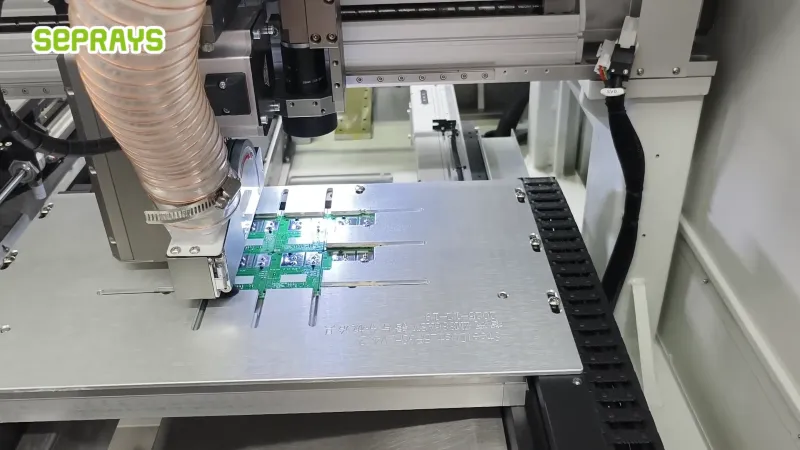
After introducing Seprays ZM300SV and optimizing fixture positioning, blade management, and cutting parameters, process consistency improved over multiple production cycles.
Operators spent less time making manual adjustments, while edge quality became more predictable.
The biggest improvement was not in headline production speed.
It was production stability.
🛠 Practical Recommendations Before Choosing a PCB Separation Solution
When evaluating a depaneling system for electric-vehicle electronics, consider more than just machine specifications.
Questions worth asking include:
- Will PCB designs become denser next year?
- Can the equipment maintain consistency during continuous production?
- How easy is blade maintenance?
- Can production parameters be standardized across shifts?
- Will future product variants require flexible programming?
These questions often influence long-term manufacturing costs more than the initial purchase price.
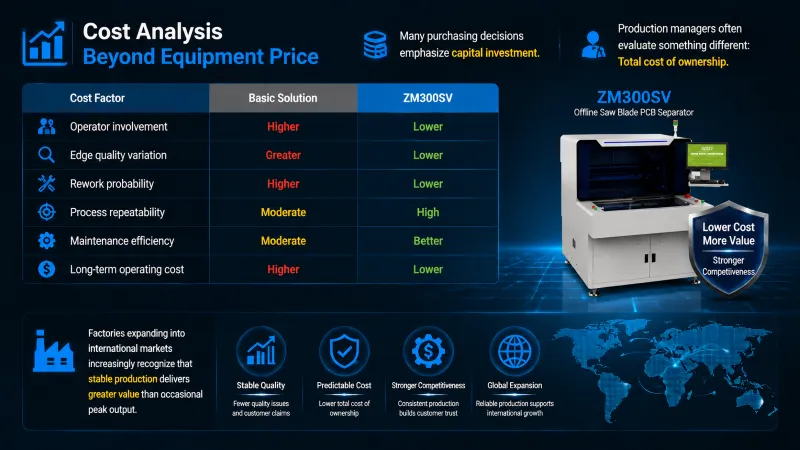
📈 Cost Analysis Beyond Equipment Price
Many purchasing decisions emphasize capital investment.
Production managers often evaluate something different:
Total cost of ownership.
| Cost Factor | Basic Solution | ZM300SV |
|---|---|---|
| Operator involvement | Higher | Lower |
| Edge quality variation | Greater | Lower |
| Rework probability | Higher | Lower |
| Process repeatability | 緩やかな | High |
| Maintenance efficiency | 緩やかな | Better |
| Long-term operating cost | Higher | Lower |
Factories expanding into international markets increasingly recognize that stable production delivers greater value than occasional peak output.
🚀 Looking Ahead: Manufacturing in 2026 and Beyond
Electric mobility continues evolving rapidly.
Manufacturers are no longer asking only:
“How can we produce faster?”
Instead, discussions increasingly focus on:
- How can production remain stable?
- How can quality remain consistent across larger volumes?
- How can manual intervention be reduced?
- How can manufacturing become easier to scale?
Reliable PCB separation is becoming part of that broader conversation.
Solutions like the ZM300SV contribute by supporting repeatable manufacturing processes, protecting sensitive assemblies, and helping production teams maintain consistency as demand continues to grow.
Why Choose Seprays Group?
For more than 30 years, Seprays Group has specialized in PCB/FPC depaneling technology and intelligent manufacturing solutions. Our product portfolio includes milling-cutter, laser, V-groove, punching, and saw-blade depanelers, as well as automated handling systems, enabling customers to build efficient and scalable production lines.
Our equipment is trusted by globally recognized manufacturers, including Foxconn, Flextronics, State Grid, Luxshare, Compal, Wistron, China Electronics, Quanta, CRRC, China Aerospace, OPPO, ZTE, and Bosch. Today, Seprays solutions operate in factories across China and around the world, supporting industries such as automotive electronics, consumer electronics, telecommunications, medical devices, industrial control, and new energy.
Whether you are expanding an existing production line or planning a new manufacturing facility, our engineering team can help you evaluate the most suitable PCB depaneling solution based on your product, process, and production goals.
If you would like to learn more about the ZM300SV or discuss your application requirements, please feel free to contact Seprays Group.
WhatsApp: +8618929266433
Eメール: sales@seprays.com
Frequently Asked Questions (FAQ)
1. What applications is the ZM300SV best suited for?
The ZM300SV is ideal for automotive electronics, e-bike controllers, electric scooter PCBs, industrial control boards, communication modules, and other products requiring clean, accurate PCB separation with consistent edge quality.
2. How does saw blade depaneling compare with router depaneling?
Saw blade depaneling generally offers higher throughput for straight-line cutting and repetitive production, while router depaneling provides greater flexibility for complex PCB contours. The best choice depends on your board design and production requirements.
3. Can the ZM300SV support high-volume manufacturing?
Yes. The system is designed for continuous production, delivering stable cutting performance, repeatable positioning, and efficient operation suitable for medium- and high-volume manufacturing environments.
4. What factors have the greatest impact on PCB separation quality?
Blade condition, PCB positioning accuracy, fixture stability, material consistency, cutting parameters, and preventive maintenance all influence the final separation quality and long-term production stability.
5. Why is process stability more important than maximum cutting speed?
Higher cutting speed can increase short-term output, but excessive process variation may lead to rework, yield loss, and higher operating costs. Stable, repeatable production usually provides better long-term manufacturing performance and overall profitability.