.png)
 Japanese
  English
  Spanish
  Korean
  Russian
  Chinese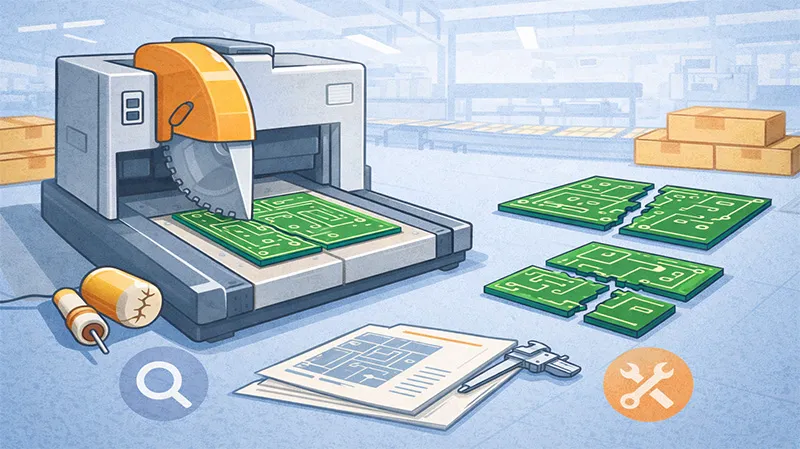
PCB V-Cut Depaneling Machine usage remains widespread in high-volume SMT production, particularly where board designs are standardized, and cost efficiency is critical. Despite the rise of routing and laser solutions, V-cut depaneling continues to play an important role in consumer electronics, power modules, and industrial products. This article shares practical insights from real SMT production lines rather than promotional comparisons.
🧱 Why V-Cut Still Matters in Mass Production
In high-volume environments, simplicity and predictability are often valued over flexibility. Engineers working with V-cut depaneling emphasize that when PCB layout allows sufficient edge clearance, the process can be highly efficient.
Key advantages frequently mentioned:
- Fast separation for large batch sizes
- Low cycle time per panel
- Minimal programming complexity
- Lower initial equipment investment
For stable product designs with long production life cycles, these benefits remain attractive.

⚠️ Stress Behavior — The Primary Engineering Concern
Mechanical stress is the most discussed limitation of V-cut depaneling. In practice, the separation force applied along the groove can affect solder joints and ceramic components.
Common pain points reported:
- Cracked MLCCs near the score line
- Edge deformation on thin PCBs
- Increased failures during thermal cycling tests
As component density increases, controlling break force becomes essential. Many SMT teams adjust scoring depth, blade angle, and separation speed to reduce stress concentration.

⚙️ Machine Durability in 24/7 Production
In high-output factories, machines operate continuously. Engineers often evaluate V-cut equipment based on durability rather than peak throughput.
Observed durability factors include:
- Blade material and wear resistance
- Frame rigidity to prevent misalignment
- Consistency of scoring depth over time
Poor blade condition is one of the most common root causes of quality variation in long production runs.

📉 Cost Analysis — Efficiency vs. Hidden Losses
While V-cut systems are generally cost-effective, experienced production managers caution against evaluating cost only at the purchase stage.
Hidden costs identified in production:
- Scrap from stress-related defects discovered later
- Additional inspection steps near cut edges
- Blade replacement and downtime
- Yield loss during reliability testing
Several factories reported that modest investment in better blade quality and preventive maintenance significantly reduced total cost.

🏭 Case Observations from High-Volume SMT Lines
- Consumer electronics: V-cut remains dominant where board design is optimized for scoring
- Power electronics: Used selectively for rigid boards with low edge sensitivity
- Industrial controls: Applied cautiously, often with conservative separation parameters
Across cases, success depends more on design discipline and process control than machine speed.
🧩 Best Practices Shared by Engineers
From production discussions, several best practices emerge:
- Maintain consistent score depth across panels
- Keep sensitive components away from V-grooves
- Monitor blade wear proactively
- Control the separation speed to limit the shock
- Review the depaneling impact during the PCB design stage
These practices help sustain yield in long-term mass production.
Why Choose Seprays Group?
Seprays Group provides V-cut depaneling solutions designed for industrial durability, consistent scoring accuracy, and stable performance in high-volume SMT environments. Our systems focus on long-term reliability and practical process control rather than short-term speed.
If you would like to discuss V-cut depaneling suitability for your PCB designs, please contact us.
WhatsApp: +8618929266433
E-mail: sales@seprays.com