.png)
 Japanese
  English
  Spanish
  Korean
  Russian
  Chinese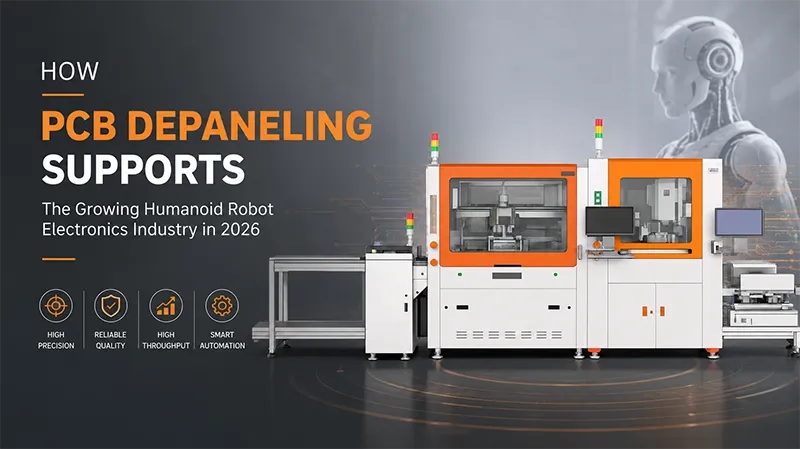
PCB depaneling may not be the first thing people think about when discussing humanoid robots. Most attention goes to AI chips, actuators, batteries, sensors, and dexterous hands.
But once a robot moves from a prototype to a production line, the electronics inside it become a manufacturing problem too.
In August 2026, the second World Humanoid Robot Games in Beijing brought together 2,056 humanoid robots from 666 teams across 16 countries. More importantly, the event expanded beyond sports into factories, logistics, hotels, homes, and other real-world scenarios.
That shift matters to electronics manufacturers.
A robot that performs well in a demonstration still needs reliable, repeatable PCBA production before it can become a commercial product.
🤖 Why Humanoid Robots Create New PCB Challenges
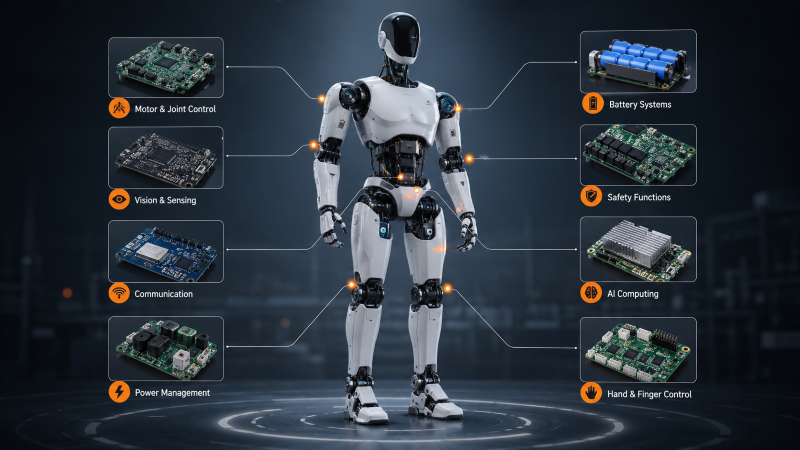
A humanoid robot is not built around one simple control board.
Depending on the architecture, it may contain electronics for:
- Motor and joint control
- Vision and sensing
- Communication
- Power management
- Battery systems
- Safety functions
- AI computing
- Hand and finger control
These boards can have different sizes, shapes, component densities, and production volumes.
A prototype may only require a few panels each week.
A commercial product can require a completely different manufacturing strategy.
This is where depaneling becomes part of the larger production discussion.
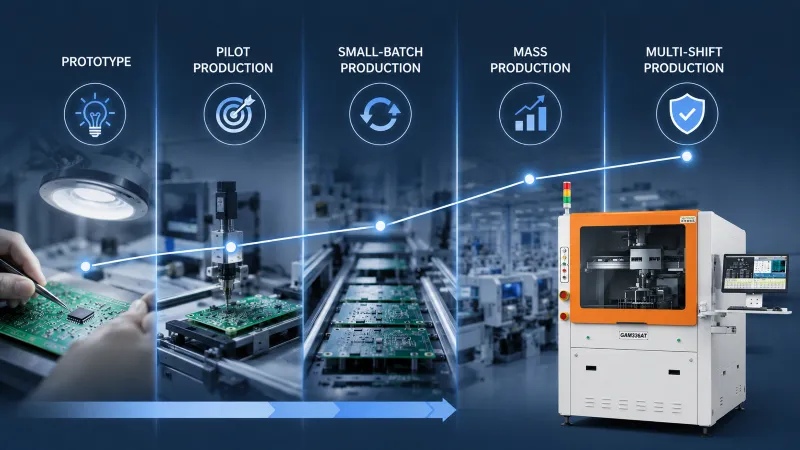
🔧 From Prototype Production to Mass Manufacturing
The manufacturing process often changes as robot production scales.
| Production Stage | Typical Priority |
|---|---|
| Prototype | Flexibility |
| Pilot production | Repeatability |
| Small-batch production | Changeover efficiency |
| Mass production | スループット |
| Multi-shift production | Automation + stability |
A manual process may be acceptable during engineering validation.
It becomes less attractive when hundreds or thousands of boards need to be separated every day.
The important point is that automation should follow production requirements, not simply the latest technology trend.
🧩 Why Different Robot PCBs Need Different Processes
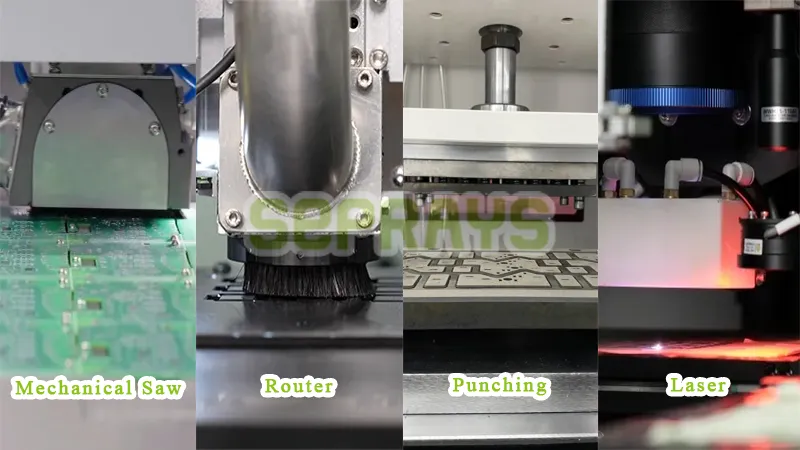
Not every humanoid robot PCB should use the same separation method.
A board with complex contours may benefit from milling.
A panel with straight V-grooves may be better suited to automatic V-groove separation.
A particularly sensitive application may justify evaluating laser processing.
Punching can also make sense when board geometry and production volume support dedicated tooling.
| PCB Situation | Possible Approach |
|---|---|
| Complex outline | Milling |
| Straight V-groove | V-groove |
| High sensitivity | Evaluate laser |
| Stable high-volume design | Automated process |
| Dedicated geometry | Punching |
This is an important boundary condition.
The robot industry is growing, but that does not mean every PCB requires the most automated machine available.
💰 Where Does the Cost Actually Come From?
Manufacturers sometimes compare depaneling equipment by purchase price alone.
For robotics electronics, that can be misleading.
The real calculation includes:
Machine + labor + tooling + maintenance + downtime + scrap + changeover
Consider a factory producing several control-board models.
A lower-cost machine may require one operator to handle loading and unloading. A more automated system may cost more initially but reduce repetitive labor and improve process consistency.
For a high-volume production line, the second option may eventually have a lower cost per board.
But there is a catch.
If the line only runs a few hundred boards per month, the additional automation may never recover its cost.
The counterintuitive conclusion: more automation can reduce manufacturing cost, but only when production volume and utilization justify it.
🏭 An Illustrative Semiconductor Electronics Case
Imagine an overseas semiconductor equipment manufacturer supplying electronics for humanoid robot platforms.
The company produces several PCBA types. Some are relatively simple motor-control boards. Others contain dense components and more complicated outlines.
During early production, operators separate panels manually.
As demand increases, several problems appear:
- Operator workload increases
- Cycle time becomes inconsistent
- Product changeovers take longer
- Board handling becomes repetitive
- Production planning becomes harder
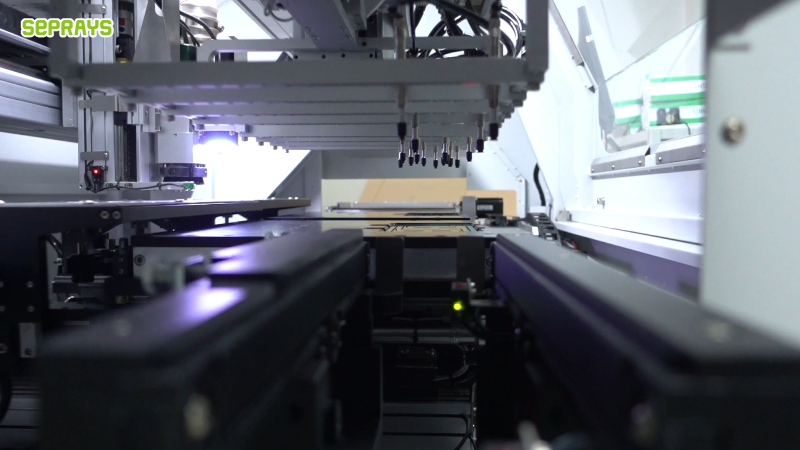
The engineering team then evaluates automated separation.
Instead of asking only, “Which machine is fastest?”, they compare the complete process.
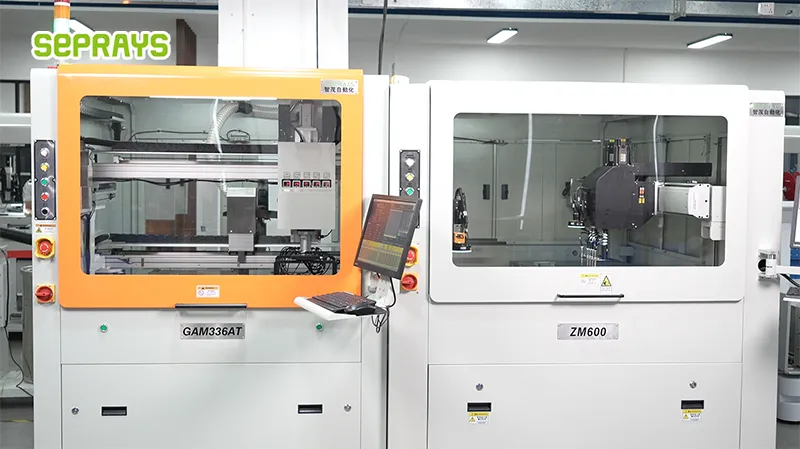
A Seprays solution could be considered according to the PCB geometry, volume, automation requirements, and downstream handling.
For example, complex boards may call for milling, while straight V-groove panels may be better matched with automatic V-groove equipment.
This is an illustrative manufacturing scenario, not a claim about a specific Seprays semiconductor customer.
The broader lesson is useful: robotics production needs process flexibility because the electronics inside the robot are not all the same.
📈 What Changes as Humanoid Robots Scale in 2026?
The 2026 robot games provide an interesting signal.
The event included not only athletic competitions but also industrial and service scenarios. Official information says the second edition expanded into real-world environments such as factories, hotels, homes, and logistics.
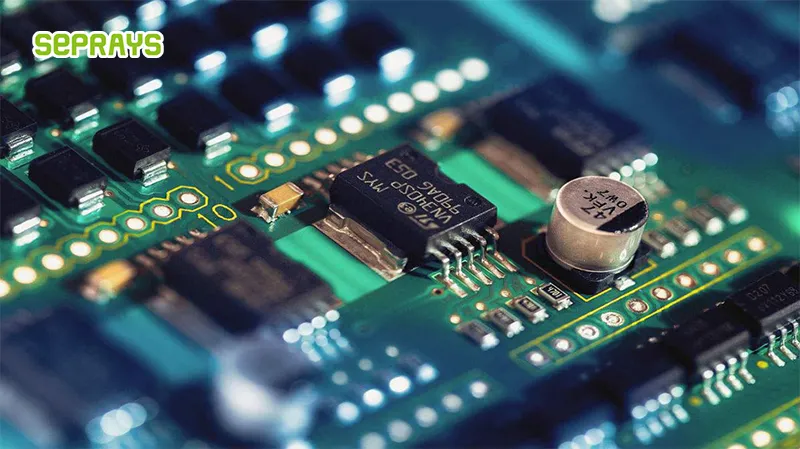
Industry research also points to growing attention to component miniaturization, durability, and long-term reliability as humanoid robots move toward practical deployment.
For PCB manufacturers, this suggests a change in priorities.
The question is gradually moving from:
“Can we build the electronics?”
to:
“Can we build the same electronics consistently at scale?”
That is where automated separation, inspection, handling, dust control, and process traceability become more relevant.
🧪 What Should Manufacturers Test First?
Before investing in equipment, use actual production panels.
Check:
Cutting quality
Look for burrs, edge damage, chipping, and dimensional consistency.
Component protection
Pay particular attention to sensitive components near the separation line.
Cycle time
Measure loading, cutting, unloading, and handling—not just the cutting action.
Changeover time
Humanoid robot platforms may evolve quickly. Flexible programming can matter more than expected.
Tooling consumption
Calculate cutter or tooling costs over a realistic production period.
Integration
For high-volume lines, check communication with conveyors, loaders, unloaders, inspection systems, and MES where required.
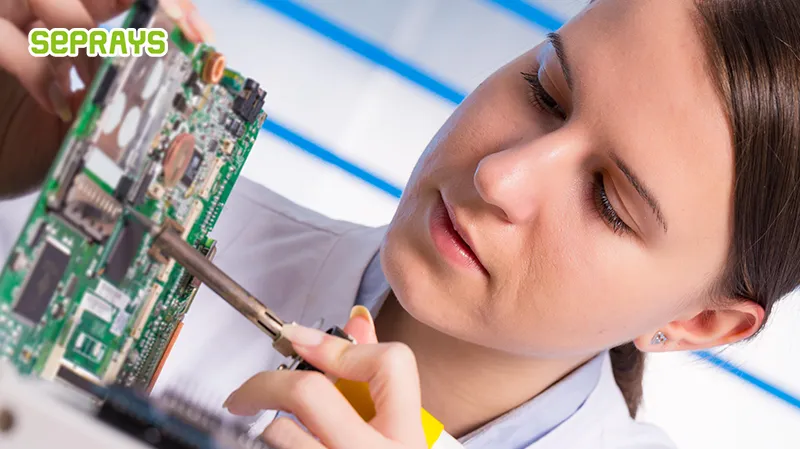
A ten-board demonstration can show whether a process works.
It cannot necessarily prove how it will behave after several thousand cycles.
🧠 A Practical Selection Rule for Robot Electronics
If you are manufacturing PCBs for humanoid robots, start with five questions:
- What does the PCB geometry require?
- How many panels will be produced per day?
- How frequently will products change?
- How sensitive are the components?
- What level of automation will the next production stage require?
Do not select equipment simply because humanoid robotics is a high-growth industry.
Select it because the production problem justifies it.
That distinction can save a surprising amount of money.
🌍 Why Choose Seprays Group?
Seprays Group has been dedicated to PCB/FPC depaneling technology for more than 30 years, with the company established in 1993. Over that time, it has developed a broad portfolio covering milling-cutter depanelers, laser depanelers, V-groove depanelers, punching depanelers, and automated handling systems.
Its equipment has been trusted by leading manufacturers and organizations, including Foxconn, Flextronics, State Grid, Luxshare, Compal, Wistron, China Electronics, Quanta, CRRC, China Aerospace, OPPO, ZTE, and Bosch. Its equipment is used in factories across China and worldwide.
For manufacturers entering humanoid robot electronics production, this experience can be useful because different PCB designs may require different separation technologies.
The goal is not to push one machine.
It is to match the process with the board, production volume, quality requirements, and future automation plan.
If you are developing or manufacturing PCB assemblies for humanoid robots, contact Seprays Group and share your PCB drawing, panel structure, material, thickness, and expected production volume for an application discussion.
WhatsApp: +8618929266433
Eメール: sales@seprays.com
❓ FAQ
1. Why is depaneling important for humanoid robot electronics?
Humanoid robots can contain multiple PCB assemblies with different shapes and production requirements. As production increases, consistent separation becomes important for quality, throughput, and labor efficiency.
2. Which depaneling method is best for humanoid robot PCBs?
There is no single answer. Complex outlines may favor milling, while straight V-groove panels may suit V-groove separation. Sensitive applications may require comparison with laser processing.
3. Does mass production always require a fully automatic machine?
No. Automation should be justified by production volume, labor requirements, utilization, and process complexity. A simpler solution can provide better ROI for low-volume production.
4. What should I test before purchasing equipment?
Test real production panels for edge quality, component protection, cycle time, tooling consumption, changeover, dust management, and integration requirements.
5. Is 2026 an important year for humanoid robot electronics manufacturing?
It is an important development period. The 2026 World Humanoid Robot Games expanded into practical scenarios and involved more than 2,000 robots, while industry research continues to highlight the need for reliable, miniaturized components as deployment expands.