.png)
 Japanese
  English
  Spanish
  Korean
  Russian
  Chinese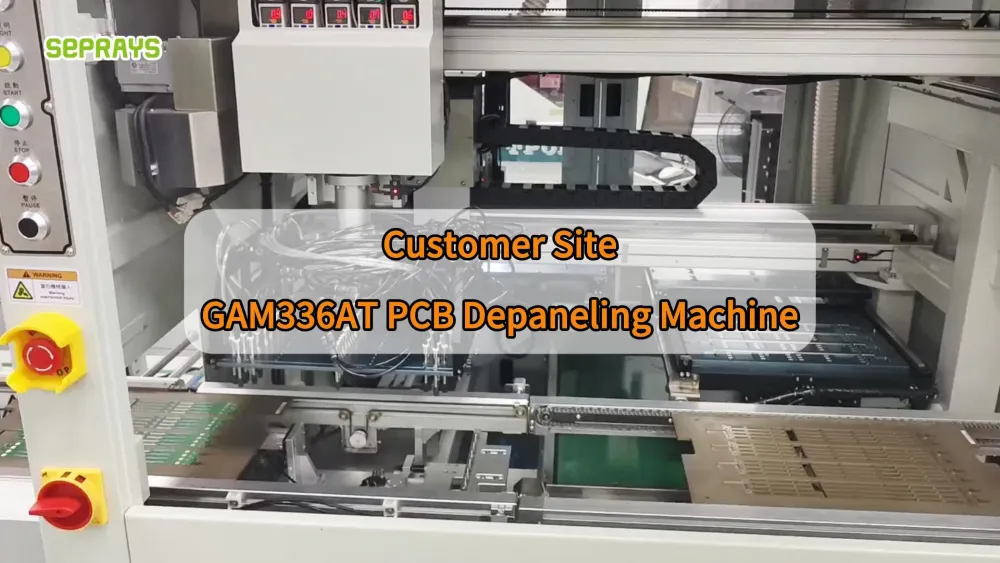
Inline PCB depaneling becomes interesting when production is no longer limited by the cutting process itself, but by everything happening around it.
In a high-volume electronics factory, operators may still need to load panels, align boards, separate finished PCBs, collect waste, and move products to the next process.
Each action looks small.
Across thousands of cycles, it becomes a production problem.
This is where an overseas semiconductor-related electronics manufacturer started reviewing its depaneling process.
🔍 The Production Problem Was Not Just Cutting
The customer was producing assembled PCBs for applications where consistency mattered more than simply achieving a fast cutting cycle.
The existing workflow involved several manual steps.
Operators had to handle panels between processes, position them correctly, and move separated boards to the next stage.
The main concerns were familiar:
- Repetitive manual handling
- Different loading positions between operators
- Increasing labor requirements
- Inconsistent production rhythm
- Dust generated during milling
- Difficulty maintaining stable output during long production runs
The question was not simply:
“Can the PCB be separated?”
It was:
“Can the separation process become part of the production line?”
⚙️ Why an Inline Routing Approach Made Sense
The PCB designs included different outlines and sections that were not always suitable for a simple straight-line separation method.
Milling offered more flexibility.
A programmed cutter can follow straight lines, L-shaped paths, U-shaped paths, circles, arcs, and other board outlines.
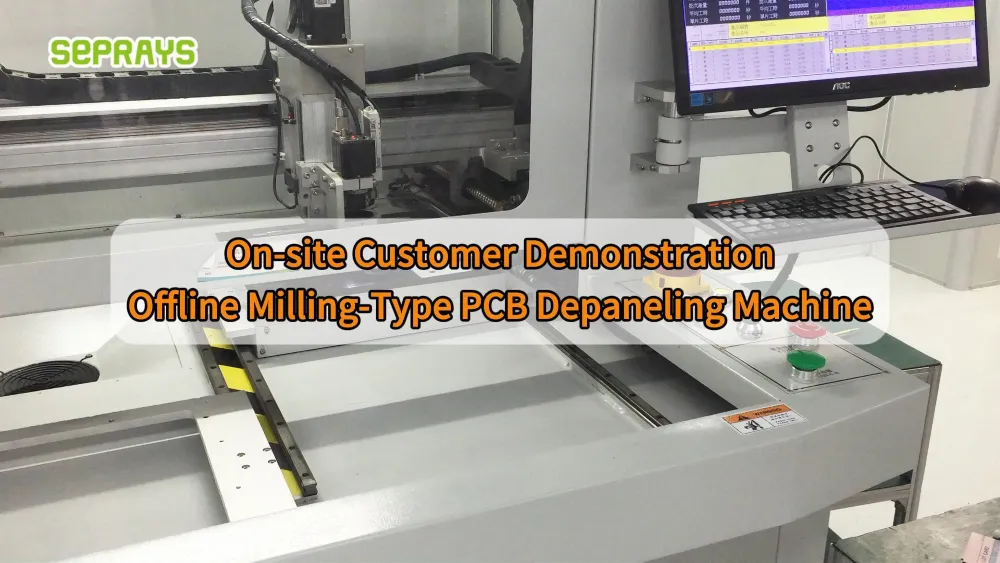
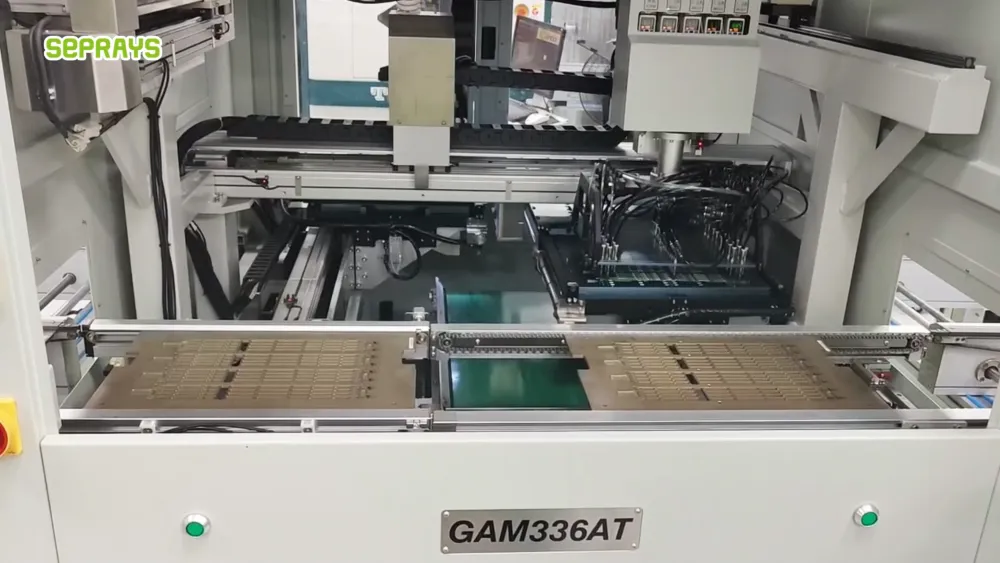
For this application, the GAM336AT was evaluated as an in-line solution.
Its published configuration includes automatic track delivery, automatic unloading options, dual worktables, CCD-based teaching, automatic tool changing, and a high-speed spindle. The standard GAM336AT also lists ±0.01 mm repeat precision and ±0.05 mm cutting precision.
The important point is not one specification by itself.
The value comes from how the functions work together.
🏭 From Loading to Unloading
In a traditional setup, depaneling can become an isolated workstation.
The operator receives a panel.
The operator positions it.
The machine cuts it.
The operator removes the finished boards.
Then the cycle starts again.
An in-line configuration changes this workflow.
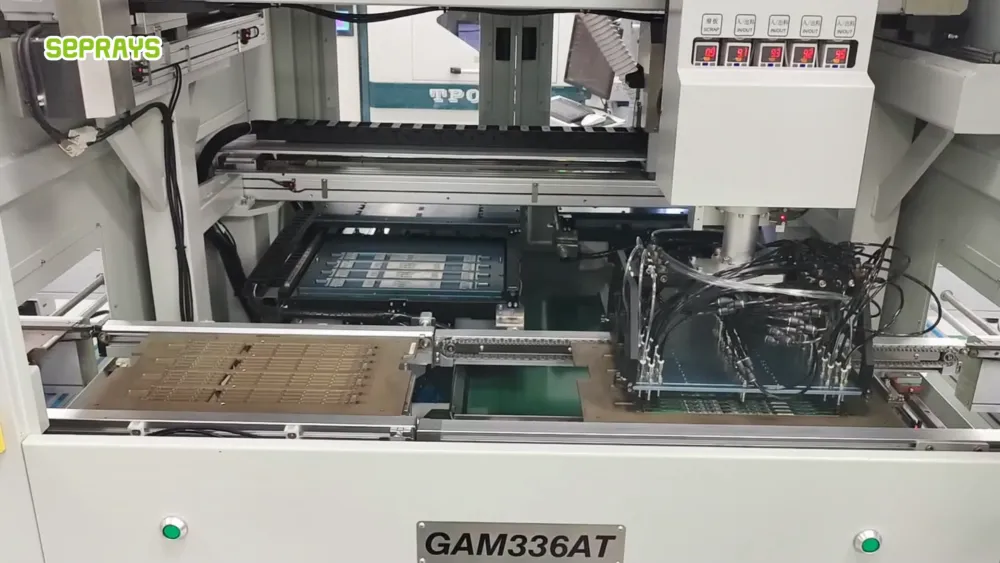
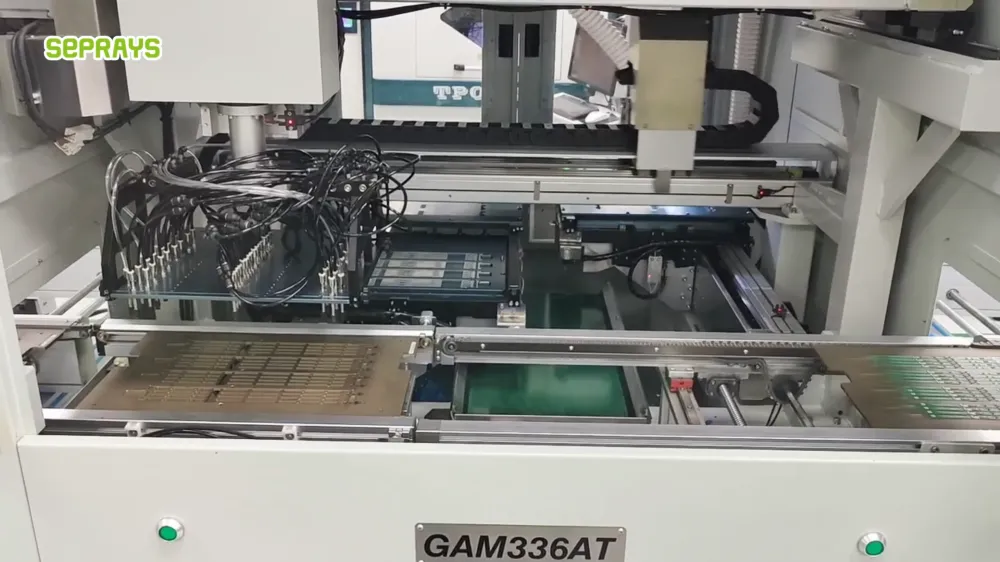
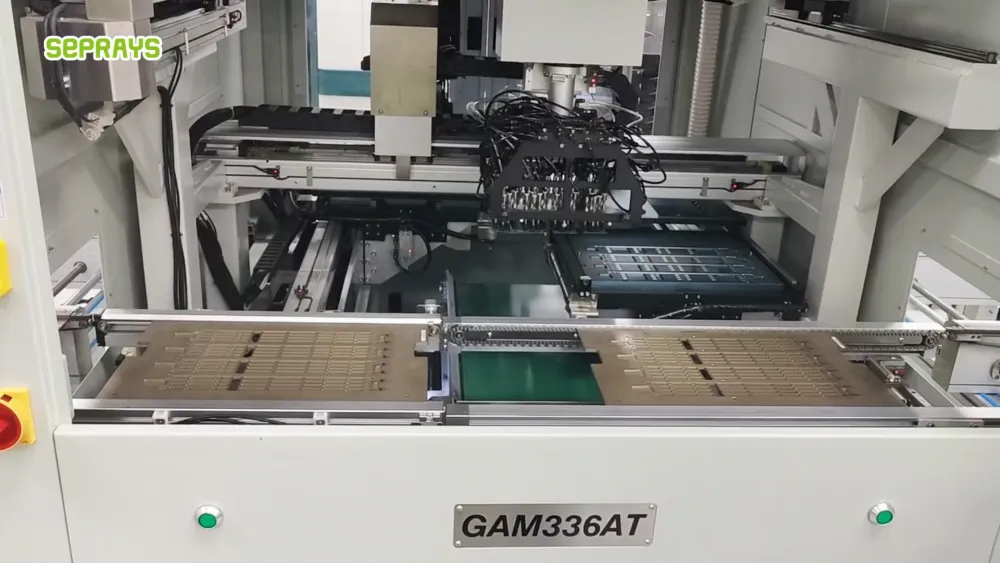
の GAM336AT can receive boards through track delivery, perform the programmed routing process, and transfer finished products through a belt, track, or fixture-based method depending on the production requirement.
The machine also supports 0–180° pick-and-place orientation, which can be useful when the upstream and downstream equipment have different transfer directions.
That sounds like a small detail.
On a real production floor, it can remove an awkward manual transfer step.
🎯 CCD Positioning Matters More Than It First Appears
A routing program may be correct.
The panel may still be slightly different from the previous panel.
That is why positioning should not be treated as an afterthought.
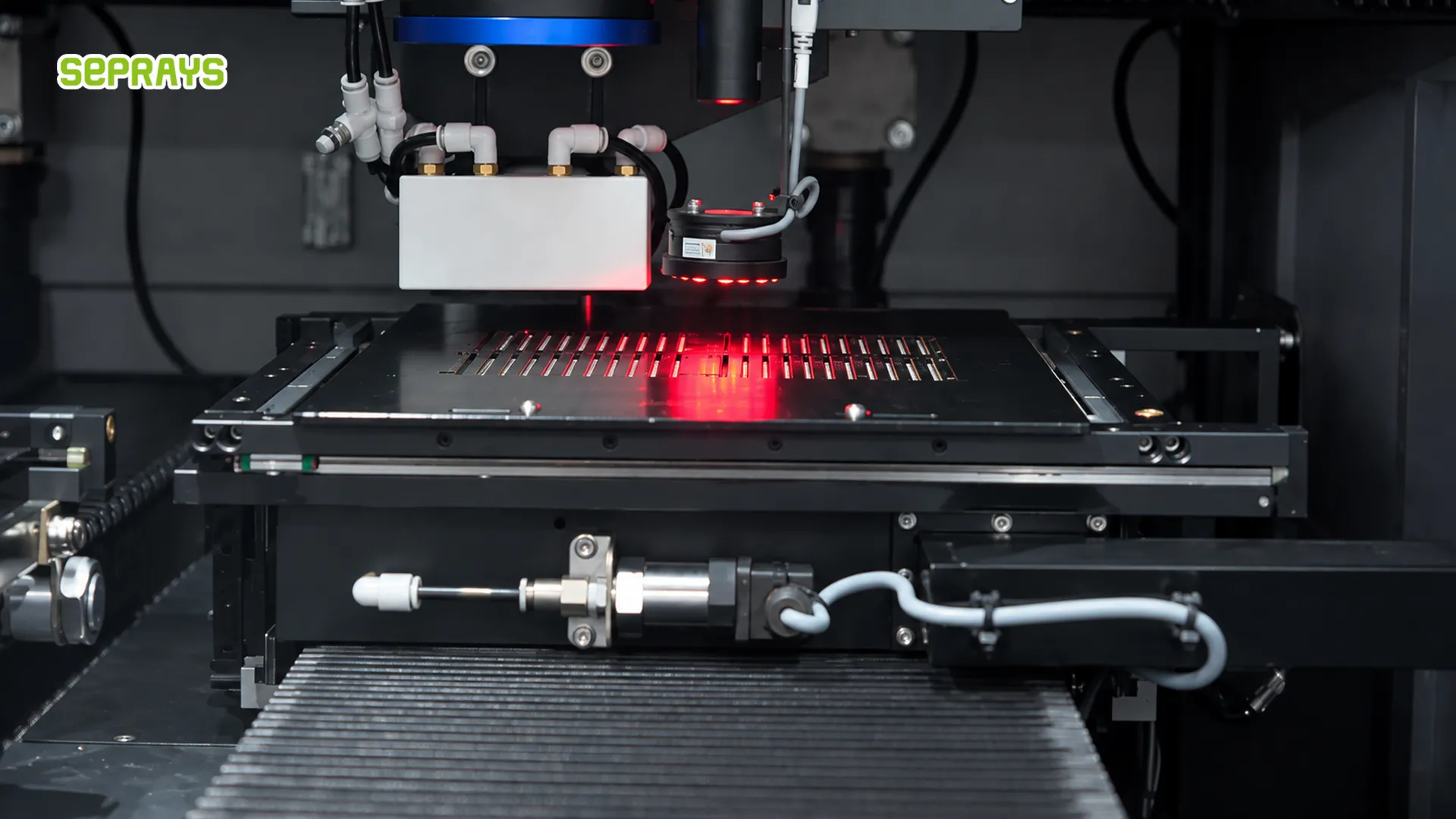
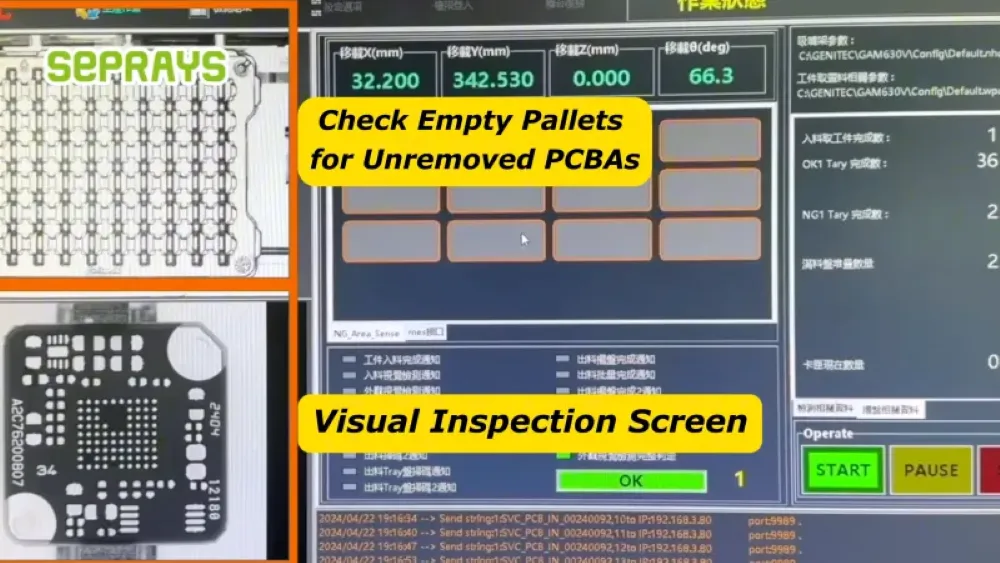
の GAM336AT uses CCD vision for alignment compensation and supports full-sheet scanning and offline programming.
For production teams, the practical benefit is repeatability.
Instead of relying entirely on how an operator places each panel, the system can use visual information to compensate for positioning differences before cutting.
This becomes particularly useful when production runs for hours rather than a few sample cycles.
🧹 Dust Is Also a Production Cost
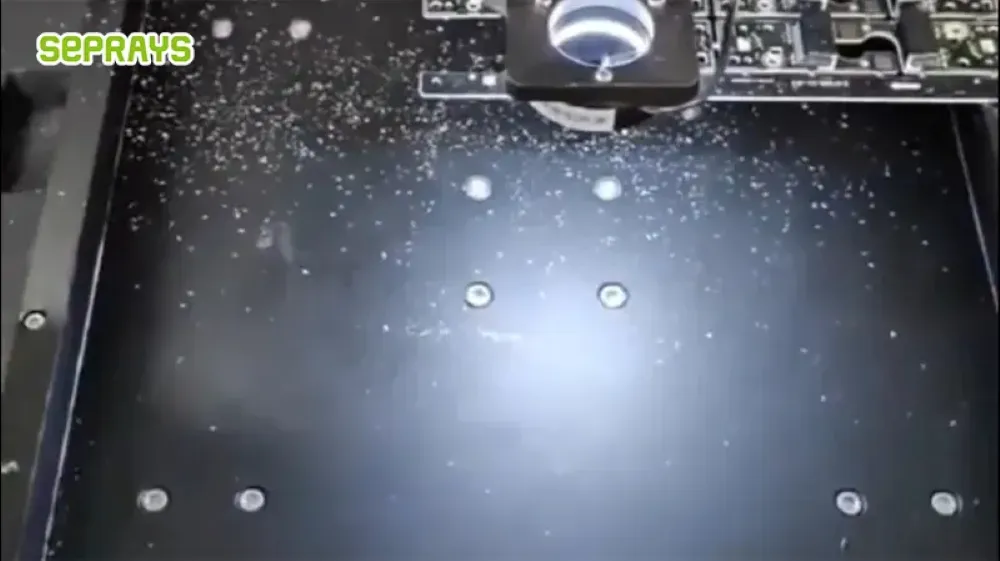
Milling naturally creates dust.
That means the calculation should include more than cutting speed.
Dust can affect the working environment, cleaning workload, maintenance routines, and potentially downstream production if extraction is poorly managed.
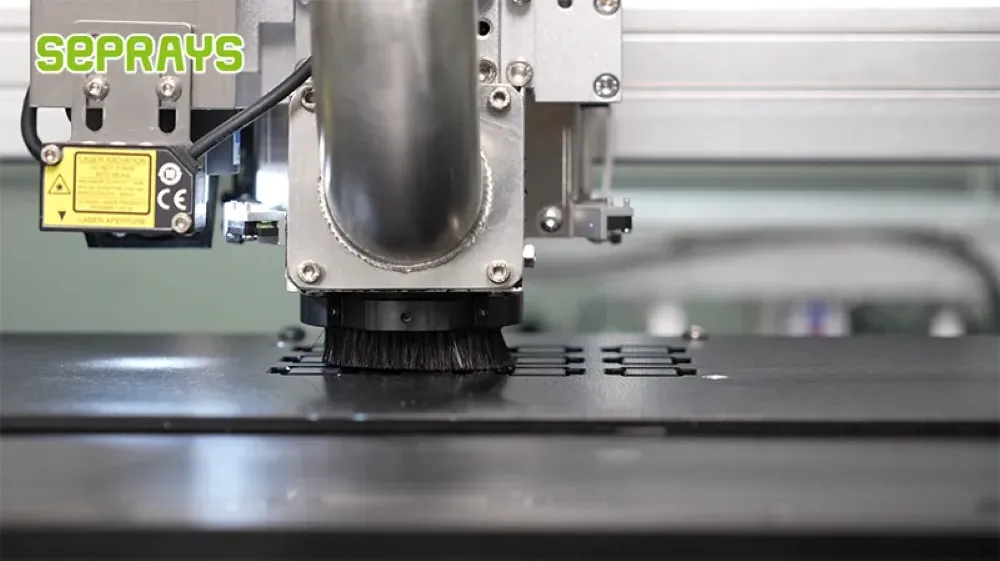
の GAM336AT uses a high-power dust collection system with negative-pressure monitoring, while its floating-brush structure is designed to improve dust collection around the cutting area. HEPA filtration is also listed as an available dust-management feature.
The lesson from production is simple:
A fast cutter is not necessarily a complete process solution.
💰 What Does the Investment Really Cost?
When comparing machines, it is tempting to focus on the quotation.
A better calculation is:
| Cost factor | Manual / semi-automatic process | Inline automated process |
|---|---|---|
| Operator handling | Higher | Lower |
| Transfer between processes | Manual | Automated |
| Positioning variation | More likely | Vision-assisted |
| Tool replacement | Manual intervention | Automatic tool change |
| Dust management | Separate attention required | Integrated collection options |
| Production consistency | Operator dependent | More standardized |
| Initial investment | Lower | Higher |
| Long-term process potential | Limited | Higher |
The last two rows are important.
Automation normally costs more at the beginning.
That does not mean it is automatically cheaper.
If production volume is low, a simpler machine may still make better financial sense.
But when production runs continuously, labor, handling time, rework, cleaning, and process variation can become more expensive than expected.
📊 A Real-World Customer Application
For the overseas semiconductor-related electronics manufacturer, Seprays approached the project from the production process rather than starting with a machine model.
The team looked at the PCB layout, panel structure, transfer requirements, cutting paths, production rhythm, and downstream connection.
の GAM336AT was then considered as part of the complete workflow.
This distinction matters.
A machine can perform well in a demonstration and still be unsuitable for a customer’s factory if loading, unloading, dust extraction, or line communication has not been considered.
The better approach is to test the complete process.
Panel in → positioning → routing → separation → dust collection → product transfer.
That is what should be evaluated.
⚠️ When Inline Automation May Not Be the Best Choice
There is a useful boundary condition here.
Not every PCB manufacturer needs a fully automated line.
For prototype production, small batches, frequent engineering changes, or highly variable products, a standalone machine may provide better flexibility.
Inline automation becomes more attractive when:
- Production volume is relatively high
- The same or similar products run repeatedly
- Manual transfer is creating a bottleneck
- Stable cycle-to-cycle positioning is important
- The depaneling process must connect with SMT or PCBA equipment
- Labor reduction is a meaningful business objective
The counterintuitive conclusion is that the fastest machine is not always the best investment.
The best machine is the one that removes the biggest bottleneck.
🌍 Why Choose Seprays Group?
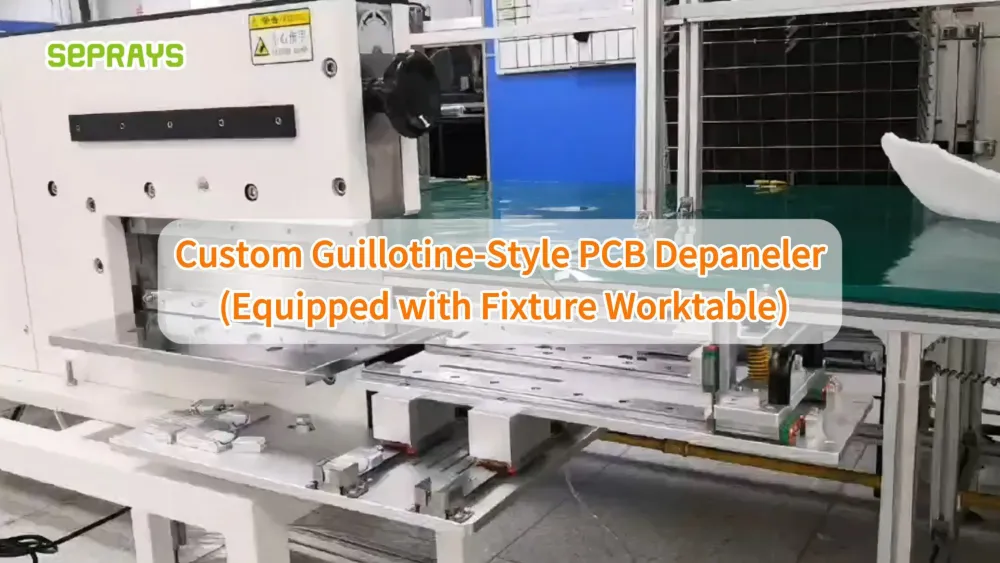
Seprays Group has specialized in PCB/FPC depaneling technology for more than 30 years, offering a full range of solutions, including milling-cutter depanelers, laser depanelers, V-groove depanelers, punching depanelers, and automated handling systems.
Its equipment is trusted by leading manufacturers, including Foxconn, Flextronics, State Grid, Luxshare, Compal, Wistron, China Electronics, Quanta, CRRC, China Aerospace, OPPO, ZTE, and Bosch, with equipment used in factories across China and worldwide.
The company’s experience covers not only individual machines, but also different depaneling methods, automation requirements, material handling, and production-line integration.
For a new project, the practical starting point is usually not the machine model.
It is the PCB.
PCB material, thickness, panel layout, cutting path, production volume, required edge quality, dust requirements, and upstream/downstream equipment all affect the final solution.
If you have a similar production challenge, please get in touch with us and share your PCB drawing, panel layout, thickness, and production requirements.
WhatsApp: +8618929266433
Eメール: sales@seprays.com
❓ FAQ
1. What is inline PCB depaneling?
It is a depaneling process integrated directly into an automated production line, reducing manual loading, unloading, and product transfer.
2. Is milling suitable for irregular PCB shapes?
Yes. Milling follows programmed cutting paths, making it suitable for many irregular outlines, curves, slots, and complex PCB geometries.
3. What is the advantage of CCD positioning?
CCD vision helps identify the actual PCB position and compensate for alignment differences before cutting, improving process consistency.
4. Does inline automation always reduce production costs?
Not necessarily. The initial investment is higher. It becomes more financially attractive when production volume, labor costs, repetitive handling, and process variation justify the investment.
5. What information should be provided before selecting a machine?
PCB drawings, panel layout, PCB thickness, material, production volume, cutting requirements, current depaneling method, and upstream/downstream equipment are useful starting points.