.png)
 Japanese
  English
  Spanish
  Korean
  Russian
  Chinese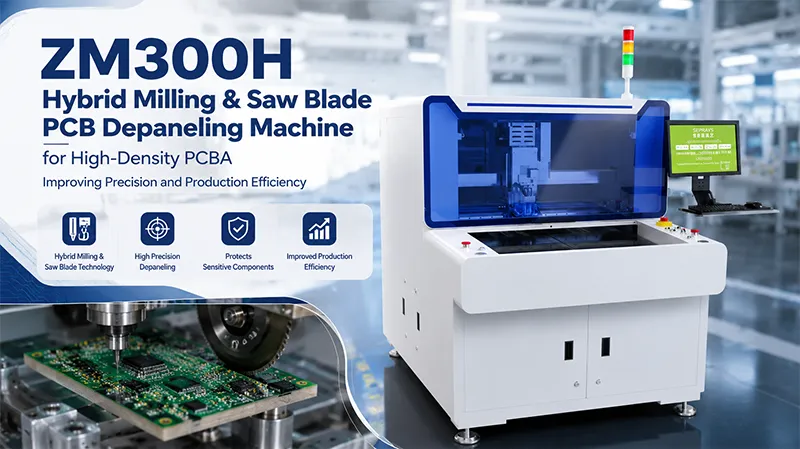
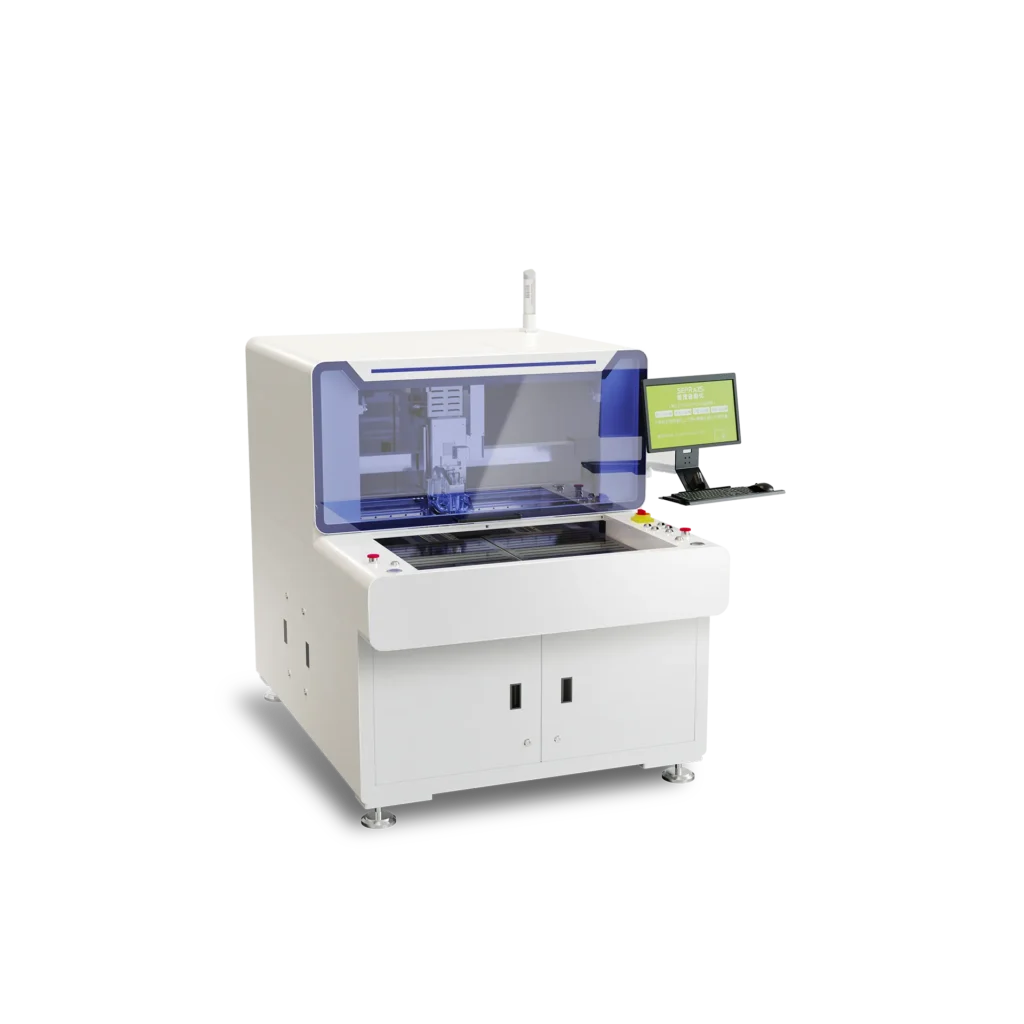
ZM300H Hybrid Milling & Saw Blade PCB Depaneling Machine for High-Density PCBA became a frequent topic in production meetings for a simple reason: PCB designs changed faster than many manufacturing processes could keep up with.
Several years ago, separating PCBs was often considered a straightforward step.
Panels were larger.
Components had more spacing.
Production tolerances were relatively forgiving.
Today, that assumption no longer holds.
In 2026, manufacturers of automotive electronics, communication modules, wearable products, industrial control systems, and compact consumer devices are operating in a different environment.
Boards continue getting smaller.
Components continue moving closer to PCB edges.
Yet quality expectations continue rising.
Many engineers have discovered an uncomfortable reality:
The cutting process itself often becomes one of the final hidden variables affecting yield.
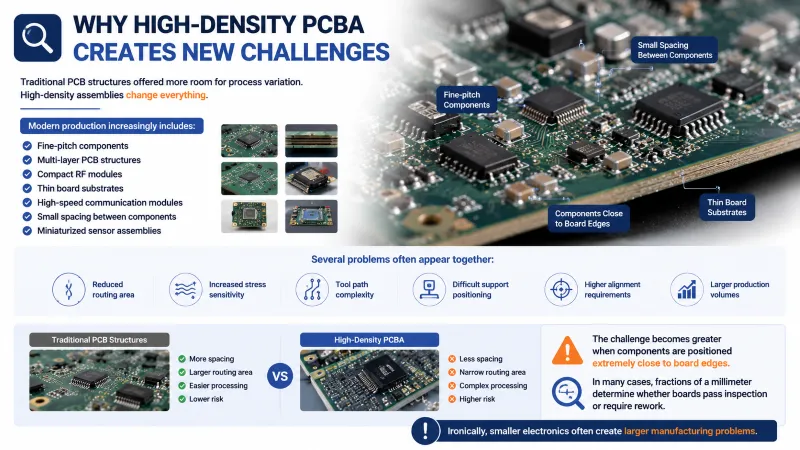
🔍 Why High-Density PCBA Creates New Challenges
Traditional PCB structures offered more room for process variation.
High-density assemblies change everything.
Modern production increasingly includes:
- Fine-pitch components
- Multi-layer PCB structures
- Compact RF modules
- Thin board substrates
- High-speed communication modules
- Small spacing between components
- Miniaturized sensor assemblies
Several problems often appear together:
- Reduced routing area
- Increased stress sensitivity
- Tool path complexity
- Difficult support positioning
- Higher alignment requirements
- Larger production volumes
The challenge becomes greater when components are positioned extremely close to board edges.
In many cases, fractions of a millimeter determine whether boards pass inspection or require rework.
Ironically, smaller electronics often create larger manufacturing problems.
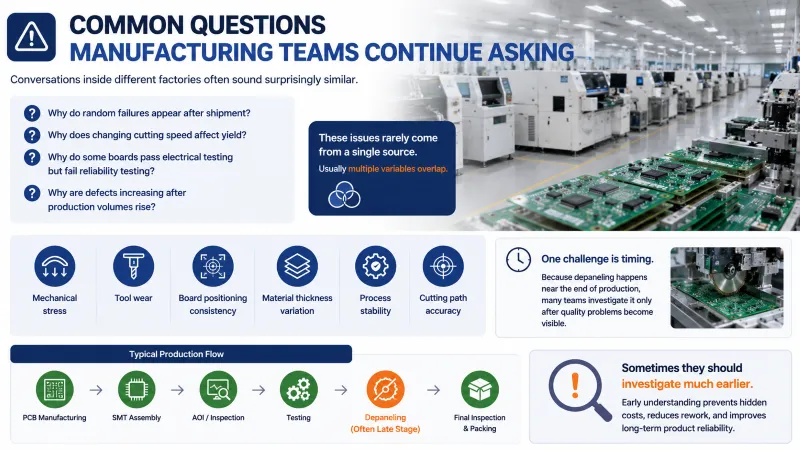
⚠️ Common Questions Manufacturing Teams Continue Asking
Conversations inside different factories often sound surprisingly similar.
“Why do random failures appear after shipment?”
“Why does changing the cutting speed affect yield?”
“Why do some boards pass electrical testing but fail reliability testing?”
“Why are defects increasing after production volumes rise?”
These issues rarely come from a single source.
Usually, multiple variables overlap:
- Mechanical stress
- Tool wear
- Board positioning consistency
- Material thickness variation
- Process stability
- Cutting path accuracy
One challenge is timing.
Because depaneling happens near the end of production, many teams investigate it only after quality problems become visible.
Sometimes they should investigate much earlier.
⚙️ The Story Behind Why Seprays Developed ZM300H
Several years ago, Seprays engineers repeatedly encountered a similar situation during customer discussions.
Factories in cities such as Shenzhen, Dongguanは、 Suzhou were increasing production output for increasingly compact electronics.
But unexpected issues continued appearing:
Small edge cracks.
Component stress.
Inconsistent cutting quality.
Increasing manual inspection.
One customer in Dongguan manufacturing communication modules, noticed an unusual trend.
Output was increasing.
But quality stability was moving in the opposite direction.
Traditional methods were beginning to show limitations.
The problem was not necessarily cutting speed.
The problem was balancing precision with flexibility.
That became one of the motivations behind developing the ZM300H hybrid solution.
Instead of depending on only one separation approach, engineers explored combining milling and saw blade technologies into a single system.
Not to make machines faster.
To make production more adaptable.
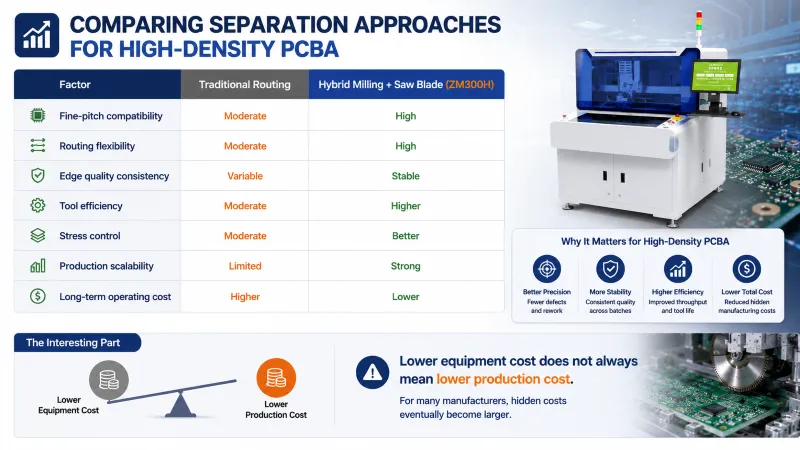
📊 Comparing Separation Approaches for High-Density PCBA
| Factor | Traditional Routing | Hybrid Milling + Saw Blade (ZM300H) |
|---|---|---|
| Fine-pitch compatibility | 緩やかな | High |
| Routing flexibility | 緩やかな | High |
| Edge quality consistency | Variable | Stable |
| Tool efficiency | 緩やかな | Higher |
| Stress control | 緩やかな | Better |
| Production scalability | Limited | Strong |
| Long-term operating cost | Higher | Lower |
The interesting part:
Lower equipment cost does not always mean lower production cost.
For many manufacturers, hidden costs eventually become larger.
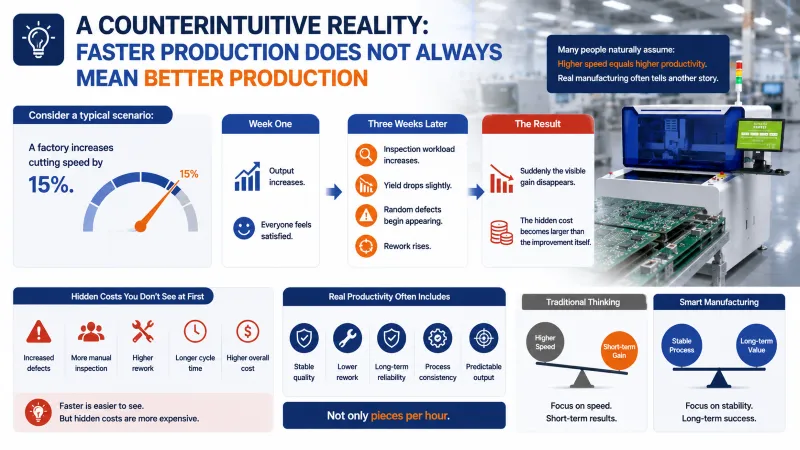
💡 A Counterintuitive Reality: Faster Production Does Not Always Mean Better Production
Many people naturally assume:
Higher speed equals higher productivity.
Real manufacturing often tells another story.
Consider a typical scenario:
A factory increases cutting speed by 15%.
Week one:
Output increases.
Everyone feels satisfied.
Three weeks later:
Inspection workload increases.
Yield drops slightly.
Random defects begin appearing.
Rework rises.
Suddenly, the visible gain disappears.
The hidden cost becomes larger than the improvement itself.
Real productivity often includes:
- Stable quality
- Lower rework
- Long-term reliability
- Process consistency
- Predictable output
Not only pieces per hour.
🏭 Real Production Experience: A Dongguan Communication Module Project
During a communication module production project in Dongguan, engineers faced challenges with fine-pitch PCB assemblies and increasing production demand.
The main concerns included:
Components close to PCB edges.
Complex routing paths.
Yield fluctuation between shifts.
Manual handling inconsistencies.
After evaluating process conditions, a hybrid approach using the Seprays ZM300H system was introduced into production evaluation.
Several observations became noticeable:
More stable edge quality.
Reduced manual adjustments.
Improved consistency across batches.
Better process repeatability.
The discussion inside the factory shifted.
Teams were no longer asking:
“How fast can we cut?”
Instead, they asked:
“How stable can the process remain six months later?”
That question often matters more.
🚀 Looking Beyond Machine Specifications
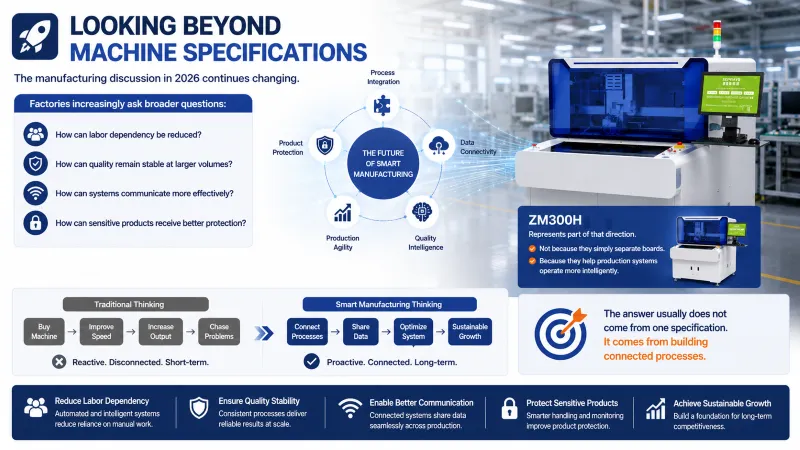
The manufacturing discussion in 2026 continues to change.
Factories increasingly ask broader questions:
How can labor dependency be reduced?
How can quality remain stable at larger volumes?
How can systems communicate more effectively?
How can sensitive products receive better protection?
The answer usually does not come from one specification.
It comes from building connected processes.
Machines like ZM300H represent part of that direction.
Not because they simply separate boards.
Because they help production systems operate more intelligently.
Why Choose Seprays Group?
For more than 30 years, Seprays Group has focused on continuous innovation in PCB/FPC depaneling technologies and practical manufacturing solutions.
Seprays Group has been dedicated to PCB/FPC depaneling technology, providing a full range of solutions, including milling-cutter depanelers, laser depanelers, V-groove depanelers, punching depanelers, and automated handling systems.
Our technologies are trusted by globally recognized manufacturers, including Foxconn, Flextronics, State Grid, Luxshare, Compal, Wistron, China Electronics, Quanta, CRRC, China Aerospace, OPPO, ZTE, and Bosch.
Our systems operate in manufacturing facilities throughout China and worldwide.
More importantly, experience accumulated across industries has allowed Seprays to understand a practical reality:
Every PCB process has unique variables.
The goal is not simply to supply machines.
The goal is to help manufacturers build reliable and scalable production systems.
If you would like to discuss your production requirements, please contact us.
WhatsApp: +8618929266433
Eメール: sales@seprays.com
FAQ
1. What makes ZM300H suitable for high-density PCBA?
ZM300H combines milling and saw blade technologies, allowing flexible processing for fine-pitch and complex PCB structures while improving cutting consistency.
2. Can ZM300H handle boards with components near the PCB edge?
Yes. Its design helps manage stress distribution and improve routing accuracy for edge-sensitive assemblies.
3. Which industries commonly use ZM300H?
Automotive electronics, communication modules, industrial control systems, medical electronics, and consumer electronics commonly use this type of solution.
4. Does higher routing speed always improve productivity?
Not necessarily. Excessive speed can increase stress, rework, and long-term reliability issues.
5. How does hybrid depaneling reduce operating cost?
By improving process stability, reducing rework, increasing tool efficiency, and maintaining more consistent production quality.