.png)
 Russian
  English
  Spanish
  Japanese
  Korean
  Chinese
How Does PCB V-Cut Depaneling Work?
PCB V-Cut depaneling is a simple but clever manufacturing technique that helps separate multiple circuit boards from a single panel. First, precise V-shaped grooves are cut along the dividing lines on both sides of the panel, leaving just a thin connecting layer of material in the middle, much like perforations on a sheet of stamps. When it’s time to separate the boards, workers or machines can easily snap them apart along these pre-cut grooves. This method is fast, cost-effective, and works especially well for rectangular boards with straight edges.
Manufacturers carefully control the depth of the cuts to ensure clean breaks without damaging components, typically leaving about one-third of the board’s thickness uncut. While V-cutting can’t be used for complex curved shapes or very fragile boards, it remains one of the most popular ways to mass-produce standard PCBs efficiently. The process combines the strength needed for manufacturing with the convenience of easy separation when the boards are ready for use.
What are the standard V-Cut design parameters?
V-Cut Angle
● Typical Angle: 30°–45° (most common: 30°).
● Purpose: Balances ease of breaking with structural integrity during panel handling.
Residual Thickness (Uncut Layer)
● Standard: 1/3 of the total board thickness (e.g., for a 1.6mm PCB, each side is cut ~0.5mm deep, leaving ~0.6mm uncut in the middle).
● Minimum: 0.3mm (to prevent accidental breakage during handling).
● Maximum: 0.8mm (beyond this, manual breaking becomes difficult).
V-Cut Width (Groove Opening)
● Standard: 0.2mm–0.5mm (depends on cutter tool size).
● Tighter Tolerance: ±0.1mm (for high-precision designs).
Distance from Components
● Minimum Clearance: ≥3mm from components/pads (per IPC-7351).
● Critical Areas: ≥5mm from BGA, fine-pitch ICs, or impedance-controlled traces.
Panel Strength Considerations
● Stress Relief Holes: Add 1.0mm–1.2mm holes at V-Cut ends to prevent cracking.
● Avoid Thin Boards: Not recommended for PCBs < 0.8mm thick (risk of warping/breaking).
Tolerance Standards
● Cut Position Accuracy: ±0.15mm (Class 2 IPC standard).
● Depth Consistency: ±0.05mm (critical for automated depaneling).
When to Use V-Cut Depaneling?
Simple Board Shapes
● Perfect for straight-line breaks (rectangles, squares);
● Ideal when all boards in the panel are the same size.
Standard Thickness Boards
● Works best for 0.8mm to 3.0mm thick rigid PCBs;
● Most common for 1.6 mm-thick consumer electronics boards.
Cost-Sensitive Projects
● 3-5x cheaper than routing for large batches;
● Faster production (can process thousands of panels per hour).
High-Volume Manufacturing
● Excellent for mass production of simple designs;
● Minimal tooling changes are needed between jobs.
Space-Efficient Designs
● Allows tighter panel packing than routing (boards can be closer together);
● Leaves more usable panel space than tab routing.
SEPRAYS’ PCB/PCB V-CUT PCB Depaneling Solutions
Разделитель V-образного сечения с круглым лезвием на печатной плате ZM30
The SEPRAYS’ ZM30 Round Knife PCB Separator is designed for various PCB circuit boards with V-grooves, including aluminum substrates, LED circuit boards, and LED light strips. Electronics manufacturers widely use it in the LED, SMT, mobile phone, toy, and other industries for efficient and precise board separation.

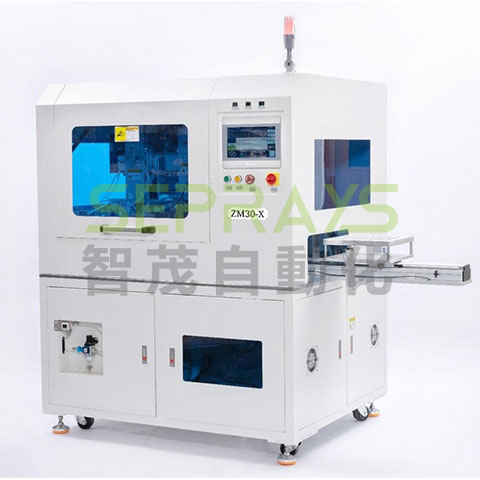
Автоматическая машина для снятия панелей с V-образных пазов ZM30-X
The machine offers advanced depaneling capabilities, featuring bidirectional (X/Y axis) automatic V-cut separation for precise panel division. It handles a wide range of materials with exceptional quality, including aluminum substrates (300-1500mm length), copper-clad boards, FR4, and fiberglass laminates – delivering smooth, burr-free cuts across all materials.
Conclusion
V-Cut depaneling is a simple but powerful solution for quickly making many circuit boards. While it’s not perfect for every situation, it’s the best choice for most standard board designs. Companies like SEPRAYS make special machines that cut boards fast and cleanly in both directions. As we make more electronic devices, this smart cutting method will continue helping factories work faster and smarter. Whether you’re making LED lights or phone parts, understanding V-Cuts can help your production run smoothly.