.png)
 Spanish
  English
  Japanese
  Korean
  Russian
  Chinese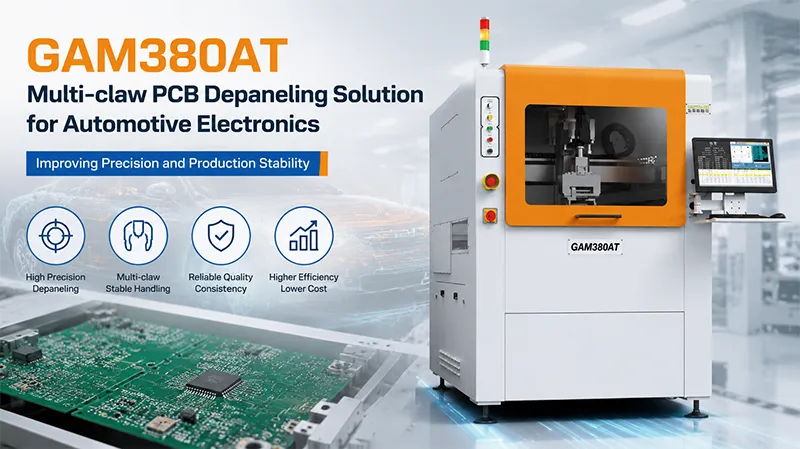
GAM380AT Multi-claw PCB Depaneling Solution is designed for automotive electronics manufacturers facing a common challenge: increasing PCB complexity while maintaining long-term production reliability.
Automotive electronics are evolving quickly.
Modern vehicles contain more electronic control units, sensors, communication modules, and intelligent systems than ever before.
This change creates higher requirements for PCB manufacturing.
Automotive PCB assemblies often include:
- High-value semiconductor components
- Multi-layer PCB structures
- Large copper areas
- Heavy components
- Sensitive connectors
- Long service-life requirements
Unlike consumer products that may be replaced within a few years, automotive electronic modules often need to operate reliably for a decade or longer.
Because of this, PCB separation is no longer just a final production step.
It has become an important factor affecting product quality.
A small process variation during depaneling may not immediately appear during factory testing.
However, it can become a reliability issue after months of field operation.
⚠️ Common Challenges in Automotive PCB Production
Many automotive electronics manufacturers experience similar production problems.
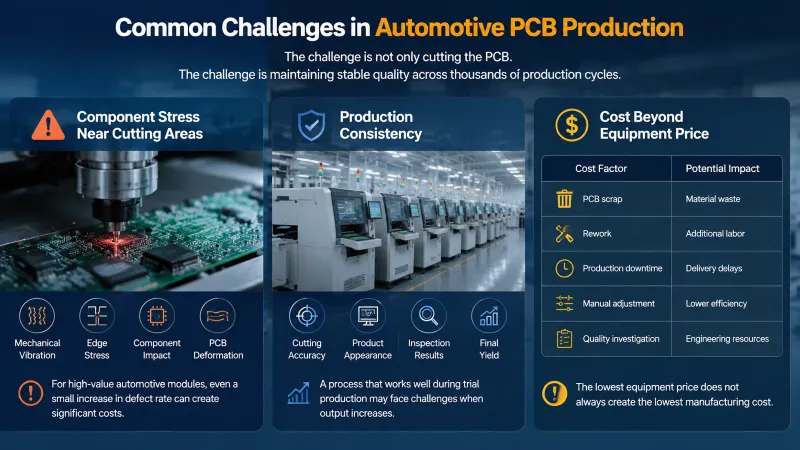
The challenge is not only cutting the PCB.
The challenge is maintaining stable quality across thousands of production cycles.
Component Stress Near Cutting Areas
Automotive PCBs often have limited space.
Components may be positioned close to routing paths.
Traditional separation methods can introduce:
- Mechanical vibration
- Edge stress
- Component impact
- PCB deformation
For high-value automotive modules, even a small increase in defect rate can create high costs.
Production Consistency
Large automotive suppliers usually operate continuous production lines.
Small differences between operators, fixtures, or processes may affect:
- Cutting accuracy
- Product appearance
- Inspection results
- Final yield
A process that works well during trial production may face challenges when output increases.
Cost Beyond Equipment Price
Many purchasing decisions focus on machine investment.
However, actual production costs include:
| Cost Factor | Potential Impact |
|---|---|
| PCB scrap | Material waste |
| Rework | Additional labor |
| Production downtime | Delivery delays |
| Manual adjustment | Lower efficiency |
| Quality investigation | Engineering resources |
The lowest equipment price does not always create the lowest manufacturing cost.
🔧 Why Multi-claw Design Matters for Automotive PCB Depaneling
One interesting point engineers often discover is that higher speed alone does not guarantee better production performance.
The entire handling process matters.
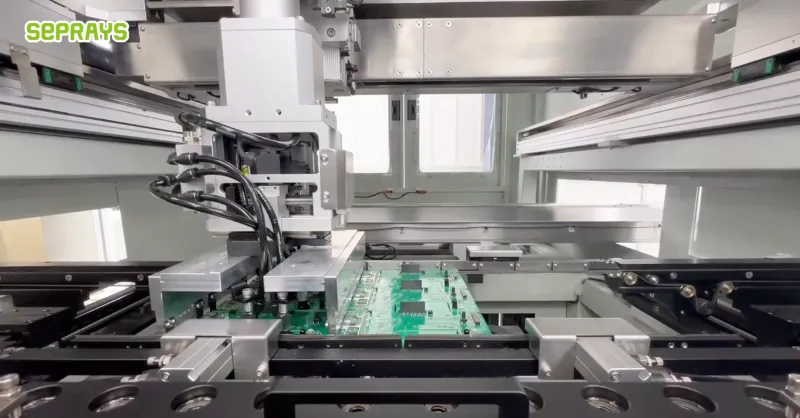
The GAM380AT Multi-claw PCB Depaneling Solution uses a multi-claw gripping concept to improve PCB handling stability during the depaneling process.
The design helps manufacturers achieve:
- More stable PCB positioning
- Reduced manual handling
- Improved production repeatability
- Better compatibility with automated production lines
For automotive applications, stable positioning is especially important.
A cutting process can only be performed accurately when the PCB remains under control throughout the operation.
⚙️ How GAM380AT Supports Automotive Electronics Manufacturing
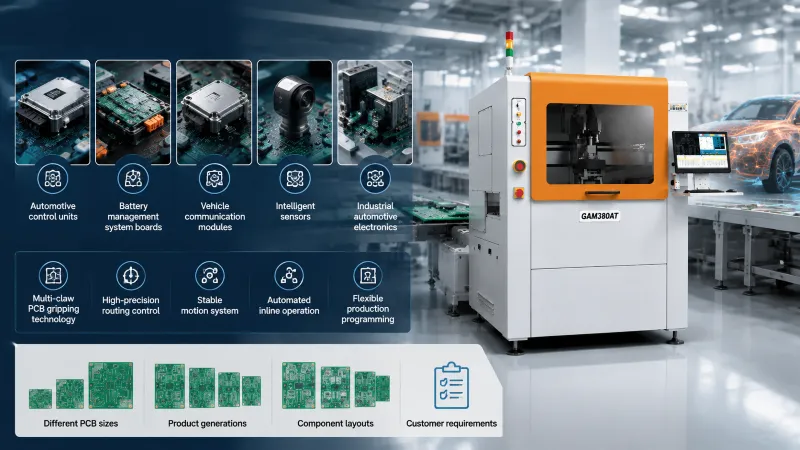
The GAM380AT is designed for manufacturers who require reliable inline PCB depaneling performance.
Typical applications include:
- Automotive control units
- Battery management system boards
- Vehicle communication modules
- Intelligent sensors
- Industrial automotive electronics
Its production advantages come from combining:
- Multi-claw PCB gripping technology
- High-precision routing control
- Stable motion system
- Automated inline operation
- Flexible production programming
For factories producing multiple automotive PCB models, equipment flexibility becomes increasingly important.
A production line may handle different:
- PCB sizes
- Product generations
- Component layouts
- Customer requirements
The ability to adapt quickly can directly influence production efficiency.
📊 Comparing Different PCB Depaneling Approaches
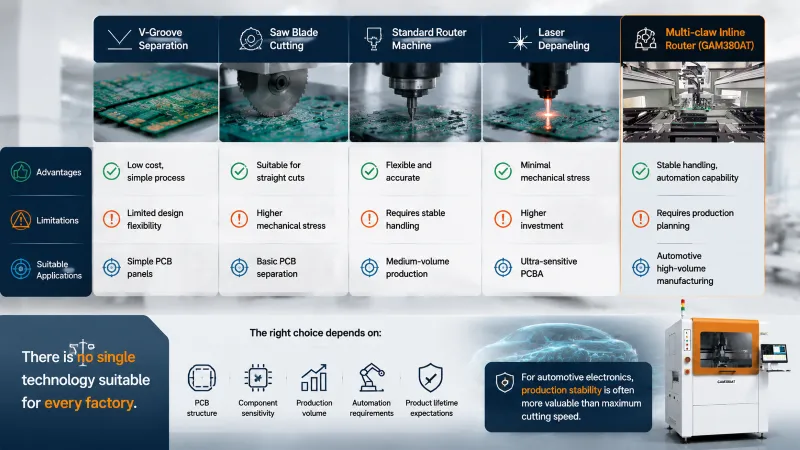
| Method | Advantages | Limitations | Suitable Applications |
|---|---|---|---|
| V-Groove Separation | Low cost, simple process | Limited design flexibility | Simple PCB panels |
| Saw Blade Cutting | Suitable for straight cuts | Higher mechanical stress | Basic PCB separation |
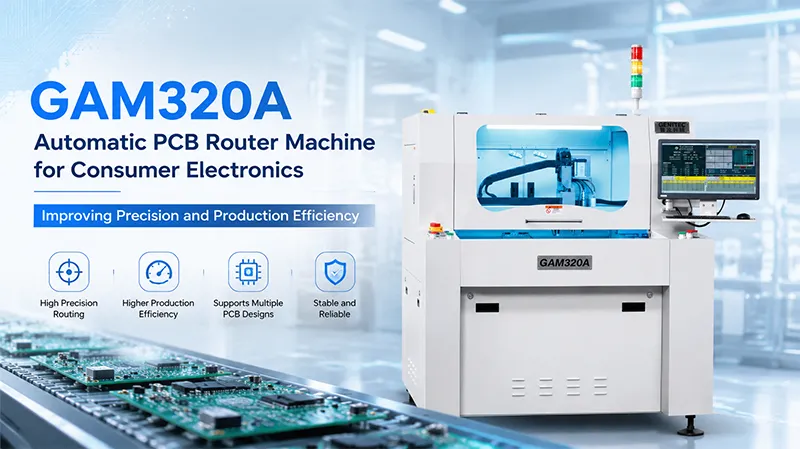
| Standard Router Machine | Flexible and accurate | Requires stable handling | Medium-volume production |
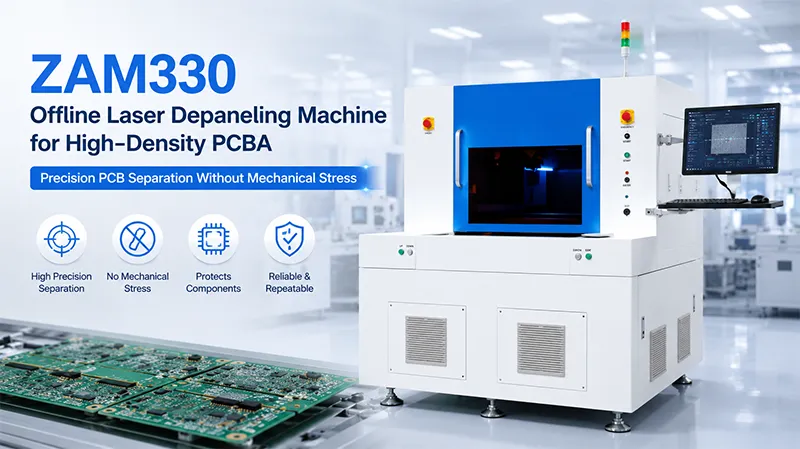
| Láser Depaneling | Minimal mechanical stress | Higher investment | Ultra-sensitive PCBA |
| Multi-claw Inline Router (GAM380AT) | Stable handling, automation capability | Requires production planning | Automotive high-volume manufacturing |
There is no single technology suitable for every factory.
The right choice depends on:
- PCB structure
- Component sensitivity
- Production volume
- Automation requirements
- Product lifetime expectations
For automotive electronics, production stability is often more valuable than maximum cutting speed.
💰 Understanding the Real Value of Production Stability
A common misunderstanding is:
“Faster equipment always reduces manufacturing costs.”
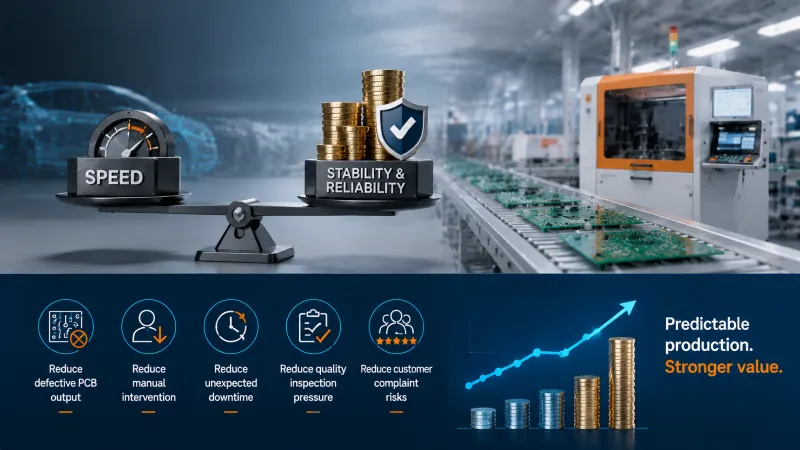
In reality, automotive manufacturers usually evaluate the complete production cycle.
A stable depaneling process can help reduce:
- Defective PCB output
- Manual intervention
- Unexpected downtime
- Quality inspection pressure
- Customer complaint risks
For example:
An automotive electronics supplier producing tens of thousands of PCB assemblies monthly may gain more value from reducing process variation than from achieving a few seconds faster cycle time.
The improvement comes from making production predictable.
🌍 Real Manufacturing Example: Improving Automotive PCB Reliability
An overseas automotive electronics manufacturer producing vehicle control modules faced a common issue.
The production line achieved acceptable output.
However, engineers noticed increasing inspection workload during mass production.
After reviewing the process, the team identified that PCB handling stability during separation was affecting consistency.
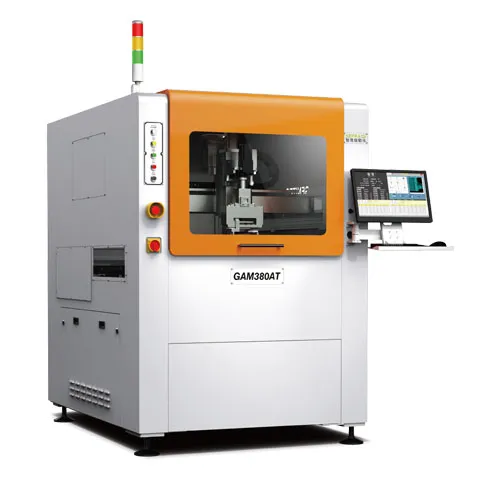
The manufacturer evaluated different depaneling methods and introduced a Seprays GAM380AT solution for selected automotive PCB production lines.
After process optimization:
- PCB positioning became more stable
- Operator involvement was reduced
- Production flow became more consistent
- Quality variation decreased
The key lesson was not simply choosing a more advanced machine.
It was selecting equipment that matched the actual manufacturing environment.
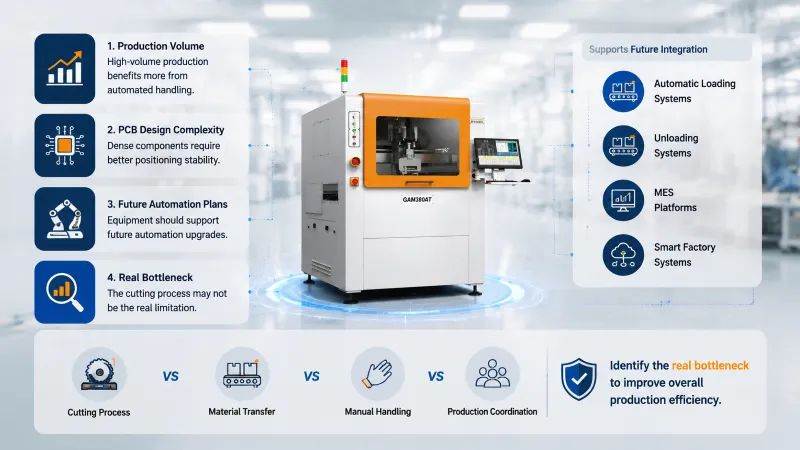
🧠 What Engineers Should Evaluate Before Choosing a Multi-claw Solution
Before upgrading equipment, manufacturers should consider:
How many PCB assemblies are produced daily?
High-volume production usually benefits more from automated handling.
How complex are the PCB designs?
Dense components require better positioning stability.
Are future automation upgrades planned?
The equipment should support possible integration with:
- Automatic loading systems
- Unloading systems
- MES platforms
- Smart factory systems
Where is the real bottleneck?
Sometimes the cutting process is not the limitation.
Material transfer, manual handling, or production coordination may create bigger challenges.
🌱 Future Trends of Automotive PCB Depaneling
Automotive electronics will continue moving toward:
- More intelligent vehicles
- Higher electronic integration
- More sensors
- Greater reliability expectations
This means PCB manufacturing will require more stable and connected processes.
Depaneling is becoming part of overall quality management.
The future goal is not simply faster separation.
It is achieving:
- Repeatable production
- Lower variation
- Better reliability
- Smarter manufacturing workflows
🏭 Why Choose Seprays Group?
Seprays Group has been dedicated to PCB/FPC depaneling technology for more than 30 years, providing complete solutions for different manufacturing requirements, including milling-cutter depanelers, laser depanelers, V-groove depanelers, punching depanelers, and automated handling systems.
Over decades of development, Seprays’ equipment has been trusted by leading manufacturers, including Foxconn, Flextronics, State Grid, Luxshare, Compal, Wistron, China Electronics, Quanta, CRRC, China Aerospace, OPPO, ZTE, and Bosch. These solutions are applied in factories across China and worldwide.
With extensive experience in PCB separation technology, Seprays focuses on helping manufacturers improve process stability, production efficiency, and long-term manufacturing reliability.
From standalone machines to fully automated inline solutions, Seprays works with customers to select the right depaneling approach based on PCB design, production volume, and future automation requirements.
If you are evaluating PCB depaneling solutions for automotive electronics manufacturing, please contact us for professional support and application discussion.
WhatsApp: +8618929266433
Correo electrónico: sales@seprays.com
Preguntas frecuentes
1. What industries can use the GAM380AT PCB depaneling machine?
The GAM380AT is mainly designed for automotive electronics, industrial electronics, communication modules, and other applications requiring stable PCB separation.
2. What is the advantage of the multi-claw design?
The multi-claw structure helps improve PCB positioning stability during processing, which is especially useful for high-volume production with strict quality requirements.
3. Can GAM380AT support automated production lines?
Yes. The GAM380AT is designed for inline production environments and can be integrated with automated manufacturing systems according to customer requirements.
4. Is GAM380AT suitable for different PCB models?
Yes. The system supports flexible programming and can handle different PCB designs when proper fixtures and process parameters are configured.
5. How should manufacturers choose between router depaneling and laser depaneling?
The choice depends on PCB design, component sensitivity, production volume, and cost requirements. Router solutions are often suitable for high-volume automotive production requiring a balance between efficiency and stability, while laser is preferred for extremely sensitive assemblies.