.png)
 Spanish
  English
  Japanese
  Korean
  Russian
  Chinese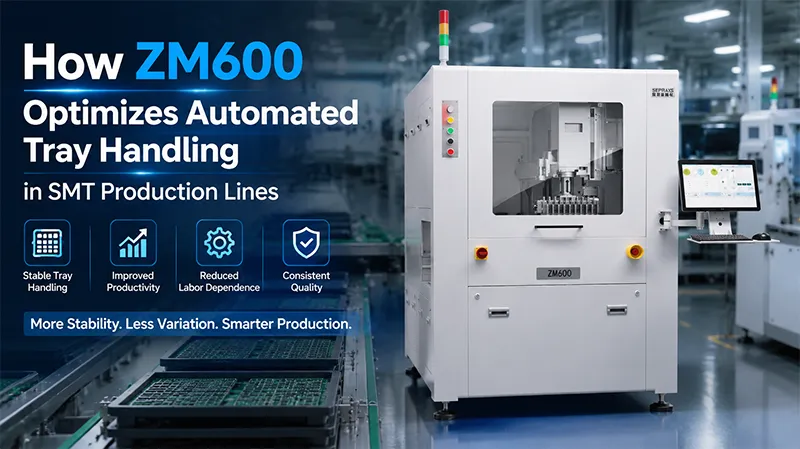
ZM600 automated tray handling was developed from a simple production reality: in modern SMT factories, the process after PCB assembly can become just as important as the assembly process itself.
Many manufacturers invest heavily in high-speed placement machines, advanced inspection systems, and intelligent production software.
But one question is often overlooked:
What happens when finished boards need to be transferred, loaded, and managed between processes?
In many factories, tray handling still depends on manual operations or semi-automatic solutions.
At low production volumes, this may appear acceptable.
However, when production scales up, small variations begin to create larger problems.
Operators spend more time adjusting trays.
Production flow becomes less predictable.
Traceability becomes harder.
And the hidden labor cost continues increasing.
This is where automated tray handling becomes a practical manufacturing discussion.
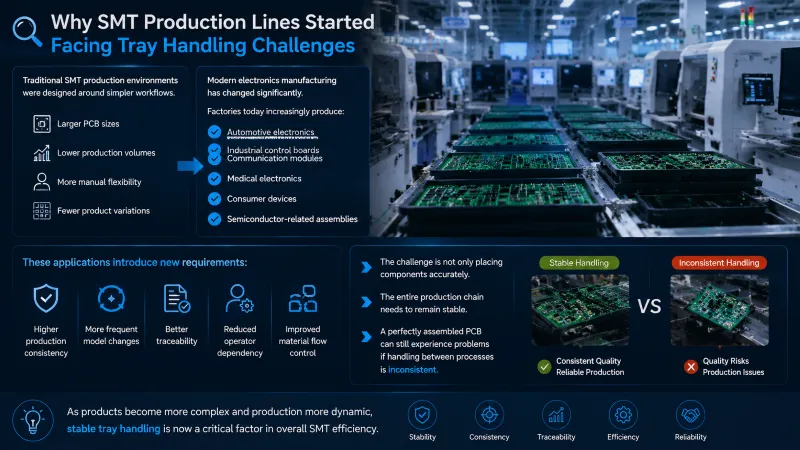
🔍 Why SMT Production Lines Started Facing Tray Handling Challenges
Traditional SMT production environments were designed around simpler workflows.
Products had:
- Larger PCB sizes
- Lower production volumes
- More manual flexibility
- Fewer product variations
Modern electronics manufacturing has changed significantly.
Factories today increasingly produce:
- Automotive electronics
- Industrial control boards
- Communication modules
- Medical electronics
- Consumer devices
- Semiconductor-related assemblies
These applications introduce new requirements:
- Higher production consistency
- More frequent model changes
- Better traceability
- Reduced operator dependency
- Improved material flow control
The challenge is not only placing components accurately.
The entire production chain needs to remain stable.
A perfectly assembled PCB can still experience problems if handling between processes is inconsistent.
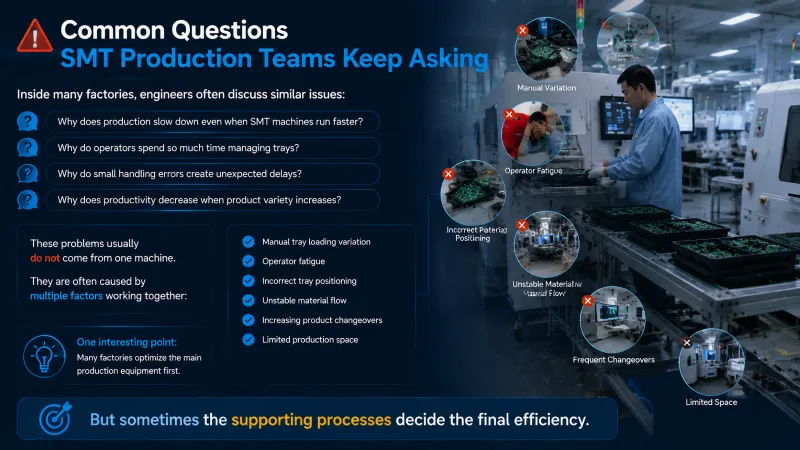
⚠️ Common Questions SMT Production Teams Keep Asking
Inside many factories, engineers often discuss similar issues:
“Why does production slow down even when SMT machines run faster?”
“Why do operators spend so much time managing trays?”
“Why do small handling errors create unexpected delays?”
“Why does productivity decrease when product variety increases?”
These problems usually do not come from one machine.
They are often caused by multiple factors working together:
- Manual tray loading variation
- Operator fatigue
- Incorrect tray positioning
- Unstable material flow
- Increasing product changeovers
- Limited production space
One interesting point:
Many factories optimize the main production equipment first.
But sometimes the supporting processes decide the final efficiency.
🏭 The Reason Seprays Developed ZM600
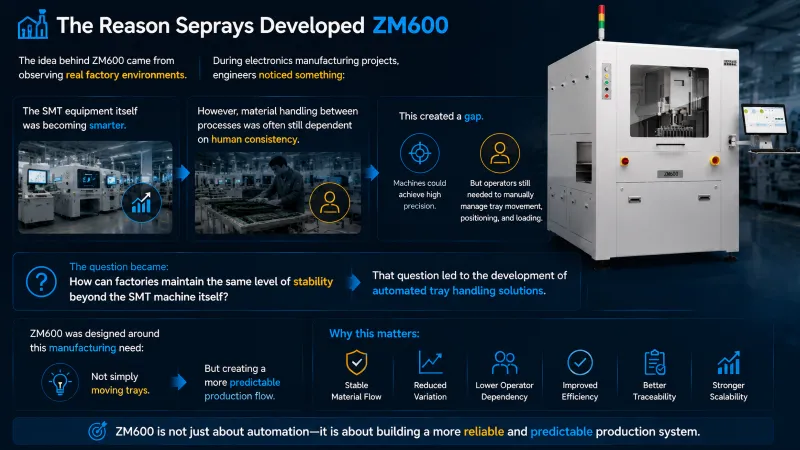
The idea behind ZM600 came from observing real factory environments.
During electronics manufacturing projects, engineers noticed something:
The SMT equipment itself was becoming smarter.
However, material handling between processes was often still dependent on human consistency.
This created a gap.
Machines could achieve high precision.
But operators still needed to manage tray movement, positioning, and loading manually.
The question became:
How can factories maintain the same level of stability beyond the SMT machine itself?
That question led to the development of automated tray handling solutions.
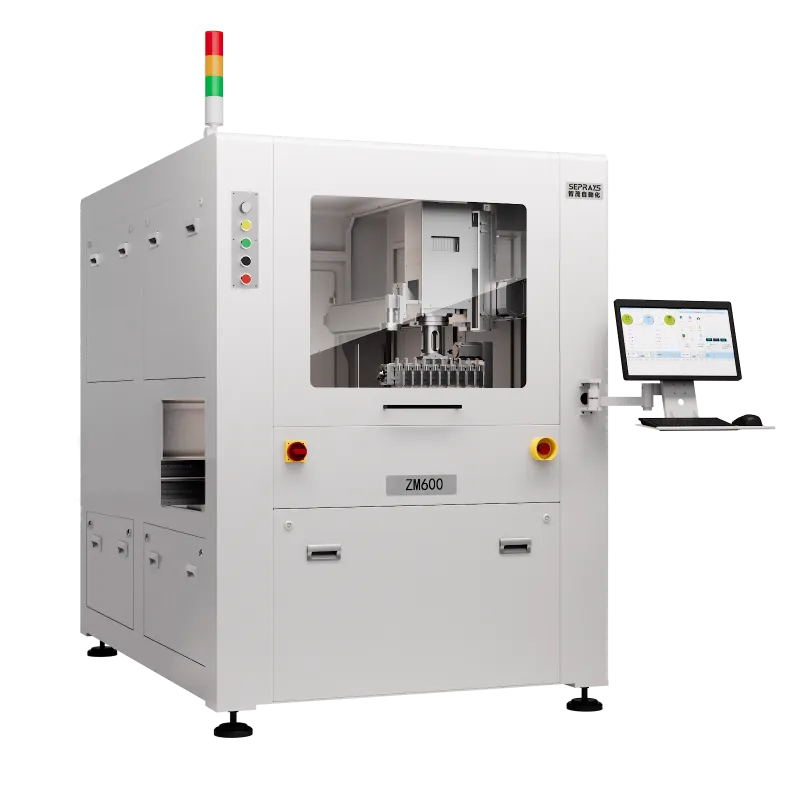
ZM600 was designed around this manufacturing need:
Not simply moving trays.
But creating a more predictable production flow.
📊 Manual Tray Handling vs Automated Tray Handling
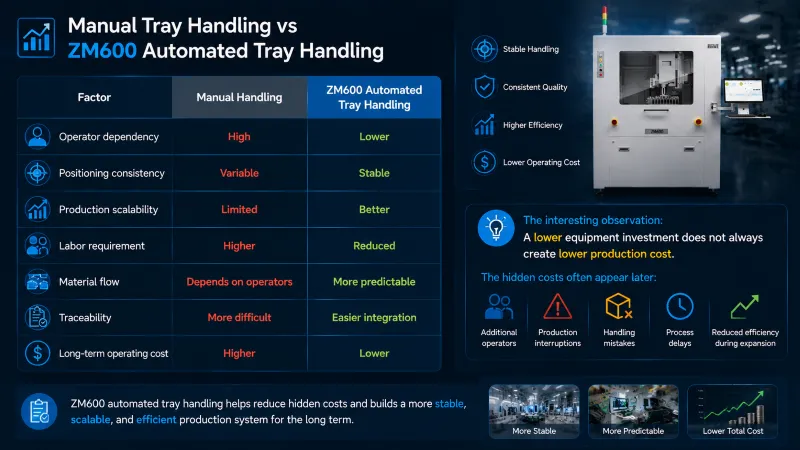
| Factor | Manual Handling | ZM600 Automated Tray Handling |
|---|---|---|
| Operator dependency | High | Lower |
| Positioning consistency | Variable | Stable |
| Production scalability | Limited | Better |
| Labor requirement | Higher | Reduced |
| Material flow | Depends on operators | More predictable |
| Traceability | More difficult | Easier integration |
| Long-term operating cost | Higher | Lower |
The interesting observation:
A lower equipment investment does not always create lower production costs.
The hidden costs often appear later:
- Additional operators
- Production interruptions
- Handling mistakes
- Process delays
- Reduced efficiency during expansion
💡 A Counterintuitive Reality: Faster SMT Equipment Does Not Always Mean Higher Productivity
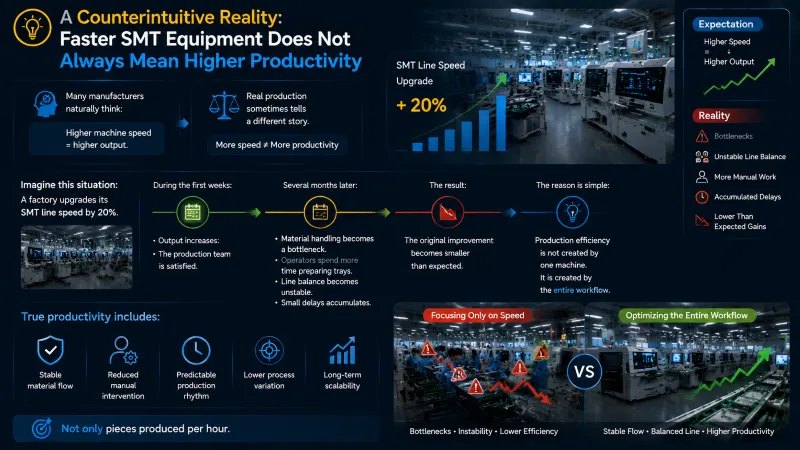
Many manufacturers naturally think:
Higher machine speed = higher output.
Real production sometimes tells a different story.
Imagine this situation:
A factory upgrades its SMT line speed by 20%.
During the first weeks:
Output increases.
The production team is satisfied.
Several months later:
Material handling becomes a bottleneck.
Operators spend more time preparing trays.
Line balance becomes unstable.
Small delays accumulate.
The original improvement becomes smaller than expected.
The reason is simple:
Production efficiency is not created by one machine.
The entire workflow creates it.
True productivity includes:
- Stable material flow
- Reduced manual intervention
- Predictable production rhythm
- Lower process variation
- Long-term scalability
Not only pieces produced per hour.
🌎 Real Case Example: Electronics Manufacturing Project in Brno, Czech Republic
A European electronics manufacturer in Brno, Czech Republic, was expanding production for industrial control modules.
The company had already optimized its SMT placement equipment.
However, as order volume increased, another issue appeared.
The challenge was not assembly speed.
The challenge was maintaining consistency between production stages.
Operators were frequently involved in:
- Tray preparation
- Manual transfer
- Material confirmation
- Product arrangement
The engineering team reviewed the complete workflow instead of focusing on one machine.
The improvement strategy included:
- Automated tray management
- More consistent loading procedures
- Reduced manual movement
- Better production rhythm
After introducing solutions based on Seprays automation technology, the production team achieved a more predictable process.
The result was not simply faster handling.
The bigger improvement was stability.
🔧 Where ZM600 Fits in Modern SMT Manufacturing
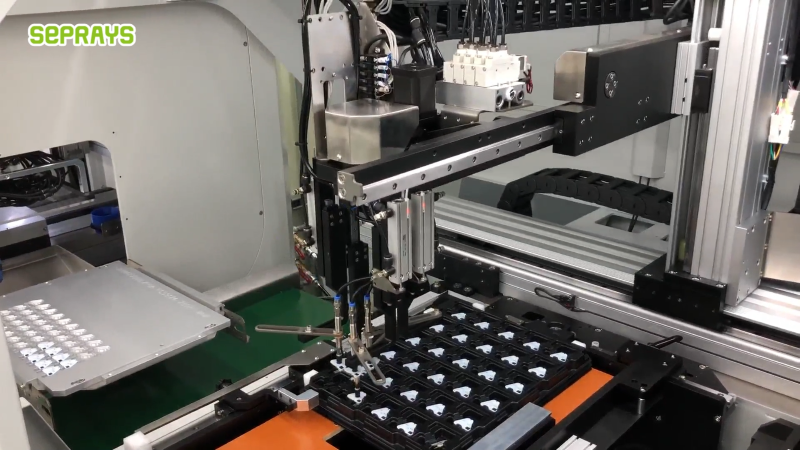
ZM600 is designed for factories that need more than basic tray movement.
Typical application scenarios include:
Automotive Electronics
Vehicle electronics require stable production because quality problems can have long-term consequences.
Automated handling helps reduce unnecessary variation.
Semiconductor-Related Manufacturing
Sensitive components often require controlled movement and consistent positioning.
Automation reduces dependence on manual operations.
High-Mix Electronics Production
When factories produce multiple product models, repeatability becomes increasingly important.
Automated systems help maintain process discipline.
📈 Cost Analysis: The Hidden Value of Automation
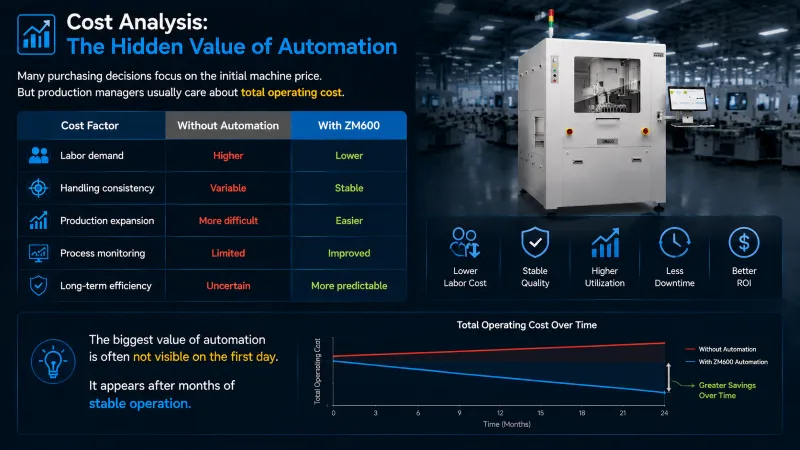
Many purchasing decisions focus on the initial machine price.
But production managers usually care about total operating cost.
| Cost Factor | Without Automation | With ZM600 |
|---|---|---|
| Labor demand | Higher | Lower |
| Handling consistency | Variable | Stable |
| Production expansion | More difficult | Easier |
| Process monitoring | Limited | Improved |
| Long-term efficiency | Uncertain | More predictable |
The biggest value of automation is often not visible on the first day.
It appears after months of stable operation.
🚀 Looking Beyond Tray Handling in 2026
Manufacturing discussions are changing.
Factories are no longer asking only:
“How fast can this machine work?”
They increasingly ask:
“How stable is the whole process?”
“How can we reduce dependence on manual operations?”
“How can production data become more connected?”
“How can quality remain consistent as volume increases?”
The future of SMT manufacturing is not only about faster equipment.
It is about creating connected production systems.
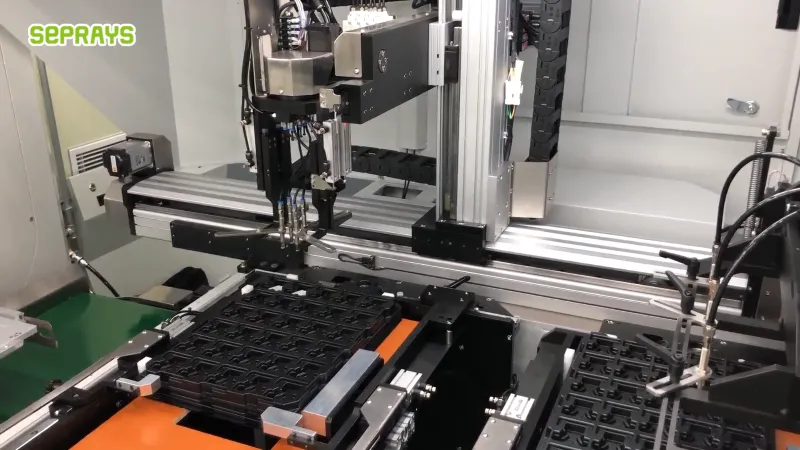
ZM600 represents this direction.
Not because it simply handles trays.
Because it helps factories build more reliable workflows.
⭐ Why Choose Seprays Group?
For more than 30 years, Seprays Group has focused on PCB/FPC depaneling technology and intelligent automation solutions.
The company has continuously developed solutions covering:
- Milling-cutter depanelers
- Laser depanelers
- V-groove depanelers
- Punching depanelers
- Automated handling systems
Seprays Group has been dedicated to PCB/FPC depaneling technology, providing a full range of solutions—milling-cutter depanelers, laser depanelers, V-groove depanelers, punching depanelers, and automated handling systems. Our equipment is trusted by leading manufacturers, including Foxconn, Flextronics, State Grid, Luxshare, Compal, Wistron, China Electronics, Quanta, CRRC, China Aerospace, OPPO, ZTE, and Bosch. It is used in factories across China and worldwide.
With decades of manufacturing experience, Seprays understands that automation is not only about replacing manual work.
It is about improving process stability, reducing production uncertainty, and helping manufacturers build reliable long-term production systems.
If you are exploring automated tray handling, PCB automation, or SMT production optimization, please feel free to contact us.
WhatsApp: +8618929266433
Correo electrónico: sales@seprays.com
Preguntas frecuentes
1. What production problems can ZM600 help solve?
ZM600 helps reduce manual tray handling, improve positioning consistency, and create a more stable material flow between SMT processes.
2. Is ZM600 suitable for automotive electronics production?
Yes. Automotive electronics often require high consistency and traceability. Automated tray handling can help reduce process variation in high-volume manufacturing environments.
3. How does automated tray handling reduce production costs?
The main benefit comes from reducing manual operations, improving workflow stability, and lowering hidden costs caused by handling variation and production interruptions.
4. Can ZM600 integrate into existing SMT production lines?
The system can be designed for integration with different production environments depending on factory layout, process requirements, and automation goals.
5. Why is tray handling important when SMT machines are already highly automated?
Because production efficiency depends on the entire process chain. Even advanced SMT equipment can lose efficiency if material transfer and handling remain inconsistent.