.png)
 Spanish
  English
  Japanese
  Korean
  Russian
  Chinese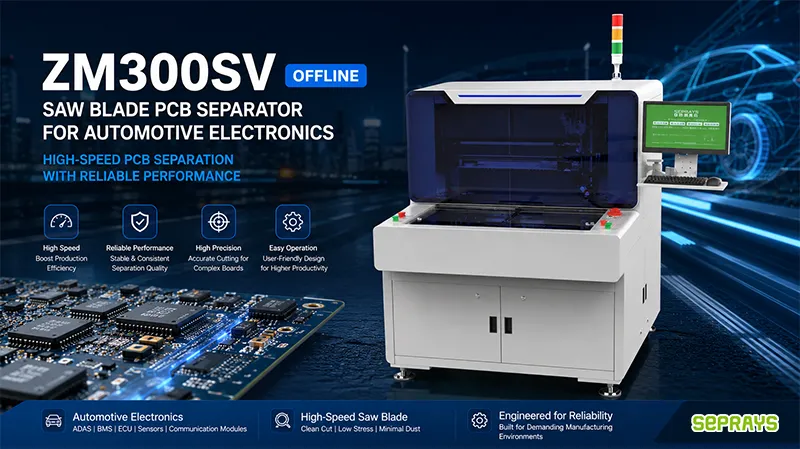
ZM300SV Offline Saw Blade PCB Separator for Automotive Electronics is becoming a more common discussion point among production engineers dealing with compact automotive electronics. A few years ago, many PCB separation tasks were relatively straightforward. Larger boards allowed more process tolerance. Small process deviations rarely caused major concerns.
That situation changed quickly.
Modern automotive electronics continue moving toward smaller dimensions, denser component layouts, and stricter reliability requirements. The challenge is no longer simply separating boards faster. The challenge is doing it repeatedly, consistently, and without introducing hidden quality risks.
Interestingly, many production teams discover this only after defects begin appearing later in the process.
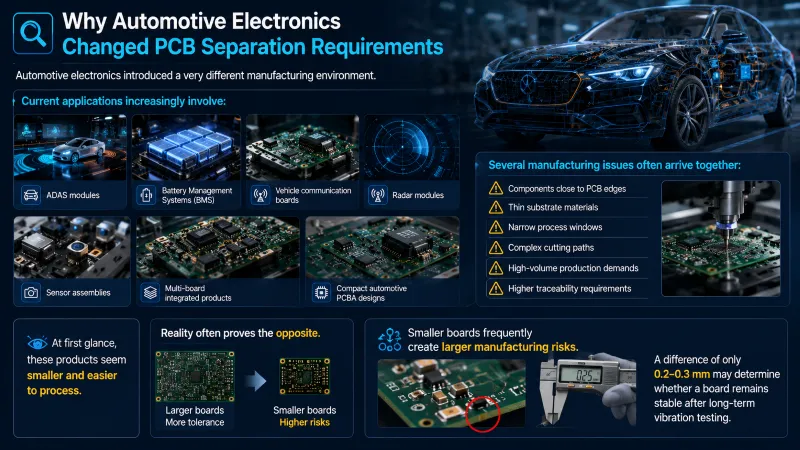
🔍 Why Automotive Electronics Changed PCB Separation Requirements
Automotive electronics introduced a very different manufacturing environment.
Current applications increasingly involve:
- ADAS modules
- Battery Management Systems (BMS)
- Vehicle communication boards
- Radar modules
- Sensor assemblies
- Multi-board integrated products
- Compact automotive PCBA designs
Several manufacturing issues often arrive together:
- Components close to PCB edges
- Thin substrate materials
- Narrow process windows
- Complex cutting paths
- High-volume production demands
- Higher traceability requirements
At first glance, these products seem smaller and easier to process.
Reality often proves the opposite.
Smaller boards frequently create larger manufacturing risks.
A difference of only 0.2–0.3 mm may determine whether a board remains stable after long-term vibration testing.
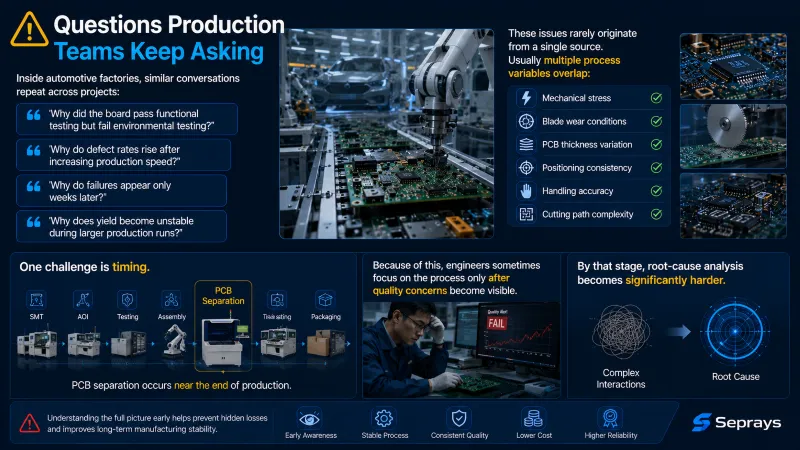
⚠️ Questions Production Teams Keep Asking
Inside automotive factories, similar conversations repeat across projects:
“Why did the board pass functional testing but fail environmental testing?”
“Why do defect rates rise after increasing production speed?”
“Why do failures appear only weeks later?”
“Why does yield become unstable during larger production runs?”
These issues rarely originate from a single source.
Usually, multiple process variables overlap:
- Mechanical stress
- Blade wear conditions
- PCB thickness variation
- Positioning consistency
- Handling accuracy
- Cutting path complexity
One challenge is timing.
PCB separation occurs near the end of production.
Because of this, engineers sometimes focus on the process only after quality concerns become visible.
By that stage, root-cause analysis becomes significantly harder.
💡 The Story Behind Why Seprays Developed ZM300SV
Several years ago, Seprays engineers worked with customers involved in automotive electronics projects.
One project from Stuttgart, Germany, involved communication boards for vehicle electronic systems.
The production line itself appeared stable.
Cutting quality looked acceptable.
Initial inspection data also looked normal.
Yet several weeks later, reliability concerns started appearing.
Nothing dramatic.
Just small inconsistencies:
Slight solder stress.
Occasional component shifts.
Unexpected inspection variation.
Individually, none of these issues seemed serious.
Together, they created measurable production losses.
The interesting discovery was this:
The problem was not always cutting accuracy.
Sometimes the problem involved maintaining stable process behavior over long production cycles.
That experience pushed Seprays engineers toward a different question:
“What if stable repeatability mattered more than peak machine speed?”
The development direction behind ZM300SV started from practical factory observations rather than simply chasing higher throughput numbers.
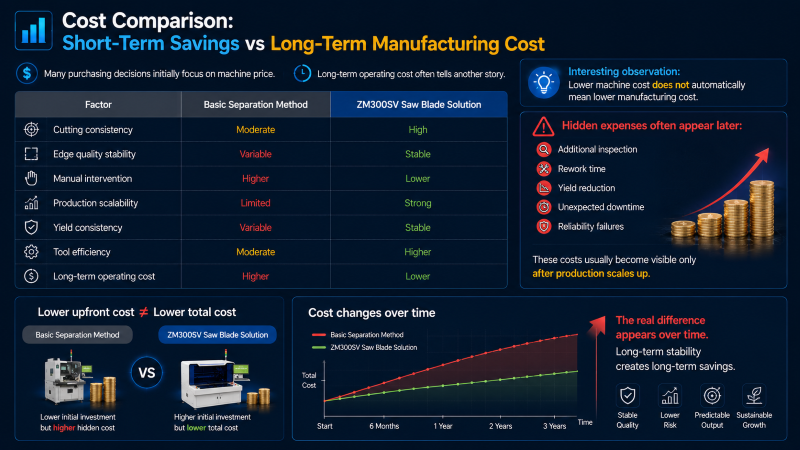
📊 Cost Comparison: Short-Term Savings vs Long-Term Manufacturing Cost
Many purchasing decisions initially focus on machine price.
Long-term operating costs often tell another story.
| Factor | Basic Separation Method | ZM300SV Saw Blade Solution |
|---|---|---|
| Cutting consistency | Moderado | High |
| Edge quality stability | Variable | Stable |
| Manual intervention | Higher | Lower |
| Production scalability | Limited | Strong |
| Yield consistency | Variable | Stable |
| Tool efficiency | Moderado | Higher |
| Long-term operating cost | Higher | Lower |
Interesting observation:
Lower machine cost does not automatically mean lower manufacturing cost.
Hidden expenses often appear later:
- Additional inspection
- Rework time
- Yield reduction
- Unexpected downtime
- Reliability failures
These costs usually become visible only after production scales up.
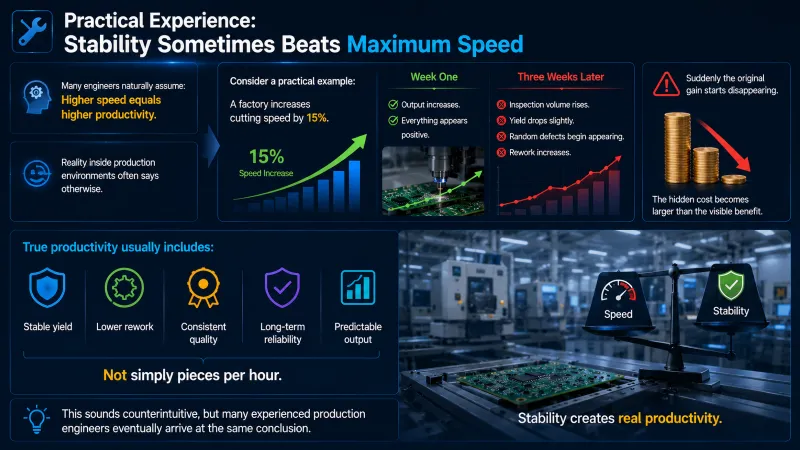
🔧 Practical Experience: Stability Sometimes Beats Maximum Speed
Many engineers naturally assume:
Higher speed equals higher productivity.
Reality inside production environments often says otherwise.
Consider a practical example:
A factory increases cutting speed by 15%.
Week one:
Output increases.
Everything appears positive.
Three weeks later:
Inspection volume rises.
Yield drops slightly.
Random defects begin appearing.
Rework increases.
Suddenly, the original gain starts disappearing.
The hidden cost becomes larger than the visible benefit.
True productivity usually includes:
- Stable yield
- Lower rework
- Consistent quality
- Long-term reliability
- Predictable output
Not simply pieces per hour.
This sounds counterintuitive, but many experienced production engineers eventually arrive at the same conclusion.
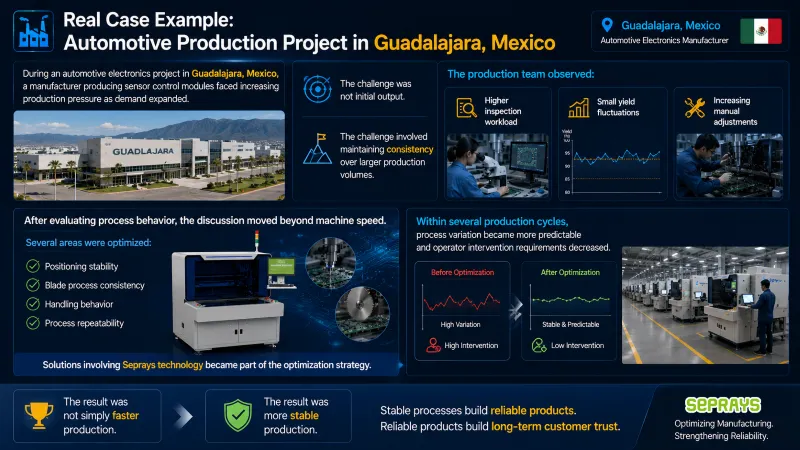
🏭 Real Case Example: Automotive Production Project in Guadalajara, Mexico
During an automotive electronics project in Guadalajara, Mexico, a manufacturer producing sensor control modules faced increasing production pressure as demand expanded.
The challenge was not the initial output.
The challenge involved maintaining consistency over larger production volumes.
The production team observed:
- Higher inspection workload
- Small yield fluctuations
- Increasing manual adjustments
After evaluating process behavior, the discussion moved beyond machine speed.
Several areas were optimized:
- Positioning stability
- Blade process consistency
- Handling behavior
- Process repeatability
Solutions involving Seprays technology became part of the optimization strategy.
Within several production cycles, process variation became more predictable, and operator intervention requirements decreased.
The result was not simply faster production.
The result was more stable production.
🚀 Looking Beyond Machine Specifications in 2026
Manufacturing conversations continue to change in 2026.
Factories increasingly ask broader questions:
“How can labor dependency be reduced?”
“How can quality remain stable during higher volumes?”
“How can systems communicate more effectively?”
“How can sensitive automotive products receive better protection?”
The answer rarely comes from one specification.
It usually comes from building connected production processes.
Solutions like ZM300SV represent part of this transition.
Not because they only separate boards faster.
Because they help factories operate more intelligently.
Why Choose Seprays Group?
For more than 30 years, Seprays Group has continuously focused on PCB/FPC depaneling technologies and real manufacturing challenges faced by global factories.
Seprays Group has been dedicated to PCB/FPC depaneling technology, providing a complete portfolio including milling-cutter depanelers, laser depanelers, V-groove depanelers, punching depanelers, and automated handling systems.
Today, Seprays equipment is trusted by many leading manufacturers worldwide, including Foxconn, Flextronics, State Grid, Luxshare, Compal, Wistron, China Electronics, Quanta, CRRC, China Aerospace, OPPO, ZTE, and Bosch.
These systems are used in factories throughout China and across global manufacturing markets.
What customers often value includes:
- More than three decades of industry experience
- Full depaneling solution capability
- Stable equipment performance for large-scale manufacturing
- Global application experience across industries
- Continuous process improvement support
If you would like to explore the right PCB depaneling approach for your production requirements, please contact us.
WhatsApp: +8618929266433
Correo electrónico: sales@seprays.com
Preguntas frecuentes
1. What type of automotive PCB applications are suitable for ZM300SV?
ZM300SV is suitable for automotive products, including ADAS modules, BMS systems, sensor modules, communication boards, and compact high-density PCBA assemblies.
2. Does ZM300SV reduce mechanical stress during PCB separation?
The saw blade design helps maintain stable separation performance and reduce unnecessary stress impact compared with less controlled processes.
3. Is ZM300SV suitable for high-volume manufacturing?
Yes. It is designed for stable and repeatable operation in larger-volume production environments.
4. How does ZM300SV help reduce manufacturing cost?
Lower rework rates, improved yield consistency, and reduced manual intervention can help lower long-term operating costs.
5. Why is process consistency important in automotive electronics?
Automotive products often operate under vibration, temperature variation, and long service life requirements. Small process inconsistencies can eventually affect reliability performance.