.png)
 English
  Spanish
  Japanese
  Korean
  Russian
  Chinese
Why Traditional Depaneling Creates Excessive Dust? Three Major Pain Points
1. Manual Depaneling: The Root Cause of Dust
Hand separation or essential cutting tools generate glass fiber and resin dust when breaking V-grooves or breakaway tabs. Studies show a single manual depaneling operation can release over 5,000 dust particles (<10μm) per cubic meter, far exceeding industrial safety standards.
2. Open Operation: Accelerating Dust Spread
Dust spreads freely without enclosed workspaces. Factory tests reveal that PM2.5 levels near depaneling stations can peak at 300μg/m³—four times China’s limit.
3. Poor Process Control: Secondary Contamination Risk
Inconsistent manual force causes burrs and micro-cracks, requiring additional grinding and generating more dust.
PCB Depaneling Machines: Three-Level Dust Control
1. Enclosed Cutting – Source Containment
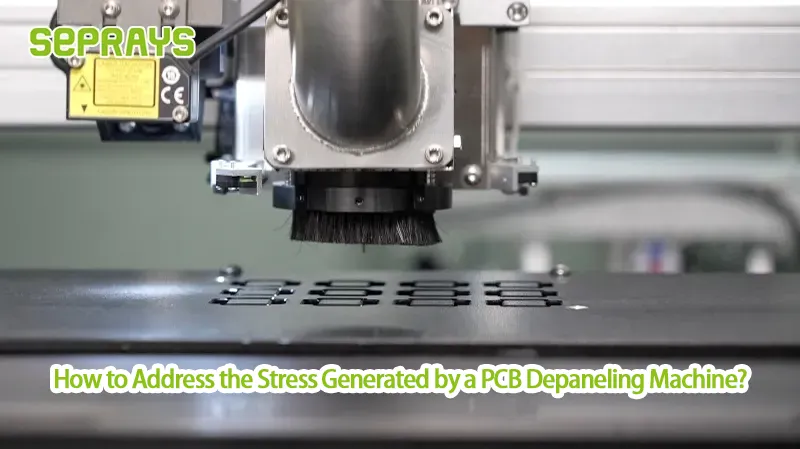
High-end depaneling machines feature fully enclosed chambers with negative-pressure dust extraction. For example, SEPRAYS machines integrate multi-stage filtration (pre-filter + HEPA), capturing 99.97% of dust for integrated cutting, suction, and filtration.
2. Precision Tooling – Minimizing Dust Generation
● Router-Based Machines: High-speed milling ensures clean cuts, reducing dust by 80% vs. manual methods.
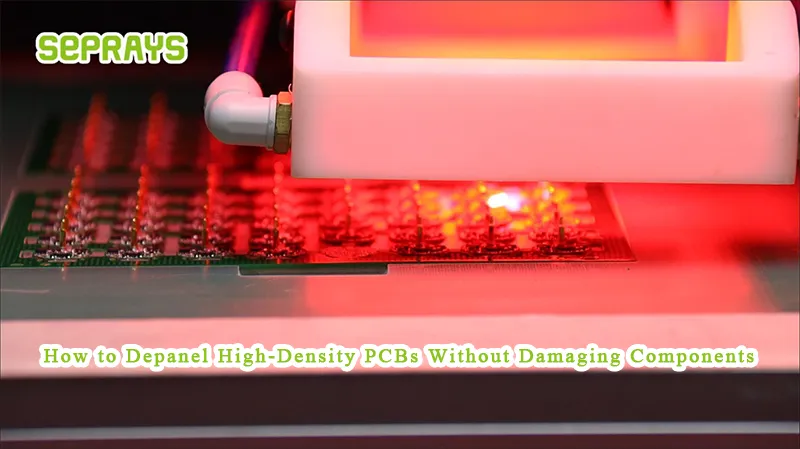
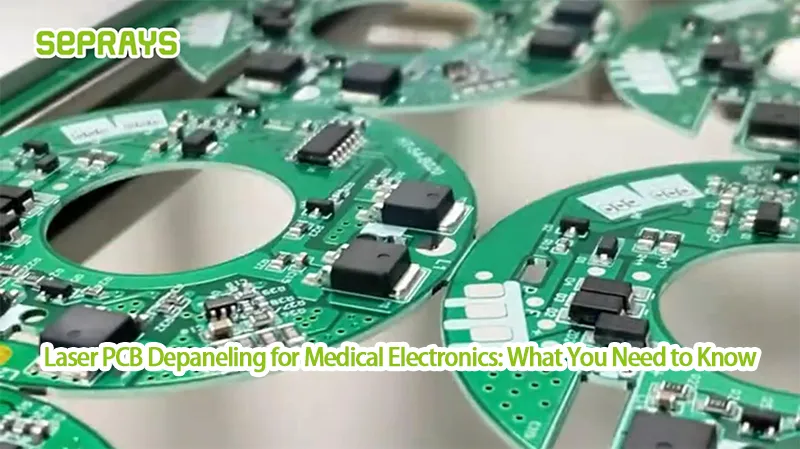
● Laser Depaneling: Non-contact ablation eliminates mechanical stress, producing near-zero dust—ideal for flex PCBs and delicate components.
3. Smart Control – Preventing Human Error
PLC-controlled systems optimize cutting speed, pressure, and path to avoid dust spikes from improper operation.
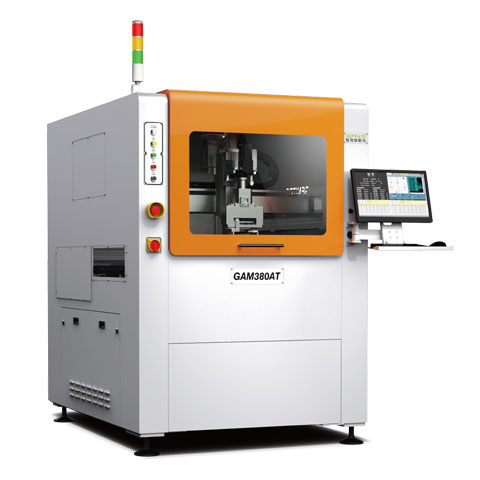
Factory Selection Guide: 3 Steps to the Best Solution
Step 1: Define Production Needs
● Board Type: FR4, aluminum, or ceramic substrates require different methods (routing/laser).
● Thickness: Standard 0.6-3.0mm boards suit router machines; ultrathin (<0.4mm) boards need a laser.
Step 2: Verify Dust Extraction
Prioritize machines with cyclone + HEPA filtration, checking filter life and dust bin capacity (≥10L).
Step 3: Evaluate Advanced Features
- Vision alignment for irregular panels.
- Barcode tracking for automotive PCB traceability.
- MES connectivity for smart manufacturing.
Dust-Free Depaneling: A Key to Smart Manufacturing
Stricter regulations (e.g., EU RoHS) and higher precision demands make advanced depaneling essential for green manufacturing and high-end orders. Procurement teams must weigh TCO (Total Cost of Ownership), engineers must match process parameters to machine specs, and executives must integrate dust-free production into a long-term strategy. Choosing the right deburring machine could be the key to factory transformation.