.png)
 Korean
  English
  Spanish
  Japanese
  Russian
  Chinese
German SMT production environments are known for their strict expectations on precision, durability, and process repeatability. When evaluating a PCB depaneling system, engineers focus not only on cutting performance but also on long-term stability, integration capability, and predictable cost of ownership. This article summarizes the practical criteria observed in German automotive, industrial control, and medical electronics workshops.
🔧 Router Solutions — Mechanical Stability and Tool Management
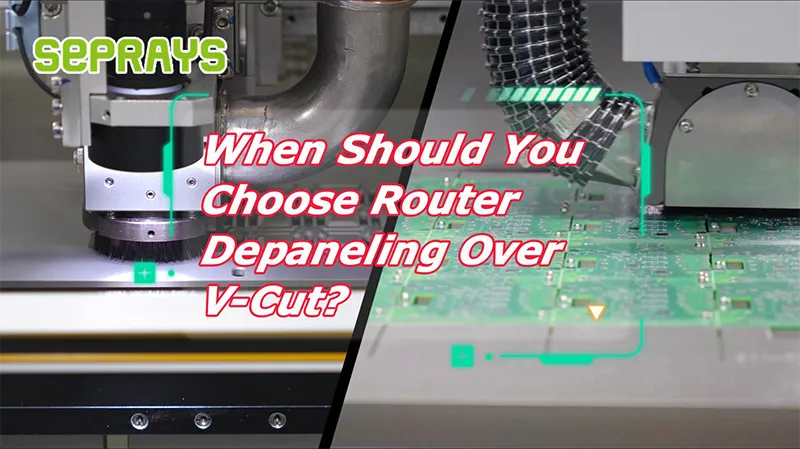
Router-type depaneling remains common in high-mix SMT lines. German engineers frequently emphasize spindle rigidity, vibration control, and tool wear consistency. A stable Z-axis design helps maintain predictable kerf width, which is essential for dense PCBA layouts.
Common pain points include:
- Variations in tool diameter after prolonged operation
- Dust extraction efficiency for FR4 and aluminum substrates
- Difficulty keeping ±0.05 mm accuracy during long shifts
In many German factories, tool-life monitoring combined with fiducial-based correction is used to control long-term dimensional drift. It reduces scrap risk and prevents unexpected downtime.
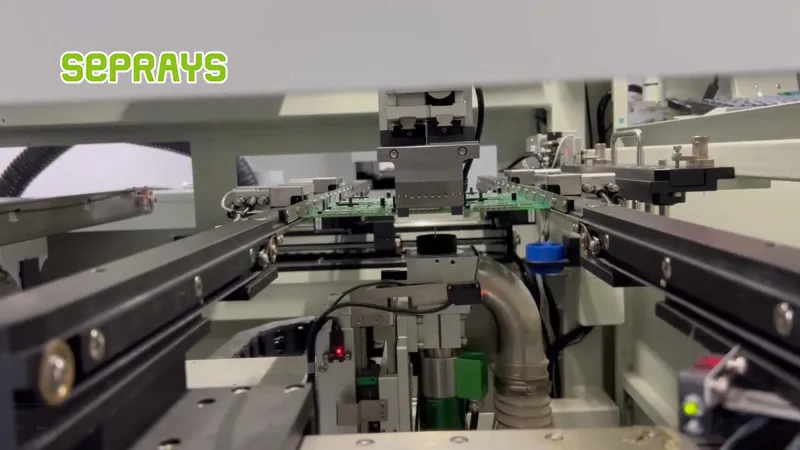
⚡ Laser Cutting — Precision, Edge Quality, and Cleanliness
Laser depaneling has gained adoption where reliability requirements are high. Engineers in Germany often highlight two evaluation points:
- Heat-affected zone behavior,
- repeatability under continuous 24/7 operation.
A well-designed laser system should provide:
- Minimal thermal impact for RF modules and flexible substrates
- Burr-free edges that improve downstream coating or testing
- Narrow kerf for compact designs
The long-term cost challenge is usually the laser source lifetime and maintenance intervals. Several automotive plants share that stable micron-level cuts significantly reduce rework, despite higher initial investment.

✂️ V-Cut Solutions — Durability and Cost Efficiency
V-cut scoring remains cost-effective for standard boards. German SMT lines tend to evaluate scoring angle consistency, blade hardness, and chassis stiffness rather than speed alone.
Practical challenges:
- Board stress when components are placed near the score line
- Variation in score depth affects break force
- Long-term wear of blades increases the risk of cracked PCBs
Well-maintained V-cut systems are still reliable for consumer and industrial electronics, but they require disciplined preventive maintenance to ensure uniform results.

🪚 Saw Blade Systems — Where They Fit in German Production
Saw blade depaneling is used when thick materials or metal-core PCBs are involved. German workshops often examine:
- Blade alignment accuracy
- Edge chipping on aluminum substrates
- Acoustic noise levels in clean production environments
The machine’s main advantage lies in its robustness for heavy boards, although operators rarely use it for fine-pitch assemblies.

📊 Cost Analysis in German SMT Facilities
Several factories report that the real cost difference between depaneling methods comes from quality losses and downtime, rather than equipment price. Key factors include:
- Scrap caused by stress or thermal distortion
- Time spent on tool replacement or alignment
- Integration with MES and production tracking
- Maintenance intervals affecting line uptime
A system that maintains stability over months—not days—usually produces better long-term ROI.
🏭 Case Observations from German Workshops
- Automotive Electronics: Laser is preferred for sensitive components and complex outlines.
- Industrial Modules: Router systems dominate due to flexibility and predictable wear behavior.
- Power Electronics: Saw blades are applied for thick PCBs requiring strong mechanical separation.
- Consumer Devices: V-cut solutions remain cost-effective when board design allows.
These observations highlight that no single method is universally best—matching the process to the product and quality tolerance is the key.

🧩 Practical Selection Framework
Engineers in Germany often use a decision matrix involving:
- required precision
- material and board thickness
- stress tolerance
- expected long-term stability
- maintenance availability
- integration with existing SMT lines
A structured evaluation helps avoid over-specification or under-investment.
Why Choose Seprays Group?
Seprays Group focuses on precision, long-term durability, and stable industrial performance—qualities valued in German SMT environments. Our solutions support router, laser, V-cut, and saw-blade configurations, ensuring that engineers can select equipment based on technical needs rather than a single method.
If you would like more details or sample test results, please contact us.
WhatsApp: +8618929266433
E-mail: sales@seprays.com