.png)
 English
  Spanish
  Japanese
  Korean
  Russian
  Chinese
In today’s rapidly growing electronics manufacturing industry, the PCB (printed circuit board) depaneling process plays a crucial role. As one of the most widely used PCB cutting methods, the performance of a knife-type depaneling machine directly impacts production efficiency and cost control.
At Seprays, experts in the SMT field, we’ll walk you through the working principles, advantages, and limitations of this technology.
🔧 How a Knife-Type Depaneling Machine Works
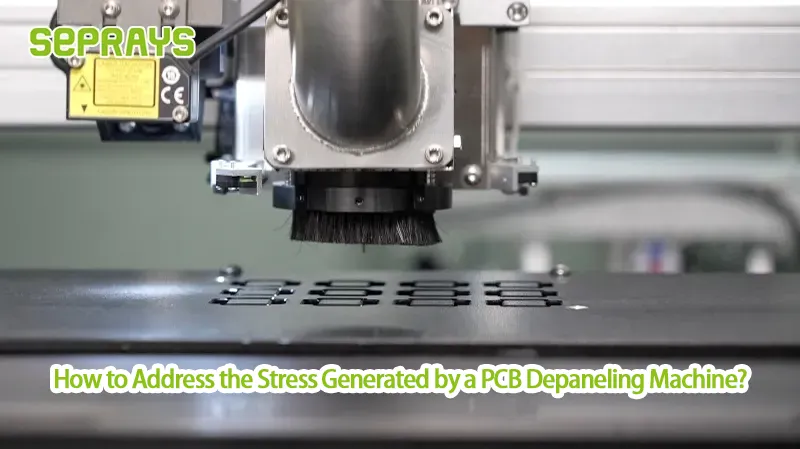
A knife-type depaneling machine relies on precise mechanical motion to separate PCBs. During operation, positioning pins, clamps, or edge guides secure the board for accuracy. A circular milling cutter or V-groove blade, driven by a high-speed motor, cuts along a pre-programmed linear path. This combination of rotation and linear feed ensures layer-by-layer separation of copper foil, substrate, and other materials, delivering clean and consistent cuts.
✅ Advantages of Knife-Type Depaneling Machines
- Simple operation & cost-effective
Easy setup with basic cutting parameters makes it ideal for businesses of all sizes, especially SMEs. - Low-stress cutting protects components.
The linear cutting motion minimizes stress, reducing the risk of damage to sensitive components. - Handles diverse materials & thicknesses
From standard FR-4 to aluminum PCBs, it accommodates a wide range of board types with adjustable settings. - High cut quality
Produces smooth, burr-free edges, reducing the need for secondary processing and boosting efficiency.
⚠️ Limitations to Consider
- Restricted cutting paths
Best for straight-line cuts and simple shapes; not suitable for complex PCB designs. - Moderate efficiency
Cutting speed is limited by the tool’s rotation, making it less ideal for high-volume production. - Faster tool wear
High-speed operation shortens tool lifespan, leading to higher maintenance costs. - Dust control challenges
Cutting generates dust, necessitating the use of additional collection systems to maintain a cleaner workspace.
📌 Seprays Summary
The Seprays knife-type depaneling solution comes with certain limitations, but its simplicity, reliability, and low-stress cutting make it an excellent choice for small and medium-sized manufacturers. Ultimately, the right depaneling equipment depends on your production scale, design complexity, and budget.
💡 Have questions or experiences with knife-type depaneling machines? Share your thoughts in the comments—we’d love to hear from you.