.png)
 Russian
  English
  Spanish
  Japanese
  Korean
  Chinese
In today’s fast-paced electronics manufacturing, every second and every cut matters. A cutting depaneling machine plays a crucial role in balancing productivity and product integrity.
But here’s the question every factory faces — how do you boost efficiency without compromising on quality?
In this article, we’ll explore how cutting depaneling machines are changing modern PCB manufacturing, the hidden costs behind “faster” production, and why precision-based automation is worth the investment.
💡 The Hidden Costs of Manual and Outdated Depaneling
Many factories still rely on manual PCB cutting or semi-automatic systems.
At first glance, they seem cost-effective — low purchase price, easy operation, and minimal training.
However, beneath the surface lies a series of hidden costs:
- High material waste due to human errors and inaccurate cuts.
- Increased PCB stress, leading to micro-cracks and long-term reliability issues.
- Slow production cycles that can’t keep up with modern SMT lines.
- Safety concerns — repetitive manual cutting exposes workers to injury and fatigue.
When compared over time, the apparent savings vanish. The total cost of ownership rises, while yield and product quality decline.

🧩 How the Cutting Depaneling Machine Improves Productivity
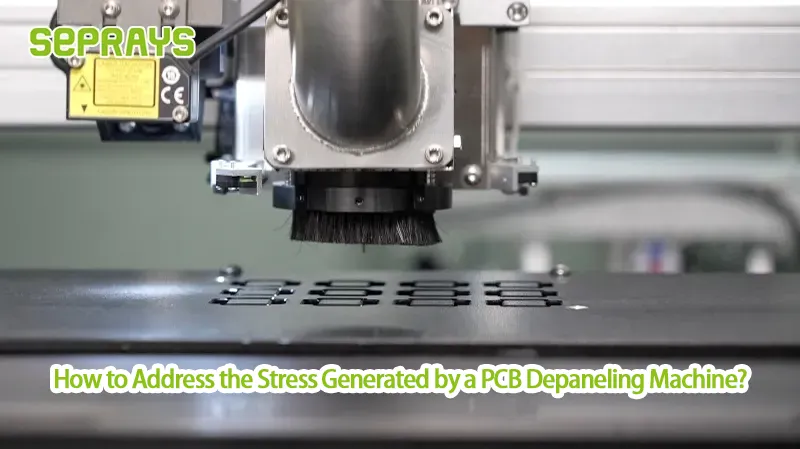
Modern cutting depaneling machines combine intelligent automation with precision mechanics.
Unlike manual tools, they deliver consistent, repeatable, and low-stress cuts — even for complex PCB shapes.
Key performance benefits include:
- High-speed cutting with accuracy down to ±0.05mm.
- Programmable control systems for multiple product models.
- Dust extraction or vacuum systems to maintain clean working environments.
- Reduced labor cost, as one operator can oversee various units.
By integrating these technologies, manufacturers can align efficiency with long-term reliability.

📊 Cost Analysis: Automation vs. Manual Operation
Let’s compare a typical case:
- Manual Cutting Line: 4 operators, 80 boards/hour, 3% defect rate.
- Automated Cutting Depaneling Machine: 1 operator, 200 boards/hour, 0.5% defect rate.
When considering wages, downtime, and rework costs, automation quickly proves more economical.
Even though the initial investment may be higher, the ROI period averages 6–12 months, depending on production scale.
That’s not just about faster output — it’s about building consistency and scalability.

🔍 Practical Application: Real-World Case Study
A communication electronics factory in Southeast Asia switched from manual cutting to an automatic cutting depaneling machine.
After 3 months of operation:
- Labor demand dropped by 60%.
- PCB yield improved by 2.8%.
- Dust accumulation around the line reduced significantly.
The management noted that the overall working environment became safer and cleaner — while operators could focus on quality inspection and system monitoring instead of repetitive cutting.

🧠 Common Concerns and Discussion Points
1. Is it suitable for all PCB materials?
Yes. Most cutting depaneling machines support FR4, aluminum base, and flexible boards — with adjustable speed and spindle parameters.
2. What about maintenance?
Modern systems feature self-diagnostic tools and modular parts, reducing downtime and simplifying maintenance.
3. Will it replace human workers?
Not exactly — it enhances productivity while allowing skilled operators to shift toward higher-value roles like programming, supervision, and QA.

🚀 The Future of PCB Depaneling Technology
As electronic devices become smaller and more complex, the cutting depaneling machine will continue to evolve.
Expect innovations like AI-based vision correction, real-time stress analysis, and inline automation that synchronizes with SMT production.
The goal is clear: achieve faster, cleaner, and smarter PCB separation without risking product integrity.
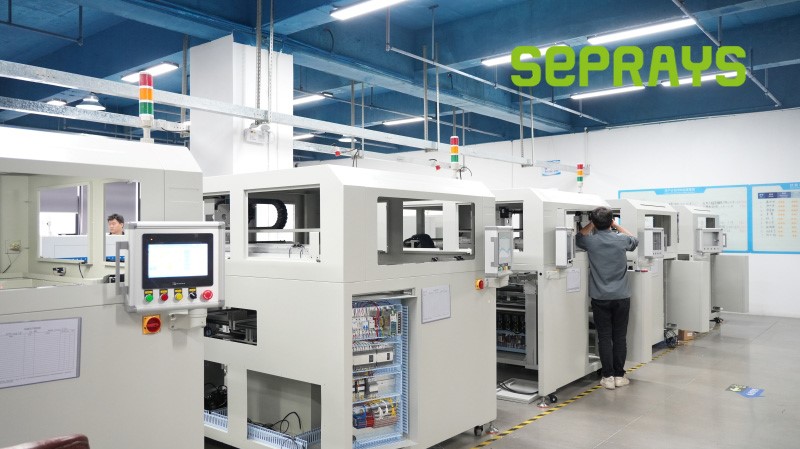
🤝 Why Choose Seprays Group?
Since 1993, Seprays Group has been dedicated to PCB/FPC depaneling technology, providing a full range of solutions — milling cutter depanelers, laser depanelers, V-groove depanelers, punching depanelers, and automated handling systems. Our equipment is trusted by leading manufacturers, including Foxconn, Flextronics, State Grid, Luxshare, Compal, Wistron, China Electronics, Quanta, CRRC, China Aerospace, OPPO, ZTE, and Bosch, serving factories across China and worldwide.
- Global service network in 31+ countries.
- ISO9001, ISO14001, and ISO45001 certified.
- Over 32 years of manufacturing experience.
- CE-certified equipment with patented dust control designs.
We combine advanced engineering with reliable service support, helping manufacturers achieve higher yields and smoother production.
📩 For more information, please contact us:
📧 E-mail: sales@seprays.com