.png)
 Russian
  English
  Spanish
  Japanese
  Korean
  Chinese
🧩 Introduction: The Evolution of PCB Depaneling
In modern electronics manufacturing, precision and consistency are no longer optional — they’re mandatory. The Traveling Knife Depaneling Machine has emerged as one of the most reliable solutions for separating printed circuit boards (PCBs) efficiently while minimizing stress and burr formation.
As production volumes rise and boards become thinner and more complex, many manufacturers are re-evaluating their existing depaneling setups. But how do you choose the right machine that fits your process — both technically and economically?
This article shares practical insights, real-world cases, and cost-performance analyses to help engineers and decision-makers make the right investment.

🧠 Understanding the Traveling Knife Depaneling Principle
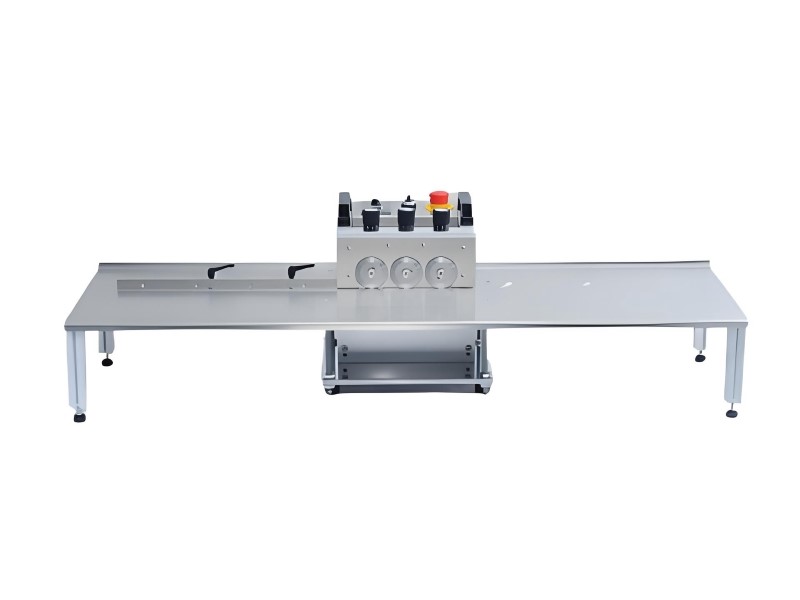
A Traveling Knife Depaneling Machine uses a linear blade that moves along the PCB’s pre-scored V-groove. Unlike manual tools or static blades, this method ensures even pressure distribution and smooth cutting without creating micro-cracks or deformation.
🔹 Key advantages include:
- Low mechanical stress on components
- Minimal burrs and edge chipping
- Stable operation suitable for large-scale automation
- Compatible with both rigid and semi-flex PCBs
The knife travels across the board rather than rotating, which significantly reduces dust generation and improves safety for sensitive electronic parts.

💥 Common Pain Points in Traditional PCB Depaneling
Many SMT factories still rely on older methods such as manual breaking, circular saws, or low-end routers. While these may seem cost-effective at first, they often bring hidden costs:
- Uneven cuts and board cracking: Manual methods lack consistency.
- High maintenance and tool wear: Saw blades dull quickly and require frequent replacement.
- Operator dependence: Skill differences lead to inconsistent results.
- High dust and contamination risk: Particularly in optical or sensor device assembly.
A European customer once reported that 10% of their finished boards were rejected due to micro-damage from manual depaneling — a significant loss considering today’s tight profit margins.
💰 Cost Analysis: Why “Cheaper” Isn’t Always Better
When evaluating a Traveling Knife Depaneling Machine, it’s essential to look beyond the initial price. Consider these cost-impacting factors:
- Tool lifespan: Traveling knives typically last 5–10 times longer than saw blades.
- Maintenance frequency: Reduced tool wear lowers downtime and service costs.
- Yield improvement: Fewer damaged boards directly improve ROI.
- Automation integration: Seamless inline connection reduces labor costs.
- Energy efficiency: Lower power consumption compared to routers or lasers.
A mid-size factory that switched from manual cutting to an automated traveling knife system reported a 25% reduction in overall operating cost after just one year — primarily through higher yield and reduced rework.
🧩 Case Study: Improving SMT Line Throughput
A European electronics manufacturer producing automotive control units faced frequent cracking issues during PCB separation. They adopted the SEPRAYS Traveling Knife Depaneling Machine, integrating it directly with their conveyor line.
Results after 3 months:
- PCB rejection rate dropped from 8% to 0.5%
- Output increased by 20%
- Machine maintenance intervals were extended from weekly to quarterly
- Operators reported quieter, cleaner working conditions
This case underscores how precision and process stability can drive tangible productivity gains.
🛠️ How to Select the Right Traveling Knife Depaneling Machine
When choosing a machine, focus on these key criteria:
🔹 Cutting Accuracy: Look for models with precision servo control and adjustable pressure settings.
🔹 Automation Level: Inline models with automatic loading/unloading save labor and increase throughput.
🔹 Material Compatibility: Ensure it handles different PCB thicknesses and materials without stress marks.
🔹 Safety Features: Include dust extraction, safety guards, and a user-friendly software interface.
🔹 After-Sales Support: Reliable technical service and spare parts availability are critical for long-term operation.
Remember — the best depaneling solution is one that matches your specific production goals, not just the one with the lowest price tag.
💡 The Future of Traveling Knife Technology
As PCB designs continue to evolve — with thinner substrates, tighter layouts, and higher component density — traveling knife systems are also advancing.
Modern systems now integrate AI-based cutting path optimization, vision alignment, и real-time monitoring for predictive maintenance. These innovations ensure every cut is precise and consistent, supporting the demands of high-reliability industries such as automotive, medical, and aerospace electronics.
🌍 Why Choose Seprays Group?
With over 30 years of expertise in PCB depaneling technology, Seprays Group has become a trusted partner to manufacturers worldwide. Our traveling knife depaneling systems combine mechanical precision with intelligent automation — designed to reduce production stress, extend tool life, and enhance product yield.
If you’re looking to optimize your PCB depaneling process, contact us today to discuss your production challenges and discover how Seprays can support your next level of manufacturing excellence.
WhatsApp: +86 189 2926 6433
E-mail: sales@seprays.com