.png)
 English
  Spanish
  Japanese
  Korean
  Russian
  Chinese
What Is PCB V Cut Depaneling
PCB V-Cut depaneling is a method for separating individual circuit boards from a larger panel or array. During the PCB manufacturing process, multiple boards are often fabricated together in a single panel to improve production efficiency. V-cut depaneling involves creating V-shaped grooves (also called V-scores) along the intended break lines on the PCB panel.
Advantages of PCB V Cut Depaneling
Saves Money
It’s cheaper because it uses simple tools and creates less waste.
Fast
It’s a quick way to separate boards, especially when using machines, which is great for making lots of boards.
Easy to Do
The process is simple and can be done by hand or with machines, making it flexible for different production needs.
Saves Space
It removes very little material, so more boards can fit on a single panel, saving space and materials.
Keeps Panels Strong
The panels stay strong and easy to handle until the boards are separated, reducing the chance of damage.
Clean Edges
It creates smooth edges when separating boards, so they look neat and don’t need extra finishing.
Works for Many Designs
It can be used for most board shapes, especially simple ones like rectangles or squares.
Gentle on Components
It puts less stress on the boards and their parts, so there’s less risk of damage.
Good for Big Production
It’s great for making lots of boards quickly and efficiently.
Can Be Automated
Machines can do the cutting, making it even faster and more consistent for large-scale production.
Disadvantages of PCB V Cut Depaneling
Only Works for Straight Lines
V-cutting can’t handle curved or complex shapes. It only works for straight edges.
Can Damage the Board
Breaking the boards along the V-grooves can put stress on the board, which might harm delicate parts or traces near the edges.
Not Good for Thin or Flexible Boards
Thin or bendy boards might crack or warp when you break them along the V-grooves.
Edges Can Be Rough
The edges might not be perfectly smooth after breaking, especially if done by hand. This might need extra cleaning or finishing.
Less Precise
V-cutting isn’t as accurate as methods like laser cutting. It’s not ideal for boards that need very clean or precise cuts.
Risk of Harming Components
If parts are too close to the edges, breaking the board could damage them. You need to plan the design carefully to avoid this.
Manual Work for Small Batches
For small production runs, you might have to break the boards by hand, which can be slow and inconsistent.
Creates Dust
Breaking the boards creates dust and small pieces, so operators may need to clean them off the boards afterward.
Advantages of Seprays V-Groove PCB Cutting Machine
- The V-groove depaneling machine offers higher-quality board separation.
- It features fully automated operations, including self-feeding, cutting, finished product discharge, and waste collection.
- It supports automatic depaneling in both X and Y directions for V-groove boards.
- The machine ensures smooth and burr-free cutting of aluminum substrates, copper substrates, FR4, and fiberglass boards.
- During line changeovers, the cutting blade module and suction cups can be replaced without manual blade adjustment, saving time.
- It can automatically arrange small PCBs into trays or transfer them via a conveyor line according to customer requirements.
Seprays’ PCB/PCB V-Groove PCB Depaneling Solutions
ZM30-ASV Fully Automatic Saw Style V-groove PCB Separator
SEPRAYS’ ZM30-ASV fully automated saw-type V-groove PCB depaneling machine represents a major advancement in PCB depaneling technology, providing a comprehensive solution for efficient and high-quality depaneling.
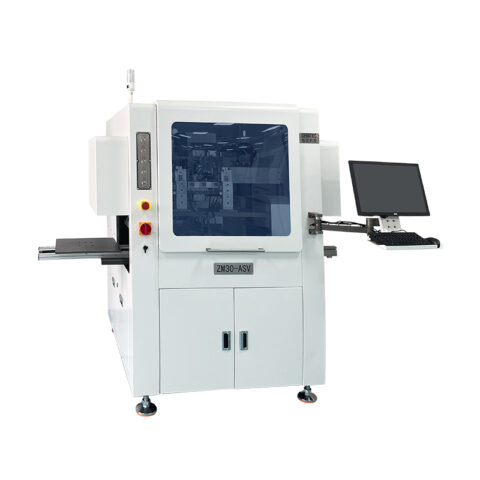
ZM30-LT In-Line Multi-Knife PCBA Depaneler
The ZM30-LT In-Line Multi-Knife PCBA Depaneler, offered by SEPRAYS, is a high-tech solution designed for efficient and precise separation of Printed Circuit Board Assemblies (PCBAs) in high-volume manufacturing environments.
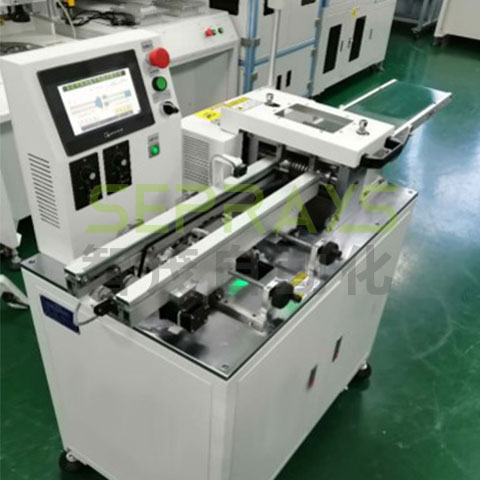
ZM30 PCB Round Blade V-CUT Separator
SEPRAYS ZM30 Round Knife PCB Separator is suitable for all kinds of PCB circuit boards with V grooves, aluminum substrates, LED circuit boards, LED light strips, etc. It is mainly used in LED, SMT, mobile phones, toys, and other electronics industries that use circuit boards. Manufacturers mainly use these circuit boards in the LED, SMT, cell phone, toy, and other electronics industries, applying them across various sectors.

Conclusion
PCB V-cut depaneling is a practical and efficient way to separate circuit boards, offering benefits like cost savings, speed, and ease of use. Although it presents some drawbacks, such as limitations to straight edges and potential stress on components, Seprays’ V-groove cutting machines actively solve many of these issues. With features like full automation, smooth cutting, and support for different materials, Seprays’ machines provide a reliable solution for modern PCB manufacturing. Whether for large-scale production or specific needs, V-cut depaneling remains an important tool in the electronics industry.