.png)
 Chinese
  English
  Spanish
  Japanese
  Korean
  Russian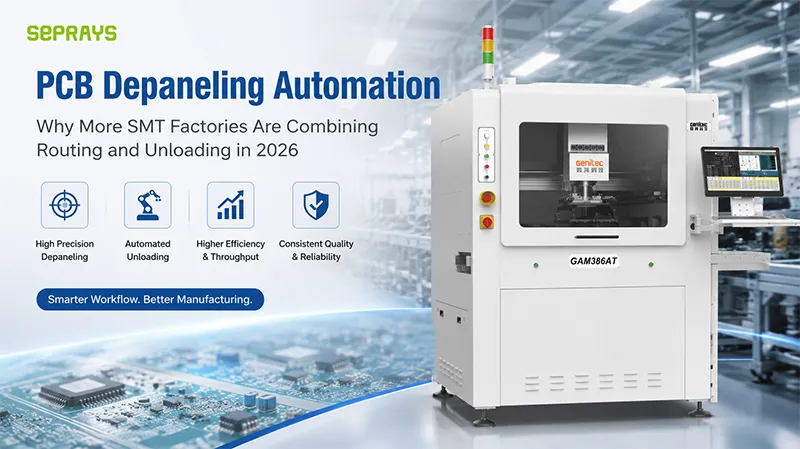
PCB depaneling automation is no longer just a topic discussed by large electronics manufacturers. Over the past two years, we have seen medium-sized EMS providers and OEM factories begin re-evaluating how much time, labor, and product risk still exist between the depaneling process and final board collection.
Interestingly, many production managers focus heavily on cutting accuracy while overlooking what happens immediately after depaneling. In reality, manual board handling often creates hidden costs that are difficult to measure until production volumes increase.
As labor costs continue rising in 2026 and manufacturers push for higher throughput, integrated depaneling and unloading systems are becoming a practical solution rather than a luxury investment.
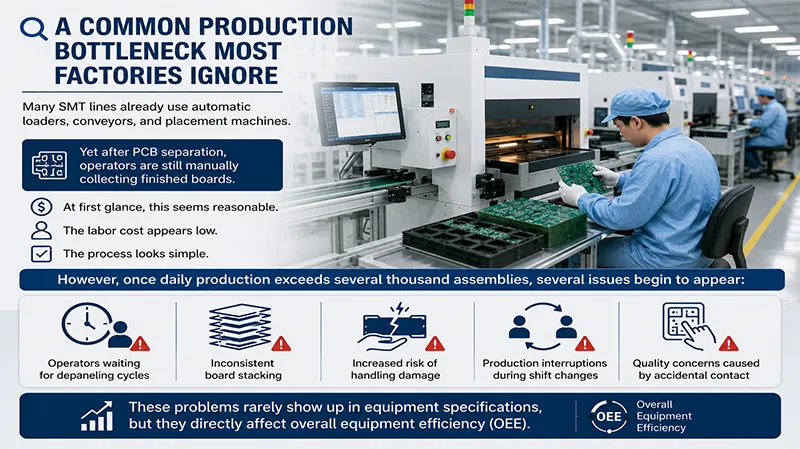
🔍 A Common Production Bottleneck Most Factories Ignore
Many SMT lines already use automatic loaders, conveyors, and placement machines.
Yet after PCB separation, operators are still manually collecting finished boards.
At first glance, this seems reasonable.
The labor cost appears low.
The process looks simple.
However, once daily production exceeds several thousand assemblies, several issues begin to appear:
- Operators waiting for depaneling cycles
- Inconsistent board stacking
- Increased risk of handling damage
- Production interruptions during shift changes
- Quality concerns caused by accidental contact
These problems rarely show up in equipment specifications, but they directly affect overall equipment efficiency (OEE).
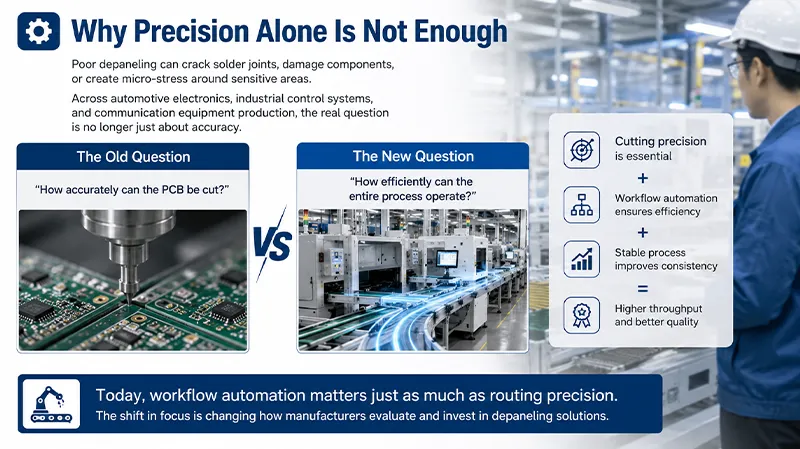
⚙️ Why Precision Alone Is Not Enough
For years, manufacturers selected depaneling equipment based mainly on cutting quality.
That made sense.
After all, poor depaneling can crack solder joints, damage components, or create micro-stress around sensitive areas.
However, a trend has emerged across automotive electronics, industrial control systems, and communication equipment production.
Factories are no longer asking:
“How accurately can the PCB be cut?”
Instead, they are asking:
“How efficiently can the entire process operate?”
This shift changes the purchasing criteria completely.
Today, workflow automation matters just as much as routing precision.
📊 Cost Comparison: Manual vs Automated Board Collection
The following comparison is based on observations from high-volume SMT production environments.
| Factor | Manual Collection | Automated Unloading |
|---|---|---|
| Labor Dependency | High | Low |
| Board Handling Risk | Medium to High | Very Low |
| Process Consistency | Operator Dependent | Stable |
| Shift Change Impact | Noticeable | Minimal |
| Production Throughput | Variable | Predictable |
| Smart Factory Readiness | Limited | Excellent |
The surprising finding?
Many factories discover that board handling contributes more production variability than the routing process itself.
🏭 Real Factory Scenario
Earlier this year, an electronics manufacturer producing industrial control modules faced a recurring issue.
The routing machine itself was performing well.
Cut quality met specifications.
Yield rates were acceptable.
Yet operators frequently reported production delays.
After reviewing the process, engineers discovered the actual bottleneck was not depaneling.
It was manual unloading.
Finished boards accumulated faster than operators could remove them during peak production periods.
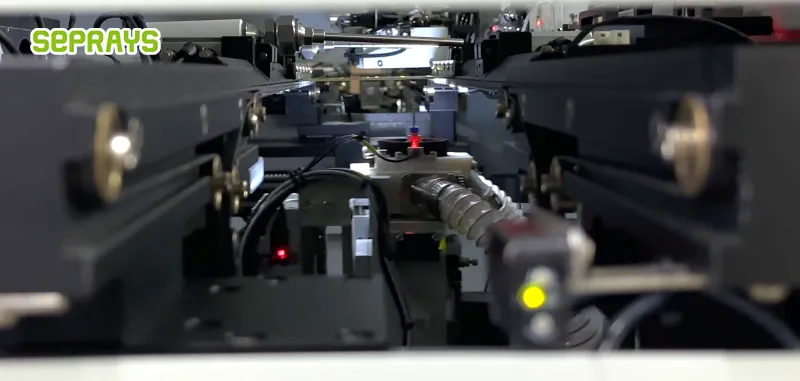
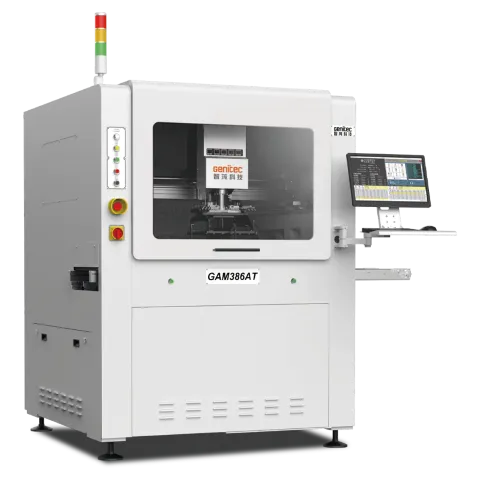
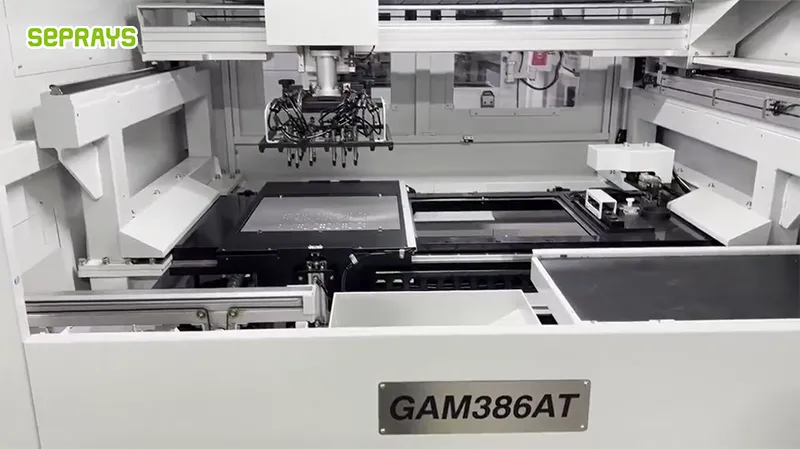
The factory eventually evaluated an integrated solution using the GAM386AT Automatic PCB Bottom Router Machine together with automated unloading equipment.
Within several months, production flow became more predictable, and operators were reassigned to higher-value tasks rather than repetitive board collection.
This is not an unusual story.
Many factories discover the same issue only after conducting a full workflow analysis.
🚀 How Integrated Routing and Unloading Improves Efficiency
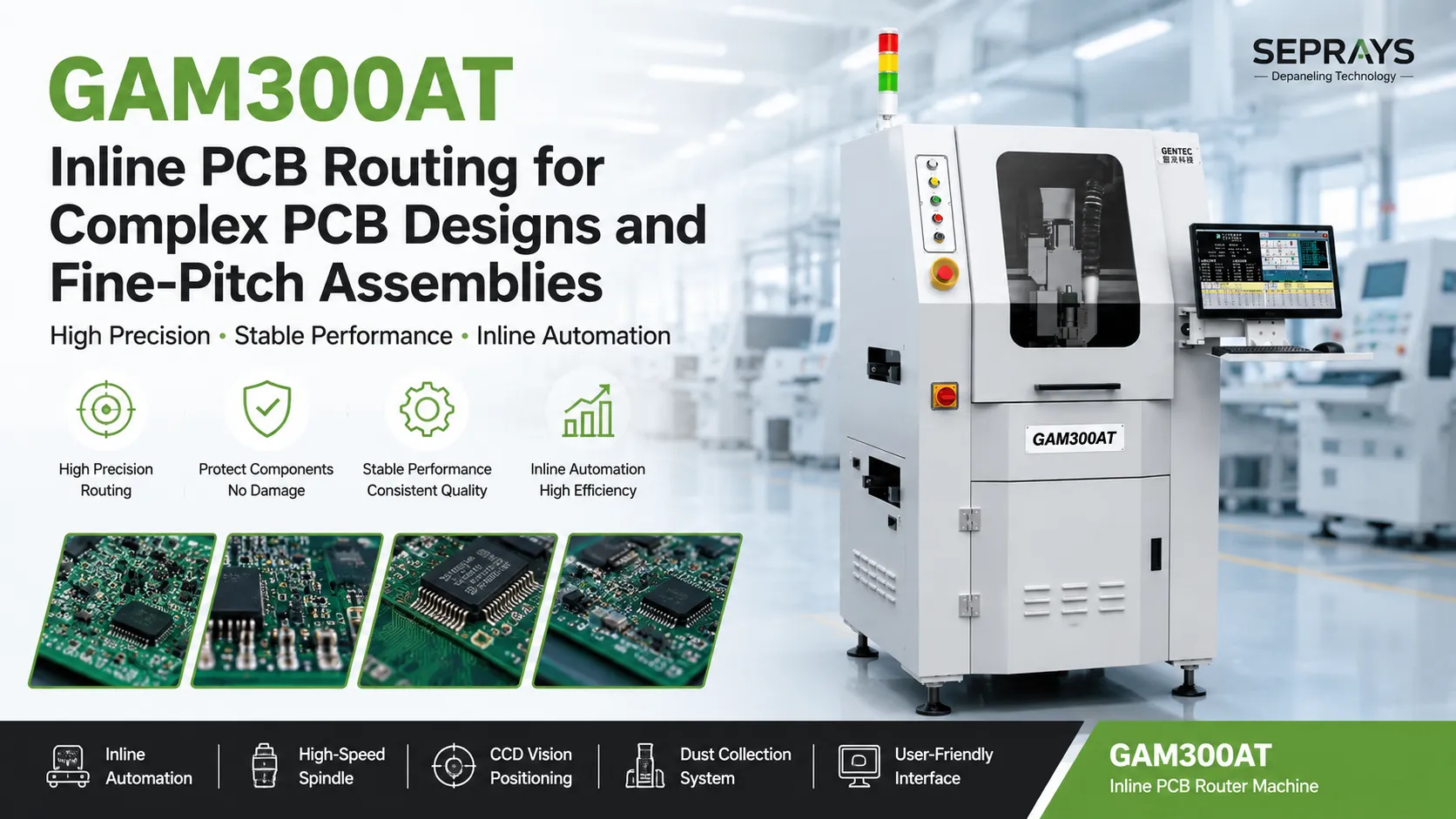
The GAM386AT adopts a bottom-cut routing design that provides stable PCB support during cutting.
Combined with CCD vision positioning, it helps maintain consistent cutting accuracy across different board designs.
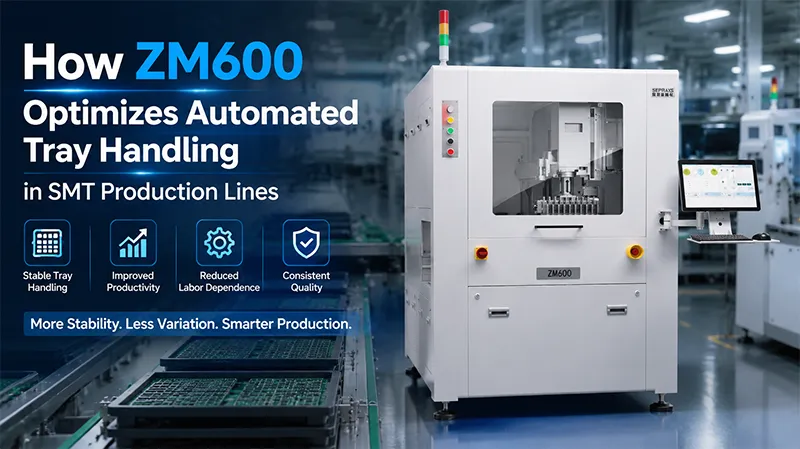
More importantly, when paired with an automatic unloading system such as the ZM640A, the process becomes continuous.
Benefits include:
- Reduced manual intervention
- Fewer production interruptions
- Improved board traceability
- Consistent downstream handling
- Better utilization of labor resources
For manufacturers pursuing Industry 4.0 initiatives, these improvements are often easier to justify than simply investing in a faster router.
💡 A Counterintuitive Lesson From Modern SMT Lines
One of the most common assumptions is that increasing machine speed automatically increases output.
In practice, this is not always true.
A routing machine running 20% faster may create little improvement if downstream handling remains manual.
The real productivity gains often come from eliminating waiting time between processes.
This explains why many manufacturers are focusing on automation between production stages rather than only upgrading individual machines.
🔧 When Does Automation Make Sense?
Integrated depaneling and unloading solutions are particularly effective when:
- Production runs continuously across multiple shifts
- Labor shortages affect operational stability
- Product quality requirements are strict
- Board designs contain sensitive components
- Manufacturers are implementing smart factory initiatives
However, smaller facilities with low production volumes may not immediately achieve the same return on investment.
Equipment selection should always consider production volume, labor availability, product type, and future expansion plans.
📅 Looking Ahead: The Direction of PCB Manufacturing in 2026
Across Asia, Europe, and North America, manufacturers are accelerating investments in automation.
The goal is not simply to reduce labor.
The goal is to build predictable production systems.
As PCB assemblies become more complex and customer quality expectations continue rising, integrated solutions that combine precision depaneling with automated material handling will likely become the standard rather than the exception.
The question is no longer whether automation is necessary.
The question is where automation creates the greatest operational value.
Why Choose Seprays Group?
For more than 30 years, Seprays Group has specialized in PCB and FPC depaneling technologies, helping manufacturers improve precision, efficiency, and production consistency across a wide range of industries.
Our portfolio includes:
- PCB Router Depaneling Machines
- Laser Depaneling Systems
- V-Groove Depaneling Machines
- Punching Depaneling Solutions
- Automated Loading and Unloading Systems
- Complete Inline Automation Solutions
Over the past three decades, Seprays equipment has been trusted by globally recognized manufacturers, including Foxconn, Flextronics, State Grid, Luxshare, Compal, Wistron, China Electronics, Quanta, CRRC, China Aerospace, OPPO, ZTE, and Bosch.
Today, our systems operate in factories throughout China and across international markets, supporting industries such as automotive electronics, telecommunications, consumer electronics, industrial automation, aerospace, and medical devices.
Rather than offering standalone equipment only, we focus on providing practical production solutions that address real manufacturing challenges—from depaneling precision to complete workflow automation.
If you are evaluating ways to improve PCB production efficiency, reduce handling risks, or prepare your factory for future automation requirements, please feel free to contact us.
WhatsApp: +8618929266433
常见问题
1. What is the biggest advantage of combining PCB depaneling and automatic unloading?
The main benefit is workflow continuity. Automated unloading reduces manual handling, minimizes production interruptions, and improves overall line efficiency.
2. Is automated unloading necessary for every SMT factory?
Not necessarily. Facilities with low production volumes may continue using manual handling effectively. Automated unloading becomes more valuable as production volume and labor costs increase.
3. How does a bottom-router PCB depaneling machine improve cutting quality?
A bottom-cut routing structure provides stable support beneath the PCB, helping reduce vibration and mechanical stress during the cutting process.
4. Which industries benefit most from automated PCB depaneling solutions?
Automotive electronics, industrial control systems, telecommunications equipment, medical devices, aerospace electronics, and consumer electronics manufacturers often benefit significantly from automation.
5. How can manufacturers evaluate the ROI of depaneling automation?
Key factors include labor savings, production throughput improvements, reduced handling damage, lower downtime, and future scalability requirements.