.png)
 Chinese
  English
  Spanish
  Japanese
  Korean
  Russian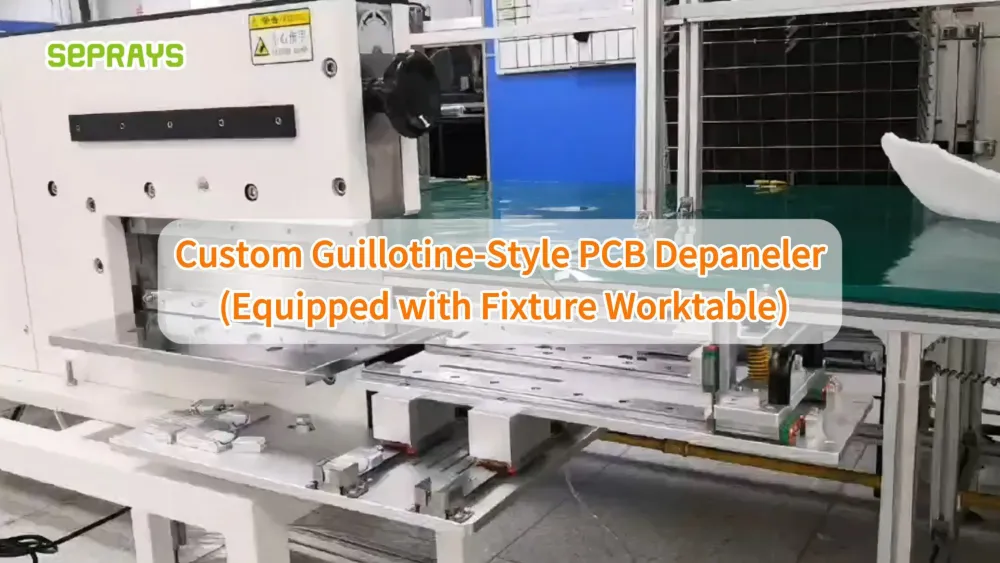
Custom PCB Depaneler is not always about building a completely new machine.
In many production lines, the real requirement is much simpler: make the existing PCB separation process safer, more repeatable, and easier for operators to control.
This becomes especially important when a PCB has a V-groove, sensitive components close to the cutting line, or a production team that needs to run the same operation repeatedly throughout the day.
A recent customer application involving an overseas semiconductor manufacturer is a good example.
The customer was not simply looking for a machine that could cut a PCB. They wanted to reduce the risk of operator error while keeping the separation process stable.
That changed the way the solution was designed.
🔎 The Problem Was Not Simply “How to Cut the PCB”
At first glance, PCB depaneling looks straightforward.
Place the panel.
Align it.
Cut along the V-groove.
Remove the separated board.
But production tells a different story.
When operators repeat the same movement hundreds or thousands of times, small differences become important.
A board may not be positioned correctly.
An operator may put their hand too close to the cutting area.
Different PCB thicknesses may require different settings.
A worn blade can also change the cutting result.
For a semiconductor-related production environment, the concern is not only cycle time.
It is also:
- Operator safety
- Board damage
- Solder-joint stress
- Cutting consistency
- Changeover time
- Training requirements
- Maintenance
- Rework and scrap
This is why customization sometimes starts with the operator’s working method, rather than the machine itself.
🏭 A Real Customer Scenario: Semiconductor Production
In this overseas application, the customer was producing electronic assemblies used in a semiconductor-related manufacturing environment.
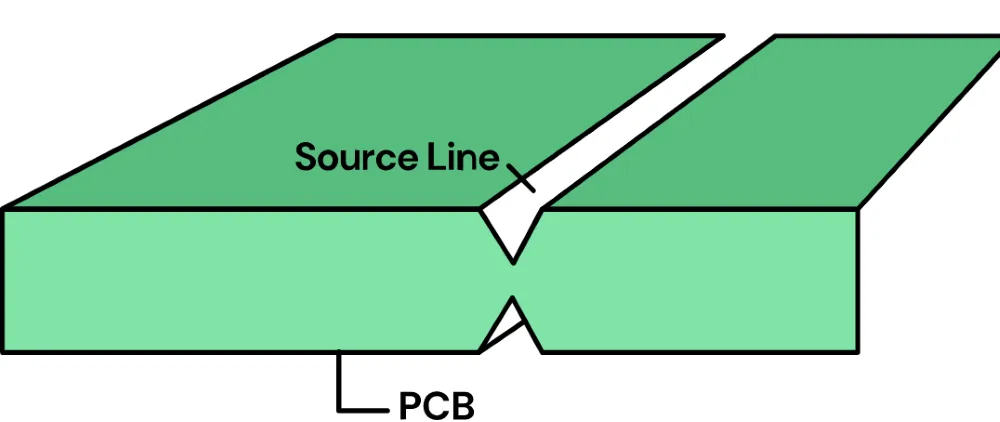
The PCB panels included V-groove separation lines.
The existing process could perform the basic separation task, but there was a practical problem.
The customer wanted to reduce the possibility of an operator making a wrong movement during cutting.
Instead of simply increasing machine speed, the solution focused on controlling the cutting process.
The machine was configured around the customer’s PCB dimensions and operating requirements.
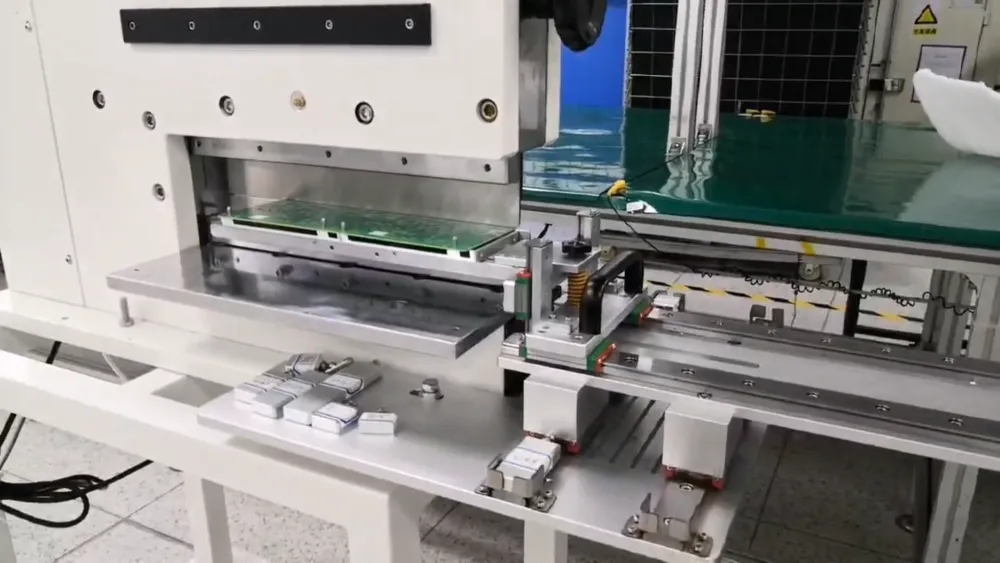
A fixture and positioning structure helped keep the PCB in the correct position.
The cutting mechanism then followed a controlled stroke rather than relying heavily on operator judgment.
This is where a Custom PCB Depaneler can make sense.
The machine is adapted to the actual board and process instead of forcing the factory to adapt its production around a standard machine.
For Seprays Group, the objective in this type of project is not simply “sell a separator.”
It is to understand how the operator handles the board, where mistakes can occur, and which part of the process should be mechanically controlled.
🛡️ Safety Should Be Designed Into the Process
One common mistake is treating safety as an accessory.
For example:
“The operator just needs to be careful.”
That may work for a small number of manual operations.
It becomes less convincing when the same action is repeated throughout an eight-hour shift.
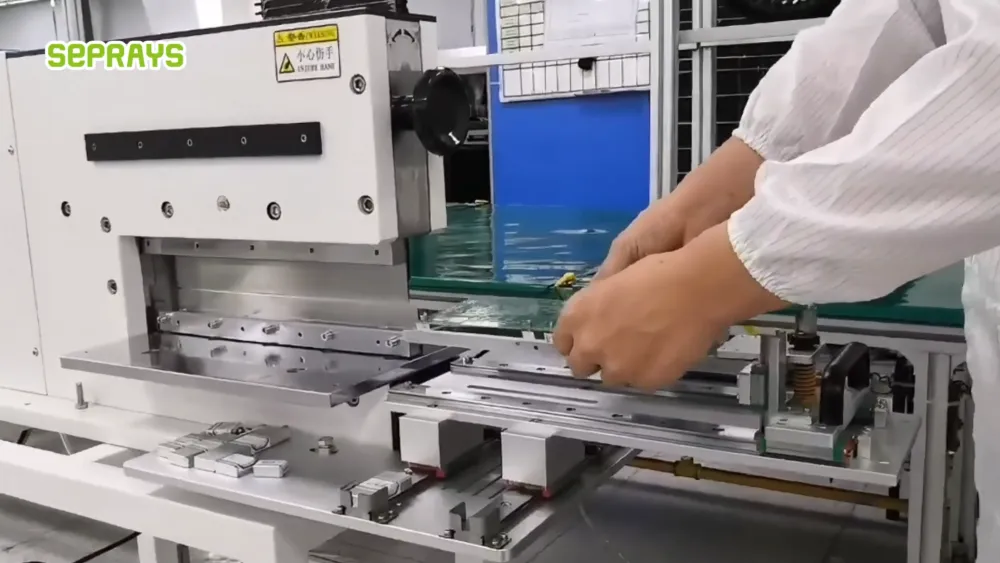
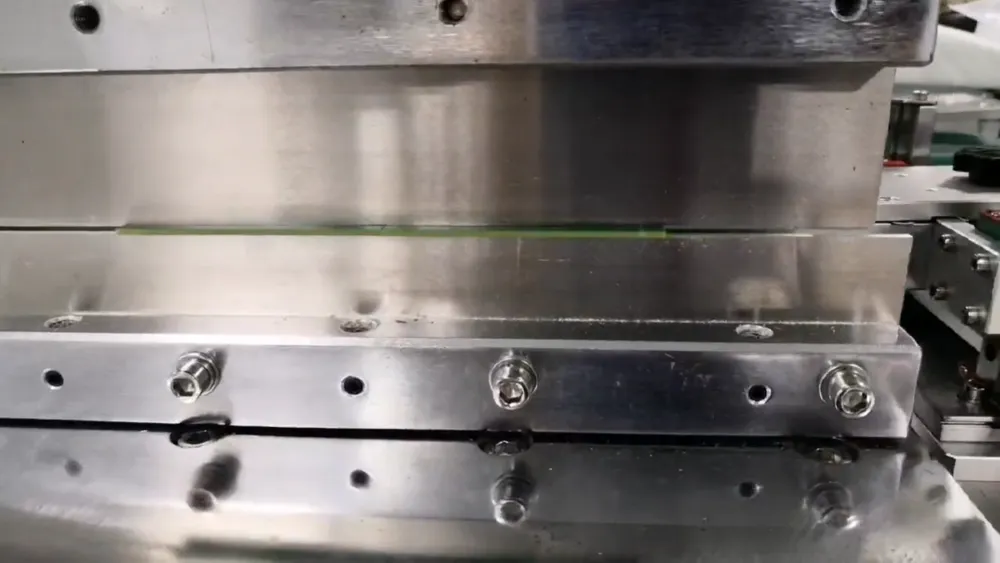
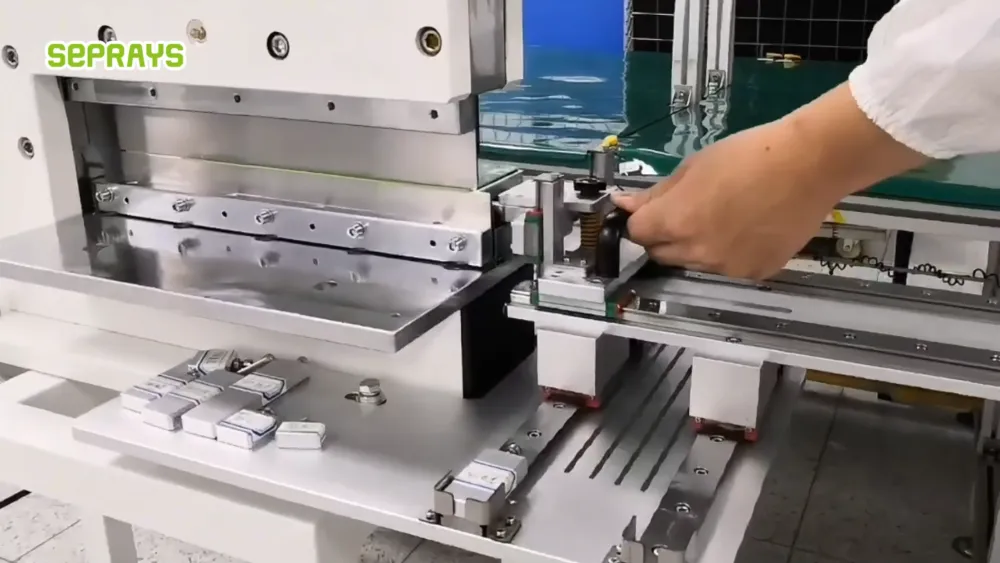
The ZM30-P, for example, uses a pneumatic pulling mechanism with controlled cutting, counting, and automatic shutdown functions. Its safety structure is designed to keep the operator’s hands away from the cutting area during operation.
The principle is simple:
Reduce the number of decisions the operator has to make.
That does not mean removing the operator from the process.
It means making the correct action easier to repeat.
⚙️ Why V-Groove PCB Separation Needs a Different Approach
A V-groove PCB is already designed with a predetermined separation line.
That makes it fundamentally different from a PCB that needs routing around an irregular outline.
For a straight V-groove line, using a router can sometimes be unnecessary.
A guillotine-style or blade-based solution can be more straightforward when the board design and production volume allow it.
The ZM30-P is designed for V-groove PCBs as well as LED aluminum and copper substrates. The published specifications cover cutting lengths of 310, 430, and 530 mm, depending on configuration.
The important point is not the number itself.
It is the match between the machine and the PCB.
If the PCB has:
- A straight V-groove
- Predictable board thickness
- A suitable cutting length
- Adequate clearance around the groove
then a blade-based separator can be a practical solution.
If the PCB has irregular outlines, tabs, internal cutouts, or complex routing requirements, another depaneling method may be more appropriate.
That boundary matters.
📊 Standard Machine vs. Customized Production Setup
| Production consideration | Standard setup | Customized setup |
|---|---|---|
| PCB positioning | General fixture | Board-specific positioning |
| Operator movement | More manual judgment | More controlled |
| Safety consideration | Depends on operation | Designed around actual workflow |
| Board changeover | May require adjustment | Can be optimized for target products |
| V-groove compatibility | General | Matched to groove and thickness |
| Training | Basic machine training | Training based on actual workflow |
| Production consistency | Operator-dependent | More repeatable |
| Initial investment | Usually lower | May be higher |
| Long-term process control | Limited | Greater |
The last two rows are worth discussing.
Customization does not automatically mean lower cost.
In fact, the initial equipment cost may be higher.
The question is whether that additional investment solves a real production problem.
💰 The Cost Is More Than the Machine Price
A PCB separator should not be evaluated only by its quotation.
A more realistic calculation is:
Machine + tooling + labor + maintenance + downtime + scrap + rework
Imagine an operator spends only a few extra seconds positioning each PCB.
That sounds insignificant.
Now multiply it by several thousand boards.
The number changes.
The same applies to damaged boards.
If a small percentage of boards require inspection or rework because of inconsistent separation, the production cost can quickly exceed the difference between two machine quotations.
There is also a less obvious cost:
operator attention.
A process that requires constant manual correction consumes human attention even when the machine itself is inexpensive.
That is one reason customers sometimes choose customization even when a standard machine technically works.
🧪 Test the Actual PCB Before Finalizing the Solution
This is probably the most practical lesson from customer projects.
Do not select a depaneling method only from a machine specification sheet.
Test the actual PCB.
Check:
- PCB material.
- Board thickness.
- V-groove depth.
- V-groove position.
- Component clearance.
- Cutting length.
- Required throughput.
- Edge quality.
- Board stress.
- Operator workflow.
For example, the ZM30-P lists a cutting thickness range of 0.1–2.0 mm for boards with V-grooves and supports different machine sizes for different cutting lengths. The manufacturer also states that the cutter design keeps depaneling stress below 400 microstrains.
But these numbers should still be treated as starting points for evaluation.
Your PCB is the final test.
🧠 An Unexpected Conclusion: Faster Is Not Always Better
It is tempting to think that the best depaneling solution is the fastest one.
In real production, that is not always true.
A faster cutting cycle is useful only if the following steps can keep up.
If the operator needs more time to position the board, the actual throughput may not improve.
If faster cutting increases the risk of board damage, the apparent productivity gain may disappear in rework.
And if the machine requires frequent adjustment between products, a high theoretical speed may have little practical value.
For some factories, stable and repeatable operation is more valuable than maximum cutting speed.
That is particularly relevant for semiconductor and high-value electronics manufacturing, where one damaged assembly can cost much more than several seconds of production time.
🔄 When a Custom Solution Makes Sense — and When It Doesn’t
A customized setup is worth considering when:
- The PCB design is relatively stable.
- The same products run repeatedly.
- Operator safety is a concern.
- The board requires specific positioning.
- Component clearance is limited.
- Production volume justifies process optimization.
- The customer needs integration with existing handling equipment.
But customization may not be necessary when:
- Production volume is very low.
- PCB designs change every few days.
- The board is a simple standard V-groove design.
- Operators already have a stable and safe workflow.
- The additional fixture or automation provides little measurable benefit.
This is an important boundary.
Not every PCB needs a customized machine.
Sometimes the simplest solution is the correct one.
🌍 Why This Matters for Electronics Manufacturing in 2026
Electronics manufacturing continues to move toward higher product variety, tighter quality requirements, and more controlled production processes.
At the same time, manufacturers are paying closer attention to operator safety and process traceability.
That does not mean every depaneling station needs to become fully automated.
There is a useful middle ground:
Mechanically control the risky part of the operation while keeping the overall process simple.
For some V-groove PCB applications, that can provide a better balance between investment, safety, and production consistency than jumping directly to a complex automated line.
🏆 Why Choose Seprays Group?
Seprays Group has been focused on PCB/FPC depaneling technology for more than 30 years, developing equipment around different PCB structures, materials, and production requirements.
Its portfolio covers milling-cutter depanelers, laser depanelers, V-groove depanelers, punching depanelers, and automated PCB handling systems. This allows the solution to be selected according to the actual PCB rather than forcing every application into one cutting method.
Over the years, Seprays Group equipment has been used by and supplied to well-known manufacturers and industrial customers, including Foxconn, Flextronics, State Grid, Luxshare, Compal, Wistron, China Electronics, Quanta, CRRC, China Aerospace, OPPO, ZTE and Bosch, with installations and applications across China and international markets.
For projects such as the semiconductor-related customer application discussed here, the focus is not simply on machine specifications.
It is on understanding the PCB, the operator workflow, production volume, safety requirements, and long-term operating cost.
That is often where the difference between a machine that can cut a PCB and a machine that fits a production process becomes clear.
If you are evaluating a V-groove PCB separation process, send us your PCB drawings, samples, or production requirements. Seprays Group can help assess whether a standard machine, customized fixture, or a different depaneling method is more appropriate for your application.
View the ZM30-P PCB Guillotine Separator
❓ FAQ
1. What type of PCB is suitable for the ZM30-P?
The ZM30-P is designed mainly for V-groove PCBs and can also handle LED aluminum and copper substrates within the applicable specifications.
2. Is a guillotine-style depaneler suitable for every PCB?
No. It is most suitable for boards with appropriate straight separation lines, particularly V-groove designs. Irregular PCB outlines may require routing, sawing, or laser depaneling instead.
3. Why customize the fixture if the machine already works?
A customized fixture can improve positioning consistency and reduce operator-dependent mistakes. It is particularly useful when the PCB has a fixed production design or sensitive components near the separation area.
4. How should PCB depaneling equipment be evaluated?
Look beyond cutting speed. Evaluate board stress, edge quality, operator safety, changeover time, maintenance, scrap rate, and actual throughput with your own PCB samples.
5. Can Seprays recommend a different depaneling method?
Yes. Depending on the PCB structure, Seprays Group provides milling, laser, V-groove, punching, and automated handling solutions. The appropriate method depends on the board material, outline, groove structure, components and production requirements.