.png)
 Chinese
  English
  Spanish
  Japanese
  Korean
  Russian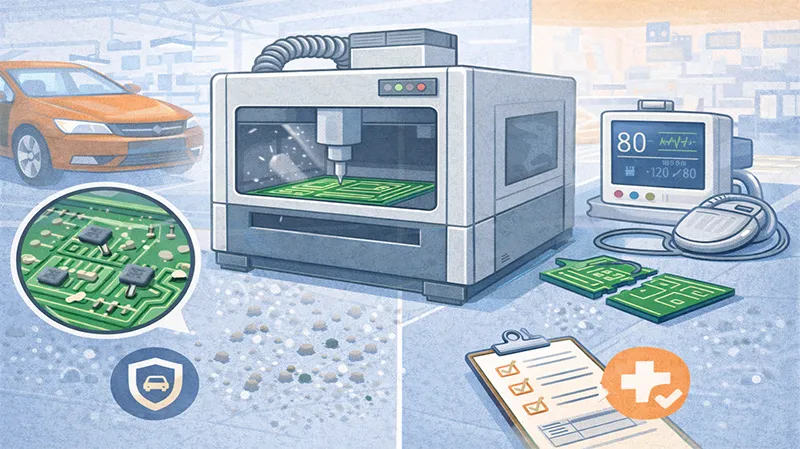
Dust-free PCB Depaneling Machine solutions have become a critical topic in high-reliability electronics manufacturing, especially in automotive and medical PCB assembly. In recent years, global SMT lines have increasingly recognized that depaneling is no longer a “last step,” but a quality-defining process that directly affects reliability, compliance, and long-term product performance.
⚙️ Understanding Why Dust Control Matters in Critical Electronics
In automotive and medical applications, even microscopic contamination can cause long-term risks. PCB dust generated during depaneling may appear harmless, but it can introduce conductive particles, weaken solder joints, or compromise insulation resistance.
From discussions with Tier-1 automotive suppliers and medical OEMs, one common concern emerges: dust is difficult to detect immediately, yet its impact often appears months or years later in the field. This shifts the depaneling from a productivity topic to a lifecycle reliability issue.

🧪 User Pain Points Observed on Production Floors
Manufacturing teams often raise similar challenges:
- Invisible debris settling under fine-pitch components
- Post-depaneling cleaning adds cost and process time
- Unstable quality results between shifts or machines
- Difficulty meeting audit requirements for medical traceability
In medical PCB assembly, compliance teams frequently require evidence that dust exposure is minimized and controlled. Traditional open depaneling methods make this difficult to document.

🧩 Cost Analysis: Prevention vs. Correction
A dust-free depaneling approach does require higher upfront investment. Enclosed structures, vacuum extraction systems, and sealed cutting zones add complexity to the process. However, experience from automotive lines shows that these costs are often offset by:
- Reduced rework and scrap rates
- Lower cleaning and inspection overhead
- Fewer customer complaints and warranty claims
When analyzed over a full production lifecycle, the cost per board often decreases rather than increases.

🚗 Case Insight: Automotive Electronics Line in Europe
One European automotive supplier transitioned from a conventional router to a dust-controlled depaneling system after recurring insulation resistance failures during climate testing. Post-implementation, defect rates dropped measurably, and internal audits became easier due to clearer process documentation and repeatability.
The lesson here was not about speed, but about process stability and durability under harsh operating conditions.

🏥 Medical PCB Assembly: A Different Risk Profile
Medical manufacturers emphasize risk avoidance over throughput. Engineers involved in the production of implantable or diagnostic devices highlight that dust-free depaneling simplifies validation and supports long-term regulatory confidence.
In this context, depaneling becomes part of the quality system rather than just an equipment choice.
🛠️ Practical Solutions and Industry Best Practices
Based on shared industry experience, effective dust-free depaneling typically includes:
- Fully enclosed cutting areas
- Active dust extraction at the source
- Controlled airflow design to avoid particle spread
- Stable mechanical structures to reduce micro-vibration
Equally important is operator training and routine system verification.
💬 Opening the Discussion
Is dust-free depaneling always necessary? Not for every product. But for automotive and medical electronics, the trend is clear: prevention is becoming the preferred strategy over downstream correction.
How manufacturers define “acceptable risk” will likely shape depaneling technology choices over the next decade.
Why Choose Seprays Group?
Seprays Group works closely with global manufacturers to address real-world depaneling challenges, focusing on industrial quality, durability, and long-term process stability rather than short-term gains.
If your production involves high-reliability PCBs and you are evaluating dust-free depaneling approaches, please feel free to contact us for technical discussion and experience sharing.
WhatsApp: +8618929266433
E-mail: sales@seprays.com