.png)
 Chinese
  English
  Spanish
  Japanese
  Korean
  Russian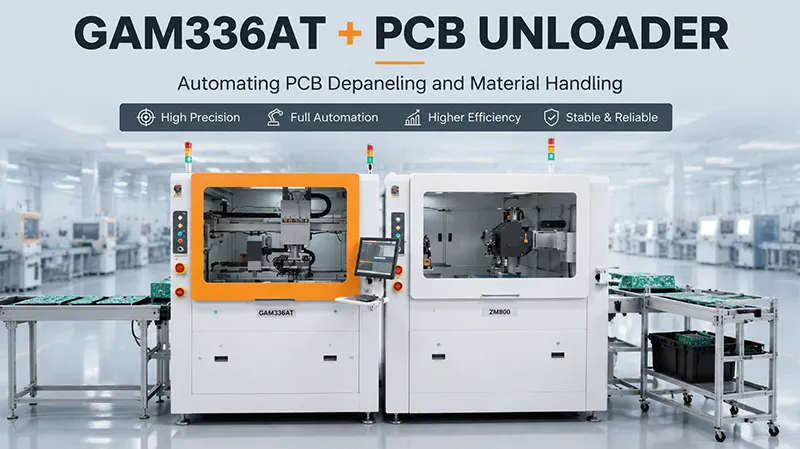
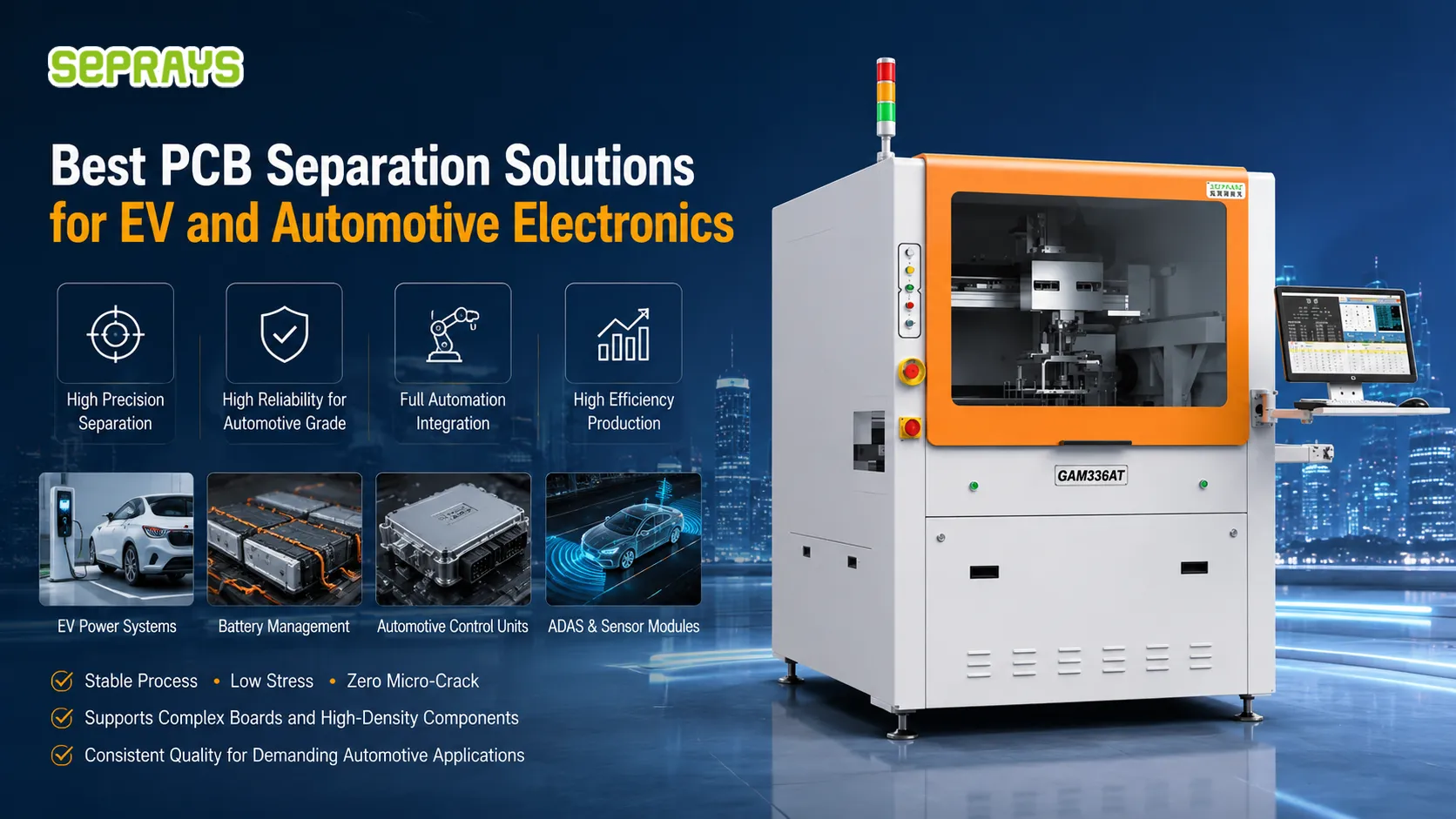
GAM336AT + PCB Unloader is designed for consumer electronics manufacturers that need more than just accurate PCB separation. In many modern factories, the real production challenge does not stop at cutting the PCB.
It continues with:
- How to move finished boards efficiently
- How to reduce manual handling
- How to maintain stable production flow
- How to prepare for future automation
As consumer electronic products become smaller, smarter, and released faster, manufacturers are under increasing pressure to improve both quality and efficiency.
A depaneling process that works well for small production volumes may become a bottleneck when demand increases.
This is where automated PCB routing and material handling begin to create measurable value.
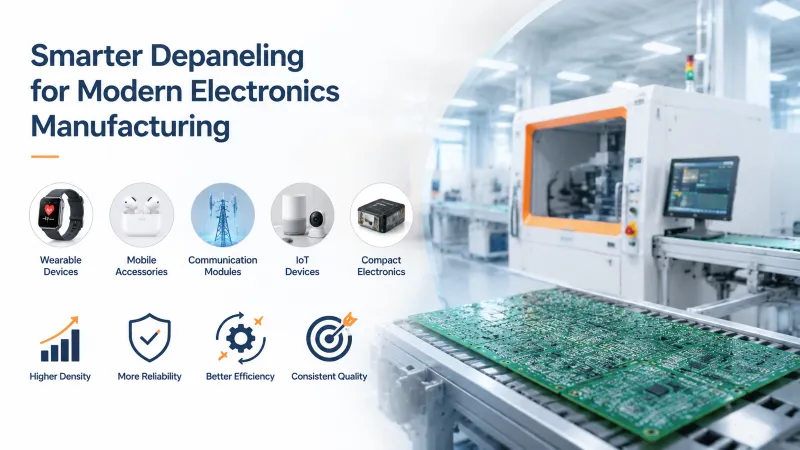
📱 Why Consumer Electronics Manufacturing Needs Smarter Depaneling
Consumer electronics production has changed significantly in recent years.
Products such as:
- Smart wearable devices
- Mobile accessories
- Communication modules
- IoT devices
- Compact electronic products
are becoming smaller while containing more functions.
This creates several manufacturing challenges.
PCB designs now often include:
- Higher component density
- Smaller board outlines
- More sensitive components
- Complex PCB shapes
- Shorter production cycles
A traditional manual loading and unloading process may still work for low-volume production.
However, when monthly output increases, manufacturers often face new problems.
Operators spend more time handling panels.
Production lines become harder to balance.
Quality consistency becomes more difficult to maintain.
The challenge is no longer only cutting the PCB.
It is creating a stable and repeatable production workflow.
⚠️ Common Problems in High-Volume PCB Production
Many consumer electronics manufacturers experience similar issues when production scales.
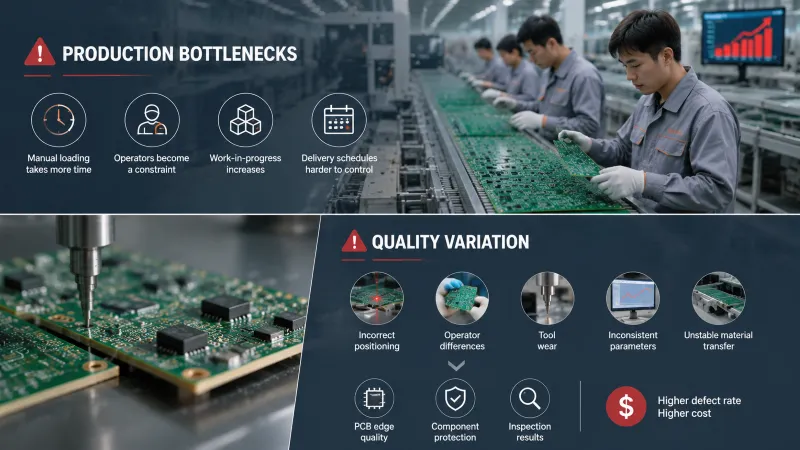
Production Bottlenecks
A typical situation:
A factory successfully produces several thousand PCB panels per month.
Then customer demand increases suddenly.
The original process starts showing limitations:
- Manual loading takes more time
- Operators become a production constraint
- Work-in-progress increases
- Delivery schedules become harder to control
The equipment itself may still perform well.
The problem is the surrounding process.
Quality Variation
PCB depaneling quality depends on many factors.
For example:
- Incorrect positioning
- Operator handling differences
- Tool wear
- Inconsistent parameters
- Unstable material transfer
Even small variations can influence:
- PCB edge quality
- Component protection
- Final inspection results
In consumer electronics, appearance and reliability are both important.
A small increase in defect rate can create high costs when production volume is high.
⚙️ How GAM336AT + PCB Unloader Creates a More Efficient Workflow
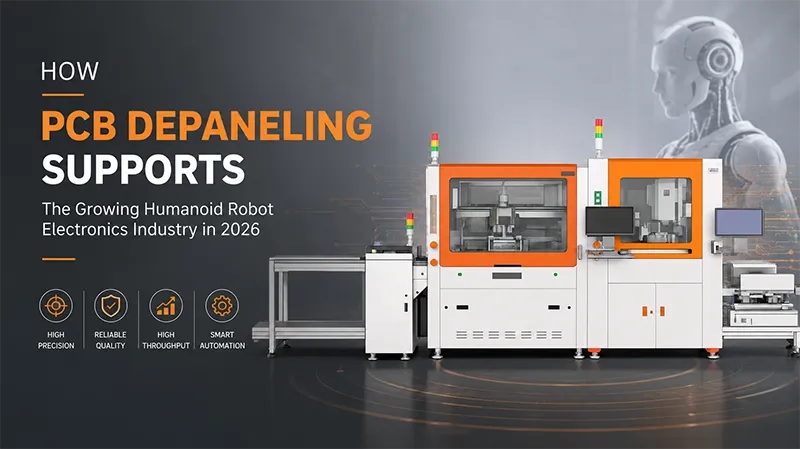
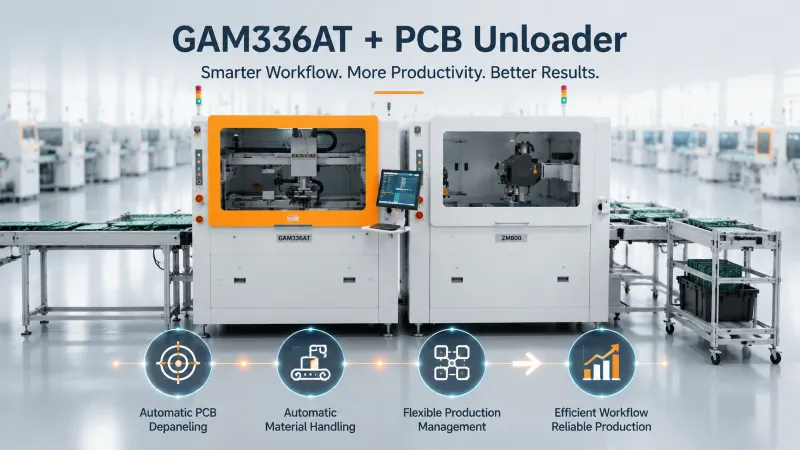
The GAM336AT + PCB Unloader solution combines automatic PCB routing with automated material handling to improve production continuity.
The system is designed for manufacturers that require:
- Higher production efficiency
- Stable cutting accuracy
- Reduced manual intervention
- Better line coordination
Key capabilities include:
Automatic PCB Depaneling
The routing process is controlled through precise motion systems and intelligent programming.
This helps maintain consistent cutting quality across different PCB models.
Automatic Material Handling
After PCB separation, the unloading system efficiently transfers finished boards.
This reduces repeated manual operations and supports continuous production.
Flexible Production Management
For factories producing multiple consumer electronic products, automation helps shorten changeover time and improve equipment utilization.
The goal is not simply faster movement.
The goal is a more predictable manufacturing process.
🔍 Why Automation Is Not Always About Maximum Speed
A common misunderstanding is:
“Higher automation always means higher productivity.”
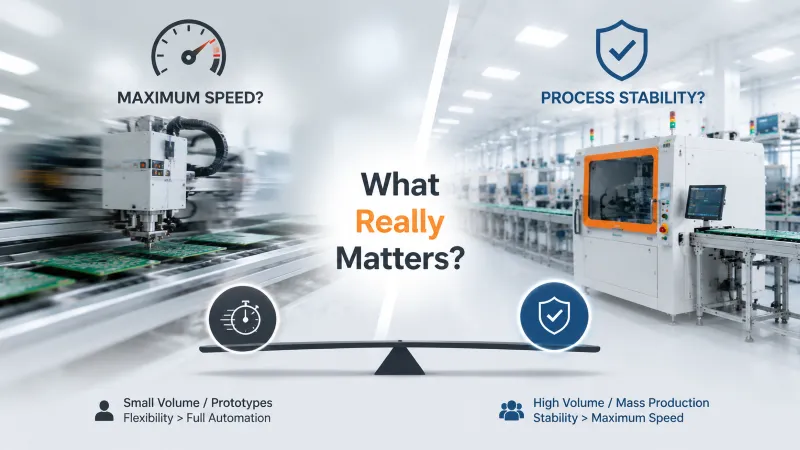
In reality, automation creates value only when it is matched to the production environment.
For example:
A factory producing only a few customized prototypes may not need a fully automated solution.
But a factory producing tens of thousands of PCB panels monthly may benefit significantly.
The right question is not:
“How fast can the machine run?”
The better question is:
“How stable is the entire production process?”
📊 Comparing Different PCB Production Approaches
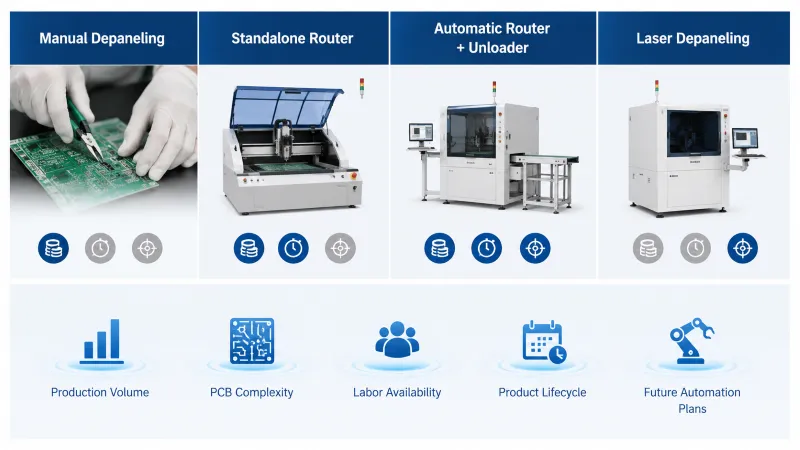
| Solution | Advantages | Limitations | Suitable Applications |
|---|---|---|---|
| Manual Depaneling | Low investment | Low efficiency, higher labor dependency | Small volume production |
| Standalone Router Machine | Flexible and accurate | Requires manual handling | Medium production volume |
| Automatic PCB Router + Unloader | Higher efficiency, stable workflow | Higher initial investment | High-volume consumer electronics |
| 激光分板 | Minimal mechanical stress | Higher equipment cost | Ultra-sensitive high-value PCBA |
There is no single solution suitable for every manufacturer.
The best choice depends on:
- Production volume
- PCB complexity
- Labor availability
- Product lifecycle
- Future automation plans
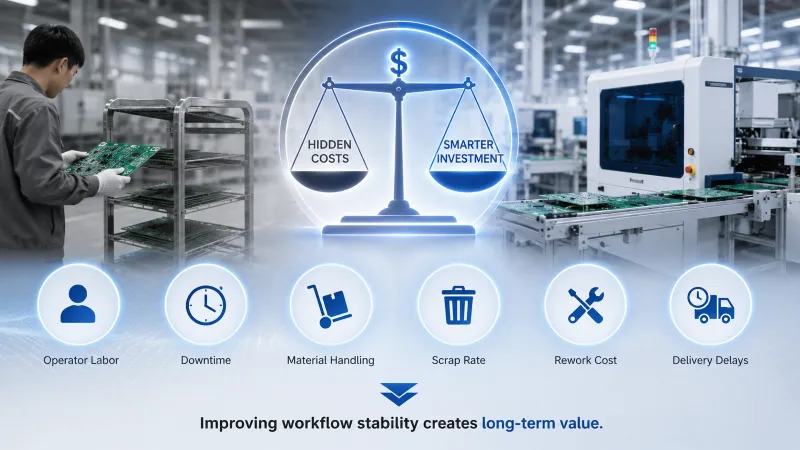
💰 Understanding the Real Cost of Production
Many purchasing decisions focus only on machine price.
However, experienced manufacturing teams usually evaluate the total production cost.
This includes:
- Operator labor
- Production downtime
- Material handling efficiency
- Scrap rate
- Rework cost
- Delivery delays
For example:
A factory may save money by choosing manual handling.
But if operators spend several hours every day transferring PCBs between processes, the hidden cost can become significant over time.
Improving workflow stability often creates more value than simply reducing equipment investment.
🌍 Case Example: Overseas Electronics Manufacturer Improves Production Flow
A semiconductor-related electronics manufacturer in Europe was producing communication and control modules for consumer applications.
The company already had stable SMT and inspection processes.
However, during production expansion, engineers noticed several challenges:
- Increasing operator workload
- Longer transfer time between processes
- Difficulty maintaining consistent output during peak demand
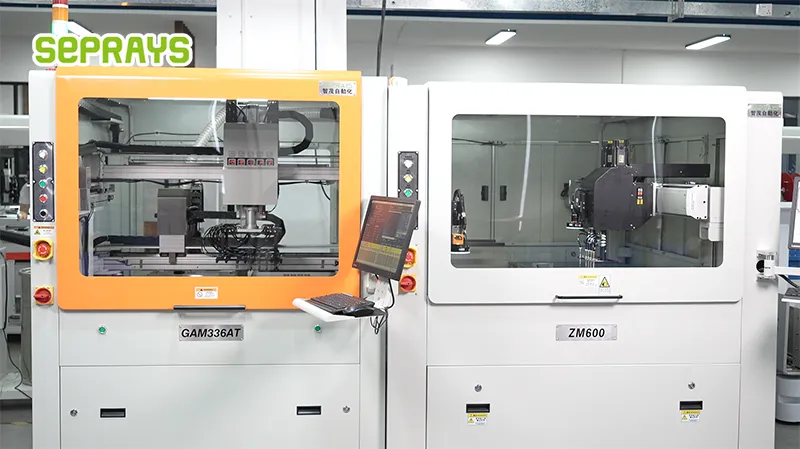
After reviewing the complete workflow, the company introduced a Seprays GAM336AT + PCB Unloader solution for selected production lines.
The improvement focused not only on cutting performance but also on material flow.
After process optimization:
- Manual handling steps were reduced
- Production continuity improved
- PCB transfer became more consistent
- Operators could focus on higher-value tasks
The key lesson was clear:
Automation is not only about replacing labor.
It is about creating a more stable manufacturing system.
🧠 Important Factors Engineers Should Evaluate Before Automation
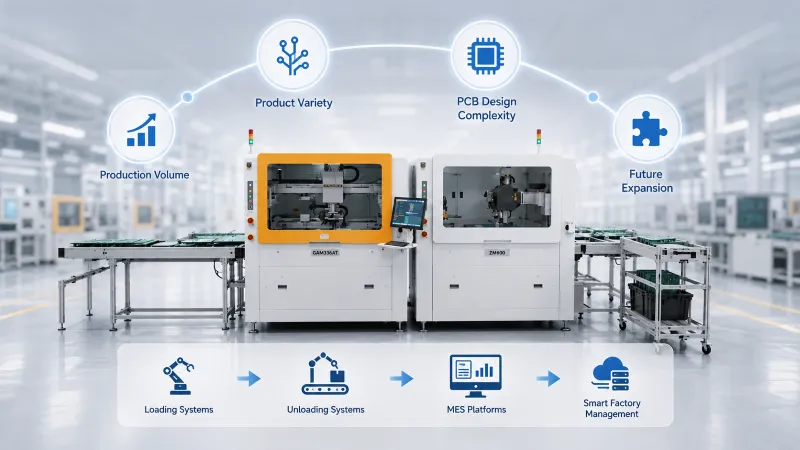
Before investing in an automated PCB depaneling solution, manufacturers should consider:
产量
High-volume factories usually achieve faster returns from automation.
Product Variety
Factories producing many PCB models need flexible programming and quick changeover.
PCB Design Complexity
Boards with sensitive components require accurate positioning and stable cutting control.
Future Expansion
Equipment should support future integration with:
- Loading systems
- Unloading systems
- MES platforms
- Smart factory management
A good production solution should solve today’s problems while preparing for tomorrow’s requirements.
🌱 The Future of Consumer Electronics Manufacturing
Consumer electronics will continue moving toward:
- Smaller devices
- More functions
- Faster product updates
- Higher quality expectations
This trend means manufacturing processes must become more intelligent.
PCB depaneling is no longer an isolated operation.
It is becoming part of the complete production ecosystem.
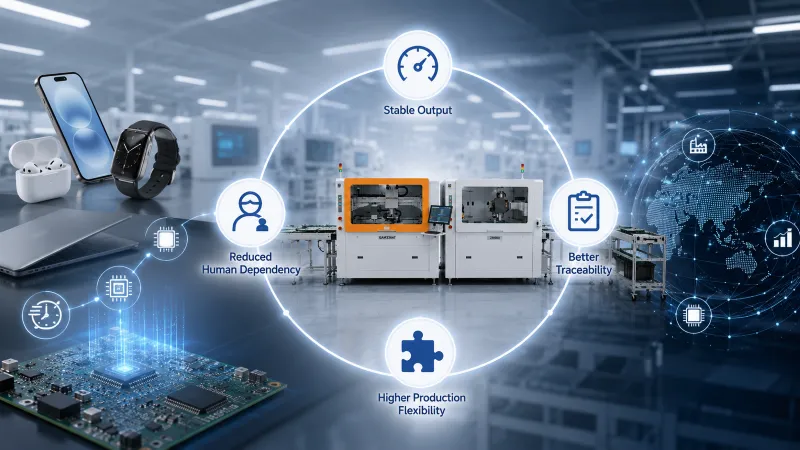
The future focus will not only be faster cutting.
It will be:
- Stable output
- Reduced human dependency
- Better traceability
- Higher production flexibility
Why Choose Seprays Group?
With more than 30 years of experience, Seprays Group has been dedicated to PCB/FPC depaneling technology, helping global manufacturers improve production efficiency, reliability, and automation capability.
Seprays Group has been dedicated to PCB/FPC depaneling technology for over three decades, providing a complete range of solutions, including milling-cutter depanelers, laser depanelers, V-groove depanelers, punching depanelers, and automated handling systems. Our equipment is trusted by leading manufacturers, including Foxconn, Flextronics, State Grid, Luxshare, Compal, Wistron, China Electronics, Quanta, CRRC, China Aerospace, OPPO, ZTE, and Bosch. These solutions are used in factories across China and worldwide, supporting industries such as consumer electronics, automotive electronics, semiconductors, medical electronics, and industrial automation.
Beyond equipment supply, Seprays works with customers to understand their PCB designs, production requirements, automation goals, and future expansion plans.
From standalone depaneling machines to integrated automated production solutions, Seprays focuses on helping manufacturers build efficient and reliable manufacturing processes.
If you are looking for an automated PCB depaneling and handling solution for consumer electronics production, please feel free to contact us.
WhatsApp: +8618929266433
常见问题
1. What is the advantage of GAM336AT + PCB Unloader compared with a standard PCB router?
The GAM336AT combined with a PCB Unloader improves production flow by reducing manual handling steps while maintaining precise PCB routing performance.
2. Is the GAM336AT suitable for high-volume consumer electronics production?
Yes. It is designed for manufacturers that need stable production efficiency, consistent PCB separation quality, and improved automation capability.
3. Can the system handle multiple PCB models?
Yes. Flexible programming allows manufacturers to process different PCB designs while reducing setup time during product changes.
4. Does automation reduce PCB manufacturing costs?
Automation can help reduce labor dependency, handling time, production interruptions, and quality variation. The actual benefit depends on production volume and workflow conditions.
5. How should manufacturers decide whether to upgrade to an automatic depaneling solution?
Manufacturers should evaluate production volume, PCB complexity, labor requirements, future automation plans, and overall manufacturing costs instead of comparing equipment price alone.