.png)
 Chinese
  English
  Spanish
  Japanese
  Korean
  Russian
The laser depaneling machine has become one of the most fascinating tools in the electronics manufacturing industry.
Its emergence represents not just a new cutting method but a shift toward precision, flexibility, and cleaner production.
In a world where PCBs are getting thinner and components are packed closer together, manufacturers are asking:
Can laser depaneling replace traditional cutting technologies entirely?
Let’s explore how this high-tech player is changing the rules of PCB depaneling.

💡 What Exactly Is a Laser Depaneling Machine?
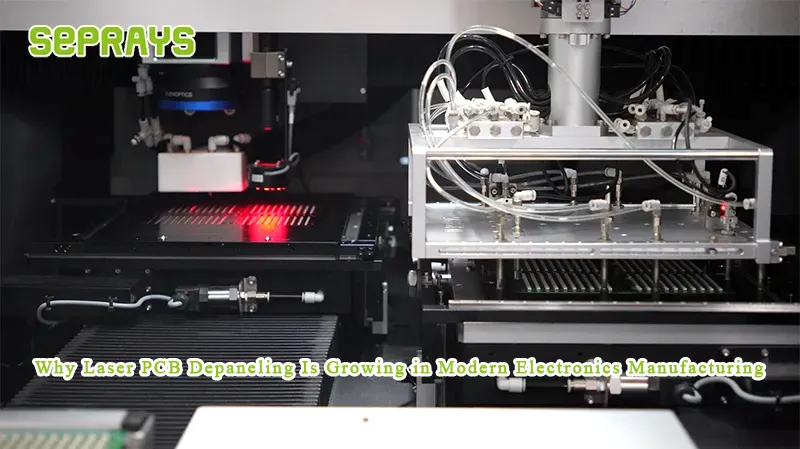
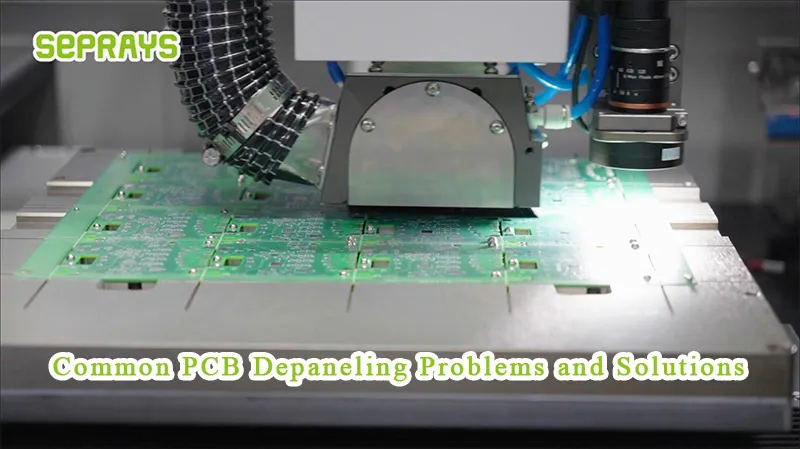
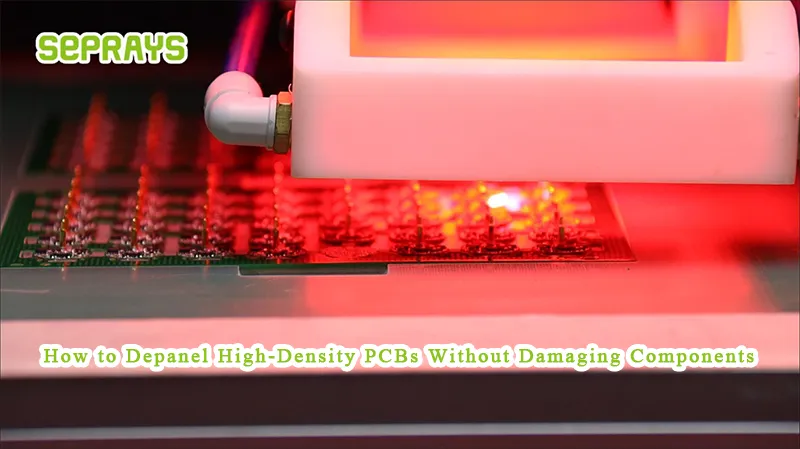
A laser depaneling machine uses a focused laser beam to separate printed circuit boards without direct contact.
Instead of using mechanical force or blades, it vaporizes the substrate material along a programmed path.
The process can handle a wide variety of PCB types — from FR4 and polyimide to flexible and rigid-flex materials.
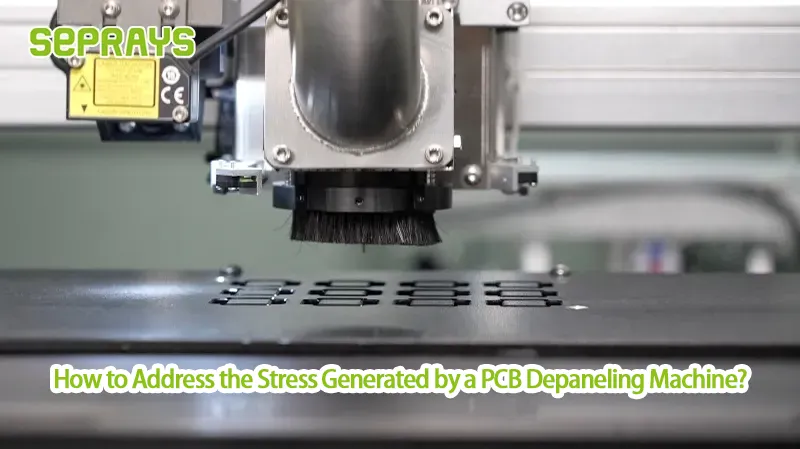
Because no cutting tool touches the board, there’s minimal mechanical stress, meaning components near the cut line remain completely safe.
⚙️ How It Works
Laser depaneling operates through a combination of precision optics, motion control, software algorithms.
High-speed galvanometers direct the beam with sub-millimeter accuracy, following digital patterns from CAD files.
This makes it possible to cut curves, intricate shapes, and tight component spacing that would be difficult — or impossible — for saw or router machines.
The precision comes with another bonus: the edge quality.
With optimized parameters, laser cuts can achieve smooth, burr-free edges that require no post-processing.
🚀 Key Advantages of Laser Depaneling
✅ 1. Zero Mechanical Stress
Because there’s no contact cutting, the risk of micro-cracks or stress-induced damage is nearly eliminated.
This is especially important for fine-pitch assemblies and sensitive components.
✅ 2. High Precision and Clean Edges
Laser systems can reach micron-level accuracy, providing clean edges and tight tolerances without burrs or residue.
✅ 3. Flexibility for Complex Designs
Unlike saw blades or router machines, the laser depaneling machine can handle irregular shapes, curves, and mixed-material PCBs.
✅ 4. Minimal Dust and Contamination
The process produces less particulate contamination, which is ideal for cleanroom or optical component manufacturing environments.
✅ 5. Digital Control and Automation
Recipe-based operation allows easy product switching and integration with automated handling systems.
⚠️ The Limitations Worth Discussing
While it sounds perfect, the laser approach has some challenges worth noting:
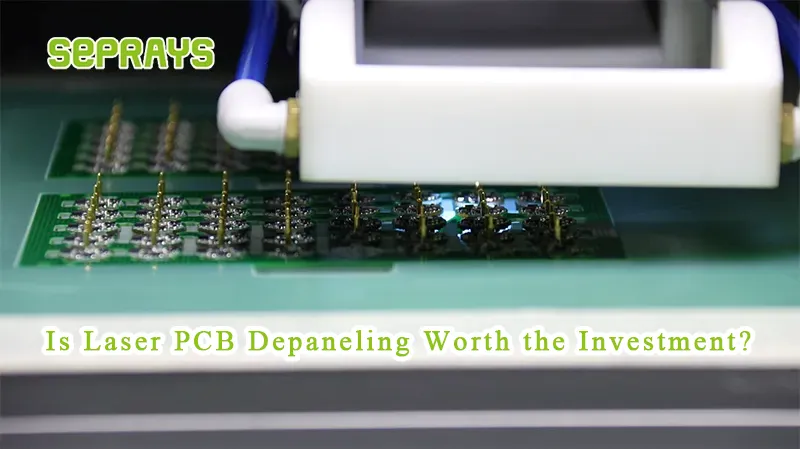
❌ 1. Higher Initial Investment
Laser systems tend to cost more upfront than mechanical machines.
However, lower maintenance and tool replacement costs can balance this over time.
❌ 2. Thermal Sensitivity
Improper settings may cause local heating or discoloration.
That’s why process tuning and experience are crucial for optimal results.
❌ 3. Slower for Simple Straight Cuts
For large-volume, straight-line production (like V-groove panels), saw or router methods can still be faster and more economical.
These points don’t make laser depaneling less valuable — they just define where it fits best.
🧠 Ideal Applications
Laser depaneling shines in industries that demand precision, flexibility, and low stress, such as:
- Medical electronics
- Aerospace and defense systems
- Wearable and flexible circuits
- Miniaturized consumer electronics
It’s not about replacing older technologies, but complementing them — especially when product design complexity rises.
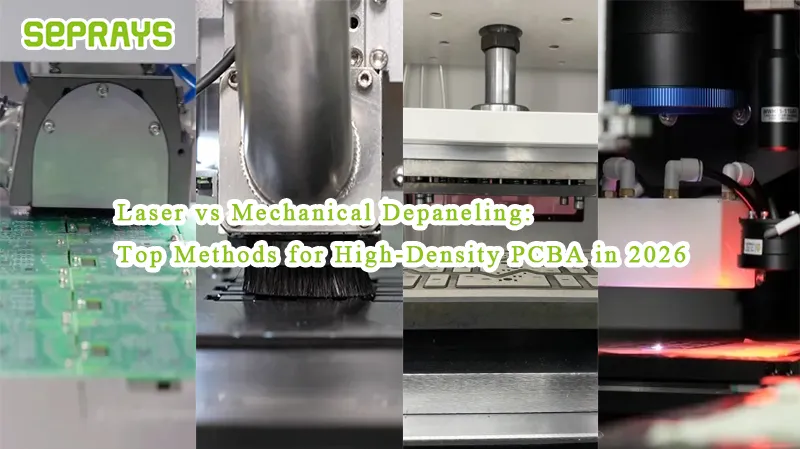
🔍 Comparison: Laser vs. Router vs. Saw
| 功能 | Laser | Router | Saw |
|---|---|---|---|
| Contact Type | Non-contact | Mechanical | Mechanical |
| 精密 | ★★★★★ | ★★★★☆ | ★★★☆☆ |
| Stress Level | ★★★★★ | ★★★★☆ | ★★☆☆☆ |
| Dust Control | ★★★★★ | ★★★☆☆ | ★★☆☆☆ |
| Investment | ★★☆☆☆ | ★★★★☆ | ★★★★★ |
This table reflects a simple truth: each depaneling method serves its own purpose.
Laser isn’t always the fastest or cheapest, but it’s often the cleanest, safest, and most adaptable.
🌍 A Step Toward Smart Manufacturing
Laser depaneling fits perfectly into Industry 4.0 environments.
It supports automation, data monitoring, and adaptive control, allowing manufacturers to achieve consistent results across shifts and batches.
As sustainability becomes more important, the laser’s clean, low-waste process also helps reduce material loss and dust pollution.
This makes it not only a high-tech choice but also an environmentally conscious one.
🌟 Why Choose Seprays Group?
Since 1993, Seprays Group has been deeply committed to advancing PCB/FPC depaneling technology. With over 32 years of expertise, we provide a comprehensive range of solutions — including laser depaneling machines, 铣刀depanelers, V-槽depanelers, punching depanelers, automated handling systems — to meet the diverse needs of modern electronics manufacturing.
Our equipment is trusted by world-leading enterprises such as Foxconn, Flextronics, State Grid, Luxshare, Compal, Wistron, China Electronics, Quanta, CRRC, China Aerospace, OPPO, ZTE, and Bosch, supporting production lines not only across China but also in factories around the globe.
Seprays is ISO9001,ISO14001,并ISO45001认证, and our CE-certified machines feature patented dust-control and precision motion systems to ensure clean, reliable, and stress-free cutting performance.
With a global service network in over 31 countries, Seprays combines advanced engineering, stable performance, and responsive after-sales support to help manufacturers achieve higher yields, lower maintenance costs, and smoother production flow.
When precision, reliability, and innovation matter most — choose Seprays Group, your long-term partner in intelligent PCB depaneling.
If you’re exploring the next step in depaneling technology, we’d love to share our experience and insights with you.
WhatsApp: +86 189 2926 6433
E-mail: sales@seprays.com