.png)
 Chinese
  English
  Spanish
  Japanese
  Korean
  Russian
Multi-Blade Depaneling Machine technology is rapidly changing the way manufacturers approach PCB separation. However, choosing between a multi-blade and a single-blade depaneling machine can be confusing, especially when balancing efficiency, precision, and operational costs. This article explores the practical differences, performance comparisons, and key considerations to help SMT professionals make an informed decision.
🧩 Understanding the Basics of PCB Depaneling
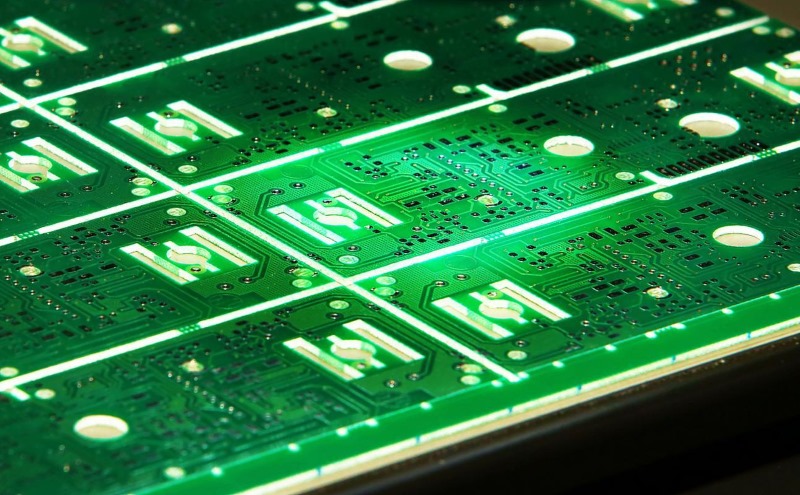
Before comparing the two, it’s essential to understand the goal of PCB depaneling — to separate multiple printed circuit boards from a larger panel while maintaining board integrity. Whether you’re working in automotive electronics, consumer products, or industrial control systems, precision and throughput are the foundation of your depaneling strategy.
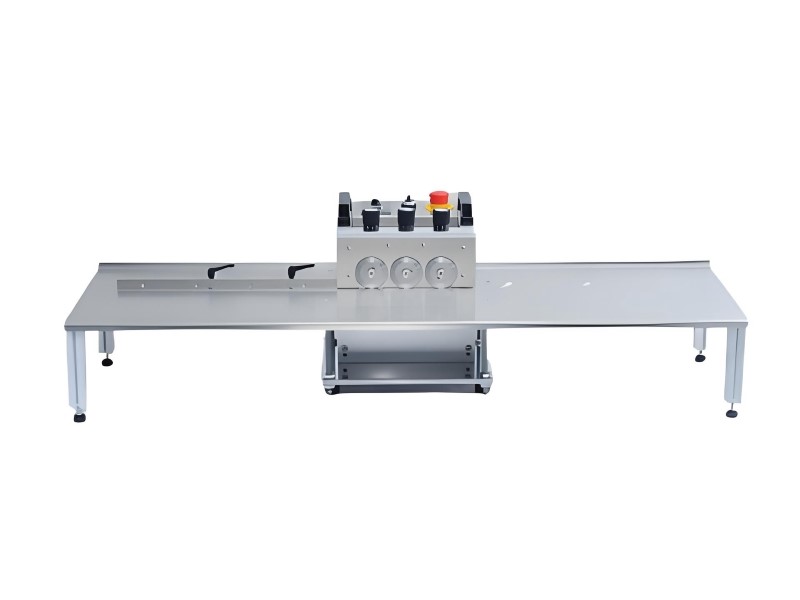
Single-blade machines use one cutting tool that travels along a defined path, while multi-blade systems operate several blades simultaneously to achieve higher output with reduced cycle times.
⚙️ The Efficiency Debate: Speed vs. Precision
The multi-blade depaneling machine shines in high-volume production lines. Cutting multiple boards at once reduces total operation time significantly. However, single-blade systems often offer higher precision and flexibility, particularly when handling irregular PCB layouts or delicate components.
- Single-blade machines: Ideal for prototypes or low-volume production where accuracy matters most.
- Multi-blade systems: Preferred in mass production environments where time efficiency drives ROI.
The challenge lies in balancing cutting speed without compromising product integrity — a topic that many engineers continue to debate.

💡 Cost Analysis: What Really Drives the Price?
When it comes to equipment investment, both machine types have distinct cost structures:
- Initial Investment: Multi-blade machines generally have a higher upfront cost due to complex mechanisms and synchronization controls.
- Maintenance: Single-blade systems require more frequent tool changes but lower maintenance complexity.
- Tool Wear & Replacement: Multi-blade configurations distribute the load across multiple cutters, potentially extending tool life but raising replacement costs when multiple blades wear simultaneously.
A smart decision depends on your production scale and the balance between capital cost and long-term operational efficiency.
🔍 Case Example: Transition from Single to Multi-Blade in Automotive PCB Production
A Tier-1 automotive electronics supplier once relied solely on single-blade depaneling. As production volumes doubled, they struggled with bottlenecks and inconsistent edge quality due to tool fatigue. After switching to a multi-blade depaneling machine, they achieved:
- 45% reduction in cutting time per panel
- 30% lower rework rate
- Stable edge quality across all boards
This transformation demonstrated how equipment choice directly impacts production consistency and downstream yield.

🧠 Key Factors to Consider Before Choosing
Before deciding which type suits your line, analyze the following:
- Production Volume: Multi-blade excels in continuous, large-scale operations.
- PCB Layout Complexity: Single-blade is more adaptable to irregular shapes or variable routing paths.
- Material Type: FR4, aluminum base, or flexible boards may require specific blade setups.
- Budget & ROI Horizon: Consider both the upfront cost and long-term process stability.
- Maintenance Capability: Skilled operators and spare part availability can determine uptime efficiency.
🧰 Solution-Oriented Insights from Industry Practice
For many manufacturers, the best approach may not be “either-or” but rather a hybrid system — using multi-blade depaneling for high-throughput lines and single-blade solutions for specialized, low-volume runs.
Moreover, integrating automated loading/unloading systems, dust collection units, and camera alignment systems can elevate performance regardless of the blade configuration.
By treating depaneling as part of the overall SMT workflow rather than a standalone process, manufacturers can unlock significant efficiency gains.
🌍 Why Choose Seprays Group?
With over 30 years of experience in PCB depaneling machine design, Seprays Group has supported factories in 30+ countries with customized, precision-driven depaneling solutions. From multi-blade automation systems to single-blade flexible cutters, we provide tailored configurations that align with your SMT production goals.
Our engineering team emphasizes performance stability, easy maintenance, and cost optimization — ensuring each customer achieves maximum productivity per square meter of factory space.
If you’d like to learn more or discuss the right depaneling solution for your production line, please feel free to contact us anytime.
WhatsApp: +86 189 2926 6433
E-mail: sales@seprays.com