.png)
 English
  Spanish
  Japanese
  Korean
  Russian
  Chinese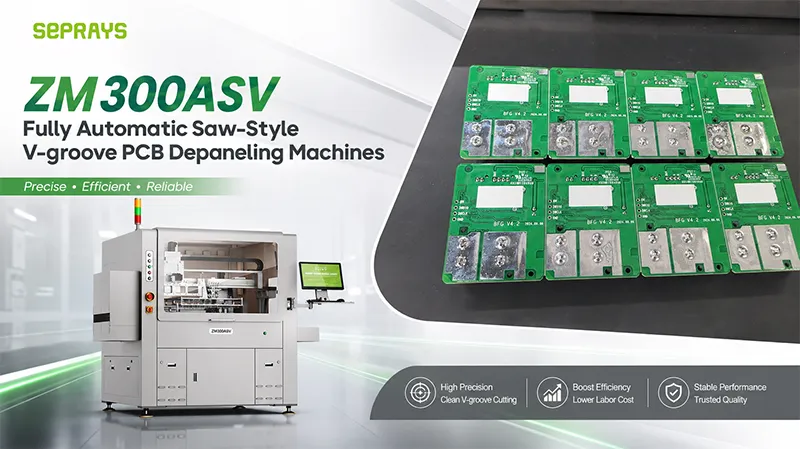
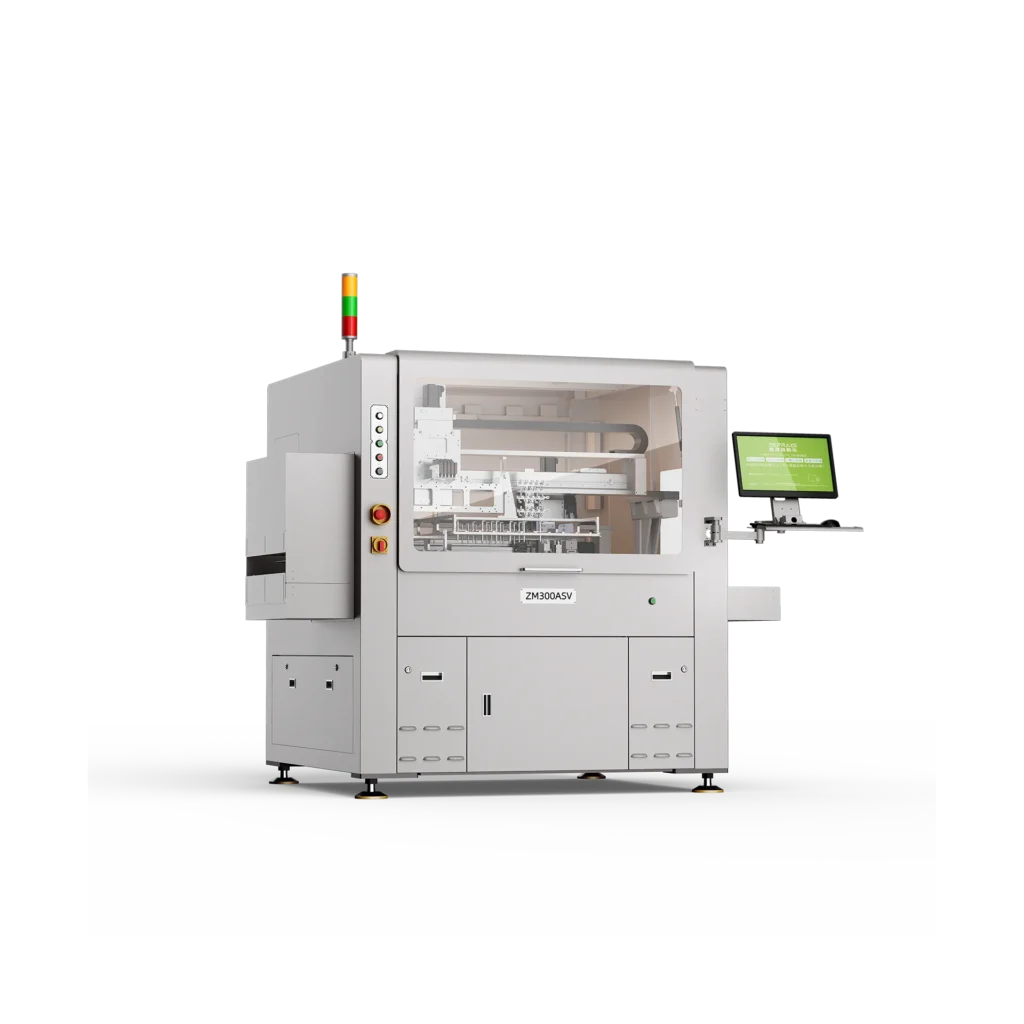
ZM300ASV fully automatic V-groove PCB depaneling becomes interesting when production volume grows, operators can no longer keep up, and a simple separation step starts affecting the whole SMT line.
For a low-volume workshop, manually separating V-scored boards may still be perfectly reasonable. At higher volumes, the calculation changes. Labor consistency, cycle time, board handling, edge quality, and downstream automation become part of the real cost.
That is where a fully automated approach deserves a closer look.
🔍 When Does V-Groove Separation Become a Production Problem?
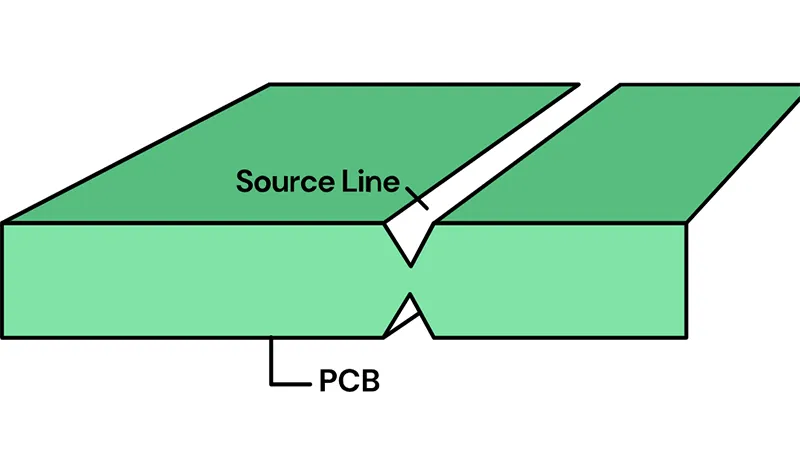
V-groove boards are attractive because the separation path is already defined. The process is relatively straightforward compared with routing complex PCB outlines.
But “simple” does not always mean “easy to scale.”
Imagine a production line running several shifts. Operators need to:
- Load panels consistently.
- Align the V-groove with the cutting position.
- Separate boards without excessive mechanical shock.
- Remove finished boards.
- Collect waste.
- Keep the process moving during product changes.
A small inconsistency repeated hundreds or thousands of times can become a quality issue.
For electronics manufacturers, the question is therefore not only “Can we separate the board?”
It is “Can we separate every panel consistently without creating another bottleneck?”
⚙️ What Makes the ZM300ASV Different?
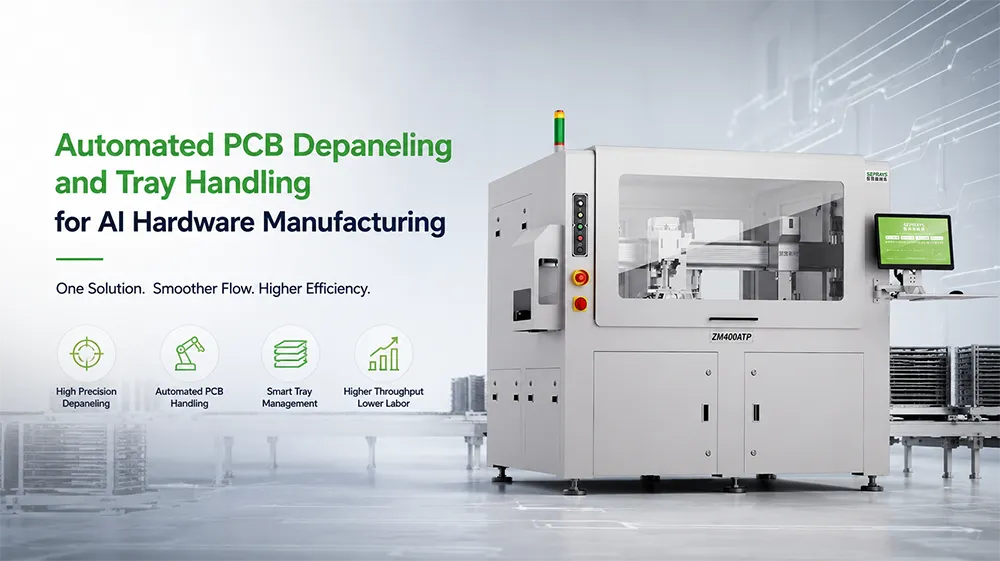
The ZM300ASV is designed around this production-line problem rather than treating separation as a standalone manual operation.
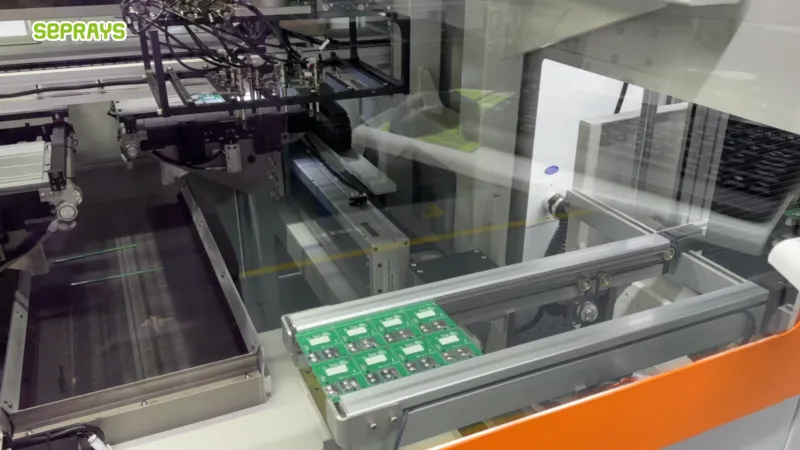
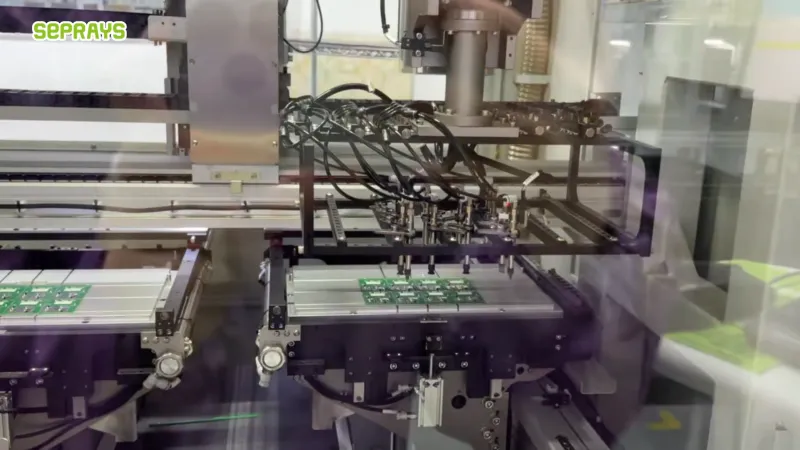
Its workflow can include automatic feeding, cutting, unloading, and waste collection. It supports V-groove separation in both X and Y directions and uses manipulator handling with vacuum suction. The machine also supports tray, belt-line, or track output depending on the production setup.
Some specifications are worth looking at before making a purchasing decision:
| Parameter | ZM300ASV |
|---|---|
| Valid cutting size | 350 × 350 mm |
| Cutting precision | ±0.2 mm |
| Repeat precision | ±0.02 mm |
| Cutting speed | Up to 100 mm/s |
| Table structure | Dual tables |
| Maximum moving speed | 1,000 mm/s |
| Power requirement | 2.5 kW |
| Machine weight | Approx. 1,000 kg |
The numbers alone do not tell the whole story. In real production, repeatability and handling time can matter just as much as cutting speed.
💰 The Cost Is More Than the Machine Price
A common purchasing mistake is comparing machines only by quotation.
Consider a simplified example.
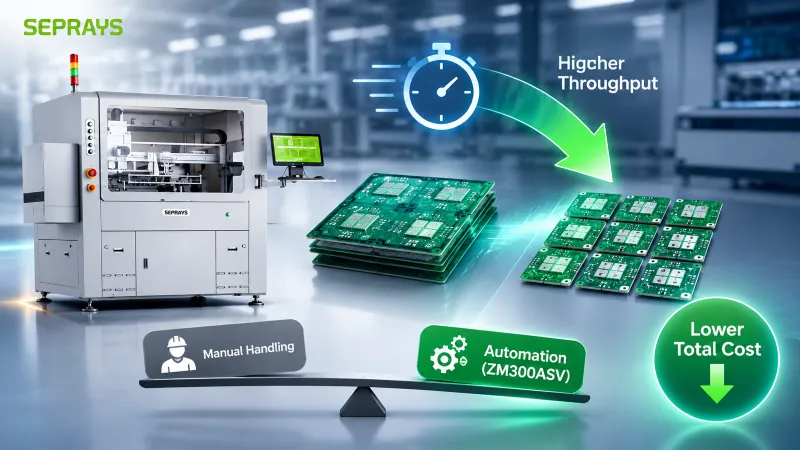
A factory processes 1,500 panels per shift. If manual handling requires two operators and the production schedule becomes tighter during peak periods, the labor cost is only one part of the equation.
You also need to consider:
Labor + rework + downtime + changeover time + material loss + line integration
Suppose a faster machine saves only a few seconds per panel. That may sound insignificant.
Across 1,500 panels, however, those seconds accumulate quickly.
The reverse is also true.
If automation is purchased for a low-volume line that rarely runs, the investment may take much longer to justify.
The counterintuitive conclusion: automation is not automatically cheaper. It becomes financially attractive when utilization, labor dependency, and production volume are high enough.
🏭 An Illustrative Semiconductor Manufacturing Scenario
Consider a hypothetical semiconductor equipment manufacturer producing control boards in panelized format.
The boards use straight V-grooves, and the factory runs multiple shifts. The main complaint is not that operators cannot separate the panels. They can.
The problem is consistency.
During busy periods, manual separation creates uneven handling speed. Finished boards also need to be placed into trays before entering the next process.
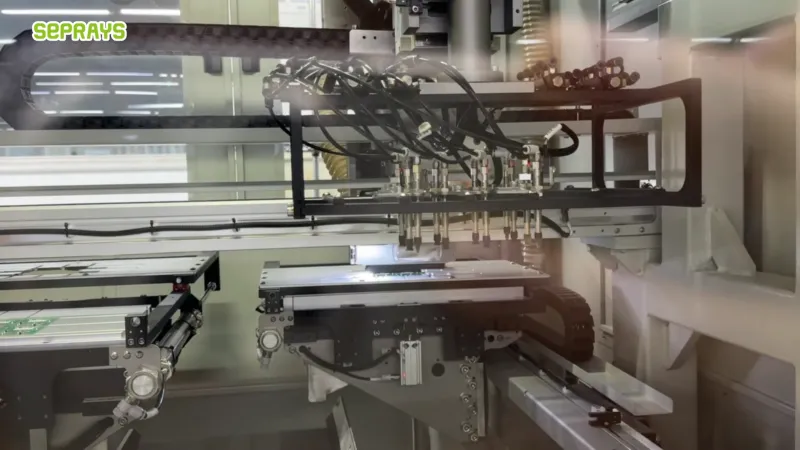
A practical solution would be to automate the sequence:
Panel feeding → V-groove cutting → board separation → automatic handling → tray/output → waste collection
In this type of application, the value is not simply faster cutting. It is reducing the number of manual touchpoints.
The ZM300ASV is designed for exactly this kind of automated workflow, including automatic feeding, separation, discharge, and waste collection.
This is an illustrative scenario, not a claim that a specific semiconductor manufacturer uses this exact machine.
🆚 V-Groove, Router, or Laser?
There is no universal winner.
| Process | Usually makes sense when | Main limitation |
| V-groove | Straight scored separation and high-volume production | Requires suitable V-groove design |
| Router | Irregular outlines and complex board shapes | More cutting dust and process management |
| Laser | Sensitive boards or very fine features | Higher equipment/process cost |
| Manual | Low volume or frequent prototypes | Labor-dependent and less consistent |
One important boundary condition is board design.
If the PCB does not have suitable straight V-grooves, forcing a V-groove solution into the process may create more problems than it solves.
Sometimes a router is the better answer.
Sometimes, laser is justified.
The right choice starts with the PCB, not the machine catalog.
🧪 What Should Be Tested Before Purchase?
Before making a final decision, ask the supplier to run your actual panels.
Check:
- Board thickness and material.
- V-groove depth and position.
- Component clearance.
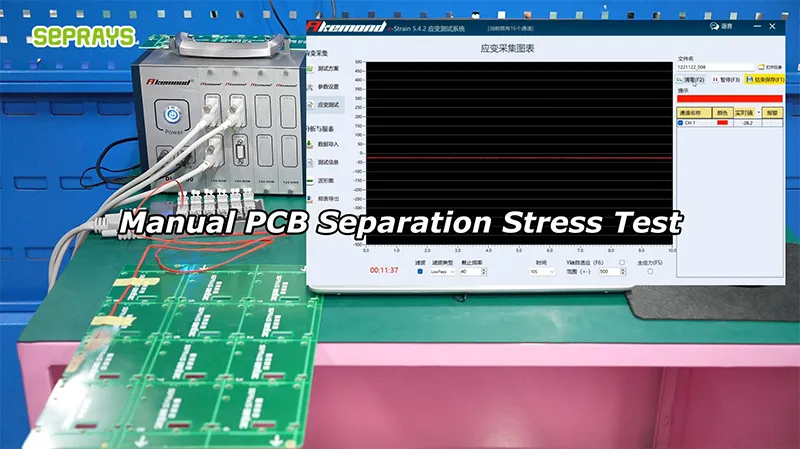
- Separation force and visible board stress.
- Edge quality.
- Burrs or chipping.
- Repeatability after continuous operation.
- Changeover time.
- Tray or conveyor compatibility.
- Waste collection.
- Integration with the existing SMT line.
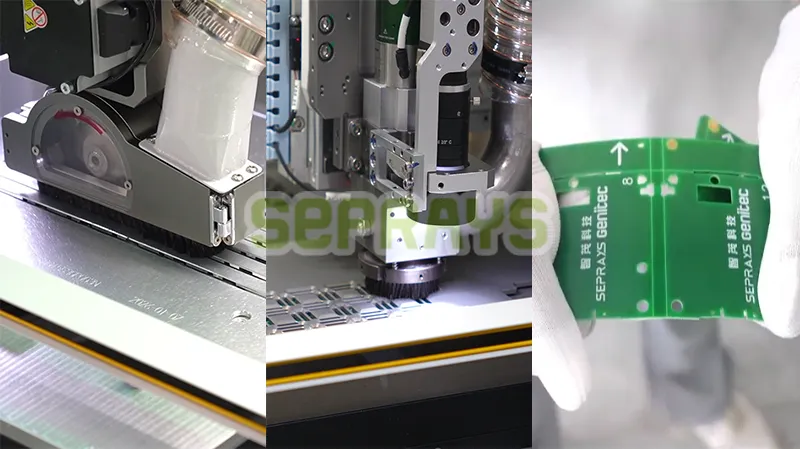
For the ZM300ASV, Seprays specifies support for aluminum, copper, FR4, and fiberglass substrates, with smooth and burr-free separation claimed for these materials. Actual results should still be validated using your own board design and process conditions.
🔄 Why Changeover Time Matters More Than It Looks
High-volume production does not always mean one product runs all day.
Many factories now deal with more product variants and shorter production cycles.
That makes changeover important.
The ZM300ASV uses replaceable cutting modules and suction-cup adjustments intended to simplify line changes. It also provides manual teaching and CAD import for programming.
A machine that runs quickly but takes too long to prepare for the next product may not deliver the expected production gain.
This is one area where real factory testing is more useful than brochure comparisons.
🌍 Why Choose Seprays Group?
Seprays Group has been dedicated to PCB/FPC depaneling technology for more than 30 years. Founded in Taiwan in 1993, the company has developed a broad portfolio covering milling-cutter depanelers, laser depanelers, V-groove depanelers, punching depanelers, and automated loading, unloading, and handling systems.
Its equipment has been supplied to manufacturers and organizations including Foxconn, Flextronics, State Grid, Luxshare, Compal, Wistron, China Electronics, Quanta, CRRC, China Aerospace, OPPO, ZTE, and Bosch. Seprays states that its equipment and complete depaneling solutions are used in factories in China and overseas.
That experience matters because PCB separation is rarely an isolated machine problem.
Board design, fixtures, feeding, cutting, unloading, dust or waste handling, operator access, and downstream equipment can all affect the final result.
Seprays’ current portfolio reflects this broader approach, from offline equipment to in-line automated systems.
If you are evaluating V-groove separation for a high-volume electronics line, it is worth discussing the actual PCB, production volume, and automation requirements before choosing a configuration.
Need to check whether the ZM300ASV fits your application? Contact Seprays Group and share your panel drawings or sample requirements for a practical evaluation.
WhatsApp: +8618929266433
E-mail: sales@seprays.com
❓ FAQ
1. What type of PCB is the ZM300ASV suitable for?
It is intended for PCB panels with V-groove separation requirements, including applications using FR4, fiberglass, aluminum, and copper substrates. Actual compatibility should be confirmed with production samples.
2. Can the ZM300ASV separate boards in both directions?
Yes. The machine is designed to perform automatic V-groove separation in both X and Y directions.
3. Is it suitable for high-volume production?
It can be a good fit where automatic feeding, cutting, unloading, and waste collection are valuable. Whether it is economically justified depends on production volume, shifts, labor cost, and line utilization.
4. Should I choose V-groove instead of a PCB router?
Not necessarily. V-groove is generally better suited to straight scored separation, while routers are more flexible for irregular PCB outlines. Board design should determine the process.
5. How can I verify whether it will work with my PCB?
Provide the PCB panel drawing, material, thickness, V-groove information, component layout, expected output, and production requirements. Ideally, test representative samples before finalizing the equipment configuration.