.png)
 English
  Spanish
  Japanese
  Korean
  Russian
  Chinese
The evolution of PCB depaneling technology is, in essence, a reflection of the electronics manufacturing industry’s relentless pursuit of miniaturization, speed, and precision.
This article explores the development of depaneling machines through three dimensions — technical principles, industrial transformation, and representative equipment — tracing their journey from manual processes to the era of intelligent laser depaneling under Industry 4.0.

🛠️ I. The Manual Era (Before 1950): The Dilemma of Efficiency and Yield
🔹 Technical Characteristics
In the early days of PCB manufacturing, circuit boards were separated by hand.
Operators used scissors or knives to break panels along pre-cut grooves — a “primitive depaneling” approach that suffered from two major flaws:
- High defect rates: According to PCBCart archives, early manual depaneling scrap rates exceeded 40%.
- Severe efficiency limits: A single operator’s daily output was far below industrial production demands.
🔹 Industrial Context
At this stage, PCB manufacturing had not yet formed a complete industrial chain. Depaneling was merely an auxiliary step — equipment automation and process optimization were still far from realization.
⚙️ II. The Mechanical Revolution (1950–1990): The Battle of Four Generations
With the rapid rise of consumer electronics, depaneling machines entered a golden age of technological innovation, giving rise to four major mechanical approaches.
🟢 1. Punch Depaneling Machines: The Price of “Brute Force”
⚡ Principle:
Hydraulic presses applied several tons of pressure, using custom molds to stamp and separate PCBs.
📊 Typical parameters (reference):
- Punching speed: ≤0.5 sec/cycle
- Stress value: up to 50 MPa (far beyond PCB yield strength)
✅ Pain points:
- High scrap rate: ≥25%, due to microcracks and internal stress
- High mold cost: average lifespan of only ~100,000 cycles
While punch depaneling achieved high throughput, its brute-force method compromised reliability and yield.
🟡 2. V-Groove PCB Depaneling Machines: Balancing Precision and Dust
🔧 Technical breakthrough:
Rotating milling cutters were introduced for contour cutting, allowing curved processing through software path control — a milestone toward precision depaneling.
📌 Application scenarios:
- Best for regular-shaped PCBs (e.g., rectangular power boards)
- Suitable for medium production runs (1,000–5,000 pcs/day)
✅ Pain points:
- Dust generation: 50–100g of conductive dust per hour
- Residual stress: Flatness deviation up to ±0.1 mm
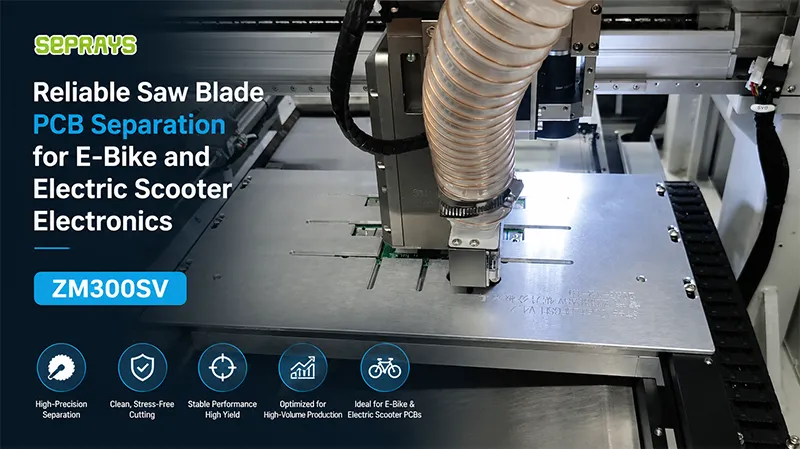
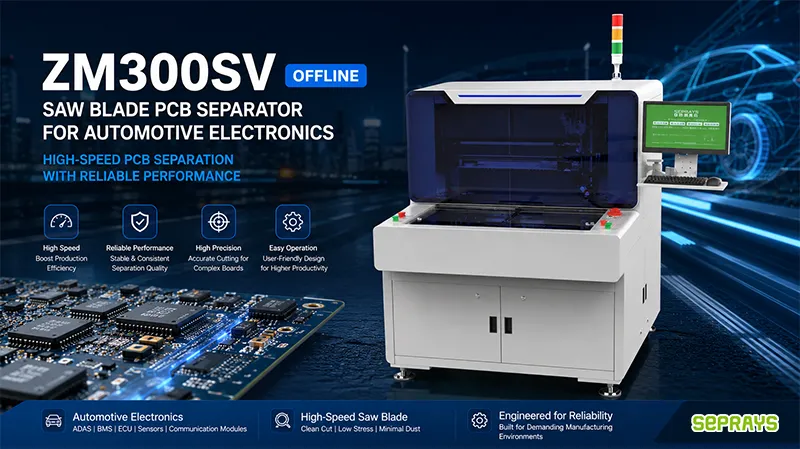
🔵 3. Saw Blade Depaneling Machines: The Straight-Cut Specialist
🔧 Material suitability:
Designed for hard substrates such as FR4 and aluminum-based PCBs.
📊 Cutting parameters:
- Cutting speed: 200–500 mm/s
- Blade life: approx. 5,000 meters of cutting
✅ Technical progress:
Triple-angle tooth design reduced cutting dust by about 30%.
However, it lacked the flexibility for irregular or curved shapes.
🟣 4. Milling Cutter Depaneling Machines: The Triumph of Automation
🔧 Core innovation:
Multi-axis linkage (typically three or more) and computer-optimized tool paths achieved:
- Cutting precision: ±0.05 mm
- Stress control: ≤5 MPa
🏆 Industrial significance:
These systems became the standard in mid-to-high-end PCB production, especially in new energy, telecommunications, and automotive electronics — occupying roughly 60% of the industrial depaneling market.
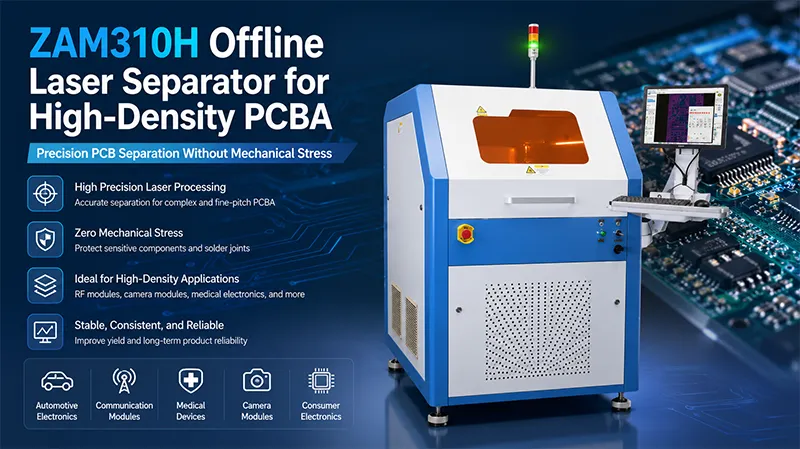
💡 III. The Laser Era (1990–Present): The Non-Contact Cutting Revolution
🔧 Technical breakthroughs:
The introduction of UV and CO₂ laser technologies brought three revolutionary changes:
- Stress-free cutting: Heat-affected zone ≤0.01 mm
- Ultra-fine precision: Capable of processing 0.1 mm micro-segmentation
- Material versatility: Suitable for FR4, ceramic, and flexible substrates
⚠️ Challenges remain:
- Cutting speed: only 1/3–1/5 of mechanical methods
- Edge taper caused by laser entry angles
- Residual carbonization and black edges
- High equipment cost, driving ongoing cost-reduction research
📊 Industry insight:
According to Seprays’ research, the price-to-performance ratio of laser depaneling machines has improved tenfold over the past decade, reshaping the competitive landscape between laser and mechanical depaneling technologies.
🤖 IV. The Future (2025+): The Rise of Intelligent Depaneling
Next-generation depaneling technology will evolve into smart, interconnected manufacturing systems, driven by digital intelligence.
✅ Key directions include:
- AI vision systems: Automated fiducial recognition and adaptive path correction
- Digital twin simulation: Optimized cutting parameters through virtual modeling
- MES integration: Real-time production data traceability and process synchronization
These innovations are paving the way toward adaptive, intelligent, and low-stress depaneling, perfectly aligned with the Industry 4.0 framework.
🌐 V. Market Landscape Insights
The current market structure forms a “spindle-shaped” distribution:
- High-end segment (20%): Laser depaneling dominates HDI and IC substrate applications
- Mid-to-high-end segment (60%): Router and saw-type depanelers lead in consumer and automotive electronics
- Entry-level segment (20%): Traditional mechanical depanelers remain active in education and laboratory testing
🏁 Conclusion
The century-long evolution of PCB depaneling is more than a story of machinery — it’s the embodiment of the electronics industry’s pursuit of precision, efficiency, and excellence.
From manual cutting to AI-driven laser depaneling, every leap forward has redefined manufacturing capability and competitiveness.
For modern manufacturers, choosing the right depaneling system is no longer just a procurement choice — it’s a strategic decision that defines the next decade of success.

🌟 Why Choose Seprays Group?
Since 1993, Seprays Group has been dedicated to PCB/FPC depaneling technology, providing a full range of solutions — milling cutter depanelers, laser depanelers, V-groove depanelers, punching depanelers, and automated handling systems. Our equipment is trusted by leading manufacturers, including Foxconn, Flextronics, State Grid, Luxshare, Compal, Wistron, China Electronics, Quanta, CRRC, China Aerospace, OPPO, ZTE, and Bosch, serving factories across China and worldwide.
- Global service network in 31+ countries.
- ISO9001, ISO14001, and ISO45001 certified.
- Over 32 years of manufacturing experience.
- CE-certified equipment with patented dust control designs.
We combine advanced engineering with reliable service support, helping manufacturers achieve higher yields and smoother production.
If your production line is ready for the next step in automation, we’re here to help.
WhatsApp: +86 189 2926 6433
E-mail: sales@seprays.com