.png)
 English
  Spanish
  Japanese
  Korean
  Russian
  Chinese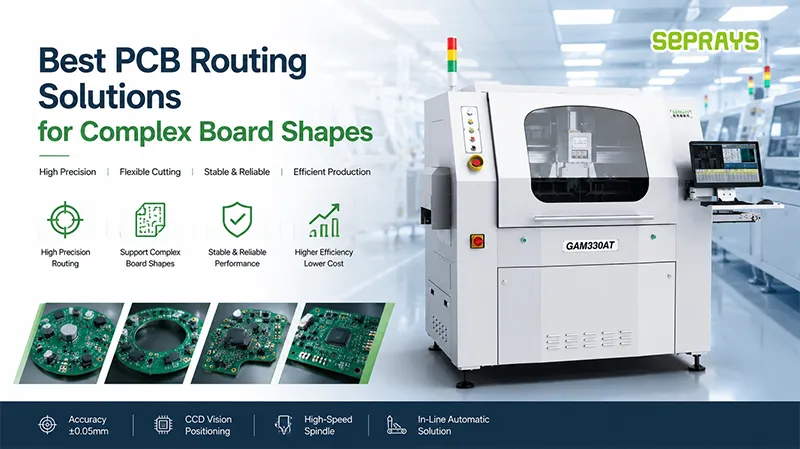
PCB routing solutions often become a serious discussion only after manufacturers run into problems. At the prototype stage, unusual board designs usually look manageable. But once production scales, irregular shapes start creating issues that are difficult to ignore.
Rounded corners. L-shaped boards. Sensor modules with openings. Automotive control units with unique outlines. Wearable electronics with curved structures.
On the screen, these designs look clean and efficient.
On the factory floor, they can become a source of yield loss, longer cycle times, tool wear, and inconsistent separation quality.
As product miniaturization continues in 2026, complex PCB geometries are becoming increasingly common across automotive electronics, industrial control systems, consumer devices, and IoT products. The question manufacturers ask is no longer simply:
“Can this board be separated?”
More often, it becomes:
“Can it be separated repeatedly, efficiently, and without affecting quality?”
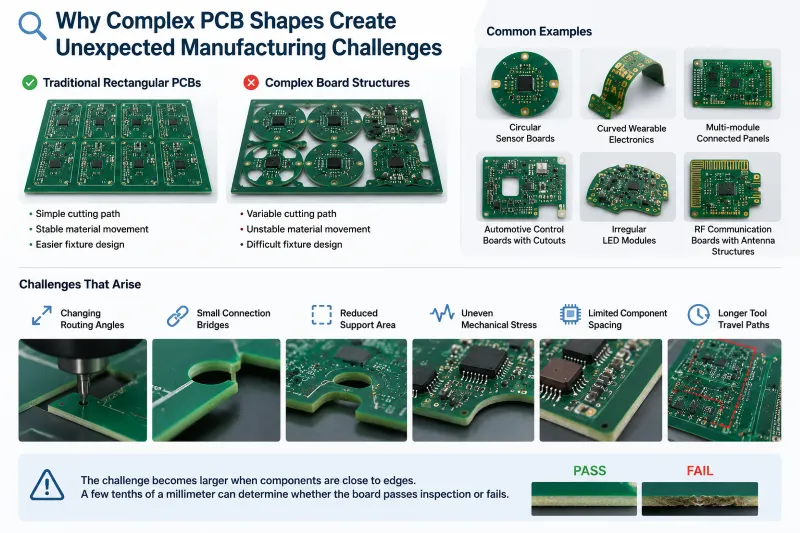
🔍 Why Complex PCB Shapes Create Unexpected Manufacturing Challenges
Traditional rectangular PCBs are relatively predictable.
The cutting path is simple. Material movement is stable. Support fixtures are easier to design.
Complex board structures change that.
Common examples include:
- Circular sensor boards
- Curved wearable electronics
- Multi-module connected panels
- Automotive control boards with cutouts
- Irregular LED modules
- RF communication boards with antenna structures
Several challenges appear at the same time:
- ✓ Changing routing angles
- ✓ Small connection bridges
- ✓ Reduced support area
- ✓ Uneven mechanical stress
- ✓ Limited component spacing
- ✓ Longer tool travel paths
The challenge becomes larger when components are close to the edges.
A few tenths of a millimeter can determine whether the board passes inspection or fails.
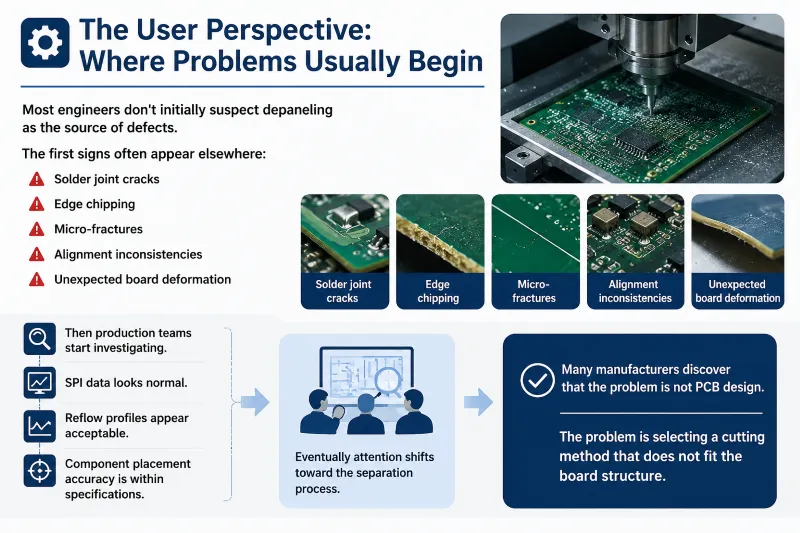
⚙️ The User Perspective: Where Problems Usually Begin
Most engineers don’t initially suspect depaneling as the source of defects.
The first signs often appear elsewhere:
- Solder joint cracks
- Edge chipping
- Micro-fractures
- Alignment inconsistencies
- Unexpected board deformation
Then production teams start investigating.
SPI data looks normal.
Reflow profiles appear acceptable.
Component placement accuracy is within specifications.
Eventually, attention shifts toward the separation process.
Many manufacturers discover that the problem is not PCB design.
The problem is selecting a cutting method that does not fit the board structure.
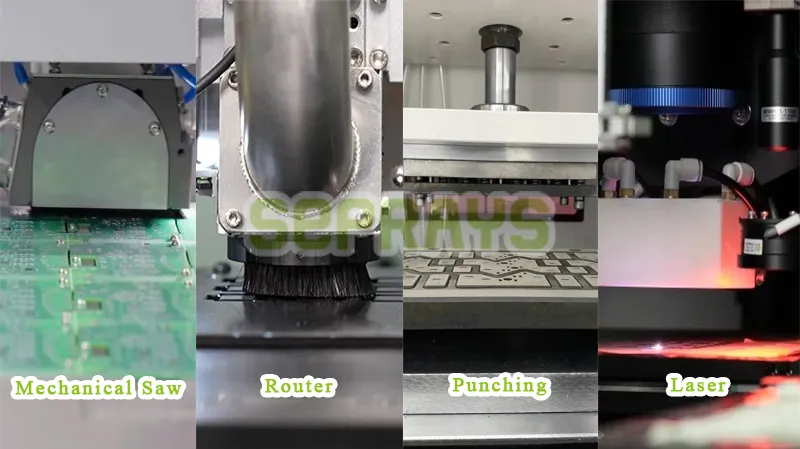
📊 Comparison of Routing Approaches for Complex Shapes
| Method | Shape Flexibility | Mechanical Stress | Speed | Tool Cost | Suitable Applications |
|---|---|---|---|---|---|
| V-Groove Depaneling | Low | Medium | High | Low | Straight line boards |
| Punching | Medium | High | Very High | Medium | Fixed repetitive designs |
| Laser Depaneling | Very High | Very Low | Medium | High | Sensitive and thin boards |
| Router Depaneling | High | Low | High | Medium | Complex outlines and mixed products |
For many manufacturers in 2026, router systems remain the practical balance between flexibility and operating cost.
🏭 Why In-Line Router Systems Are Becoming More Common
An interesting pattern has emerged in production environments.
Many factories originally focused only on cutting precision.
Later, they realized that precision alone was not solving efficiency problems.
Manual loading and unloading often became the hidden bottleneck.
A line may achieve:
- Accurate cutting
- Stable spindle performance
- Low defect rates
Yet still lose productivity because operators constantly move boards between stations.
This is one of the reasons integrated systems are becoming more common.
🛠 GAM330AT Example: Handling Complex Board Structures at Production Scale
In one project involving industrial communication modules, engineers faced several issues:
- Multiple irregular board shapes
- Different module dimensions
- Tight component placement
- High daily output requirements
Initially, an offline process was used.
The result:
- Frequent handling interruptions
- Longer cycle times
- Inconsistent output between shifts
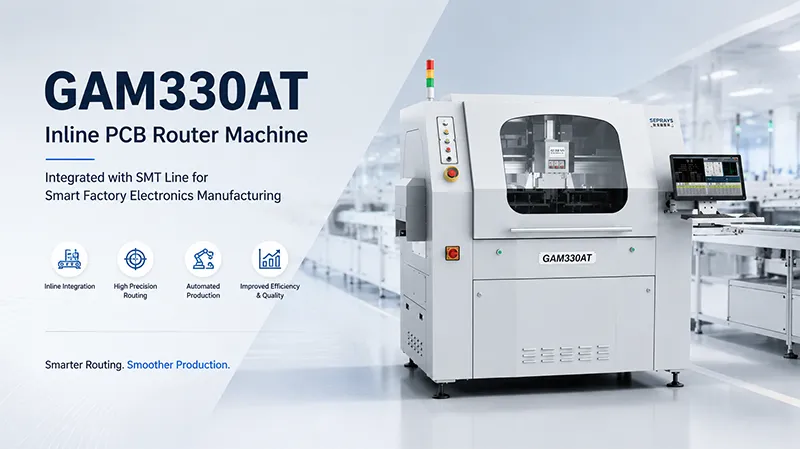
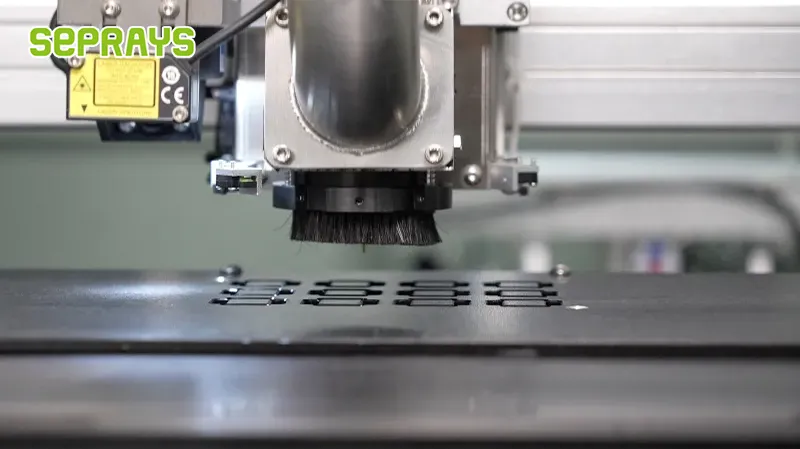
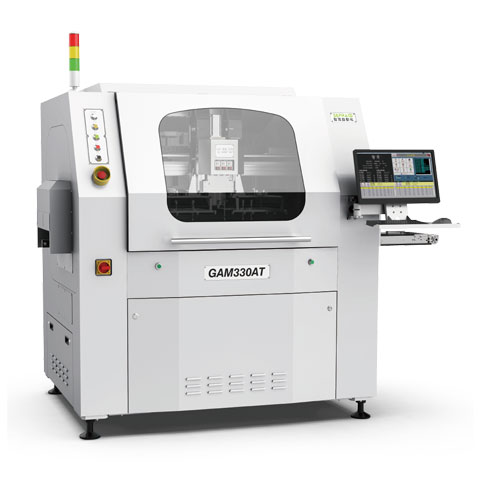
The production team later moved toward an inline routing setup using the Seprays GAM330AT In-Line Automatic PCB Router Machine.
Several characteristics proved useful:
- ✓ CCD vision positioning for accurate alignment
- ✓ Stable routing path control
- ✓ High-speed spindle operation
- ✓ Automated board transfer
- ✓ Compatibility with mixed production environments
Rather than focusing only on cutting speed, the larger benefit came from process stability.
Sometimes the biggest improvement is not reducing cutting time by two seconds.
It is removing small interruptions that occur hundreds of times each day.
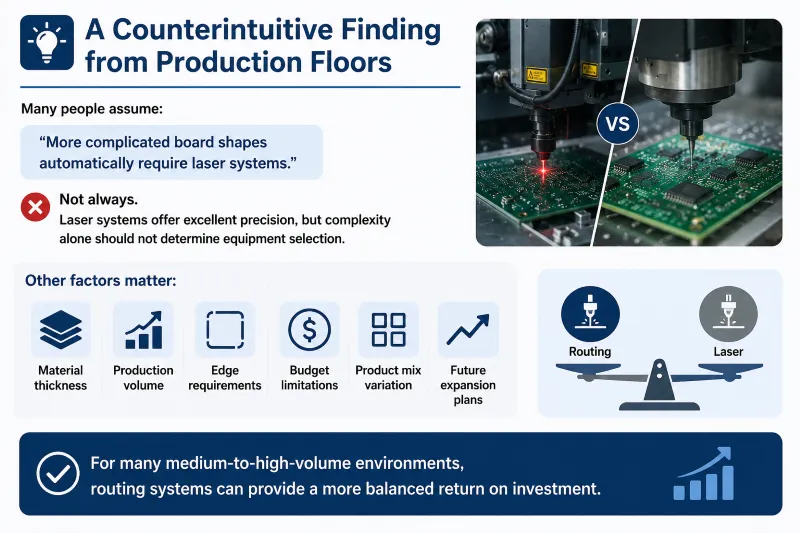
💡 A Counterintuitive Finding from Production Floors
Many people assume:
“More complicated board shapes automatically require laser systems.”
Not always.
Laser systems offer excellent precision, but complexity alone should not determine equipment selection.
Other factors matter:
- Material thickness
- Production volume
- Edge requirements
- Budget limitations
- Product mix variation
- Future expansion plans
For many medium-to-high-volume environments, routing systems can provide a more balanced return on investment.
📈 Cost Analysis Beyond Equipment Price
Initial purchase cost often attracts the most attention.
However, operating costs tell a different story.
| Cost Category | Short-Term Focus | Long-Term Impact |
|---|---|---|
| Machine purchase | High visibility | One-time |
| Labor | Moderate | Continuous |
| Scrap loss | Often ignored | Significant |
| Downtime | Hidden | High |
| Tool replacement | Predictable | Medium |
| Production interruptions | Hidden | Very high |
Factories frequently underestimate the cost of instability.
Small inefficiencies repeated thousands of times eventually become expensive.
🔧 Practical Selection Checklist
Before choosing a routing solution, many engineers review:
- ✓ Maximum board dimensions
- ✓ Board thickness range
- ✓ Component clearance
- ✓ Expected output volume
- ✓ Future product diversity
- ✓ Automation compatibility
- ✓ Maintenance requirements
- ✓ Dust management
Simple questions often prevent expensive mistakes.
🌍 Looking Ahead in 2026
Board designs are becoming more unconventional.
Product cycles are shorter.
Mixed production environments are increasing.
Routing systems are evolving from isolated machines into connected production tools.
The discussion is gradually changing from:
“Which machine cuts faster?”
to:
“Which system supports long-term manufacturing flexibility?”
That shift is becoming increasingly visible across automotive, industrial, and consumer electronics production lines.
Why Choose Seprays Group?
For more than 30 years, Seprays Group has focused on advancing PCB and FPC depaneling technology while adapting to changing manufacturing requirements across industries.
Seprays Group has been dedicated to PCB/FPC depaneling technology, providing a full range of solutions—including milling-cutter, laser, V-groove, and punching depanelers, as well as automated handling systems.
Our equipment has earned the trust of leading manufacturers, including Foxconn, Flextronics, State Grid, Luxshare, Compal, Wistron, China Electronics, Quanta, CRRC, China Aerospace, OPPO, ZTE, and Bosch, and supports production facilities throughout China and in global markets.
Beyond equipment supply, Seprays focuses on:
- ✓ Process optimization
- ✓ Automated production integration
- ✓ Stable long-term performance
- ✓ Industry-specific application support
- ✓ Flexible solutions for evolving manufacturing environments
If you are evaluating routing solutions for complex PCB structures, feel free to contact us.
WhatsApp: +8618929266433
E-mail: sales@seprays.com
FAQ
1. Which PCB types usually require routing rather than V-cut separation?
Irregular boards, curved designs, boards with internal openings, and products with edge components usually benefit more from routing.
2. Can router depaneling handle automotive electronics?
Yes. Automotive boards often contain complex geometries and strict quality requirements, making router systems suitable for many applications.
3. Does router depaneling create stress on PCB assemblies?
All mechanical processes create some level of stress, but optimized routing systems significantly reduce it compared with manual or punching methods.
4. Is a laser always better for complex PCB shapes?
Not necessarily. Laser systems are excellent for delicate products, but routing may provide a better balance between cost and flexibility.
5. Why are inline systems becoming more popular in 2026?
Manufacturers increasingly prioritize production continuity, labor reduction, and process consistency rather than focusing only on cutting performance.