.png)
 Korean
  English
  Spanish
  Japanese
  Russian
  Chinese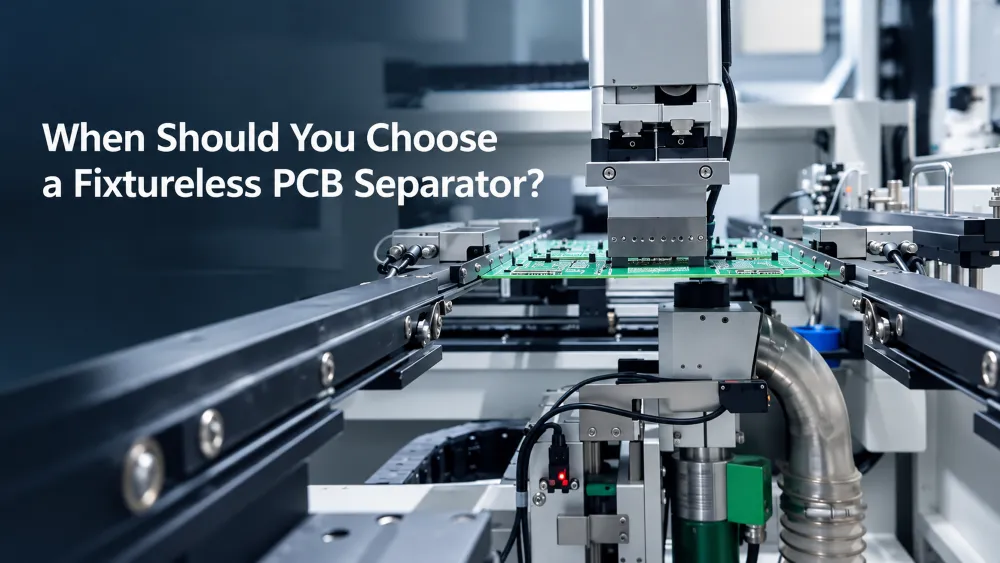
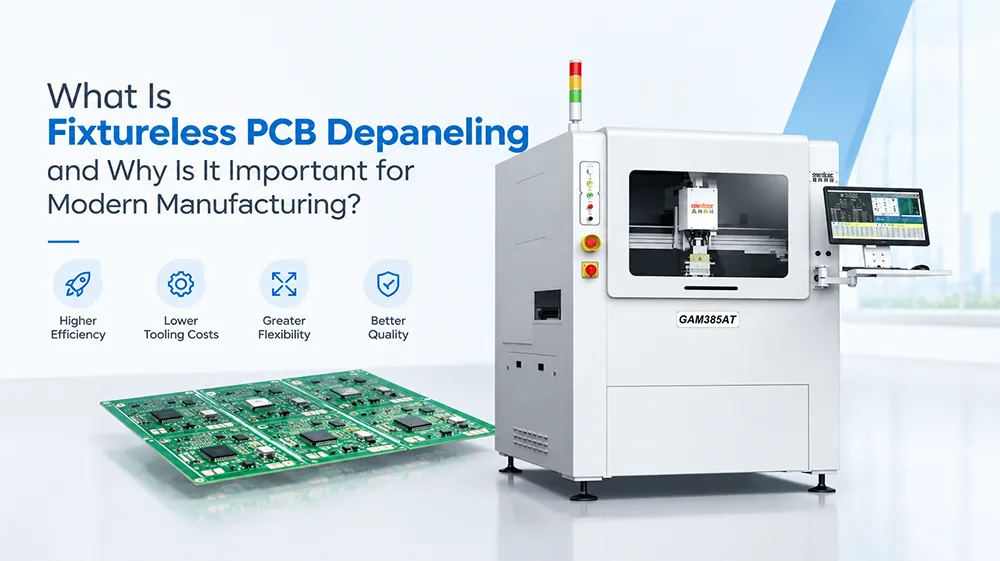
Fixtureless PCB separation sounds attractive when production teams are dealing with frequent PCB changes.
No dedicated fixture to store.
No fixture change every time the product changes.
Less preparation before production.
But there is a catch.
A fixtureless process is not automatically the better choice.
The real question is whether the PCB can be separated reliably without depending on a dedicated mechanical fixture.
For some semiconductor and electronics manufacturers, that can save time and reduce recurring tooling costs. For others, a properly designed fixture still provides better support and repeatability.
So when should you choose a fixtureless approach?
🏭 Start With the Production Problem
Imagine a factory running eight PCB models during the same week.
Model A runs in the morning.
Model B runs after lunch.
A small batch of Model C comes in the afternoon.
Every change may require more than changing a machine program.
If each PCB needs its own fixture, the operator may need to:
- Find the correct fixture.
- Remove the previous fixture.
- Install the new one.
- Adjust positioning.
- Check alignment.
- Store the old fixture.
- Verify the first few boards.
None of these tasks actually separates a PCB.
But they consume production time.
This is where a fixtureless process becomes interesting.
🔍 What Does “Fixtureless” Really Mean?
The term can be misunderstood.
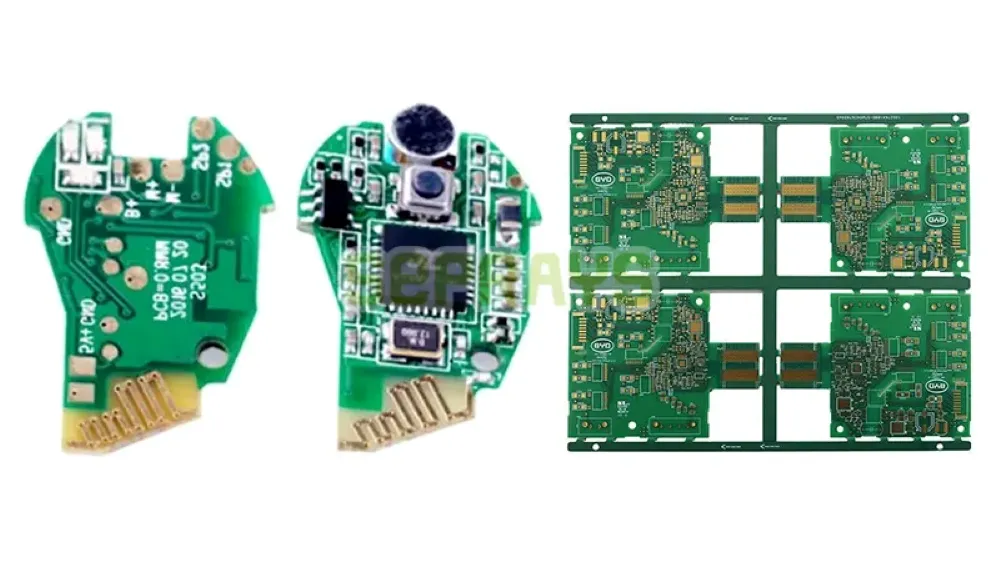
Fixtureless does not mean that the PCB has no positioning or support at all.
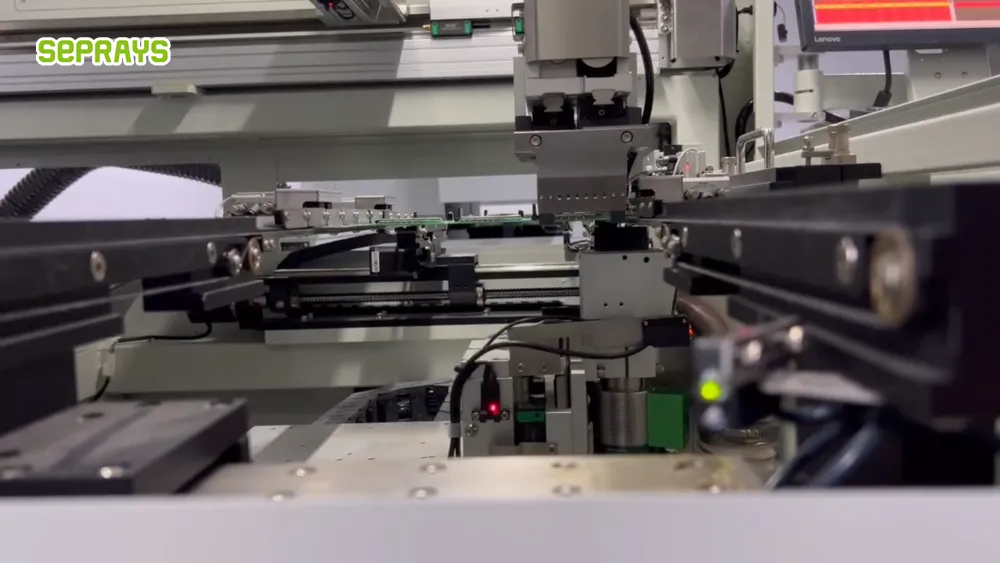
The machine still needs to control the board during separation.
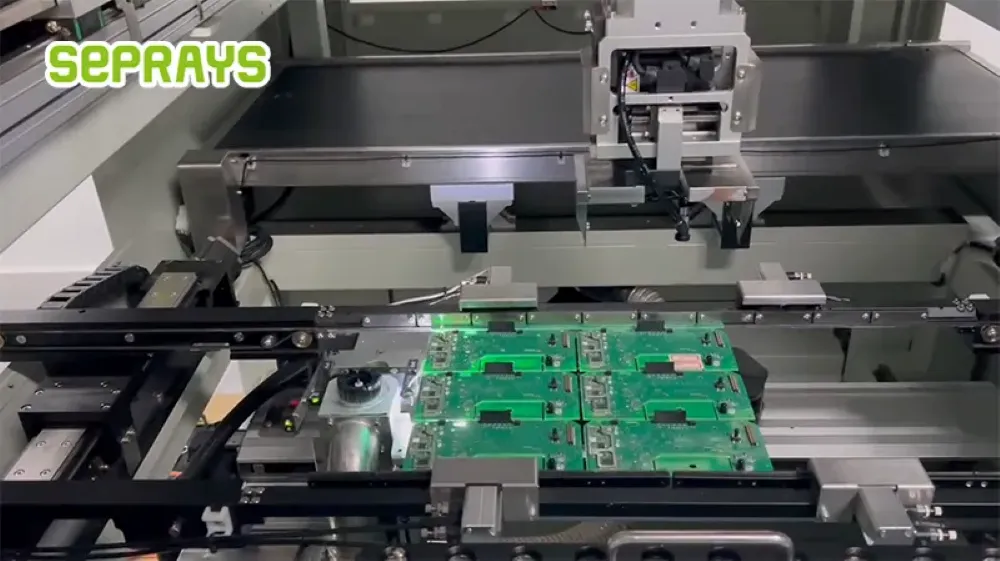
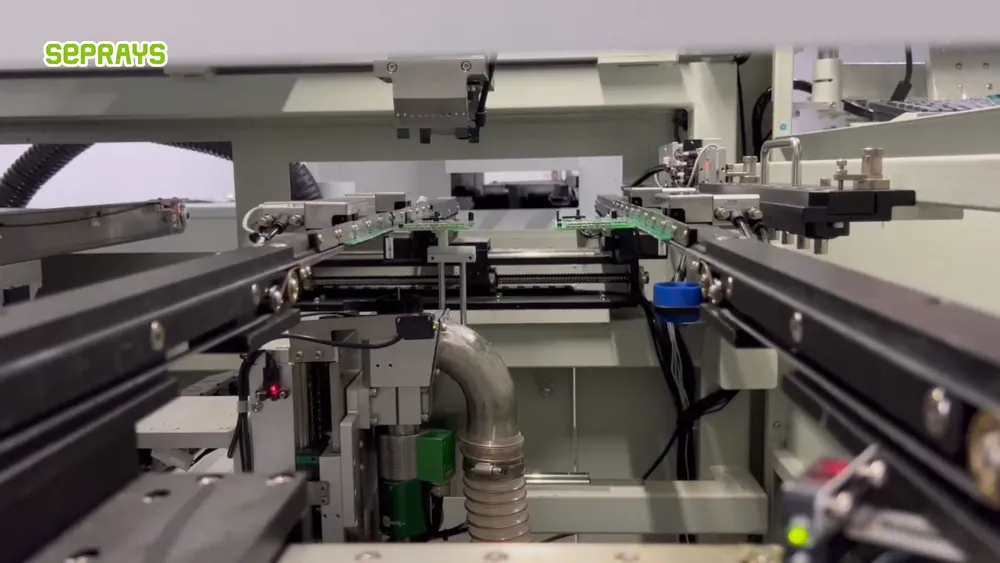
Depending on the equipment and application, this may involve conveyor support, vacuum, positioning mechanisms, sensors, clamps integrated into the machine, or other forms of workpiece control.
The difference is that the process does not rely on a dedicated PCB-specific fixture in the traditional sense.
That distinction matters.
A PCB still needs to remain stable.
It still needs to be positioned accurately.
And the cutting or separation force still needs to be controlled.
⚙️ When Is a Fixtureless Process Useful?
There are several situations where the approach deserves serious consideration.
🔄 Frequent PCB Changes
If your factory produces many PCB models in relatively small batches, fixture management can become surprisingly expensive.
A fixtureless system can reduce the physical preparation required between products.
The benefit is not necessarily a faster cutting cycle.
It is faster changeover.
📦 High-Mix, Lower-Volume Production
High-volume factories often have a different calculation.
If one PCB model runs continuously for months, a dedicated fixture may be perfectly reasonable.
But high-mix production has a different problem.
The equipment needs to adapt.
This is particularly relevant to semiconductor equipment, industrial electronics, prototypes, and contract manufacturing environments where product schedules can change frequently.
💰 Lower Fixture Inventory
Fixtures cost money.
They also occupy storage space.
And they need maintenance.
If a factory has 30 PCB models, maintaining 30 dedicated fixtures creates another layer of production management.
A fixtureless approach can reduce that inventory burden when the PCB designs fall within the machine’s operating range.
📊 Fixtureless vs. Dedicated Fixture
| Factor | Fixtureless Approach | Dedicated Fixture |
|---|---|---|
| Product changeover | Generally faster | Requires fixture change |
| Fixture inventory | Lower | Higher |
| High-mix production | 적합 | More management required |
| Stable mass production | Application-dependent | Often practical |
| PCB support | Integrated machine system | Dedicated support |
| Initial setup | Simpler for compatible PCBs | More preparation |
| Complex/sensitive boards | Requires validation | Can provide strong support |
| Maintenance | Fewer dedicated fixtures | Fixture maintenance required |
This table describes general production tendencies.
The actual result depends on PCB dimensions, thickness, weight, component layout, separation method, and machine design.
🧪 The Semiconductor Customer Example
Consider a semiconductor-related electronics manufacturer producing several PCB assemblies for overseas equipment.
The customer had an interesting production pattern.
The monthly volume was healthy.
But the product mix kept changing.
Some PCB models were produced for long periods.
Others appeared only in smaller batches.
Initially, the production team considered making a dedicated fixture for every model.
The calculation looked reasonable until they added everything together:
Fixture manufacturing + storage + changeover labor + maintenance + engineering time
The total was less attractive.
Seprays Group evaluated the application and looked at whether the boards could be processed using a fixtureless separation approach.
The team did not start with the machine.
They started with the PCB.
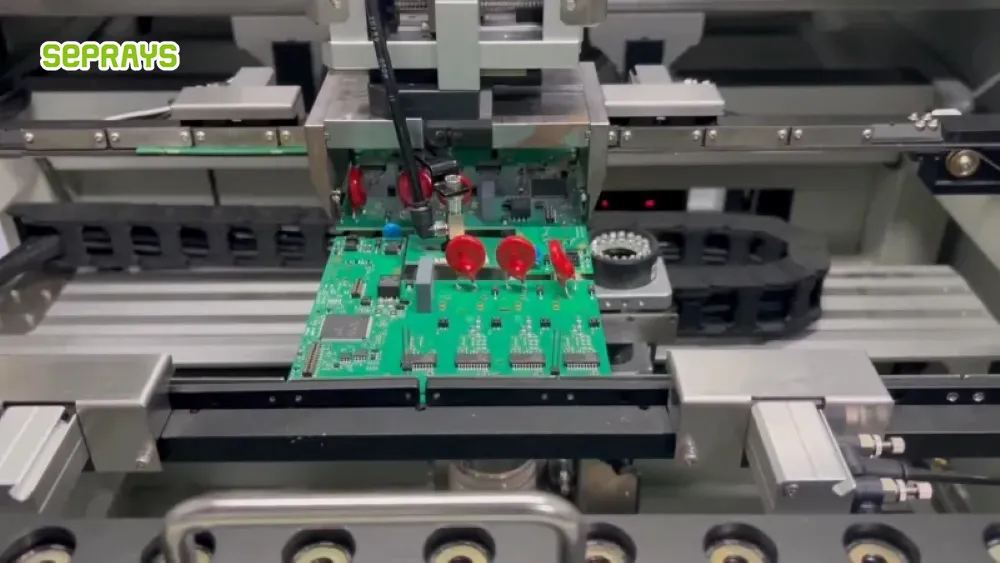
Board dimensions were checked.
Thickness was reviewed.
Component locations near the separation area were considered.
The production sequence was observed.
The key question was simple:
Can the board remain sufficiently stable during separation without a dedicated fixture?
That became the decision point.
📐 PCB Design Still Sets the Boundary
Fixtureless does not remove engineering limitations.
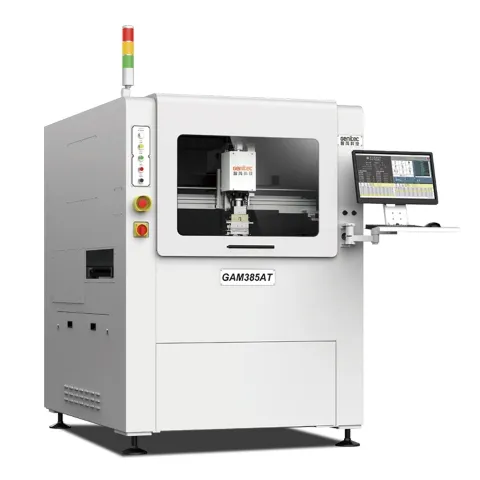
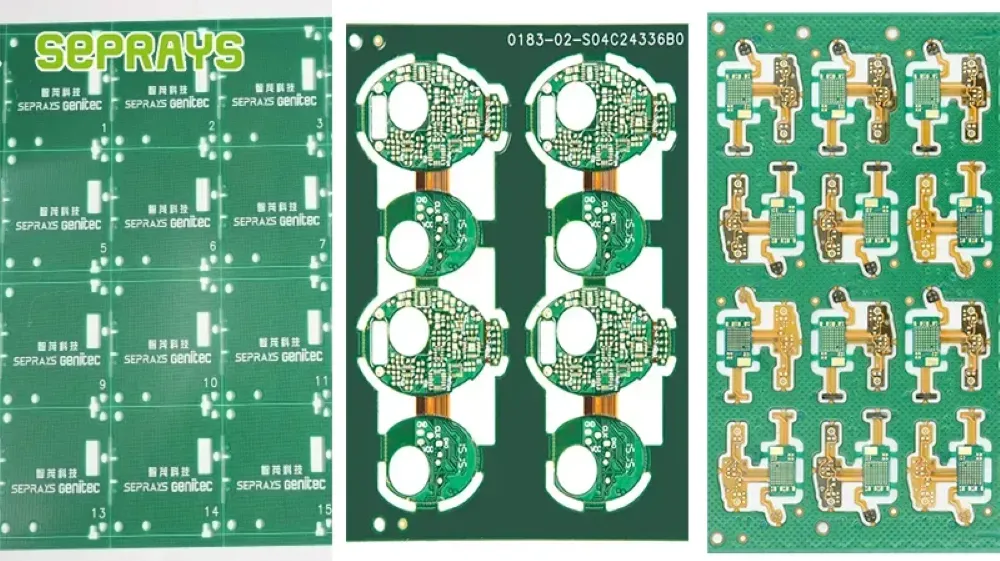
For example, a very thin PCB may flex more easily.
A heavy assembly may require additional support.
Components close to the separation line may restrict the available handling method.
An unusually shaped board may also require more controlled positioning.
These are not reasons to reject fixtureless equipment.
They are reasons to test the actual PCB.
A production sample can reveal issues that are difficult to predict from dimensions alone.
🧠 The Counterintuitive Part: No Fixture Does Not Mean No Setup
This is probably the most important point.
Some buyers assume:
No fixture = zero setup.
That is not realistic.
You may still need to configure:
- PCB dimensions
- Program parameters
- Positioning references
- Cutting or separation conditions
- Board support
- Sensor settings
- Tray or downstream handling
The difference is that the operator does not necessarily need to physically replace a dedicated fixture for every PCB model.
That can still be a significant improvement.
But it should not be confused with completely setup-free production.
💵 How to Calculate the Real Cost
When comparing fixtureless and fixture-based equipment, do not compare only the machine quotations.
Use a broader calculation:
Total cost = Machine + Fixtures + Fixture maintenance + Storage + Changeover labor + Downtime + Scrap
For high-mix production, changeover time can become a meaningful cost.
For stable mass production, however, a dedicated fixture may have a relatively small impact on the overall unit cost.
This creates an important boundary condition:
The more stable your product mix, the less valuable fixtureless operation may become.
That is why the same machine strategy can make sense in one factory and little sense in another.
🛠️ How We Would Evaluate It
Before choosing a fixtureless PCB separator, we would normally check:
- PCB length and width.
- PCB thickness.
- Panel configuration.
- Board weight.
- Component clearance.
- Separation method.
- Required positioning accuracy.
- Production volume.
- Number of PCB models.
- Average changeover frequency.
Then comes the practical test.
Run the actual PCB.
Do not test only an empty panel.
Do not judge the result from one cycle.
Run enough samples to observe positioning consistency, edge quality, handling stability, and repeatability.
That is where an engineering decision becomes more reliable.
🌎 Why Choose Seprays Group?
With more than 30 years of experience, Seprays Group has been dedicated to PCB/FPC depaneling technology, providing a full range of solutions—including milling-cutter depanelers, laser depanelers, V-Groove depanelers, punching depanelers, and automated handling systems.
Our equipment is trusted by leading manufacturers, including Foxconn, Flextronics, State Grid, Luxshare, Compal, Wistron, China Electronics, Quanta, CRRC, China Aerospace, OPPO, ZTE, and Bosch. Our equipment and solutions are used in factories across China and in manufacturing facilities worldwide.
With more than three decades in PCB/FPC depaneling, Seprays Group has worked with different PCB structures, production volumes, automation requirements, and separation processes.
That experience is useful when a customer is unsure whether a fixtureless solution is actually appropriate.
The goal is not to remove fixtures simply because they are fixtures.
The goal is to determine whether the production process can achieve the required stability, accuracy, throughput, and cost without relying on dedicated tooling.
For some applications, the answer may be fixtureless.
For others, a dedicated fixture may still be the more practical engineering choice.
If you are considering a fixtureless PCB separation solution, please contact us with your PCB dimensions, drawings, production volume, and current process. We can evaluate the application based on the actual production conditions.
WhatsApp: +8618929266433
이메일: sales@seprays.com
❓ FAQ
1. What is a fixtureless PCB separator?
A fixtureless PCB separator separates boards without relying on a dedicated PCB-specific mechanical fixture. The machine still uses positioning and support mechanisms to maintain the PCB during the separation process.
2. Is fixtureless PCB separation suitable for every PCB?
No. PCB thickness, dimensions, weight, component placement, shape, and separation requirements all affect suitability. Actual PCB testing is recommended before production implementation.
3. Does a fixtureless system completely eliminate changeover time?
No. It can reduce physical fixture replacement, but operators may still need to load a different program or adjust process parameters depending on the equipment and PCB.
4. Is fixtureless equipment cheaper than a fixture-based system?
Not necessarily. The economic advantage may come from lower fixture inventory, reduced storage, faster changeovers, and less fixture maintenance. The total production cost should be evaluated rather than only the equipment price.
5. When should I consider a fixtureless PCB separator?
It is particularly worth evaluating when your factory handles multiple PCB models, frequent product changes, small or medium production batches, and recurring fixture-management costs. A production sample test can help determine whether the approach fits your specific PCB.