.png)
 Korean
  English
  Spanish
  Japanese
  Russian
  Chinese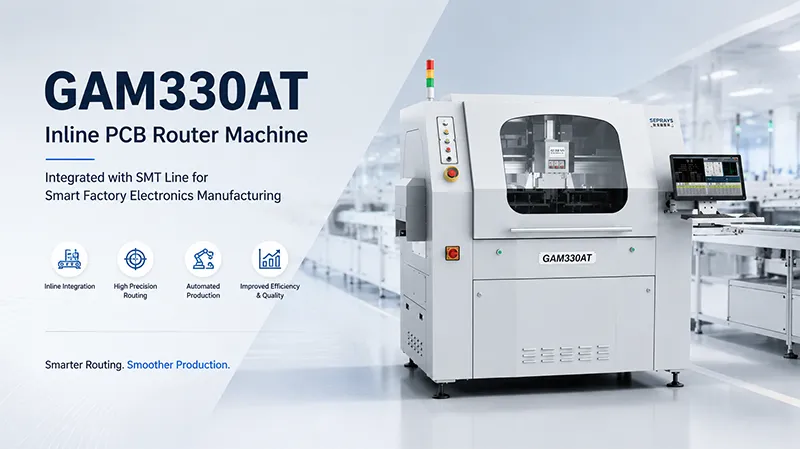
PCB 밀링 커터 디패널링 기계 integration has become an important topic for many electronics manufacturers as smart factories continue to develop.
In the past, PCB depaneling was often treated as an independent finishing step after SMT assembly.
A typical production flow looked like this:
SMT placement → Reflow → Inspection → Manual transfer → PCB separation → Next process
This approach can work well for small production volumes.
However, as consumer electronics, industrial devices, communication products, and smart hardware continue to increase in complexity, many factories face a new challenge:
The cutting process itself may not be the bottleneck.
The real problem is the connection between processes.
Manufacturers are now looking for solutions that can improve:
- Production continuity
- Material flow efficiency
- Quality consistency
- Automation capability
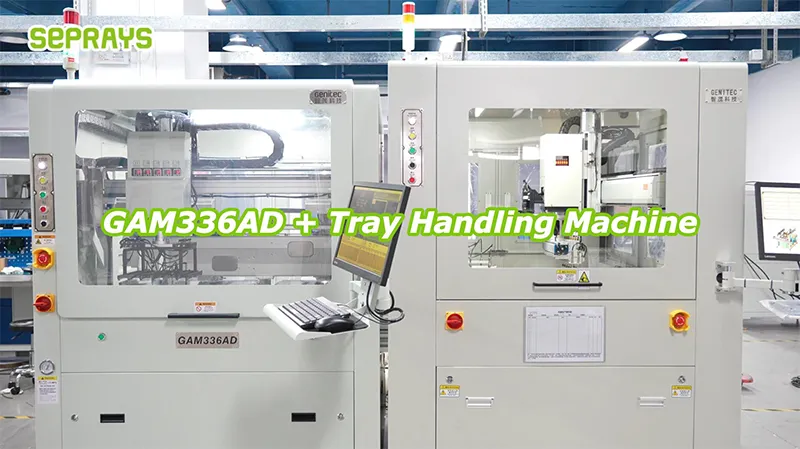
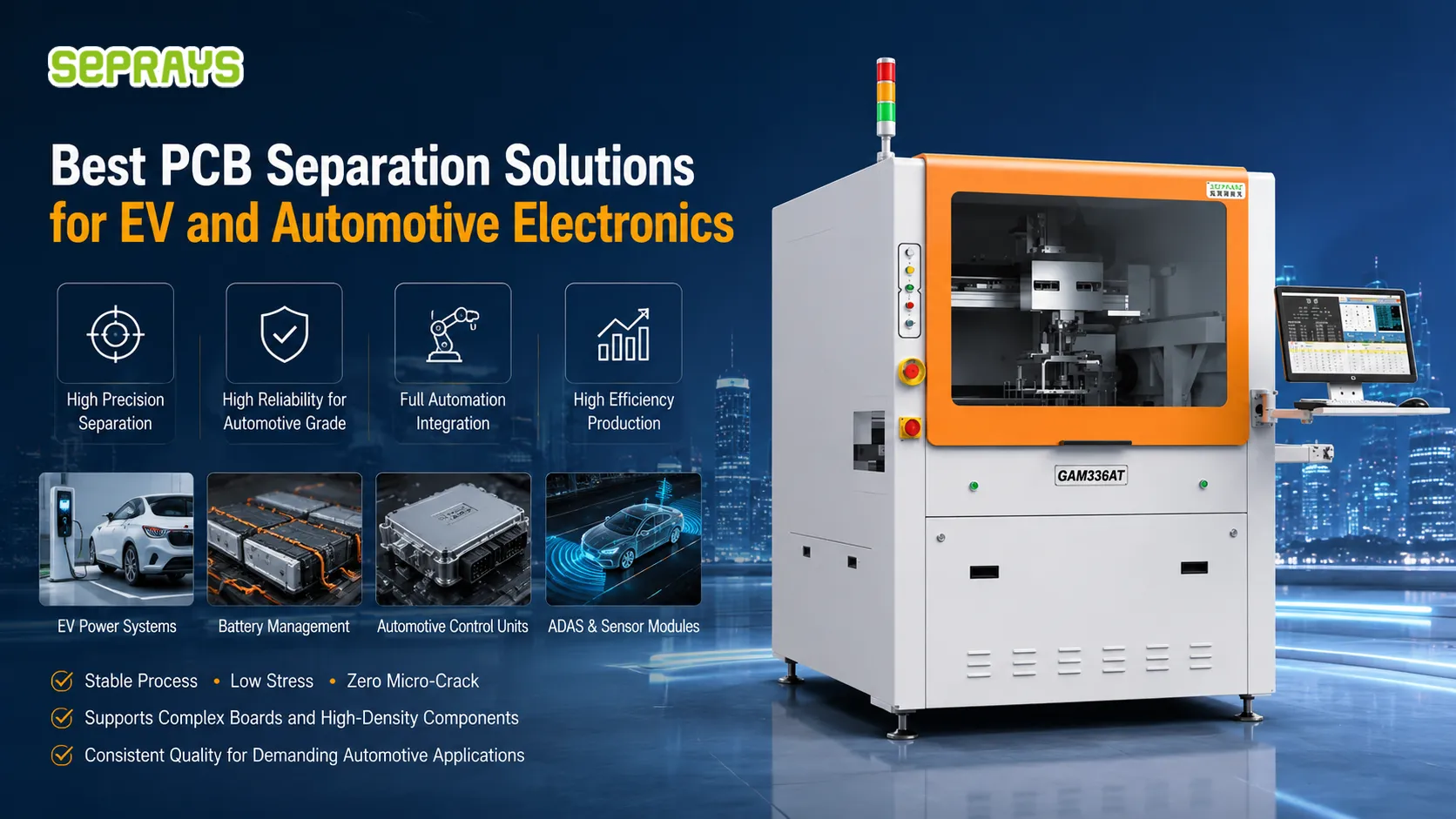
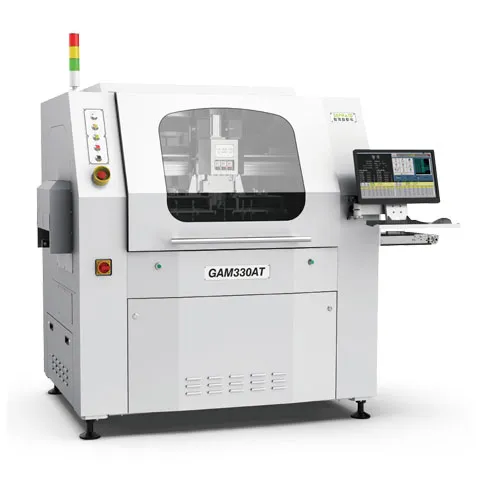
The GAM330AT Inline PCB Router Machine is designed for this type of smart manufacturing environment, helping factories connect PCB separation with SMT production lines and reduce unnecessary manual handling.
🏭 Why Smart Factory Electronics Manufacturing Requires Better PCB Integration
Modern electronics manufacturing is moving toward higher automation levels.
Factories producing:
- Smart consumer electronics
- Communication modules
- Industrial control boards
- IoT devices
- Automotive electronic assemblies
often need to manage thousands of PCB assemblies every month.
At this scale, traditional standalone equipment may create several challenges.
Production Flow Becomes More Important
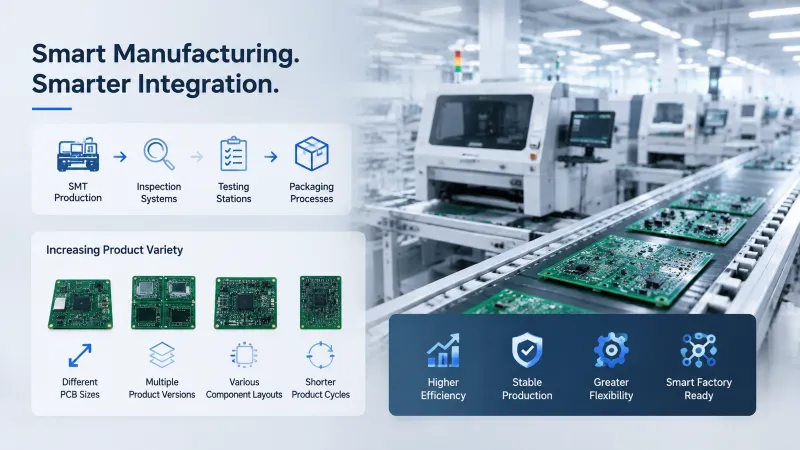
A PCB separation process does not exist alone.
It is connected with:
- SMT production
- Inspection systems
- Testing stations
- Packaging processes
If one process requires manual transportation, the entire production rhythm may be affected.
For example:
A PCB router may complete cutting accurately.
But if operators spend significant time moving boards between machines, the overall efficiency improvement becomes limited.
Increasing Product Variety
Many electronics manufacturers no longer produce only one product model.
A single production line may handle:
- Different PCB sizes
- Multiple product versions
- Various component layouts
- Shorter product cycles
This creates higher requirements for equipment flexibility.
The challenge is not only processing speed.
It is maintaining stable production when conditions continuously change.
⚠️ Common Challenges When PCB Routing Is Separate from SMT Production
Many factories experience similar problems when upgrading from traditional production methods.
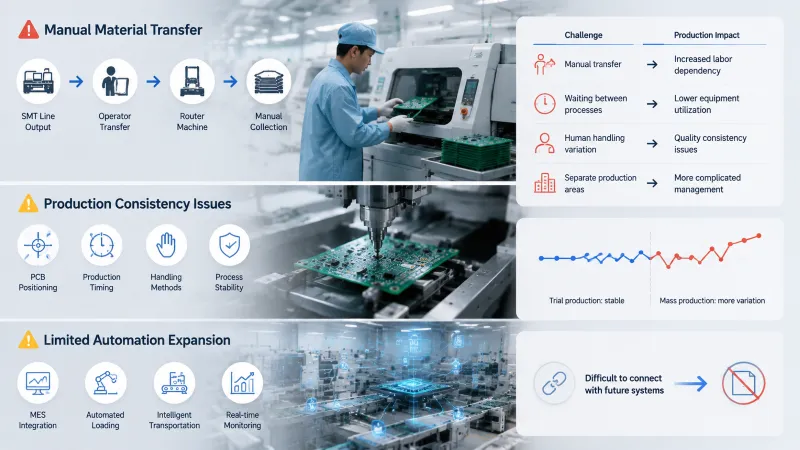
Manual Material Transfer
A common workflow includes:
SMT line output → Operator transfer → Router machine → Manual collection
This creates additional operations.
Although each transfer may only take a few seconds, the accumulated time can become significant.
Potential impacts include:
| Challenge | Production Impact |
|---|---|
| Manual transfer | Increased labor dependency |
| Waiting between processes | Lower equipment utilization |
| Human handling variation | Quality consistency issues |
| Separate production areas | More complicated management |
Production Consistency Issues
For high-volume electronics manufacturing, repeatability is critical.
Manual operations may influence:
- PCB positioning
- Production timing
- Handling methods
- Process stability
A process that performs well during trial production may face different challenges during long-term mass production.
Limited Automation Expansion
Smart factories are moving toward connected manufacturing.
Many manufacturers are considering:
- MES integration
- Automated loading
- Intelligent transportation
- Real-time production monitoring
Equipment that cannot connect with future systems may create limitations later.
⚙️ How GAM330AT Connects PCB Routing with SMT Line Manufacturing
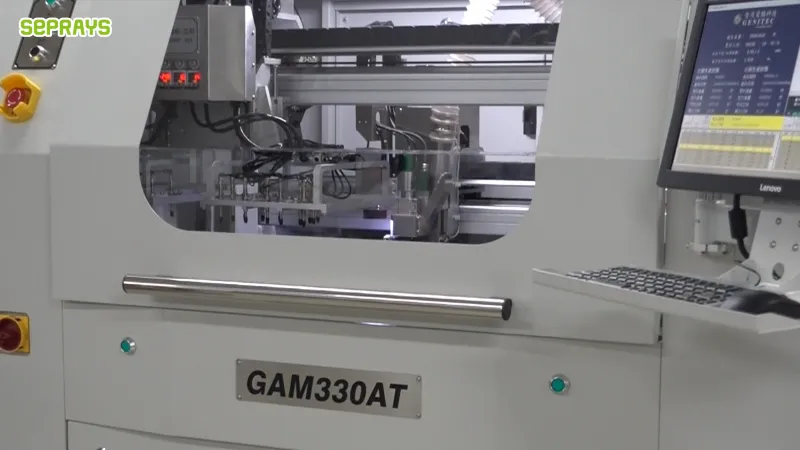
The GAM330AT Inline PCB Router Machine focuses on improving the complete production workflow rather than only the cutting process.
The main concept is:
SMT production + automatic PCB routing + continuous material flow
Inline Production Integration
The GAM330AT can be integrated into automated production lines.
This helps reduce unnecessary manual transportation between processes.
A typical workflow becomes:
SMT Assembly → Inspection → GAM330AT PCB Routing → Next Manufacturing Stage
This creates a more connected production environment.
Automatic PCB Processing
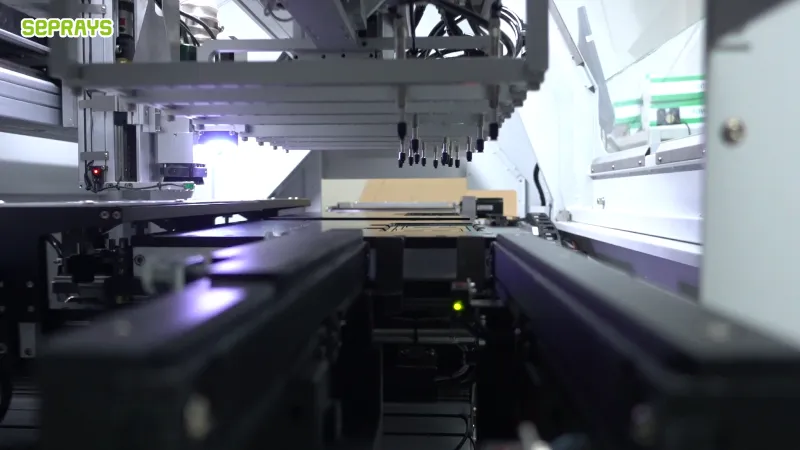
The system supports automated PCB handling and routing operations.
Key functions include:
- Automatic board positioning
- Precision routing control
- Stable PCB processing
- Automated production coordination
For manufacturers producing large quantities of electronic assemblies, reducing manual intervention can improve process consistency.
Flexible Manufacturing Capability
Electronics production changes quickly.
The same factory may manufacture different products within a short period.
The GAM330AT supports flexible production management, helping manufacturers adapt to:
- Different PCB models
- Different production requirements
- Changing customer orders
The goal is not simply faster cutting.
The goal is a more predictable production process.
📊 GAM330AT Compared with Traditional PCB Routing Methods
Different factories have different requirements.
There is no single solution suitable for every application.
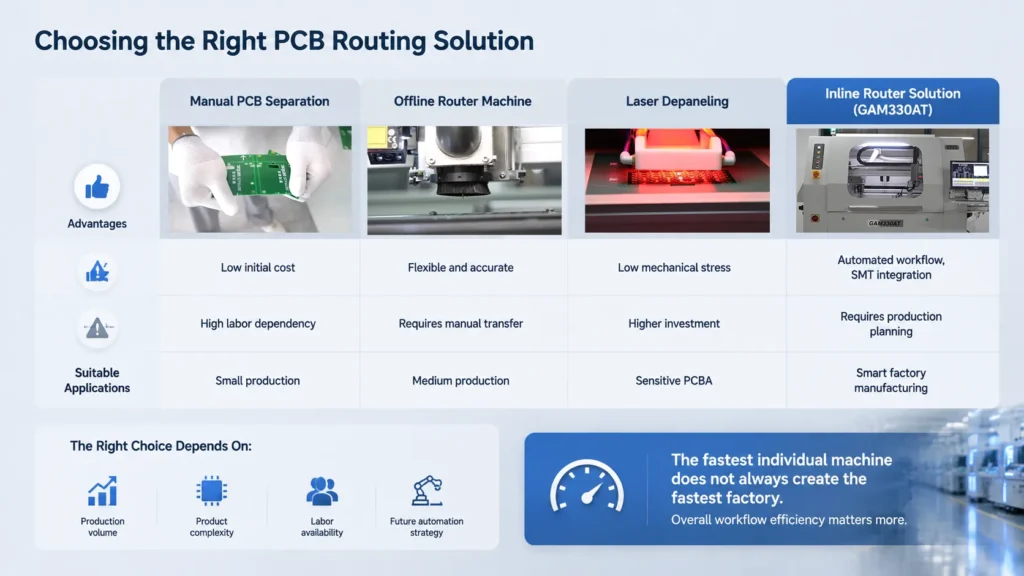
| Solution | Advantages | Limitations | Suitable Applications |
|---|---|---|---|
| Manual PCB Separation | Low initial cost | High labor dependency | Small production |
| Offline Router Machine | Flexible and accurate | Requires manual transfer | Medium production |
| 레이저 구분 | Low mechanical stress | Higher investment | Sensitive PCBA |
| Inline Router Solution (GAM330AT) | Automated workflow, SMT integration | Requires production planning | Smart factory manufacturing |
The right choice depends on:
- Production volume
- Product complexity
- Labor availability
- Future automation strategy
An important point many engineers discover:
The fastest individual machine does not always create the fastest factory.
Overall workflow efficiency matters more.
💰 Evaluating the Real Cost of PCB Production
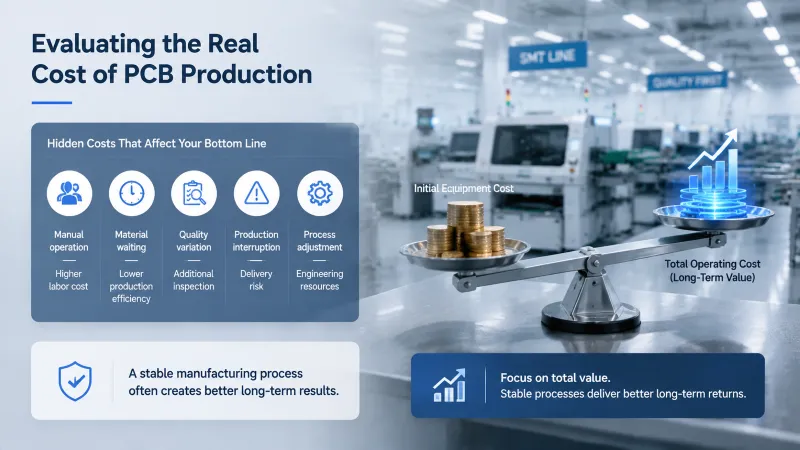
When purchasing production equipment, many companies initially focus on machine price.
However, experienced manufacturing teams usually evaluate total operating costs.
Hidden costs may include:
| Cost Factor | Possible Impact |
|---|---|
| Manual operation | Higher labor cost |
| Material waiting | Lower production efficiency |
| Quality variation | Additional inspection |
| Production interruption | Delivery risk |
| Process adjustment | Engineering resources |
For example:
A factory producing tens of thousands of PCB assemblies monthly may gain more value from reducing process interruptions than from choosing the lowest-cost equipment.
A stable manufacturing process often creates better long-term results.
🌍 Real Manufacturing Example: Improving Smart Electronics Production Efficiency
An overseas semiconductor and electronics manufacturer producing communication and industrial control modules faced a common production challenge.
The SMT lines were operating efficiently.
However, the PCB separation process still depended on manual transportation.
Engineers noticed:
- Increased operator workload
- Unstable production rhythm
- Difficulties in coordinating different processes
After evaluating several approaches, the company introduced a Seprays GAM330AT inline PCB routing solution into selected production lines.
After process optimization:
- PCB transfer steps were reduced
- Production flow became more continuous
- Operator involvement decreased
- Manufacturing coordination improved
The key lesson was not simply adding automation.
It was connecting previously separated processes into one smoother workflow.
🚀 Why GAM330AT Supports Future Smart Factory Development
Electronics manufacturing will continue moving toward:
- Higher automation
- More connected equipment
- Shorter production cycles
- Greater product diversity
Manufacturers should consider not only today’s production needs but also future expansion.
Before selecting an inline PCB routing solution, engineers should ask:
- Can the equipment connect with existing production lines?
- Can it handle future product changes?
- Can it reduce unnecessary manual processes?
- Can it support smart factory development?
The GAM330AT provides a practical approach for manufacturers seeking more connected PCB processing.
For smart electronics factories, PCB routing is no longer only a cutting operation.
It is part of the complete manufacturing ecosystem.
🏢 Why Choose Seprays Group?
Seprays Group has been dedicated to PCB/FPC depaneling technology for more than 30 years, continuously developing reliable solutions for global electronics manufacturers.
The company provides a complete range of PCB processing solutions, including milling-cutter depanelers, laser depanelers, V-groove depanelers, punching depanelers, and automated handling systems.
Seprays equipment is trusted by leading manufacturers such as Foxconn, Flextronics, State Grid, Luxshare, Compal, Wistron, China Electronics, Quanta, CRRC, China Aerospace, OPPO, ZTE, and Bosch. These solutions are applied in factories across China and worldwide.
With long-term experience in PCB separation technology, Seprays focuses on helping manufacturers improve production stability, automation capability, and process efficiency.
For companies evaluating PCB routing automation, smart factory integration, or customized depaneling solutions, Seprays provides engineering support based on real manufacturing requirements.
If you need a suitable PCB separation solution for your production line, please get in touch with us.
WhatsApp: +8618929266433
이메일: sales@seprays.com
❓ FAQ
1. What is the main advantage of the GAM330AT Inline PCB Router Machine?
The main advantage is its ability to integrate PCB routing with automated production workflows, helping reduce manual transfer and improve production continuity.
2. Can the GAM330AT be connected with an SMT production line?
Yes. The GAM330AT is designed for inline manufacturing environments and can work with automated production systems depending on factory requirements.
3. Is an inline PCB router suitable for small production volumes?
It depends on production goals. Small-volume manufacturers may prefer offline solutions, while factories with continuous production often benefit more from inline automation.
4. What industries can use the GAM330AT?
Typical applications include smart electronics, communication equipment, industrial electronics, IoT products, and other high-volume PCB assembly manufacturing.
5. How should manufacturers choose between offline and inline PCB routing solutions?
Manufacturers should evaluate production volume, product complexity, labor availability, and future automation plans instead of focusing only on equipment price.