.png)
 English
  Spanish
  Japanese
  Korean
  Russian
  Chinese
PCB depaneling is one of the most critical stages in electronics manufacturing — it separates assembled boards from production panels while ensuring precision, speed, and minimal mechanical stress. But as technology advances, manufacturers face a key question:
Should you choose router depaneling or laser depaneling for your production line?

Both methods have unique advantages, costs, and ideal application scenarios. This article presents a real-world comparison of router versus laser PCB depaneling, providing insights from factory experiences, cost analysis, and performance data.
🔍 The Pain Points of Traditional Depaneling
Before the advent of modern automation, many factories relied on manual cutting or V-scoring methods. These older techniques, though simple, caused several recurring issues:
- Burrs and cracks from mechanical stress.
- Inconsistent cut quality due to human variation.
- High maintenance from tool wear.
- Dust contamination is affecting downstream processes.
- Safety risks for operators during repetitive cutting.
As PCB designs became thinner and denser — especially in automotive, communication, and consumer electronics — manufacturers realized that traditional methods couldn’t maintain precision or yield.
This led to two modern alternatives: router depaneling and laser depaneling.
⚡ Router Depaneling: Proven, Flexible, and Reliable
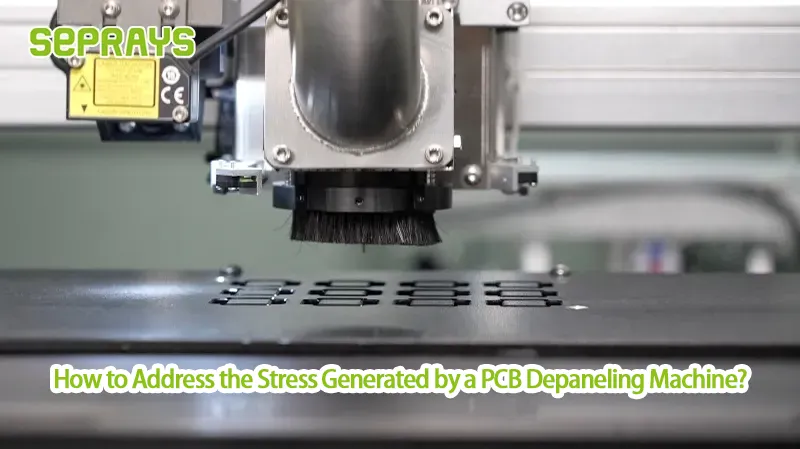
A router depaneling machine uses a high-speed spindle bit to cut PCBs along programmed paths, guided by CCD vision alignment.
✅ Advantages:
- High precision: Perfect for rigid and semi-flex PCBs.
- Adaptable: Works with different board thicknesses and materials.
- Stable yield: Minimizes stress when cutting near components.
- Cost-effective: Lower initial investment and easy integration.
- Smart automation: Modern routers include automatic tool changing, MES connectivity, and tray handling.
⚠️ Limitations:
- Generates dust that requires extraction systems.
- Tool wear over time can slightly affect edge consistency.
- Slight mechanical contact means some stress on the board.
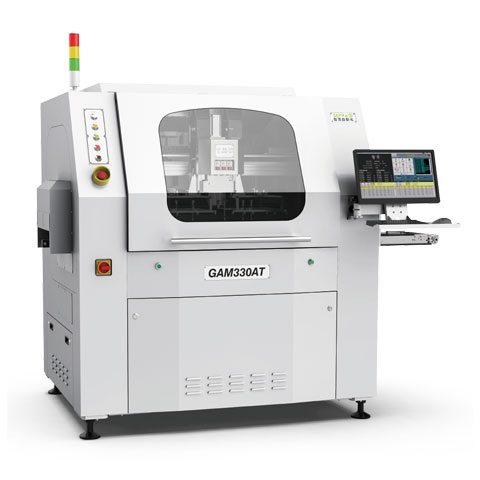
In most SMT production lines, router depaneling offers the ideal balance between speed, cost, and quality — especially when paired with intelligent automation systems like SEPRAYS’ GAM330AT series.
🔬 Laser Depaneling: Stress-Free Cutting for the Next Generation
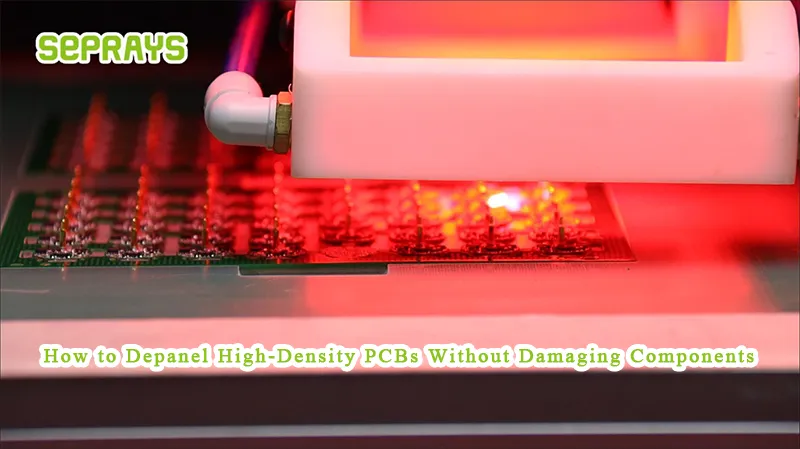
Laser depaneling uses a high-energy beam to vaporize PCB material, separating panels without physical contact. It’s increasingly used for fine-pitch, flexible, and microelectronic applications.
✅ Advantages:
- Zero mechanical stress: Ideal for ultra-thin or fragile PCBs.
- No burrs or debris: Perfect edge quality, no post-cleaning required.
- Micron-level accuracy: Excellent for high-density interconnect (HDI) boards.
- Fully automated process: Integrated with SMT and MES systems.
- Reduced maintenance: No tools, no wear.
⚠️ Limitations:
- Higher equipment cost: Initial investment can be 1.5–2x that of router systems.
- Slower for thick FR4 boards: Cutting speed depends on material thickness.
- Requires trained operators for laser parameter tuning.
For factories focused on miniaturized electronics, automotive sensors, or flex-PCB modules, laser depaneling ensures top-tier quality and reliability.
💰 Cost Analysis: Which One Truly Saves More?
| Factor | Router Depaneling | Laser Depaneling |
|---|---|---|
| Initial Cost | Moderate | High |
| Operating Cost | Tool replacement | Minimal |
| Maintenance | Periodic tool checks | Low |
| Cutting Speed (Rigid PCB) | Fast | Moderate |
| Cutting Speed (Flex PCB) | Moderate | Fast |
| Edge Quality | Excellent | Perfect |
| Stress on PCB | Low | None |
| Dust Generation | Present (manageable) | None |
| Automation Compatibility | High | High |
In high-volume production, routers often deliver a faster return on investment due to lower upfront cost.
However, for precision-critical industries, laser systems may outperform in long-term stability and quality assurance.
🏭 Real Case: Transitioning from Router to Laser in a European Facility
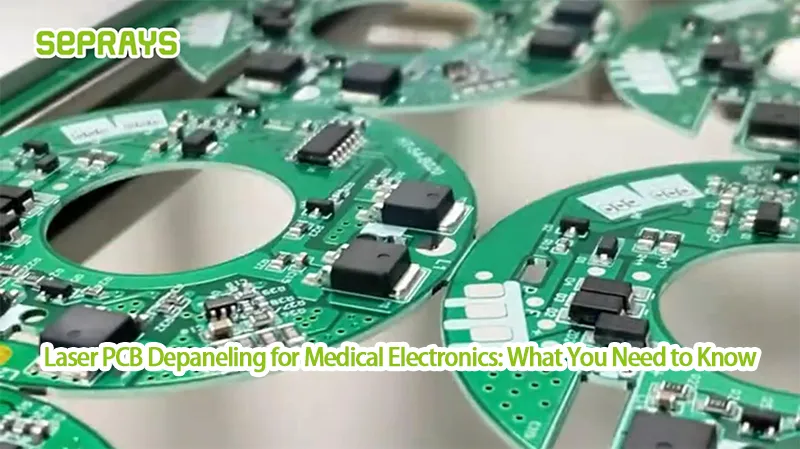
A European electronics manufacturer producing flexible PCBs for medical devices initially relied on router depaneling. Despite good performance, they faced micro-cracks along ultra-thin edges.
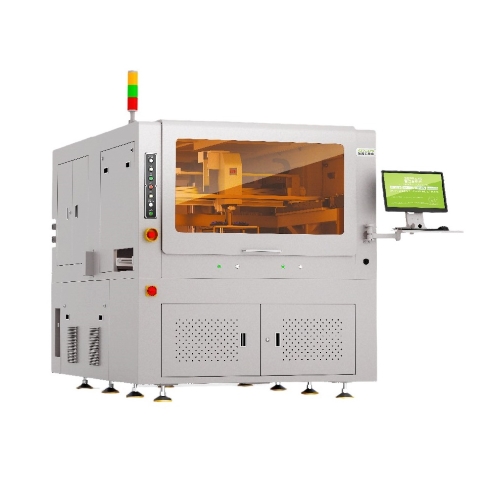
After integrating a SEPRAYS laser depaneling machine, the results included:
- Defect rate reduced by 80%
- Improved cutting consistency across all panel designs
- 30% shorter setup time due to program-based automation
- Faster prototype turnaround, supporting R&D flexibility
The investment paid off within 14 months, thanks to reduced rework and improved yield.
💬 Discussion: Which Is Right for You?
There’s no one-size-fits-all answer — the right solution depends on your production goals:
- Choose router depaneling if you prioritize cost-efficiency, flexibility, and proven reliability.
- Choose laser depaneling if your production involves thin substrates, fine-pitch components, or flex-PCBs requiring zero mechanical stress.
A growing number of smart factories now combine both technologies, using routers for rigid PCBs and lasers for precision tasks — optimizing productivity across multiple product lines.
🌍 Looking Ahead: Automation and Intelligence in Depaneling
As Industry 4.0 continues to reshape manufacturing, the future of PCB depaneling lies in intelligent, data-driven systems. Integration with MES, automatic tool calibration, and AI-based path optimization are already becoming standard features in modern depaneling lines.
Whether router or laser, the key is to ensure process stability, traceability, and consistent edge quality — factors that directly impact downstream yield and customer satisfaction.
⭐ Why Choose Seprays Group?
With over 32 years of expertise, Seprays Group is a leading global provider of PCB depaneling technology, specializing in router, laser, V-cut, and punching machines.
We deliver complete automation solutions—from R&D design to manufacturing integration—ensuring every customer achieves high-speed, stress-free, and precise depaneling performance.
If your factory is evaluating router vs. laser depaneling,
Contact Seprays Group today.
📱 WhatsApp: +86 189 2926 6433
📧 E-mail: sales@seprays.com
Our engineers will help you identify the most cost-effective, future-ready solution for your production line.