.png)
 Russian
  English
  Spanish
  Japanese
  Korean
  Chinese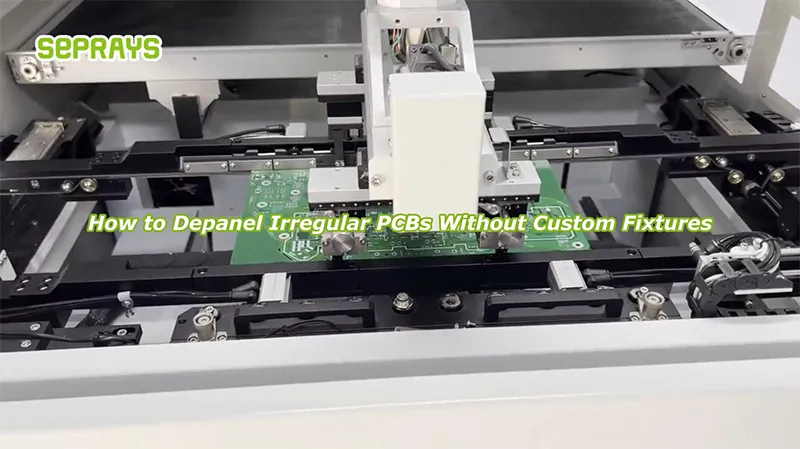
Irregular PCB depaneling has become a growing challenge for electronics manufacturers in 2026.
As PCB designs become smaller, more complex, and increasingly customized, many production teams are finding that traditional fixture-based depaneling methods no longer provide the flexibility they need.
Circular boards.
L-shaped boards.
Sensor modules.
Automotive control units.
Wearable electronics.
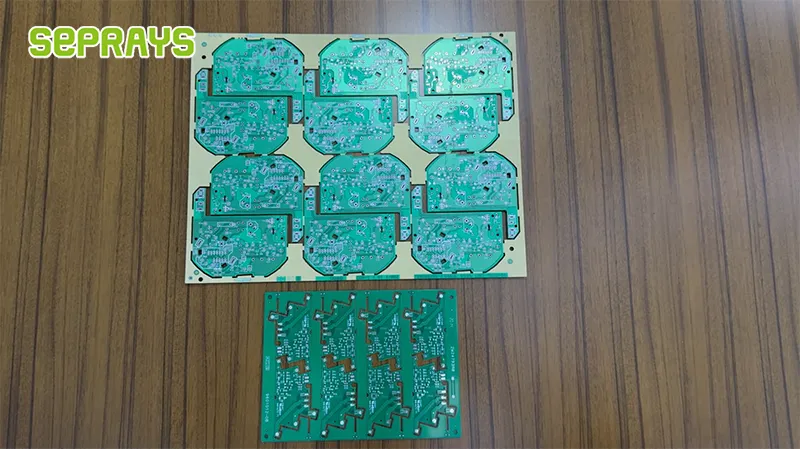
These products often feature unique outlines that make conventional fixtures expensive, time-consuming, and difficult to manage.
The question many engineers are asking today is simple:
Can irregular PCBs be depaneled accurately without custom fixtures?
In many cases, the answer is yes.
Modern vision-guided PCB router systems are making fixture-less production practical for a wide range of applications.
🔍Why Irregular PCB Shapes Create Manufacturing Challenges
Not every PCB is designed as a simple rectangle.
Today’s products often require:
- Curved edges
- Non-standard outlines
- Multiple cut paths
- Embedded connectors
- Edge-mounted components
While these designs improve product performance, they create challenges during separation.
Common production issues include:
- Fixture manufacturing costs
- Long changeover times
- Positioning inaccuracies
- Increased operator workload
- Reduced flexibility for small-batch production
For high-mix manufacturing environments, these problems quickly become expensive.
⚠️The Hidden Cost of Custom Fixtures
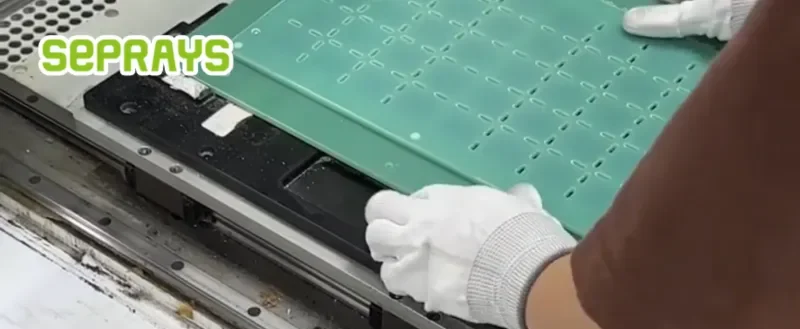
Many factories automatically assume that custom fixtures are necessary.
However, the real cost is often underestimated.
A fixture may seem inexpensive initially.
But when production includes dozens of PCB models, costs accumulate rapidly.
Typical Fixture-Related Expenses
| Cost Factor | Impact |
|---|---|
| Fixture design | Engineering time |
| Fixture manufacturing | Additional investment |
| Storage requirements | Factory space consumption |
| Changeover time | Production downtime |
| Fixture wear | Maintenance cost |
| Product updates | Fixture redesign |
Surprisingly, some factories spend more time managing fixtures than improving their actual depaneling process.
This is especially common in EMS factories handling multiple customer projects simultaneously.
🚀 Why Fixture-Less Depaneling Is Gaining Popularity
One major manufacturing trend in 2026 is flexibility.
Customers expect:
- Faster delivery
- More product variants
- Smaller production batches
- Shorter product life cycles
Traditional fixture-dependent processes struggle to keep up.
Fixture-less depaneling addresses these challenges by using machine vision instead of mechanical positioning.
The result:
- Faster product changeovers
- Reduced tooling investment
- Greater manufacturing flexibility
For many factories, this approach aligns better with modern production demands.
🛠️ How CCD Vision Alignment Changes the Process
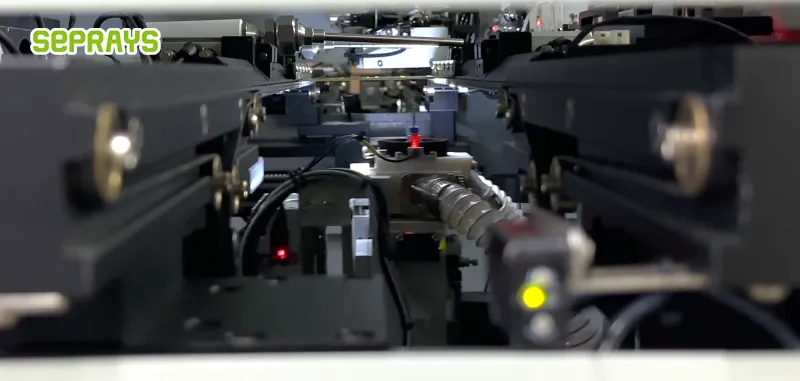
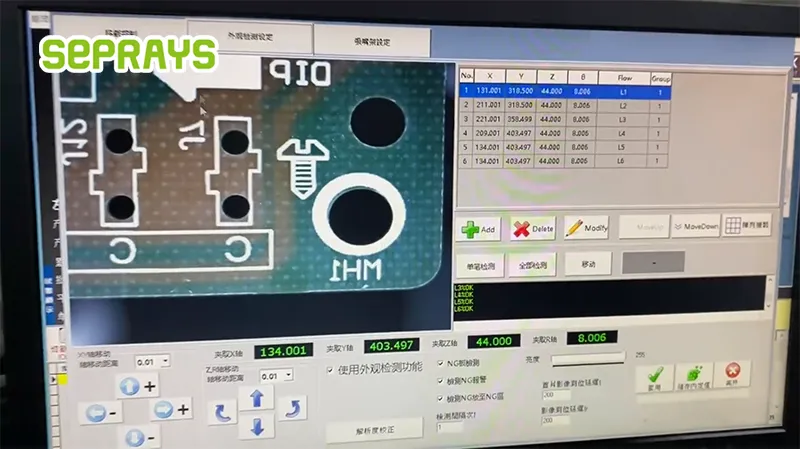
The key technology behind fixture-less depaneling is CCD vision alignment.
Rather than relying on a physical fixture, the system automatically identifies fiducial marks or board features.
This allows the machine to compensate for:
- PCB positioning variations
- Panel placement differences
- Manufacturing tolerances
Many engineers are surprised by how much setup time can be eliminated.
A common production challenge looks like this:
Frequent product changes.
Manual fixture replacement.
Repeated alignment adjustments.
Lost production hours.
Vision-guided systems reduce much of this complexity.
The machine adapts to the board.
Not the other way around.
📈 Real Factory Scenario: High-Mix Production Bottleneck
One electronics manufacturer producing industrial control modules faced continuous changeover delays.
More than 30 PCB variants were processed every month.
Most boards featured irregular outlines.
Operators spent significant time:
- Replacing fixtures
- Verifying positioning
- Running test cuts
The actual cutting process was fast.
The setup process was not.
After evaluating a fixture-less routing solution using the ГАМ385АТ platform, the factory significantly reduced setup-related downtime.
The biggest improvement was not cutting speed.
It was production flexibility.
This is a lesson many manufacturers discover only after examining their overall workflow.
🏭 Why GAM385AT Is Suitable for Irregular PCB Applications
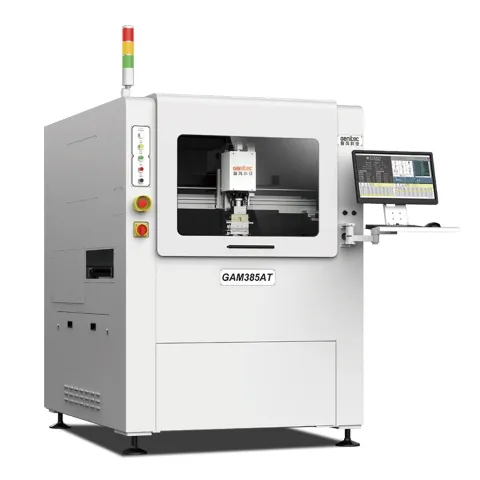
The GAM385AT was designed for manufacturers facing frequent product changes and complex PCB geometries.
Key capabilities include:
- High-speed routing
- CCD vision positioning
- Fixture-less processing
- Automatic board recognition
- Offline programming support
- High-mix production compatibility
For factories handling various PCB designs, these features can considerably simplify daily operations.
Instead of creating new fixtures for every project, engineers can focus on optimizing production flow.
💡 A Counterintuitive Lesson From Production Lines
Many managers focus exclusively on machine speed.
Faster spindle.
Higher cutting rate.
Shorter cycle time.
Those factors matter.
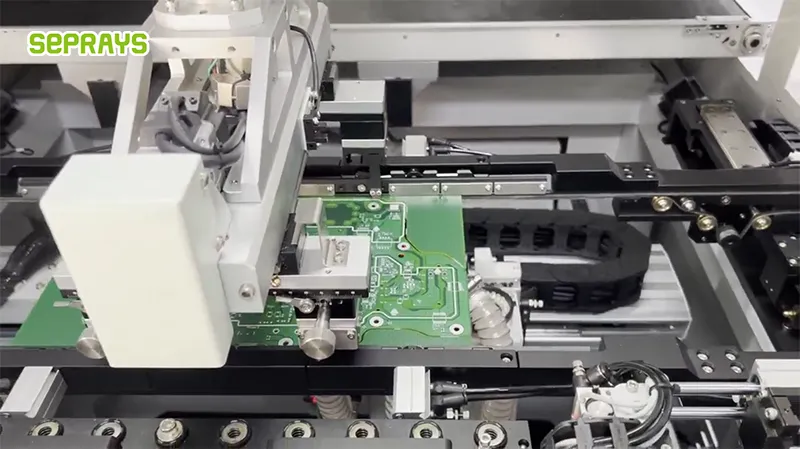
But in many high-mix environments, setup time creates a larger bottleneck than cutting time.
A machine that saves 10 minutes during every changeover may deliver greater overall productivity than one that cuts a few seconds faster.
This is one reason fixture-less technology is receiving increased attention across the electronics industry.
📊 Fixture-Based vs Fixture-Less Depaneling
| Comparison Factor | Fixture-Based | Fixture-Less Vision System |
| Initial Tooling Cost | Medium to High | Low |
| Product Changeover | Slow | Fast |
| New Product Introduction | Requires New Fixture | Software-Based |
| Storage Requirements | High | Minimal |
| High-Mix Production | Limited Flexibility | Excellent |
| Position Compensation | Mechanical | Vision-Based |
| Scalability | Moderate | High |
The best choice depends on production requirements.
For long-term mass production of a single PCB design, fixtures may still be practical.
For diverse product portfolios, vision-guided solutions often provide greater value.
🔧 Best Practices for Depaneling Irregular PCBs
Successful implementation usually involves several key considerations:
1. Optimize PCB Panel Design
Early collaboration between PCB designers and manufacturing teams helps reduce processing difficulties later.
2. Maintain Fiducial Quality
Reliable vision alignment depends on clear and consistent fiducials.
3. Use Offline Programming
Programming outside production minimizes downtime.
4. Evaluate Component Clearance
Cutting paths should account for nearby components and connectors.
5. Analyze Total Production Cost
Look beyond the machine price.
Consider labor, tooling, maintenance, and changeover efficiency.
🌎 What Manufacturers Are Prioritizing in 2026
Based on current industry trends, manufacturers are focusing on:
- Faster product introductions
- Reduced labor dependency
- Smart factory integration
- Lower tooling costs
- Flexible automation
As product diversity continues to increase, fixture-less depaneling is becoming less of a niche solution and more of a mainstream manufacturing strategy.
For many factories, flexibility now has measurable economic value.
Why Choose Seprays Group?
With more than 30 years of experience in PCB and FPC depaneling technology, Seprays Group helps electronics manufacturers improve production efficiency, product quality, and automation capability.
Seprays Group has been dedicated to PCB/FPC depaneling technology, providing a full range of solutions—including milling-cutter depanelers, laser depanelers, V-groove depanelers, punching depanelers, hybrid depaneling systems, and fully automated handling solutions.
Our equipment is trusted by globally recognized manufacturers such as Foxconn, Flextronics, State Grid, Luxshare, Compal, Wistron, China Electronics, Quanta, CRRC, China Aerospace, OPPO, ZTE, and Bosch. These solutions are widely deployed across automotive electronics, consumer electronics, telecommunications, industrial control, medical electronics, and semiconductor manufacturing facilities worldwide.
For irregular PCB applications, Seprays provides:
- CCD vision-guided routing systems
- Fixture-less depaneling solutions
- High-mix production support
- Automated loading and unloading integration
- Customized process evaluation
- Professional technical support
If you are evaluating the best depaneling solution for irregular PCB designs, feel free to contact us for application analysis and expert recommendations.
WhatsApp: +8618929266433
Электронная почта: sales@seprays.com
Вопросы и ответы
1. Can irregular PCBs be depaneled without custom fixtures?
Yes. Modern CCD vision-guided router systems can accurately locate and process irregular PCB shapes without dedicated fixtures in many applications.
2. What types of PCBs benefit most from fixture-less depaneling?
Automotive modules, sensor boards, wearable electronics, medical devices, IoT products, and industrial control boards often benefit from fixture-less processing.
3. Does fixture-less depaneling reduce accuracy?
No. When combined with CCD vision alignment, fixture-less systems can maintain excellent positioning accuracy while improving flexibility.
4. Is fixture-less depaneling suitable for high-mix production?
Yes. It is particularly valuable for manufacturers handling frequent product changes and multiple PCB designs.
5. How does GAM385AT improve production efficiency?
The GAM385AT combines CCD vision alignment, offline programming, and fixture-less operation to reduce setup time, improve flexibility, and support efficient processing of complex PCB designs.