.png)
 Russian
  English
  Spanish
  Japanese
  Korean
  Chinese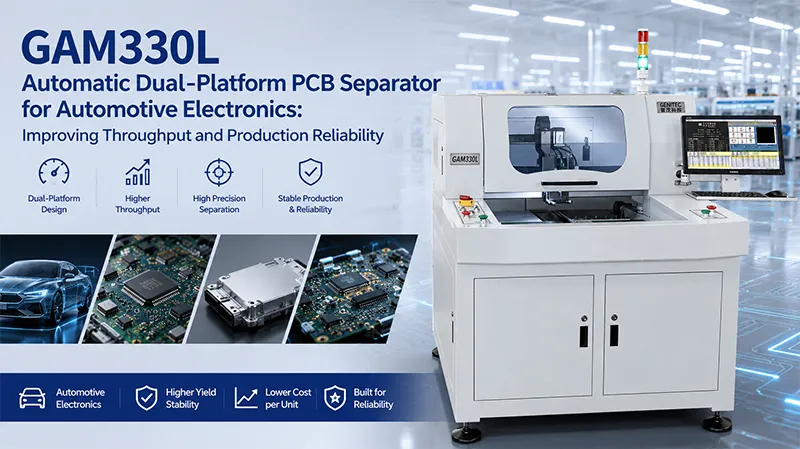
GAM330L Automatic Dual-Platform PCB Separator technology is becoming a larger discussion point inside automotive electronics manufacturing in 2026. The reason is not simply speed. Production teams increasingly face a different challenge: maintaining stable quality while output continues growing.
Several years ago, separating automotive PCBA panels was often considered a standard process step. Today, it increasingly affects long-term reliability, production cost, and yield consistency.
As vehicle electronics continue evolving toward ADAS systems, battery management modules, vehicle communication units, and intelligent sensors, manufacturers are discovering that separation quality directly influences product performance.
A small crack created during cutting may not appear immediately.
Sometimes it appears months later.
That is where production concerns start becoming expensive.
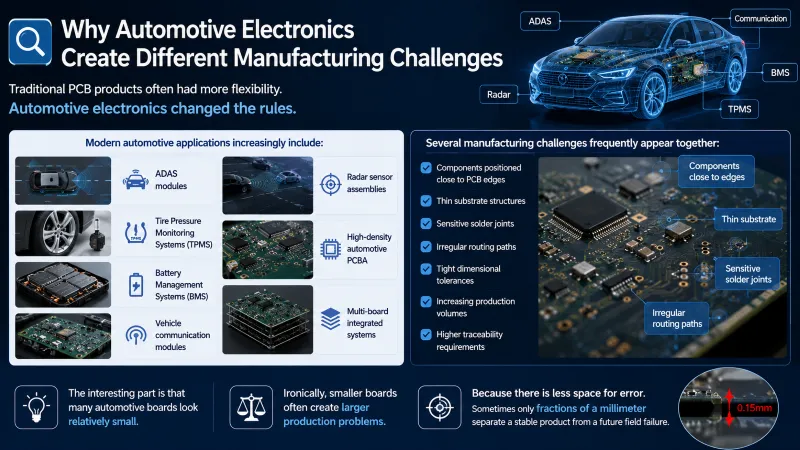
🔍 Why Automotive Electronics Create Different Manufacturing Challenges
Traditional PCB products often had more flexibility.
Automotive electronics changed the rules.
Modern automotive applications increasingly include:
- ADAS modules
- Tire Pressure Monitoring Systems (TPMS)
- Battery Management Systems (BMS)
- Vehicle communication modules
- Radar sensor assemblies
- High-density automotive PCBA
- Multi-board integrated systems
Several manufacturing challenges frequently appear together:
- Components positioned close to PCB edges
- Thin substrate structures
- Sensitive solder joints
- Irregular routing paths
- Tight dimensional tolerances
- Increasing production volumes
- Higher traceability requirements
The interesting part is that many automotive boards look relatively small.
Ironically, smaller boards often create larger production problems.
Because there is less space for error.
Sometimes only fractions of a millimeter separate a stable product from a future field failure.
⚠️ Common Questions Production Teams Keep Asking
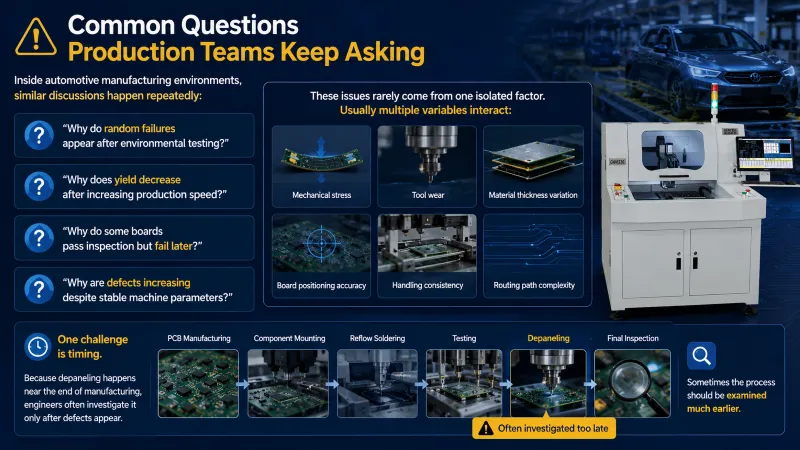
Inside automotive manufacturing environments, similar discussions happen repeatedly:
“Why do random failures appear after environmental testing?”
“Why does yield decrease after increasing production speed?”
“Why do some boards pass inspection but fail later?”
“Why are defects increasing despite stable machine parameters?”
These issues rarely come from one isolated factor.
Usually, multiple variables interact:
- Mechanical stress
- Tool wear
- Material thickness variation
- Board positioning accuracy
- Handling consistency
- Routing path complexity
One challenge is timing.
Because depaneling happens near the end of manufacturing, engineers often investigate it only after defects appear.
Sometimes the process should be examined much earlier.
🏭 The Story Behind Why Seprays Developed GAM330L
Several years ago, Seprays engineers observed a recurring issue while supporting automotive projects.
The discussion was rare:
“How can we cut faster?”
The discussion became:
“How can we maintain stable quality while production volume doubles?”
A project in Stuttgart, Germany, involving automotive control module manufacturing highlighted something interesting.
The customer had already improved inspection systems.
They upgraded the testing equipment.
They optimized production parameters.
Yet random failures still appeared.
After reviewing the process flow, engineers discovered an overlooked issue:
The separation process itself created slight mechanical stress variation during high-volume production.
Not enough to trigger immediate failure.
Enough to affect long-term reliability.
That project became part of the motivation behind developing solutions such as GAM330L Automatic Dual-Platform PCB Separator.
The objective was never simply higher speed.
It was improving consistency.
Because consistent production often matters more than peak production.
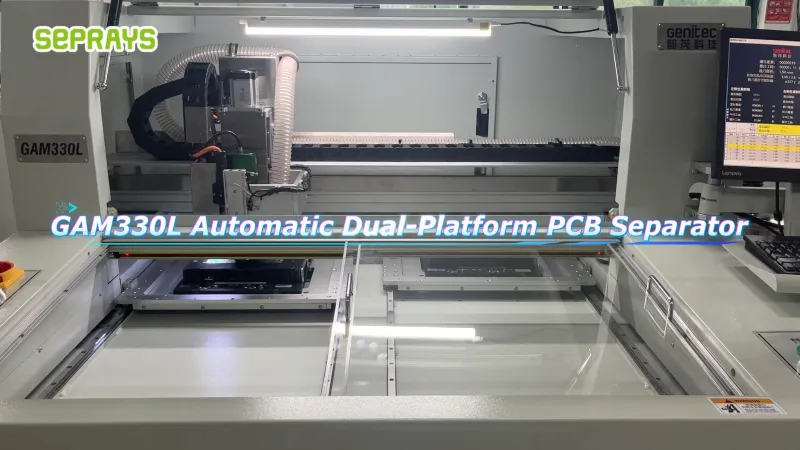
⚙️ How GAM330L Addresses Real Manufacturing Problems
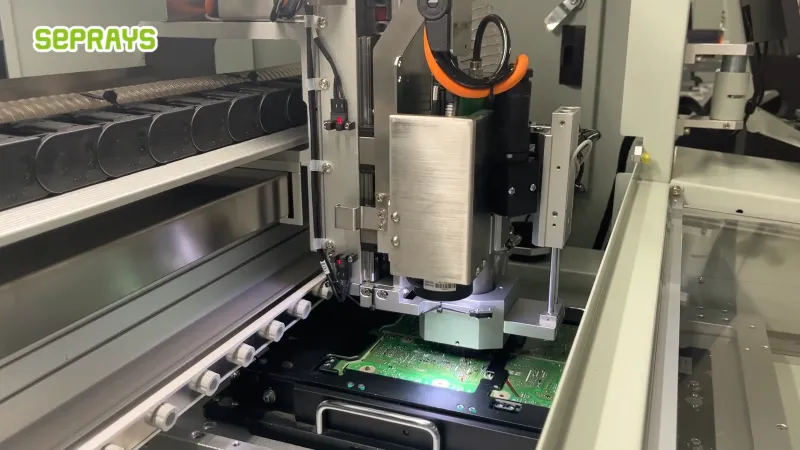
GAM330L introduces a dual-platform architecture designed for continuous inline production environments.
From a practical production perspective, this creates several advantages:
- Reduced waiting time between cycles
- Improved throughput stability
- Less operator intervention
- Better positioning consistency
- Lower handling variation
- Continuous production capability
For automotive manufacturers dealing with increasing production demands, these factors frequently influence final results more than raw machine speed.
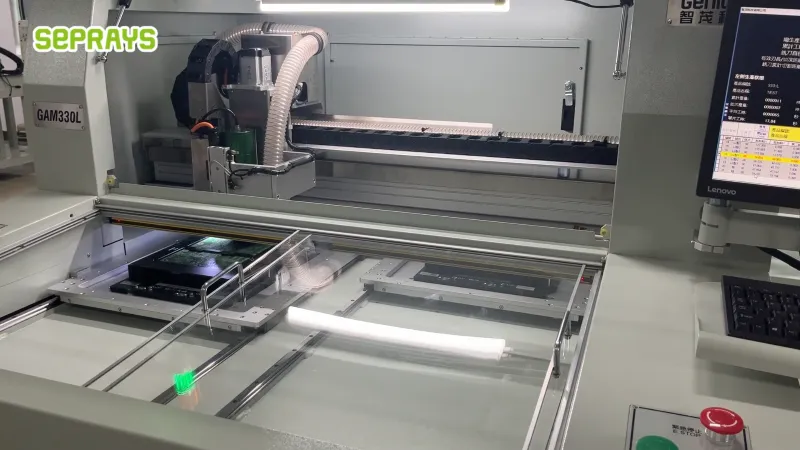
📊 Comparing Traditional Separation and GAM330L Solutions
| Factor | Traditional Separation | GAM330L Dual-Platform Solution |
|---|---|---|
| Handling consistency | Moderate | High |
| Production continuity | Variable | Stable |
| Operator dependence | Higher | Lower |
| Positioning accuracy | Moderate | High |
| Yield stability | Variable | Better |
| Scalability | Limited | Strong |
| Long-term operating cost | Higher | Lower |
The interesting part:
Lower equipment cost does not always create lower manufacturing cost.
Hidden costs often appear later:
- Rework
- Inspection labor
- Yield variation
- Reliability risks
- Production interruptions
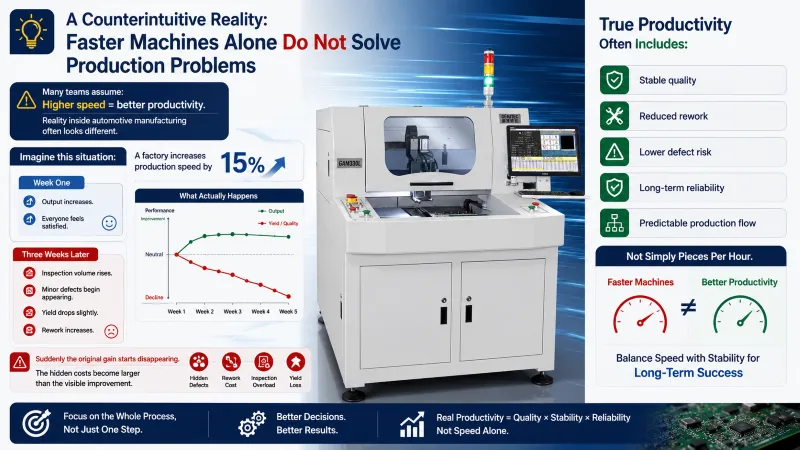
💡 A Counterintuitive Reality: Faster Machines Alone Do Not Solve Production Problems
Many teams assume:
Higher speed = better productivity.
Reality inside automotive manufacturing often looks different.
Imagine this situation:
A factory increases production speed by 15%.
Week one:
Output increases.
Everyone feels satisfied.
Three weeks later:
Inspection volume rises.
Minor defects begin appearing.
Yield drops slightly.
Rework increases.
Suddenly, the original gain starts disappearing.
The hidden costs become larger than the visible improvement.
True productivity often includes:
- Stable quality
- Reduced rework
- Lower defect risk
- Long-term reliability
- Predictable production flow
Not simply pieces per hour.
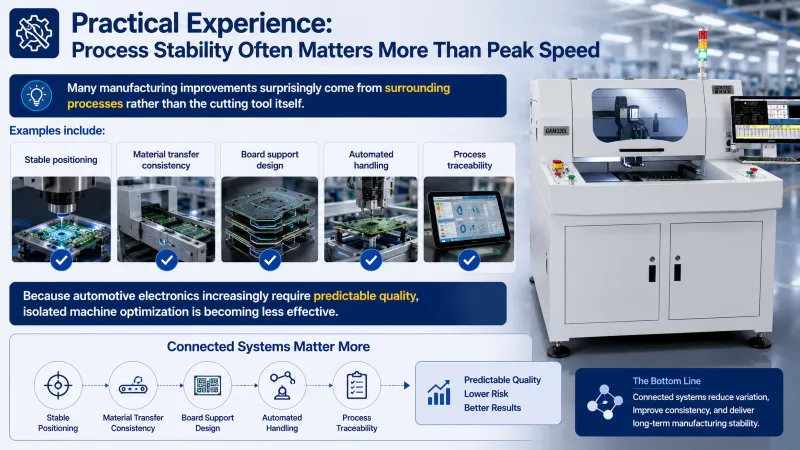
🔧 Practical Experience: Process Stability Often Matters More Than Peak Speed
Many manufacturing improvements surprisingly come from surrounding processes rather than the cutting tool itself.
Examples include:
- Stable positioning
- Material transfer consistency
- Board support design
- Automated handling
- Process traceability
Because automotive electronics increasingly require predictable quality, isolated machine optimization is becoming less effective.
Connected systems matter more.
🚀 Looking Beyond Machine Specifications in 2026
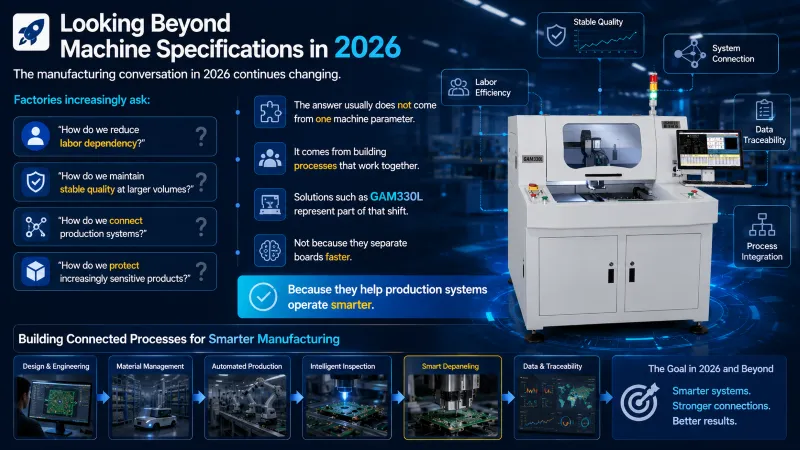
The manufacturing conversation in 2026 continues to change.
Factories increasingly ask:
“How do we reduce labor dependency?”
“How do we maintain stable quality at larger volumes?”
“How do we connect production systems?”
“How do we protect increasingly sensitive products?”
The answer usually does not come from one machine parameter.
It comes from building processes that work together.
Solutions such as GAM330L represent part of that shift.
Not because they separate boards faster.
Because they help production systems operate smarter.
Why Choose Seprays Group?
For more than 30 years, Seprays Group has continuously focused on PCB and FPC depaneling technologies, supporting manufacturers through changing production demands and increasingly complex electronic products.
Seprays Group has been dedicated to PCB/FPC depaneling technology, providing a full range of solutions—including milling-cutter depanelers, laser depanelers, V-groove depanelers, punching depanelers, and automated handling systems.
Our solutions are trusted by global manufacturers, including Foxconn, Flextronics, State Grid, Luxshare, Compal, Wistron, China Electronics, Quanta, CRRC, China Aerospace, OPPO, ZTE, and Bosch, supporting production facilities throughout China and international markets worldwide.
Why do many manufacturers continue working with Seprays:
- 30+ years of industry experience
- Complete PCB/FPC depaneling solutions
- Strong automotive and semiconductor application expertise
- Automation integration capability
- Global installation experience
- Stable long-term support
If your project involves increasingly complex PCB applications, larger production volumes, or higher reliability requirements, please feel free to contact us.
WhatsApp: +8618929266433
Электронная почта: sales@seprays.com
Вопросы и ответы
1. What industries commonly use the GAM330L Automatic Dual-Platform PCB Separator?
GAM330L is commonly used in automotive electronics, communication modules, industrial electronics, consumer devices, medical products, and other high-volume PCB manufacturing environments.
2. Why is dual-platform design beneficial?
Dual-platform architecture reduces idle time between cycles, improves throughput, and supports more stable continuous production.
3. Can GAM330L handle high-density automotive PCBA?
Yes. It is designed to support precise routing requirements commonly found in automotive electronics and compact PCB assemblies.
4. Does higher routing speed always improve productivity?
Not necessarily. Excessive speed may increase stress, inspection workload, and rework cost. Stable quality often creates better overall productivity.
5. Why is PCB depaneling becoming more important in 2026?
Modern electronics continue to become smaller and more complex. As component density increases, separation quality increasingly affects reliability and manufacturing cost.