.png)
 Russian
  English
  Spanish
  Japanese
  Korean
  Chinese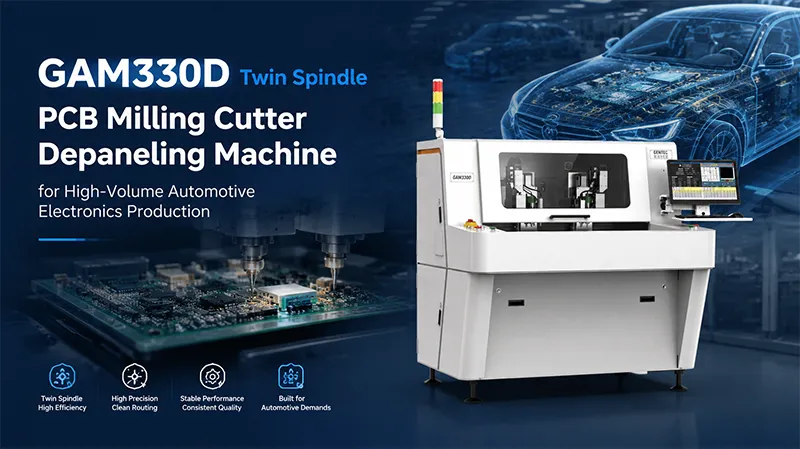
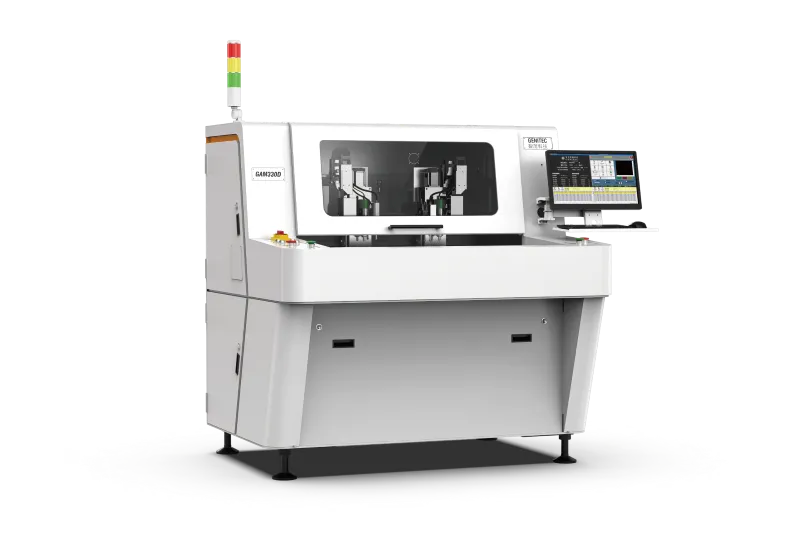
GAM330D Twin Spindle PCB Milling Cutter Depaneling Machine was developed for a challenge many automotive electronics manufacturers are facing today: how to increase PCB separation efficiency without sacrificing accuracy and reliability.
In automotive electronics production, PCB panels are becoming more complex. More control modules, sensors, and communication units are being installed in vehicles. At the same time, manufacturers must maintain strict quality standards because a small defect can create expensive field problems.
Many factories have already optimized SMT placement and testing processes. However, the depaneling stage is sometimes overlooked.
A question worth discussing is:
Can your current PCB separation process support the next generation of automotive electronics?
🚗 Why Automotive Electronics Need a Different Depaneling Approach
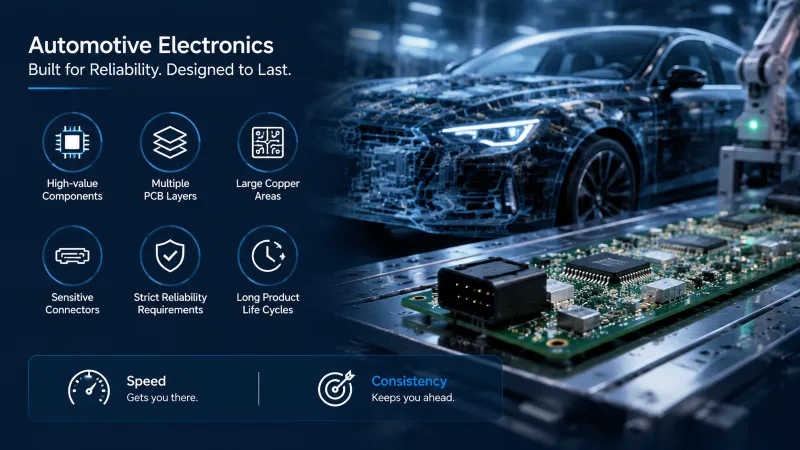
Automotive PCBs are not the same as standard consumer electronics boards.
They often include:
- High-value components
- Multiple PCB layers
- Large copper areas
- Sensitive connectors
- Strict reliability requirements
- Long product life cycles
A smartphone PCB may be replaced after a few years.
An automotive electronic control unit may need to operate reliably for more than ten years.
This difference changes how manufacturers evaluate production equipment.
Speed is important.
But consistency is often more important.
A faster machine that increases hidden defects may create higher costs later.
⚠️ Common Production Challenges in High-Volume PCB Manufacturing
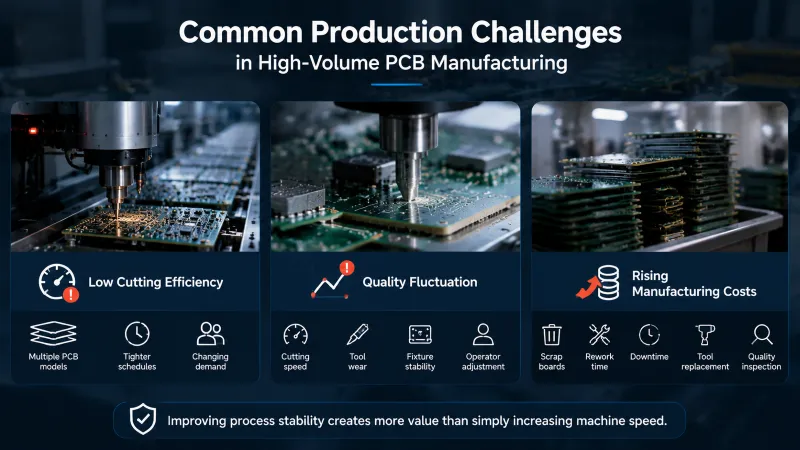
During daily production, engineers often encounter similar problems:
Low Cutting Efficiency
Single-spindle equipment may become a bottleneck when production volume increases.
Especially when:
- Multiple PCB models share the same line
- Production schedules become tighter
- Customer demand changes quickly
Quality Fluctuation
Even small variations in:
- Cutting speed
- Tool wear
- Fixture stability
- Operator adjustment
can affect the final PCB edge quality.
Rising Manufacturing Costs
The real cost is not only the machine investment.
It also includes:
- Scrap boards
- Rework time
- Production downtime
- Tool replacement
- Quality inspection
Many manufacturers discover that improving process stability creates more value than simply increasing machine speed.
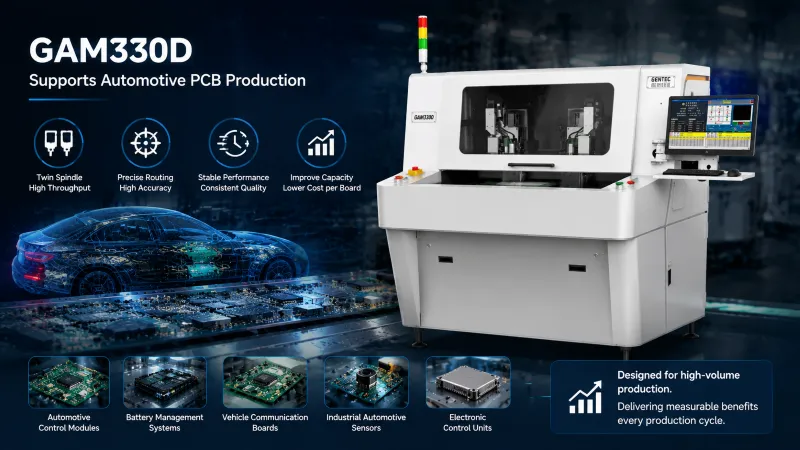
⚙️ How GAM330D Supports Automotive PCB Production
В GAM330D Twin Spindle PCB Milling Cutter Depaneling Machine is designed for manufacturers that need higher throughput while maintaining precise PCB routing performance.
Its twin spindle structure allows two cutting processes to work efficiently, helping improve production capacity compared with traditional single-spindle solutions.
Typical application scenarios include:
- Automotive control modules
- Battery management systems
- Vehicle communication boards
- Industrial automotive sensors
- Electronic control units
For factories producing thousands of PCB panels monthly, improving every production cycle can create measurable benefits.
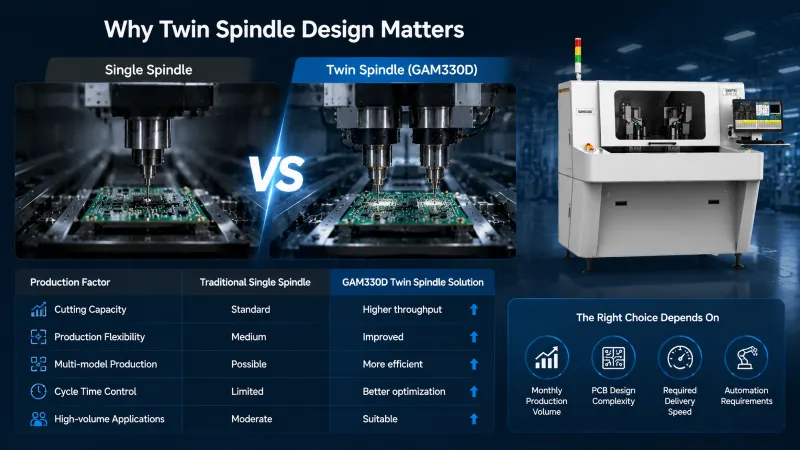
🔧 Why Twin Spindle Design Matters
A common misunderstanding is that production speed only depends on machine movement speed.
In reality, the overall output depends on the complete cutting process.
A twin spindle design can help manufacturers achieve:
| Production Factor | Traditional Single Spindle | GAM330D Twin Spindle Solution |
|---|---|---|
| Cutting Capacity | Standard | Higher throughput |
| Production Flexibility | Medium | Improved |
| Multi-model Production | Possible | More efficient |
| Cycle Time Control | Limited | Better optimization |
| High-volume Applications | Moderate | Suitable |
However, twin spindle technology is not automatically the best choice for every factory.
For low-volume production or highly customized prototypes, a different solution may provide better flexibility.
The correct choice depends on:
- Monthly production volume
- PCB design complexity
- Required delivery speed
- Automation requirements
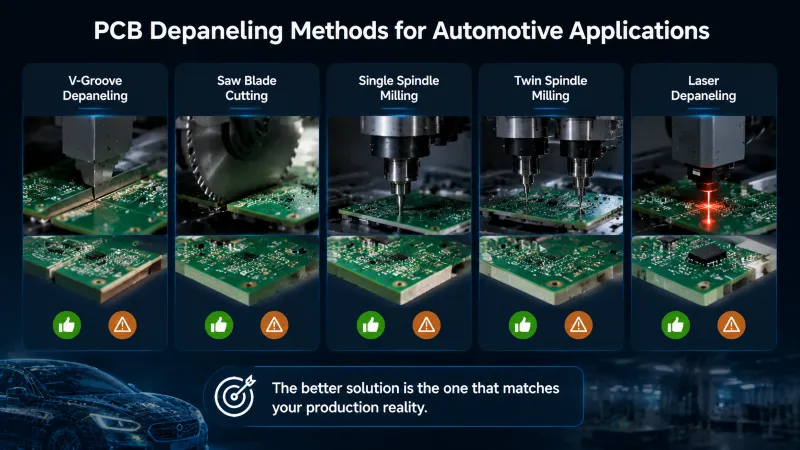
📊 Comparing PCB Depaneling Methods for Automotive Applications
| Method | Advantages | Limitations |
|---|---|---|
| V-Groove Depaneling | Low cost, simple operation | Limited shape flexibility |
| Saw Blade Cutting | Suitable for straight cuts | More mechanical stress |
| Single Spindle Milling | Flexible and accurate | Lower throughput |
| Twin Spindle Milling | High efficiency and stable precision | Higher initial investment |
| Laser Depaneling | Minimal mechanical stress | Higher equipment cost |
There is no single technology that fits every automotive PCB manufacturer.
The better solution is the one that matches your production reality.
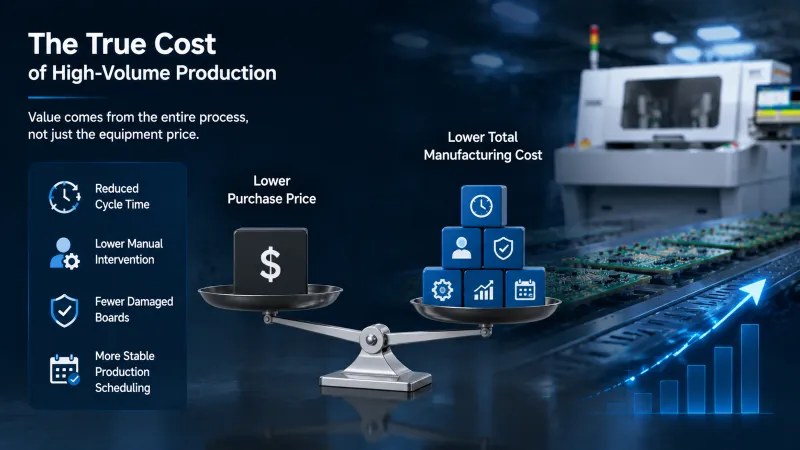
💰 Understanding the True Cost of High-Volume Production
A lower equipment price does not always mean lower manufacturing costs.
For automotive electronics suppliers, a small improvement in efficiency can have a significant financial impact.
For example:
A factory producing thousands of PCB panels every month may save costs through:
- Reduced cycle time
- Lower manual intervention
- Fewer damaged boards
- More stable production scheduling
The return comes from improving the entire manufacturing process, not only purchasing new equipment.
🏭 Production Example: Improving Automotive PCB Throughput
An automotive electronics supplier faced increasing orders but found that its existing depaneling process struggled during peak production periods.
The main issues were:
- Long processing time
- Frequent operator adjustments
- Difficulty maintaining consistent output
After evaluating different options, the company introduced a Seprays GAM330D Twin Spindle PCB Milling Cutter Depaneling Machine into its production line.
Through process optimization:
- Cutting efficiency improved.
- Production scheduling became more predictable.
- Operators spent less time adjusting parameters.
- Quality monitoring became easier.
The key lesson was not simply replacing equipment.
It was matching the depaneling process with future production requirements.
🧠 What Engineers Should Consider Before Upgrading
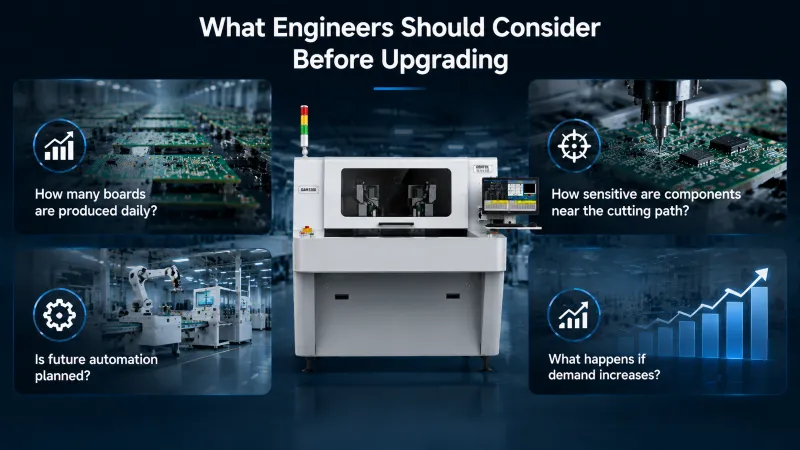
Before selecting a new depaneling machine, manufacturers should review several practical questions:
How many boards are produced daily?
High-volume factories benefit more from throughput improvements.
How sensitive are components near the cutting path?
More sensitive designs require better vibration control and precision.
Is future automation planned?
Equipment selection should consider possible integration with loading, unloading, and MES systems.
What happens if demand increases?
A machine should support future production growth, not only current needs.
🌱 The Future Trend of Automotive PCB Depaneling
Automotive electronics are moving toward:
- More intelligent vehicles
- Higher electronic content
- More sensors
- Greater reliability requirements
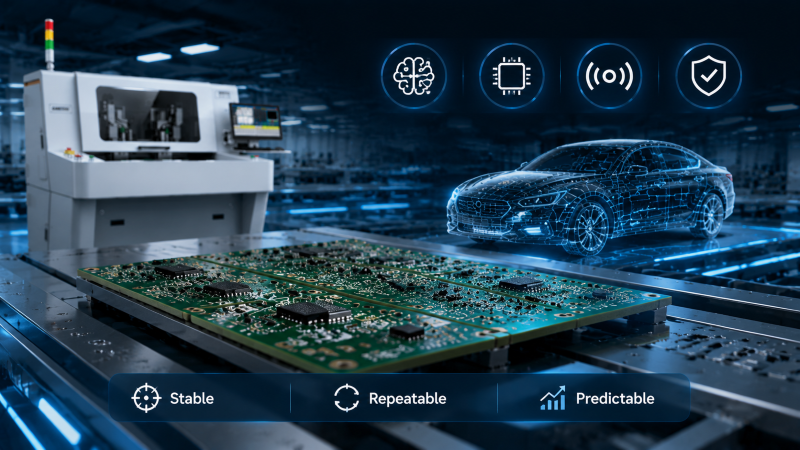
This means PCB manufacturing processes must continue improving.
Depaneling will become an increasingly important part of production quality management.
The goal is not only faster cutting.
The goal is stable, repeatable, and predictable manufacturing.
Why Choose Seprays Group?
With more than 30 years of experience, Seprays Group has been dedicated to PCB/FPC depaneling technology and continuous innovation in electronic manufacturing solutions.
Seprays Group has been dedicated to PCB/FPC depaneling technology for over three decades, providing a complete range of solutions—including milling-cutter depanelers, laser depanelers, V-groove depanelers, punching depanelers, and automated handling systems. Leading global manufacturers, including Foxconn, Flextronics, State Grid, Luxshare, Compal, Wistron, China Electronics, Quanta, CRRC, China Aerospace, OPPO, ZTE, and Bosch, trust our equipment. These solutions are widely used in factories across China and worldwide, supporting industries such as automotive electronics, consumer electronics, communications, industrial control, and advanced manufacturing.
Rather than providing only equipment, Seprays focuses on helping customers build suitable depaneling solutions based on their PCB design, production volume, and quality objectives.
From standalone machines to automated production systems, Seprays engineers work with manufacturers to improve efficiency, stability, and long-term production value.
If you are evaluating PCB depaneling solutions for automotive electronics production, please feel free to contact us.
WhatsApp: +8618929266433
Электронная почта: sales@seprays.com
Вопросы и ответы
1. What industries can use the GAM330D Twin Spindle PCB Milling Cutter Depaneling Machine?
The GAM330D is suitable for automotive electronics, industrial control, communication equipment, consumer electronics, and other high-volume PCB manufacturing applications.
2. What is the advantage of a twin-spindle depaneling machine?
A twin spindle design can improve production efficiency by increasing processing capacity while maintaining accurate PCB routing performance, especially for high-volume manufacturing environments.
3. Is milling better than V-groove depaneling for automotive PCBs?
It depends on the PCB design. Milling is generally more flexible for complex shapes and boards with sensitive components, while V-groove solutions may be suitable for simpler PCB structures.
4. How can manufacturers reduce PCB depaneling costs?
Manufacturers can reduce total costs by improving process stability, lowering scrap rates, reducing manual adjustments, optimizing tool usage, and selecting equipment that matches production requirements.
5. Can the GAM330D be integrated into an automated production line?
Yes. Depending on production requirements, the GAM330D can be combined with automated loading, unloading, material handling, and factory management systems to support intelligent manufacturing processes.