.png)
 Russian
  English
  Spanish
  Japanese
  Korean
  Chinese
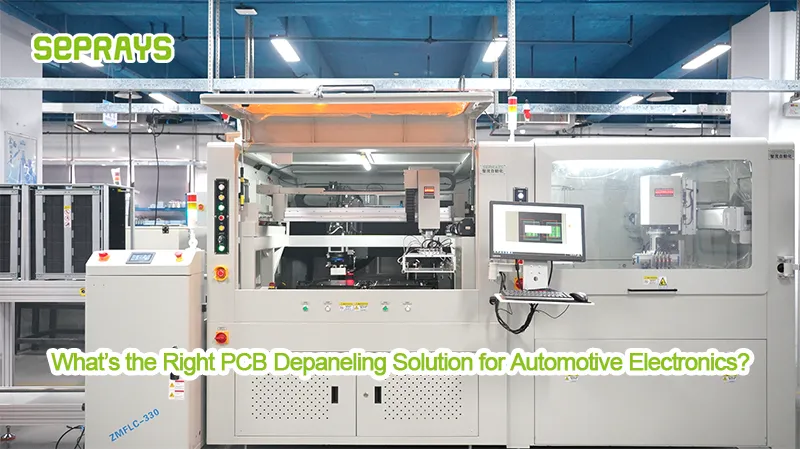
High-precision PCB Router solutions are becoming an essential part of modern automotive electronics manufacturing. As vehicles integrate more ADAS systems, battery management modules, infotainment units, and safety-critical control boards, the tolerance for cutting defects, micro-cracks, and misalignment has significantly decreased. High-precision PCB Router machines are now used to depanel complex multilayer boards while maintaining structural integrity and long-term reliability.
This article shares practical industry experience, not marketing language—focusing on manufacturing challenges, cost considerations, and real application cases often discussed in German and French automotive production environments, where industrial durability и technical compliance are highly valued.
🔧 What Makes Automotive PCB Depaneling Unique?
Automotive electronics are exposed to:
- Extreme temperature cycles (−40°C to +150°C)
- High vibration and mechanical stress
- Humidity, corrosion, and chemical exposure
- Long product lifecycle expectations (10–15+ years)
Therefore, PCB depaneling must cause minimal stress. Any internal damage during separation can lead to failure in the ECU, inverter, BMS, or radar modules. Manufacturers in Germany and France frequently evaluate router machines based on:
✔ Cutting accuracy
✔ Repeatability over millions of cycles
✔ Low-particle and low-stress performance
✔ Compatibility with automotive PPAP & traceability standards

🛠 Common Pain Points in Automotive PCB Depaneling
| Pain Point | Impact on Automotive Manufacturing |
|---|---|
| Micro-cracks around routed edges | Risk of electronic failure over time |
| Dust particles during routing | Contamination of optical or RF modules |
| Slow or unstable tool wear | Increased maintenance and quality deviations |
| Difficulty handling thick copper / multi-layer boards | Limits new EV and ADAS designs |
| Poor traceability and operator reliance | Fails to meet IATF 16949 expectations |
Routers equipped with low-runout spindles, vacuum dust extraction, and closed-loop motion control can significantly reduce these issues.

🧩 Cost & Performance Analysis
While the initial cost of a high-precision router is higher than manual or V-cut methods, German and French integrators typically evaluate the total lifetime cost:
| Cost Elements | Manual / V-Cut | High-Precision Router |
|---|---|---|
| Initial Investment | Low | Higher |
| Risk of Stress Damage | High | Very Low |
| Cycle Accuracy | Depends on operators | Stable and repeatable |
| Tool Lifetime | Short | Optimized spindle & bit wear |
| EV/ADAS Compatibility | Limited | Ideal for complex boards |
Result: In most automotive environments, routers become more economical after 12–24 months of continuous production.

📌 Real Case Example (Europe, EV Manufacturer)
A French EV electronics supplier, which produces BMS and inverter control boards, replaced a V-cut system with a high-precision router.
Before:
- Scrap rate: 2.7% per panel
- Frequent field returns from power cycling failures
After 6 months:
- Scrap reduced to 0.35%
- 22% improvement in routing cycle time
- Reduced field return claims

⚙ Technology Features That Matter Most
When selecting an automotive PCB router, manufacturers typically look for:
🔹 High-speed spindle (60,000–100,000 RPM, low runout)
🔹 Closed-loop servo motion control
🔹 Real-time bit wear monitoring
🔹 Effective dust extraction and filtering
🔹 MES / traceability connectivity
🔹 Automatic fiducial recognition & compensation
These enable the consistency required for IATF 16949, ISO 26262, and functional safety compliance.

🧪 Materials & PCB Types Suitable for Routing
Routers handle complex stacks, including:
- FR4 / High-TG laminates
- Copper-heavy busbar PCBs
- Ceramic substrates for high-temperature modules
- Aluminum IMS boards for power electronics
- Ultra-thin RF and radar boards

💬 Discussion: Router vs. Laser for Automotive Electronics?
Laser systems are gaining attention, especially for RF boards и miniaturized radar modules, offering:
✔ Zero mechanical stress
✔ Very clean edges
However, routers remain preferred for battery, inverter, and powertrain boards due to:
- Better handling of copper thickness
- Lower overall cost of operation
- Easier maintenance and operator adoption
Future automotive production may integrate a hybrid router + laser depaneling cells.

🏁 Why Choose Seprays Group?
Seprays offers high-precision router solutions designed for long-term industrial use, with a focus on:
🔧 German-level mechanical stability
🛡 Industrial safety and CE compliance
📉 Reduced tool wear and low-stress cutting
📊 Full traceability and MES connectivity
🌍 Experience supporting EU automotive suppliers
If you need support selecting the right system or want a technical evaluation based on your PCB files, feel free to contact us.
WhatsApp: +86 189 2926 6433
E-mail: sales@seprays.com