.png)
 Chinese
  English
  Spanish
  Japanese
  Korean
  Russian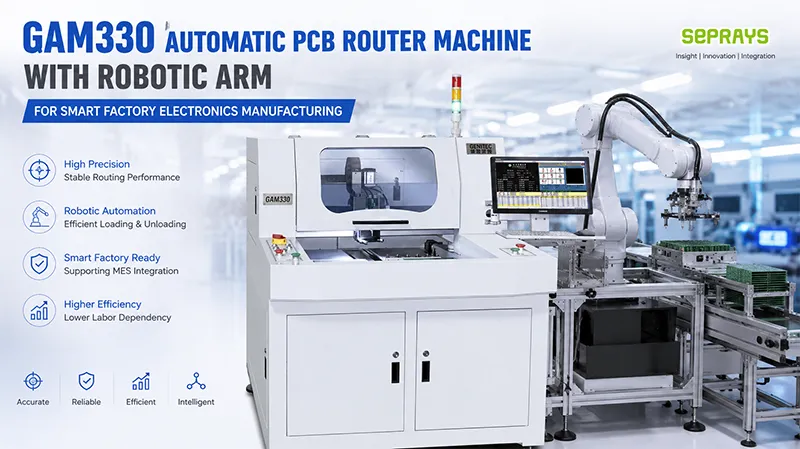
In modern electronics factories, the biggest challenge is not always increasing production speed. Many manufacturers are finding that GAM330 Automatic PCB Router Machine solutions become important when they need stable quality, lower manual handling, and better production consistency.
A PCB router process may look simple from the outside: place the board, cut the outline, remove the finished parts. However, in real production environments, problems often appear after scaling up.
Operators need to repeat the same movements hundreds or thousands of times every day. Small positioning errors, dust contamination, tool wear, and inconsistent handling can gradually affect yield.
This is why more factories are exploring automated PCB routing systems with robotic integration, especially for smart factory production lines.
The question is not only:
“Can the machine cut the PCB?”
The more important question is:
“Can the entire process remain stable after running continuously for months?”
🔍 Why PCB Router Automation Becomes Important in Smart Factories
Many electronics manufacturers have experienced similar situations.
At the beginning of production, manual PCB depaneling may appear acceptable.
The output is manageable.
The operators are familiar with the process.
The investment seems lower.
But when production volume increases, hidden costs start appearing:
- Operator fatigue affects consistency
- Manual loading creates waiting time
- Human handling increases ESD risks
- Production data becomes difficult to track
- Labor costs continue rising
A smart factory is not only about replacing workers with machines.
It is about connecting each manufacturing step into a more predictable system.
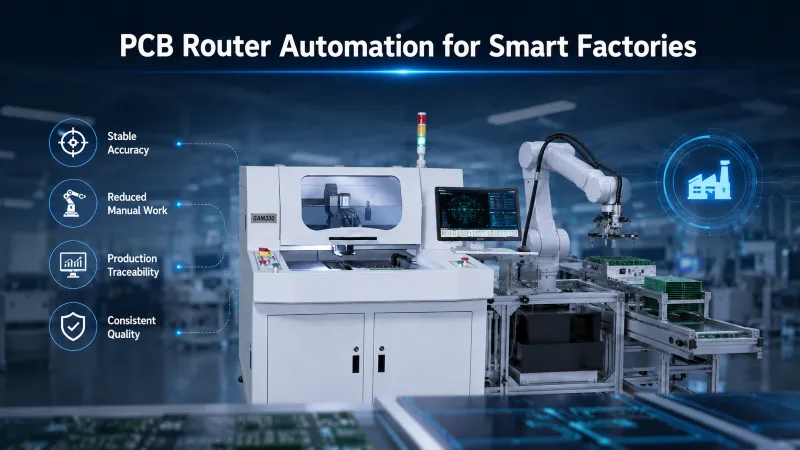
For PCB routing applications, automation helps manufacturers achieve:
- Stable cutting accuracy
- Reduced manual intervention
- Improved production traceability
- More consistent product quality
⚙️ Common Manufacturing Problems Before Automation
Before choosing an automated routing solution, many factories should first understand their actual bottlenecks.
A common mistake is focusing only on machine speed.
In reality, production efficiency depends on the whole workflow.
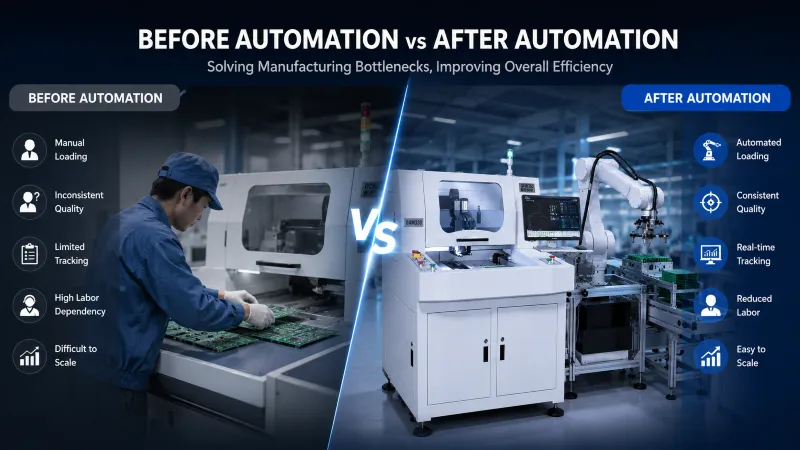
| Manufacturing Challenge | Traditional Process | Automated Solution |
|---|---|---|
| PCB loading | Manual placement | Robotic arm handling |
| Cutting consistency | Depends on operator experience | Program-controlled process |
| Production tracking | Limited data collection | Easier MES integration |
| Labor dependency | Requires continuous operation | Reduced manual workload |
| High-volume production | Difficult to scale | Designed for continuous running |
For example, a factory producing automotive electronic control modules may not struggle with the cutting speed itself.
The bigger issue is maintaining the same quality across different shifts and operators.
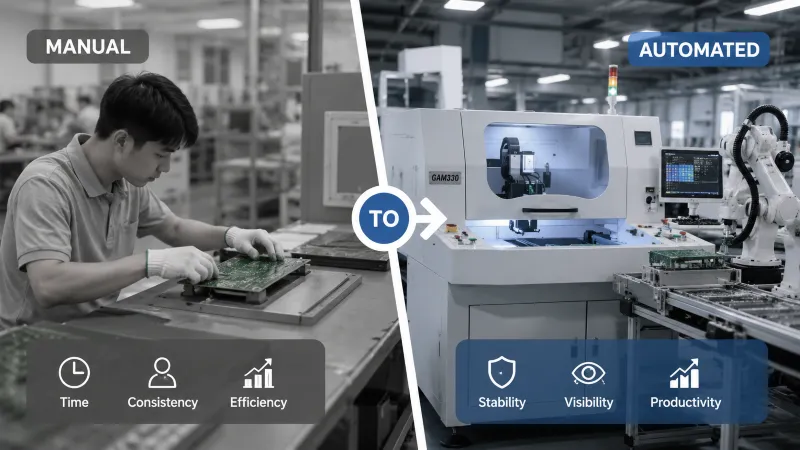
🏭 A Practical Example: From Manual Handling to Automated Production
A consumer electronics manufacturer previously used manual loading and unloading during PCB routing.
The production team noticed several issues:
- Operators spent significant time handling boards
- Different operators produced slightly different results
- Production planning became difficult during peak orders
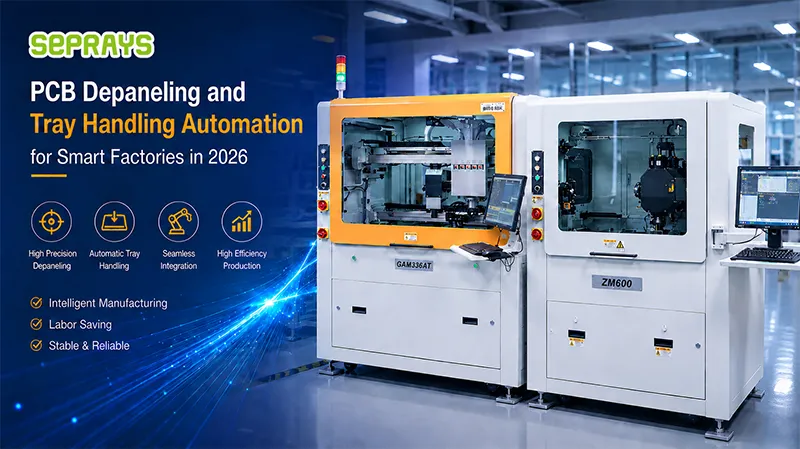
After evaluating automated solutions, the factory introduced a PCB router system integrated with robotic handling.
The improvement was not only faster processing.
The factory gained:
- More stable production flow
- Lower dependence on operator experience
- Better production visibility
Similar situations are common in automotive electronics, communication devices, and high-density PCBA manufacturing.
For manufacturers like these, automation is often a long-term production decision rather than a simple equipment purchase.
🤖 How GAM330 Supports Automated PCB Routing Applications
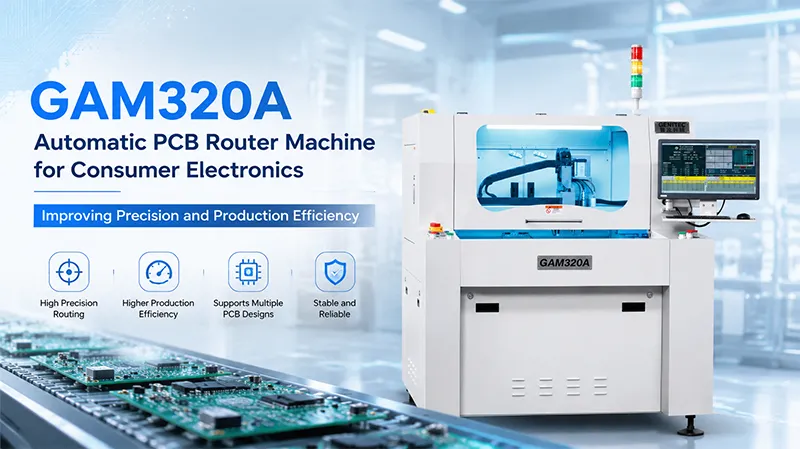
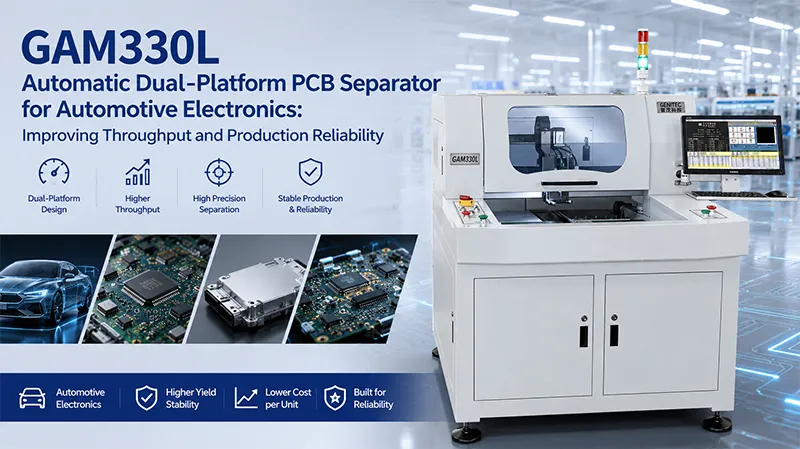
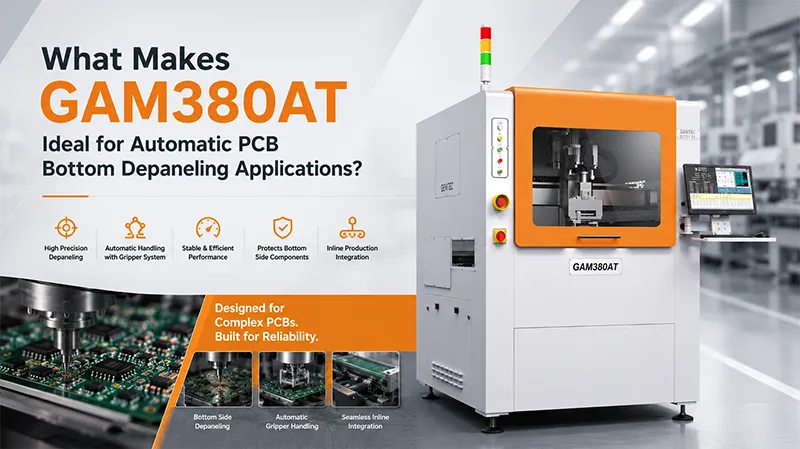
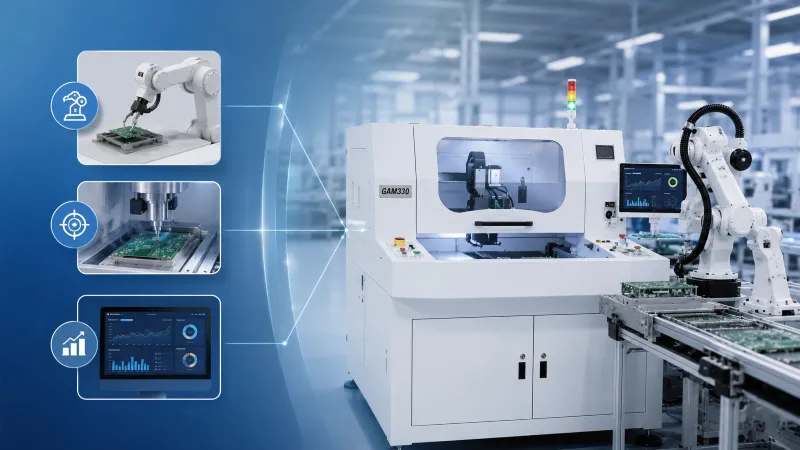
The GAM330 is designed for manufacturers looking to improve PCB routing efficiency with automation.
Its robotic arm integration helps create a smoother material handling process.
Key application advantages include:
📌 Automated Loading and Unloading
The robotic system reduces repeated manual board movement.
This is especially useful for factories with:
- Large production volumes
- Multiple shifts
- Strict quality requirements
📌 High-Precision PCB Cutting
PCB routing requires accuracy.
Small deviations may influence:
- Component safety distance
- PCB edge quality
- Final assembly performance
The GAM330 uses controlled routing processes to maintain consistent results.
📌 Suitable for Smart Factory Integration
Modern factories increasingly require equipment that can communicate with production systems.
Automation solutions can support:
- Production monitoring
- Process management
- Data collection
However, integration requirements vary depending on factory systems.
Not every factory needs the highest level of automation.
The correct solution depends on:
- Production volume
- PCB structure
- Labor conditions
- Future expansion plans
💰 Cost Analysis: Is Automation Always Worth It?
A common assumption is:
“Automation is expensive, so manual production must be cheaper.”
This is only partly true.
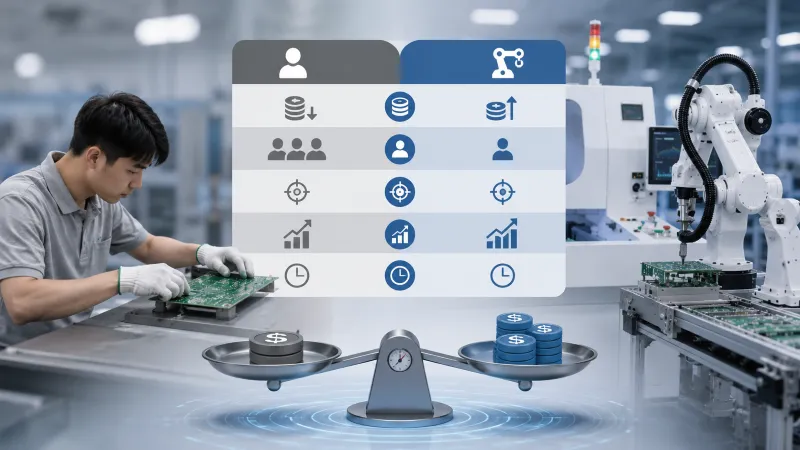
The initial investment of an automated PCB routing system is higher.
But manufacturers should calculate the complete production cost.
Consider these factors:
| Cost Factor | Manual Process | Automated Process |
|---|---|---|
| Equipment investment | Lower | Higher |
| Labor requirement | Higher | Lower |
| Quality variation | More possible | More controlled |
| Production scalability | Limited | Stronger |
| Long-term operation | Higher hidden costs | More predictable |
For high-volume production, automation may provide better value over time.
For small-batch production with frequent product changes, manual or semi-automatic solutions may still be suitable.
The best choice depends on the real production situation.
🧩 An Important Question: Faster Cutting or Better Stability?
Many buyers initially compare spindle speed, cutting time, and machine specifications.
However, experienced manufacturers often look at another factor:
“How stable is the process after 1 million boards?”
A slightly faster machine does not always create better results.
Production stability can influence:
- Customer delivery schedules
- Factory efficiency
- Quality reputation
This is why smart manufacturers evaluate the complete process, including:
- Fixture design
- Dust management
- Tool life
- Maintenance requirements
- Operator training
🌍 Real Manufacturing Experience from Seprays Group
With more than 30 years of experience in PCB/FPC depaneling technology, Seprays Group has worked with manufacturers across different industries and production environments.
In practical applications, factories often face different challenges:
- Automotive electronics require long-term reliability
- Consumer electronics require flexible production
- Communication products require high throughput
- Industrial electronics require stable quality
Seprays solutions are developed based on these real manufacturing needs.
Seprays Group has been dedicated to PCB/FPC depaneling technology, providing a full range of solutions—including milling-cutter depanelers, laser depanelers, V-groove depanelers, punching depanelers, and automated handling systems.
Over the years, Seprays equipment has been trusted by leading manufacturers such as Foxconn, Flextronics, State Grid, Luxshare, Compal, Wistron, China Electronics, Quanta, CRRC, China Aerospace, OPPO, ZTE, and Bosch.
These solutions are applied in factories throughout China and worldwide, supporting different electronics manufacturing scenarios.
🌱 Why Choose Seprays Group?
Choosing PCB automation equipment is not only about purchasing a machine.
It is about selecting a long-term manufacturing partner.
Seprays Group has been specializing in PCB/FPC depaneling technology for over 30 years, continuously developing solutions for electronics manufacturers worldwide.
The company provides complete depaneling solutions, including:
- Milling cutter PCB routers
- Laser PCB depaneling systems
- V-groove depaneling machines
- Punching depaneling equipment
- Automated loading and unloading systems
With experience serving global electronics manufacturers, Seprays understands that different factories require different solutions.
From prototype production to high-volume smart manufacturing lines, Seprays focuses on helping customers improve:
- Production stability
- Manufacturing efficiency
- Product quality control
- Automation capability
If you are evaluating PCB routing automation for your production line, please contact Seprays Group. Our engineering team can help analyze your application requirements and recommend a suitable solution.
WhatsApp: +8618929266433
❓ FAQ
1. What industries can use the GAM330 automatic PCB router machine?
The GAM330 is suitable for various electronics manufacturing applications, including consumer electronics, automotive electronics, industrial control systems, communication devices, and high-density PCB assemblies.
2. Is an automatic PCB router better than manual PCB depaneling?
It depends on production requirements. For high-volume manufacturing, automation usually provides better consistency, lower labor dependency, and improved process control. For small production batches, manual methods may still be practical.
3. Can the GAM330 be integrated into a smart factory production line?
Yes. The GAM330 can be designed for automated production environments and can support factory integration requirements depending on the customer’s manufacturing system.
4. What factors should manufacturers consider before purchasing a PCB router?
Manufacturers should evaluate PCB material, board size, production volume, accuracy requirements, tool life, dust control, automation level, and future production expansion plans.
5. How does robotic integration improve PCB routing production?
Robotic integration reduces repeated manual handling, improves production consistency, and helps create a smoother automated workflow, especially for continuous manufacturing operations.