.png)
 Chinese
  English
  Spanish
  Japanese
  Korean
  Russian
Laser vs Blade PCB Cutting is a common comparison in European factories where reliability, repeatability, and long-term durability matter as much as upfront cost. German and French manufacturers often face pressure to balance high-quality production with restrained investment budgets. This article offers a practical, engineering-focused discussion to help make an informed decision based on real pain points from the shop floor.
🔧 H1 — Understanding the Two Cutting Principles
Both laser and blade methods have proven industrial value, but their strengths differ:
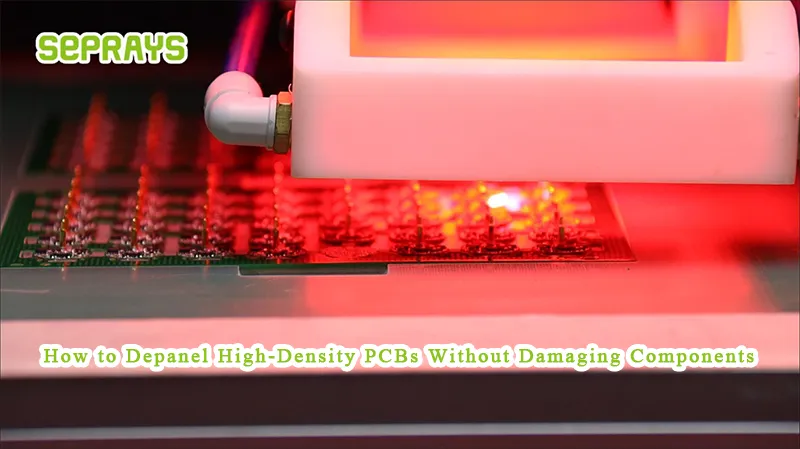
- Laser systems rely on non-contact energy to cut with minimal mechanical stress.
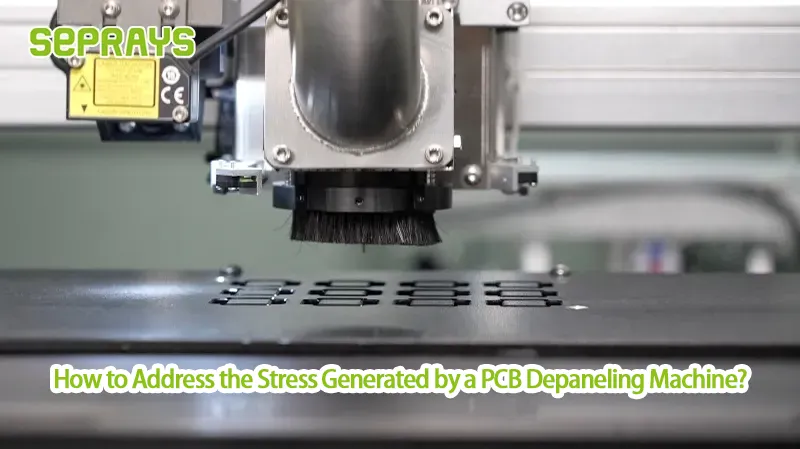
- Blade systems (saw, V-cut, or traveling knife) use physical separation with controlled force.
Factories choosing between them typically prioritize:
precision, cut quality, long-term stability, consumable cost, and compatibility with various PCB stack-ups.

⚙️ H2 — Common Pain Points in EU PCB Production
German automotive, industrial automation, and French aerospace electronics share similar challenges:
- Sensitive components close to the cutting path
- Thick copper or mixed-material PCB designs
- Need for traceability and repeatable accuracy
- Demands for lower scrap rates due to rising material costs
- Limited floor space for additional operator stations
These pain points heavily influence whether laser or blade systems can be integrated efficiently.

🔍 H3 — Long-Term Cost Analysis (Beyond Purchase Price)
Many factories initially compare machines solely by the sticker price. However, lifetime cost usually tells a more realistic story:
Laser
- No mechanical tool wear
- High energy consumption but low rework cost
- Minimal burrs → fewer cleaning steps
- Better for high-value boards where scrap is expensive
刀片
- Lower upfront investment
- Tool wear must be monitored (blades, bits, scoring wheels)
- Mechanical stress requires careful process parameters
- Very cost-efficient for standard FR4 with clear routing paths
A German EMS case study showed that while laser equipment cost ~30–40% more initially, annual savings from reduced rework compensated the difference within two years.

🧪 H4 — Real Factory Scenarios: Which One Fits?
✔ When Laser Makes More Sense
- PCBs include flex, rigid-flex, or RF materials
- Sensitive components are placed near the edge
- Tolerances below ±0.05 mm
- You want dust-free, burr-free cutting
- High-mix, low-volume production where setups change often
✔ When Blade Machines Fit Better
- Standard FR4 with V-grooves or clear routing channels
- Medium-to-high volumes needing fast throughput
- Factories with limited budgets and predictable board designs
- Applications where ±0.1 mm tolerance is acceptable
A French OEM producing industrial controllers switched to a dual-blade system and reduced cycle time by 45% because the boards were designed around scoring rules.

🧭 H5 — Practical Decision Guide (Engineering Checklist)
Your selection becomes clearer when you evaluate:
- PCB material: FR4, IMS, Flex, hybrid
- Copper thickness and laminate hardness
- Component density and distance from edge
- Expected lifetime of the product line
- Required cleanliness and surface finish
- Cost of scrap for each product family
Most EU factories benefit from test cuts before finalizing their decision.
🛠️ H6 — Process Optimization Tips
Regardless of the chosen method:
For Laser:
- Tune pulse frequency for copper-heavy designs
- Stabilize vacuum extraction for clean optics
- Use fiducial-based correction for rigid-flex
For 刀片:
- Maintain strict blade-change intervals
- Inspect V-groove consistency from suppliers
- Add vibration damping to extend tool life
These small process adjustments significantly improve stability and reduce long-term cost.
⭐ Why Choose Seprays Group?
Seprays Group provides durable, industry-oriented PCB depaneling solutions used across European industrial sectors. Our systems are engineered for long service life, predictable maintenance, and precise process control. Whether you need high-accuracy laser cutting or robust blade-based equipment, our engineers can help evaluate your PCB design and recommend the optimal solution.
If you need expert guidance or sample evaluations, please contact us — we are ready to support your factory’s next step toward stable and efficient PCB depaneling.
WhatsApp: +86 189 2926 6433
E-mail: sales@seprays.com