.png)
 English
  Spanish
  Japanese
  Korean
  Russian
  Chinese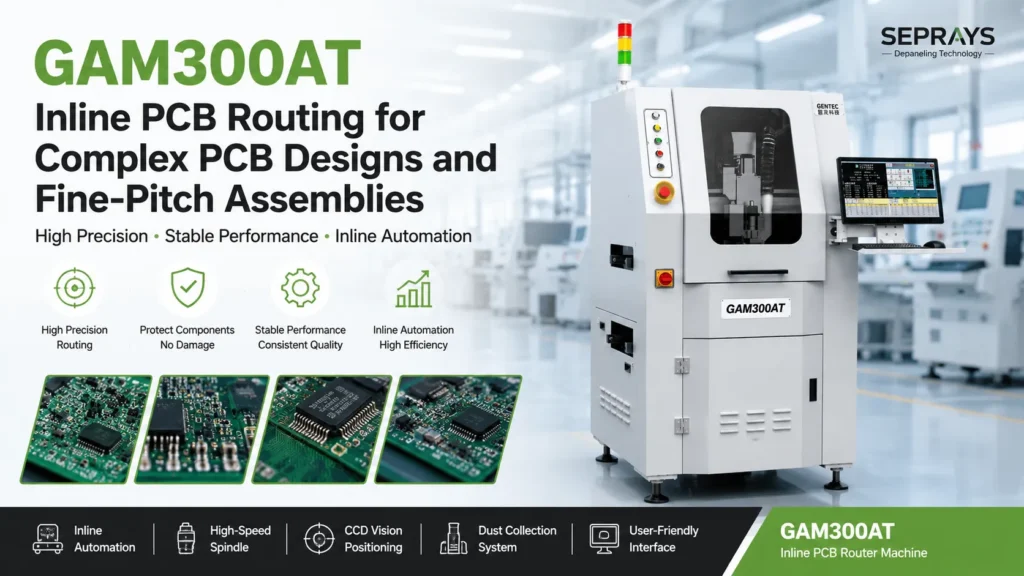
GAM300AT Inline PCB Routing is becoming a practical topic in manufacturing discussions because PCB designs are changing faster than many production processes can keep pace with. A few years ago, most boards followed relatively simple layouts with comfortable component spacing. Today, things look very different.
High-density assemblies are becoming standard.
Fine-pitch components continue shrinking.
Board shapes are becoming more complex.
And designers increasingly place components close to board edges.
For production teams, this creates an uncomfortable reality: the assembly process may improve while depaneling becomes more difficult.
Many factories only discover this after quality issues begin appearing.
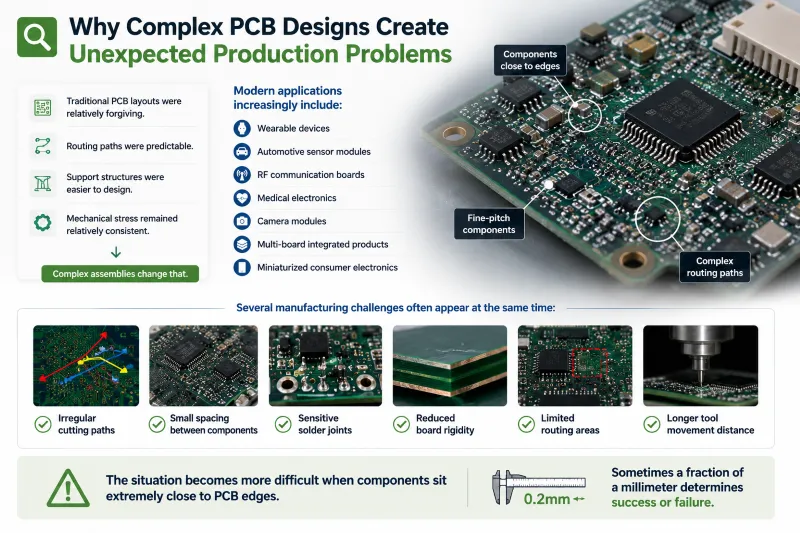
🔍 Why Complex PCB Designs Create Unexpected Production Problems
Traditional PCB layouts were relatively forgiving.
Routing paths were predictable.
Support structures were easier to design.
Mechanical stress remained relatively consistent.
Complex assemblies change that.
Modern applications increasingly include:
- Wearable devices
- Automotive sensor modules
- RF communication boards
- Medical electronics
- Camera modules
- Multi-board integrated products
- Miniaturized consumer electronics
Several manufacturing challenges often appear at the same time:
- Irregular cutting paths
- Small spacing between components
- Sensitive solder joints
- Reduced board rigidity
- Limited routing areas
- Longer tool movement distance
The situation becomes more difficult when components sit extremely close to PCB edges.
Sometimes a fraction of a millimeter determines success or failure.
⚠️ Common Questions Manufacturing Teams Keep Asking
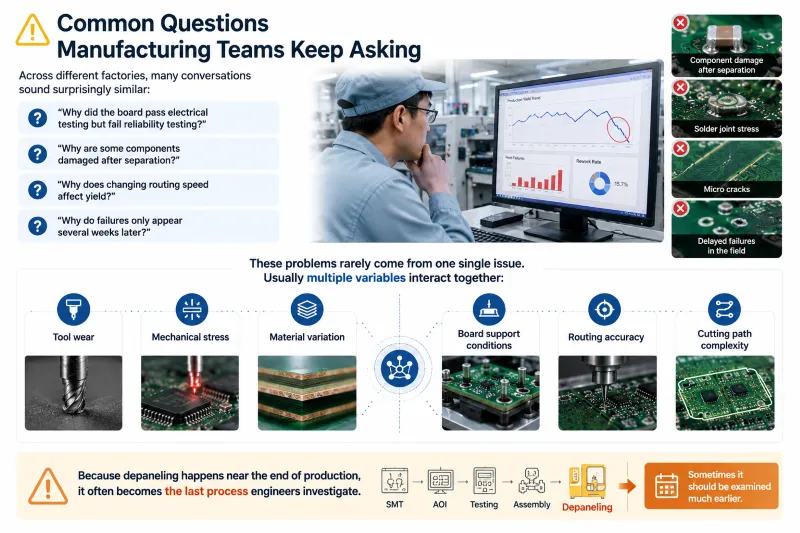
Across different factories, many conversations sound surprisingly similar:
“Why did the board pass electrical testing but fail reliability testing?”
“Why are some components damaged after separation?”
“Why does changing routing speed affect yield?”
“Why do failures only appear several weeks later?”
These problems rarely come from one single issue.
Usually, multiple variables interact with each other:
- Tool wear
- Mechanical stress
- Material variation
- Board support conditions
- Routing accuracy
- Cutting path complexity
Because depaneling happens near the end of production, it often becomes the last process engineers investigate.
Sometimes it should be examined much earlier.
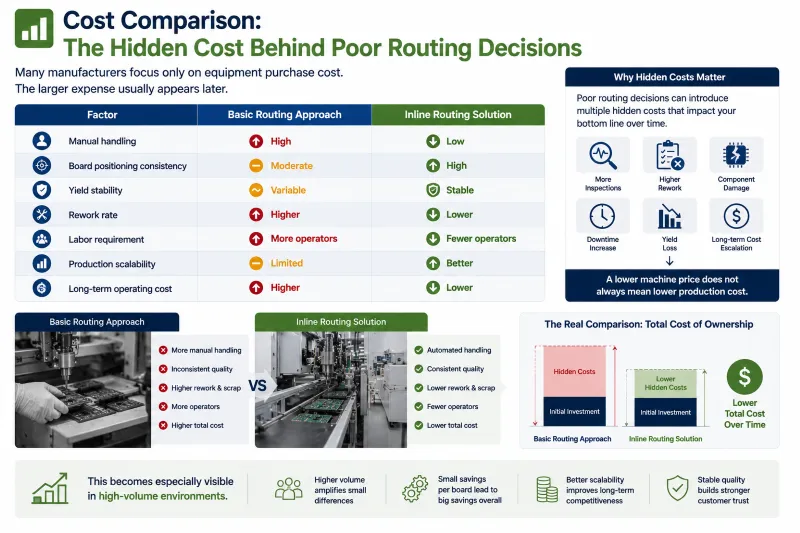
📊 Cost Comparison: The Hidden Cost Behind Poor Routing Decisions
Many manufacturers focus only on equipment purchase cost.
The larger expense usually appears later.
| Factor | Basic Routing Approach | Inline Routing Solution |
|---|---|---|
| Manual handling | High | Low |
| Board positioning consistency | Moderate | High |
| Yield stability | Variable | Stable |
| Rework rate | Higher | Lower |
| Labor requirement | More operators | Fewer operators |
| Production scalability | Limited | Better |
| Long-term operating cost | Higher | Lower |
A lower machine price does not always mean lower production cost.
This becomes especially visible in high-volume environments.
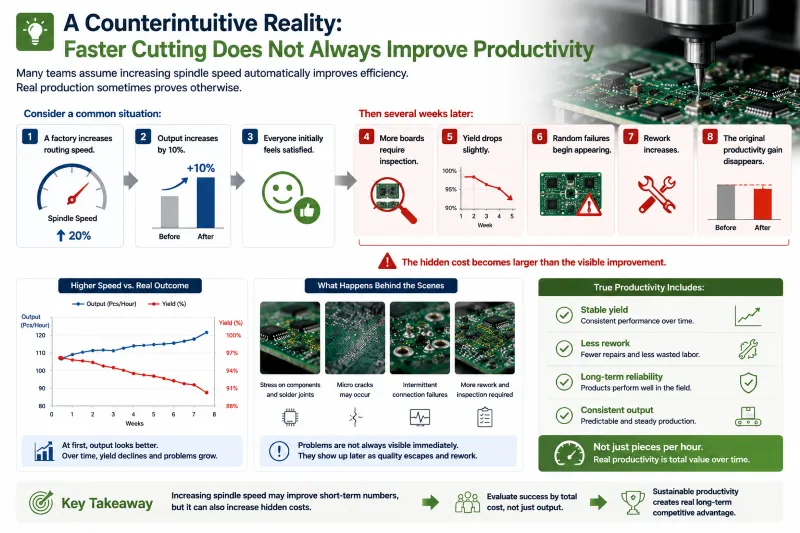
💡 A Counterintuitive Reality: Faster Cutting Does Not Always Improve Productivity
Many teams assume increasing spindle speed automatically improves efficiency.
Real production sometimes proves otherwise.
Consider a common situation:
A factory increases routing speed.
Output increases by 10%.
Everyone initially feels satisfied.
Then several weeks later:
More boards require inspection.
Yield drops slightly.
Random failures begin appearing.
Rework increases.
The original productivity gain disappears.
The hidden cost exceeds the visible improvement.
True productivity includes:
- Stable yield
- Less rework
- Long-term reliability
- Consistent output
Not just pieces per hour.
⚙️ Why Inline Routing Is Becoming More Important in 2026
The shift toward smart manufacturing is changing expectations.
Factories increasingly want connected production rather than isolated machines.
Modern inline routing systems help address:
- Automated board transfer
- Reduced operator dependence
- Consistent positioning
- Better traceability
- Stable production rhythm
- Integration with MES environments
The goal is no longer simply cutting boards.
The goal becomes maintaining process stability throughout the entire line.
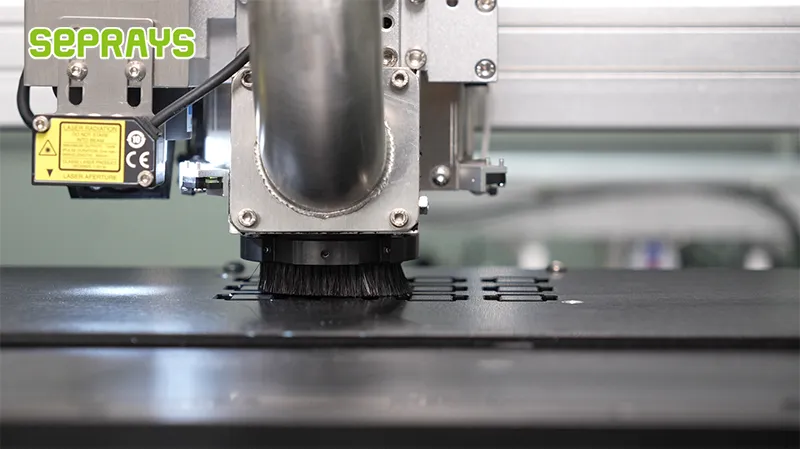
📖 Case Example: Automotive Module Production Using GAM300AT
A manufacturer producing automotive communication modules faced recurring issues.
The boards contained:
- Fine-pitch connectors
- Multiple RF components
- Irregular routing paths
- Tight component spacing
Initially, manual handling created inconsistent positioning.
Yield variation between shifts became difficult to explain.
The engineering team later implemented a Seprays GAM300AT inline PCB routing solution.
Instead of changing the board design, they improved process consistency.
Results observed after implementation:
- Reduced manual intervention
- More stable routing precision
- Improved process continuity
- Reduced variation across batches
- Better production predictability
Interestingly, the largest improvement did not come from cutting speed.
It came from process consistency.
That surprised several engineers involved in the project.
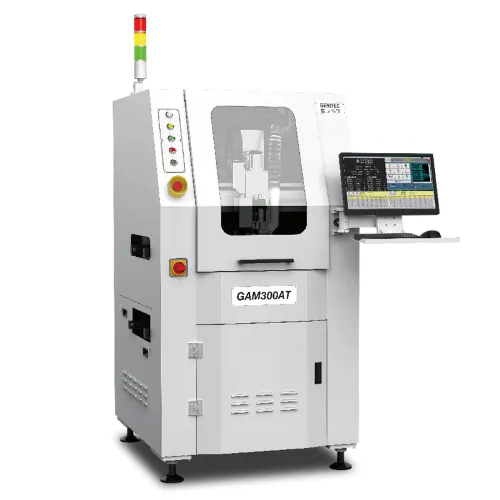
🛠 How GAM300AT Helps Handle Complex PCB Designs
The GAM300AT is designed for inline automated PCB routing applications where complex board structures and fine-pitch assemblies create additional challenges.
Key capabilities include:
- High-speed routing performance
- Stable board positioning
- Inline automation compatibility
- Reduced manual handling
- Support for complex routing paths
- High repeatability
For manufacturers processing increasingly complicated PCB assemblies, consistency often matters more than absolute speed.
🚀 Practical Selection Advice Before Buying Equipment
Before selecting a routing system, many engineers benefit from asking several questions:
- How close are components to PCB edges?
- What is the expected production volume?
- Are board shapes changing frequently?
- Will the line require automation upgrades later?
- How much rework currently exists?
The answers often determine the right solution more accurately than specifications alone.
🔎 Final Thoughts
PCB manufacturing continues moving toward smaller products and more complex assemblies.
Ironically, smaller products often create larger process challenges.
The discussion in 2026 is shifting away from simply “How fast can we cut?”
A more practical question is:
“How consistently can we produce reliable boards at scale?”
For many manufacturers, that difference becomes visible in yield, quality, and long-term cost.
Why Choose Seprays Group?
For more than 30 years, Seprays Group has focused on PCB/FPC depaneling technology and continues supporting manufacturers with practical production solutions rather than one-size-fits-all equipment.
Seprays Group has been dedicated to PCB/FPC depaneling technology, providing a complete range of solutions, including milling-cutter depanelers, laser depanelers, V-groove depanelers, punching depanelers, and intelligent automated handling systems.
Our solutions have earned the trust of leading global manufacturers, including Foxconn, Flextronics, State Grid, Luxshare, Compal, Wistron, China Electronics, Quanta, CRRC, China Aerospace, OPPO, ZTE, and Bosch. Equipment is widely deployed across China and international manufacturing facilities worldwide.
Why many manufacturers work with Seprays:
- 30+ years of industry experience
- Extensive automation integration capabilities
- Solutions for multiple PCB technologies
- High-volume production support
- Global application experience
- Continuous engineering support
If you would like to explore the right PCB depaneling solution for your application, please feel free to contact us.
WhatsApp: +8618929266433
E-mail: sales@seprays.com
FAQ
1. Is the GAM300AT suitable for fine-pitch PCB assemblies?
Yes. The GAM300AT is designed to support precise routing requirements for assemblies with tight component spacing and high-density layouts.
2. Can inline routing reduce manual labor?
Yes. Inline systems can automate board transfer and positioning, reducing manual handling and improving production consistency.
3. Does higher routing speed always improve efficiency?
Not necessarily. Excessive speed can increase stress and create hidden quality costs that reduce overall productivity.
4. Which industries commonly use inline PCB routing systems?
Automotive electronics, consumer electronics, medical devices, industrial control products, communication equipment, and RF applications commonly use inline routing solutions.
5. How can manufacturers reduce PCB damage during depaneling?
Reducing mechanical stress, improving board support, optimizing routing parameters, and using stable automation systems can significantly improve results.