.png)
 English
  Spanish
  Japanese
  Korean
  Russian
  Chinese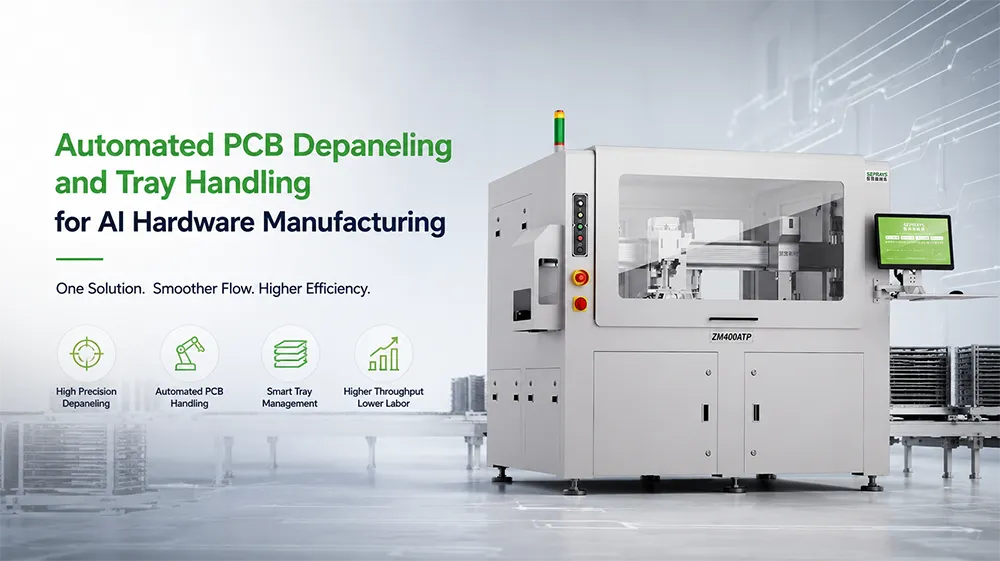
Automated PCB depaneling is becoming more relevant as AI hardware moves from engineering samples into higher-volume production.
For a factory, however, the challenge is not simply separating PCBs faster. The bigger question is what happens after separation.
Who removes the finished boards?
Where are they placed?
How are trays exchanged?
How much operator handling is still required?
When production runs across multiple shifts, these small steps can become a surprisingly large part of the manufacturing cost.
🤖 Why AI Hardware Needs a Different Production Approach
AI servers, accelerator systems, communication equipment, and other high-performance electronics often use densely populated PCB assemblies.
Manufacturers can separate and transfer multiple boards from a single panel without unnecessary handling.
At low volume, operators can manage this process manually.
At high volume, the situation changes.
Repeated handling can introduce:
- Longer cycle times
- Operator dependency
- Inconsistent board positioning
- Additional work-in-progress
- More floor-space requirements
- Delays between depaneling and the next process
The problem is not always the cutting operation itself.
The real bottleneck may be material handling.
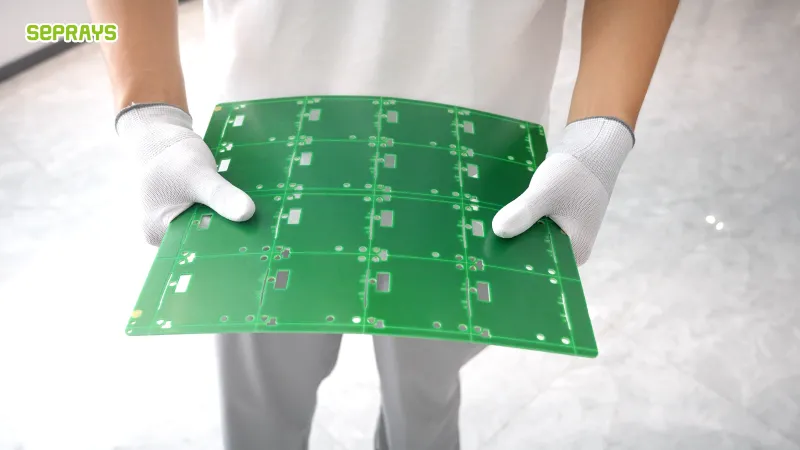
🔄 Depaneling Is Only One Part of the Cycle
Consider a typical production sequence:
Panel feeding → positioning → cutting → PCB transfer → tray loading → tray stacking
A conventional machine may solve only the cutting step.
The rest still depends on operators.
That can make the overall line slower than expected.
This is why manufacturers should evaluate the complete production cycle, rather than looking only at cutting speed.
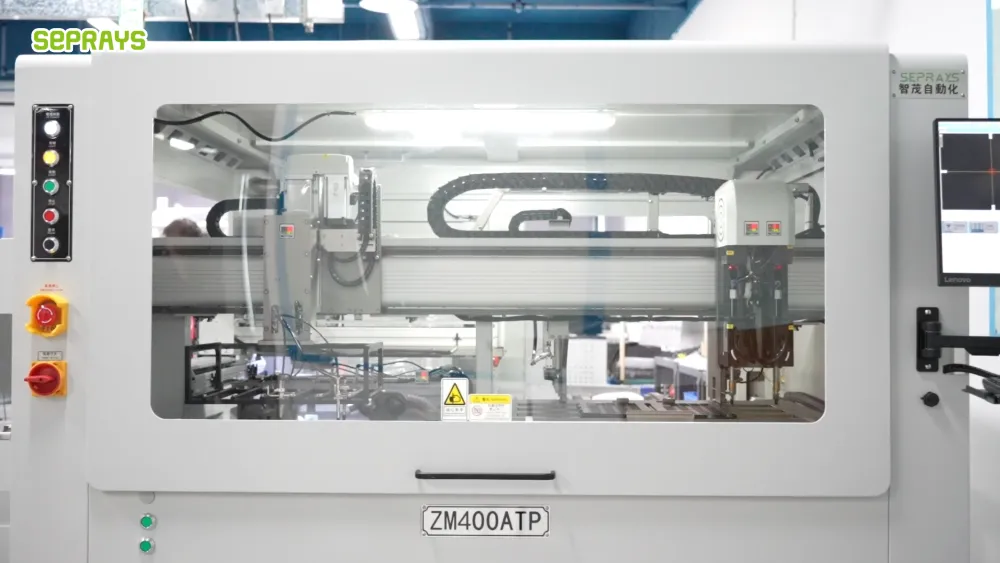
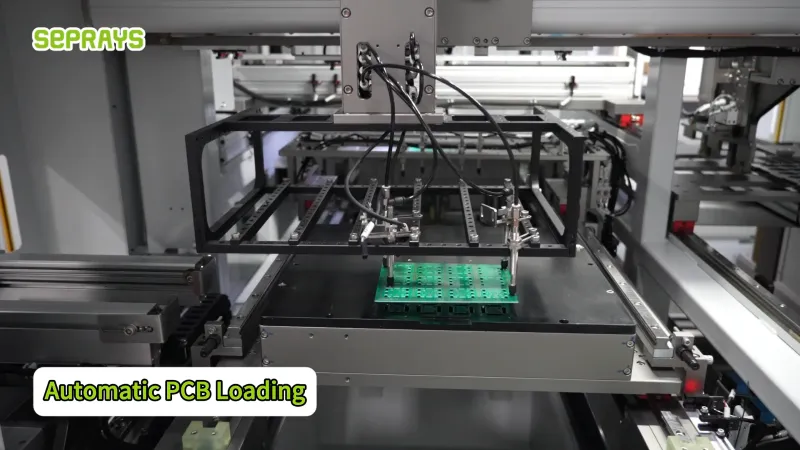
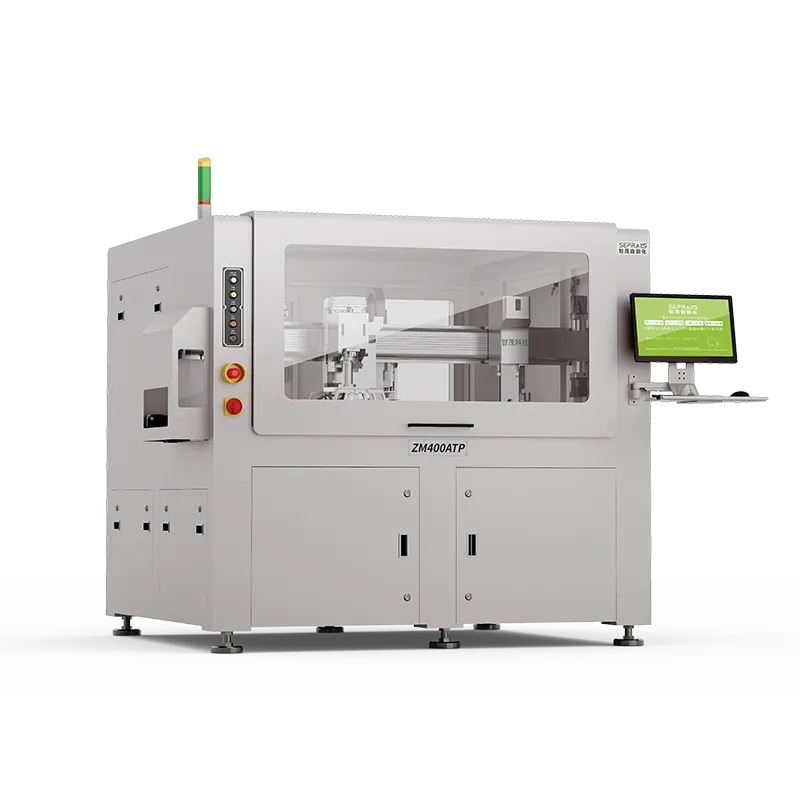
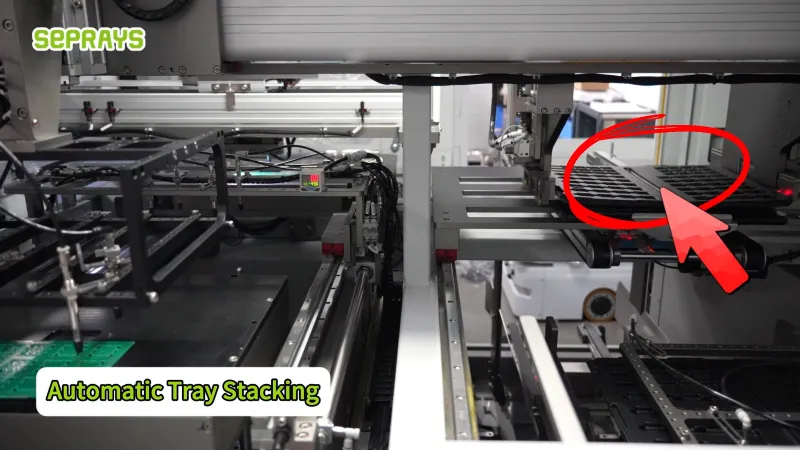
The ZM400ATP combines PCB depaneling, PCB transfer, tray handling, and automatic palletizing in one system. Its dual-worktable design reduces waiting between loading, cutting, and unloading operations.
📦 Why Tray Handling Matters More Than It Looks
Finished PCB assemblies cannot simply be left on the machine table.
They need to be placed somewhere safely and consistently.
A tray-based process can provide a defined location for finished boards before the next manufacturing stage.
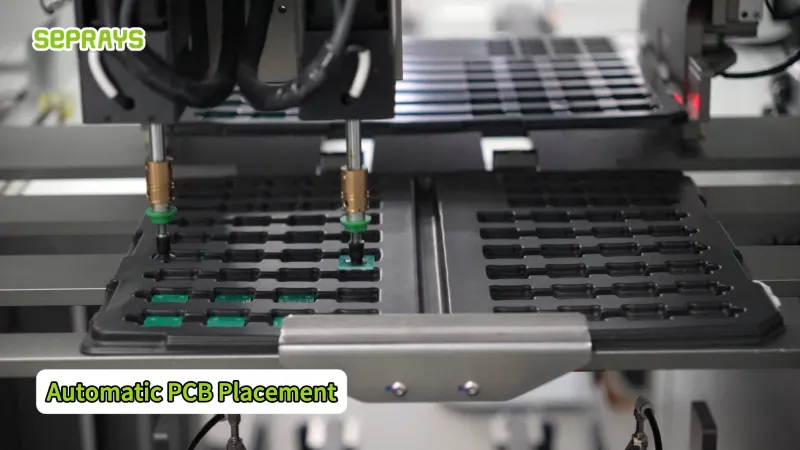
For the ZM400ATP, the tray system supports tray sizes from 300 × 200 mm to 520 × 420 mm, with buffer capacity for three stacks. Automatic palletizing accuracy is specified at ±0.2 mm.
This becomes particularly useful when production needs to continue for long periods without constant manual intervention.
The objective is simple:
Separate the board, place it, and prepare it for the next process without creating another manual bottleneck.
📊 When Does Automation Make Financial Sense?
Automation is not automatically the cheapest option.
For a small production workshop, manual loading and tray handling may still be perfectly reasonable.
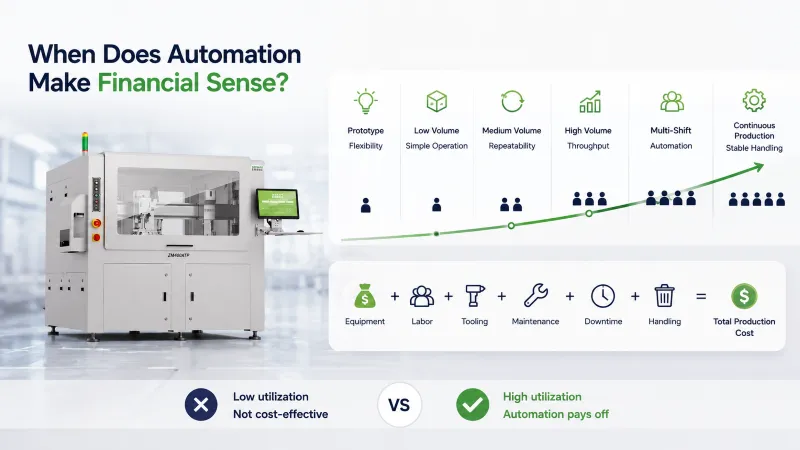
For a factory operating two or three shifts, the calculation can be very different.
| Production Situation | Practical Priority |
|---|---|
| Prototype | Flexibility |
| Low volume | Simple operation |
| Medium volume | Repeatability |
| High volume | Throughput |
| Multi-shift | Automation |
| Continuous production | Stable handling |
A useful calculation is:
Total production cost = equipment + labor + tooling + maintenance + downtime + handling
Suppose an automated system costs more initially.
If the system significantly reduces repetitive handling across several shifts, the additional investment may eventually pay for itself.
But if the machine only runs for a few hours each week, the same automation may not make financial sense.
The counterintuitive lesson: automation should be purchased for utilization, not for appearance.
🧪 What Should You Validate Before Buying?
A factory should test the actual production panel.
Do not rely only on a supplier demonstration board.
Check:
Cutting quality
Look for burrs, edge damage, and dimensional consistency.
Positioning accuracy
Confirm that the PCB remains correctly aligned during processing.
Handling reliability
Check whether different board shapes and component layouts can be transferred safely.
Cycle time
Measure the entire sequence, not only the cutting.
Tray capacity
Calculate how frequently trays need to be exchanged.
Changeover
Test how easily different PCB programs can be selected.
Integration
For smart factories, consider conveyors, inspection systems, AGVs, MES, and downstream equipment.
The ZM400ATP supports CCD vision positioning, flexible vacuum gripping, 360° nozzle rotation, optional AGV docking, cutting inspection, and NG sorting, depending on the configuration.
Not every factory needs all of these options.
That is precisely why they should be evaluated against the actual process.
🏭 An Illustrative Semiconductor Electronics Case
Consider an overseas semiconductor electronics manufacturer supplying control and communication boards for AI computing equipment.
At first, operators manually remove finished PCBs from the depaneling machine and place them into trays.
Production volume increases.
The cutting process remains stable, but the handling team becomes the bottleneck.
The factory starts measuring the complete cycle.
They discover that cutting is only part of the production time. Manual transfer and tray stacking consume additional labor and create waiting periods.
The engineering team evaluates an integrated depaneling and tray-handling system from Seprays.
Instead of simply increasing cutting speed, they redesign the workflow:
automatic feeding → vision positioning → depaneling → vacuum transfer → tray placement → automatic stacking
This example is illustrative rather than a claim about a specific Seprays customer.
The practical lesson is more important than the brand:
When handling constraints already limit production, making the cutter faster may not solve the actual problem.
🧠 A Better Way to Select the System
Before requesting a quotation, answer five questions:
1. How many panels are processed per shift?
2. How many individual PCBs are produced from each panel?
3. How much manual handling is currently required?
4. What tray size and stacking method does the next process require?
5. Will production volume increase over the next two or three years?
If the answers point toward high-volume, multi-shift production, integrated automation deserves serious consideration.
If production remains low or highly variable, a simpler offline solution may be more practical.
🌍 Why Choose Seprays Group?
Seprays Group has been dedicated to PCB/FPC depaneling technology for more than 30 years, since its establishment in 1993. The company provides a broad range of solutions, including milling-cutter depanelers, laser depanelers, V-groove depanelers, punching depanelers, and automated handling systems.
Its equipment has been trusted by leading manufacturers and organizations, including Foxconn, Flextronics, State Grid, Luxshare, Compal, Wistron, China Electronics, Quanta, CRRC, China Aerospace, OPPO, ZTE, and Bosch, with equipment used in factories across China and worldwide.
For high-volume AI hardware manufacturing, Seprays focuses not only on PCB separation but also on how depaneling can fit into the wider production flow.
The ZM400ATP combines depaneling and tray handling in one system, with CCD positioning, independent vacuum-elastic suction cups, dual worktables, automatic stacking, and optional inspection and AGV docking functions.
The right configuration still depends on your PCB design, panel layout, production volume, tray requirements, and factory automation level.
If you are evaluating an automated depaneling and tray-handling solution, please contact Seprays Group and provide your PCB drawings, panel dimensions, production volume, and tray requirements for an application evaluation.
View the ZM400ATP Product Details
WhatsApp: +8618929266433
E-mail: sales@seprays.com
❓ FAQ
1. What does an integrated depaneling and tray-handling system do?
It combines PCB separation with automatic PCB transfer, tray loading, and stacking, reducing repetitive manual handling.
2. Is automated tray handling necessary for AI hardware production?
Not always. It becomes more valuable when production volume, shift hours, and repetitive handling are high enough to justify the investment.
3. Can different PCB layouts be handled?
The ZM400ATP uses flexible vacuum gripping, optional ceramic or special-shaped nozzles, and 360° nozzle rotation to accommodate different handling requirements. Actual compatibility should be tested with production samples.
4. Can the system connect with an automated factory?
Yes. The system can be configured for different production layouts, with optional AGV docking and inspection functions. Integration should be confirmed according to the existing line architecture.
5. What information should I provide for a machine evaluation?
PCB drawings, panel dimensions, board thickness, cutting paths, component clearance, daily output, number of shifts, tray specifications, and desired automation level are a good starting point.