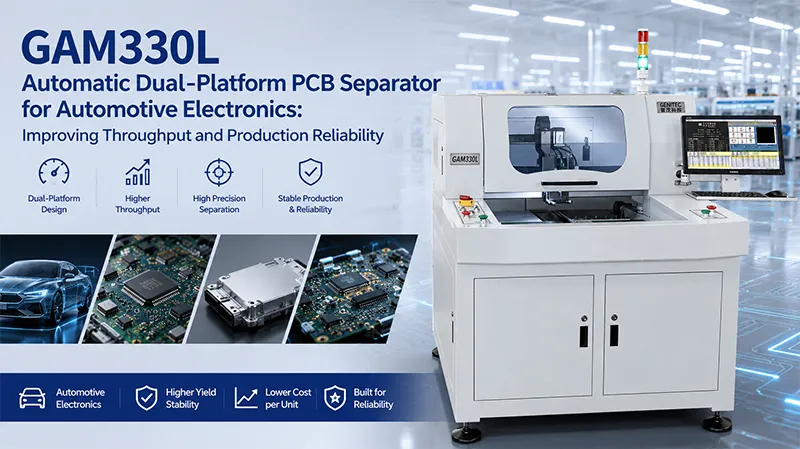
.png)
 Spanish
  English
  Japanese
  Korean
  Russian
  Chinese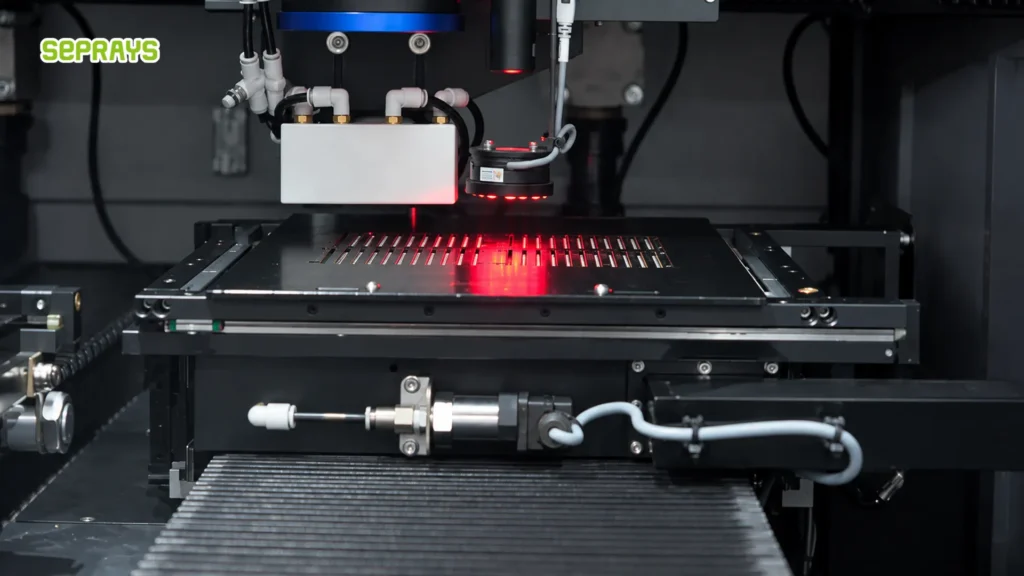
Láser depaneling becomes much more interesting when it is no longer a standalone cutting operation.
In a modern electronics factory, the question is often bigger than how quickly a PCB can be separated.
What happens before cutting?
How is the PCB positioned?
How are separated boards transferred?
Who loads the trays?
And what happens when the tray becomes full?
For a semiconductor-related electronics manufacturer, these questions became increasingly important as production volume increased and manual handling started to interrupt an otherwise stable process.
The solution was not simply a faster laser.
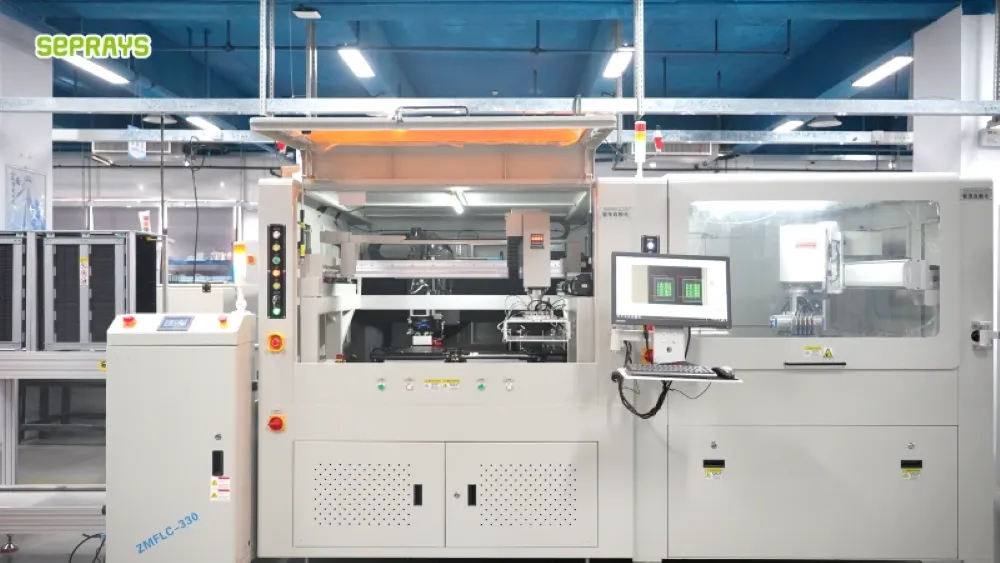
It was a connected workflow—from PCB infeed to automated tray loading.
🏭 The Customer Production Challenge
The customer manufactures electronic assemblies for semiconductor-related equipment.
The existing process involved several separate steps:
PCB infeed → positioning → laser separation → manual collection → manual tray loading
Each step worked independently.
The problem appeared between the steps.
Operators had to move boards manually.
Finished boards accumulated while waiting for tray loading.
Empty trays needed to be prepared.
Full trays had to be removed.
With higher production volume, these small interruptions became more noticeable.
There was another concern.
The PCB assemblies contained sensitive components, so reducing unnecessary mechanical contact during separation and handling was important.
The production team therefore wanted to improve two things at the same time:
process continuity and board handling consistency.
🔍 Why Laser Depaneling Was Considered
Different depaneling methods solve different problems.
For this application, the customer was particularly interested in a non-contact cutting process.
A laser does not use a mechanical milling cutter or saw blade to physically push through the PCB.
That can be useful when mechanical stress, component clearance, or very fine cutting paths are important considerations.
However, laser is not automatically the best choice.
Material composition, board thickness, required cutting speed, heat-affected areas, fume extraction, and edge requirements all need to be evaluated.
This is why a sample test is important.
A process that looks ideal on a specification sheet still needs to work on the actual PCB.
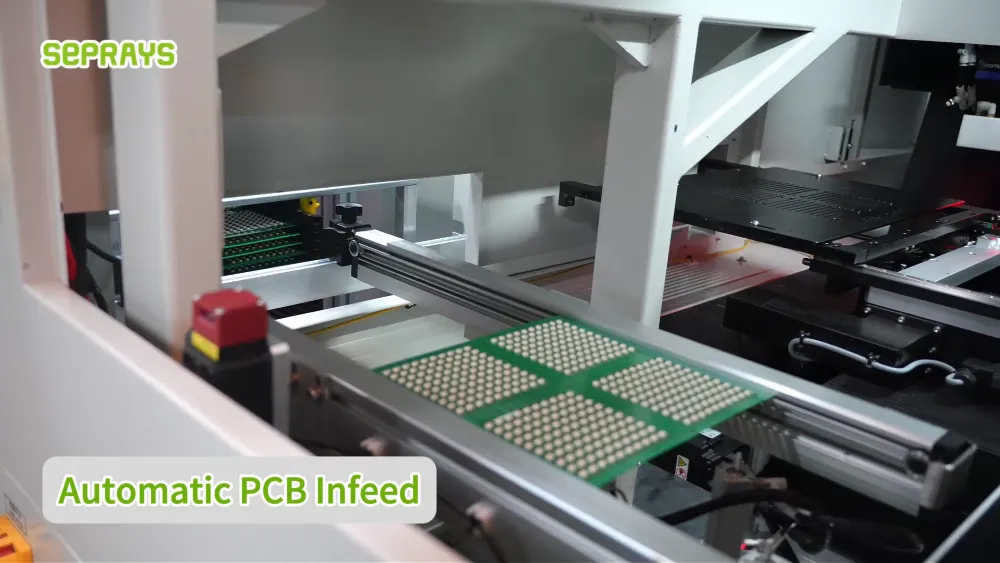
📥 Step 1: PCB Infeed
Automation starts before the laser turns on.
The PCB first enters the system through the infeed section.
The goal is simple:
Deliver the correct PCB to the correct position at the correct time.
That sounds basic.
In practice, stable infeed is essential because downstream accuracy depends on it.
If the board arrives at an inconsistent position, the laser path may not align correctly with the programmed cutting route.
A reliable automated line therefore needs to consider:
- PCB orientation
- Board spacing
- Position detection
- Transfer speed
- Buffer capacity
- Communication with upstream equipment
This is one reason automated depaneling should be considered as a complete material-flow problem rather than a single machine function.
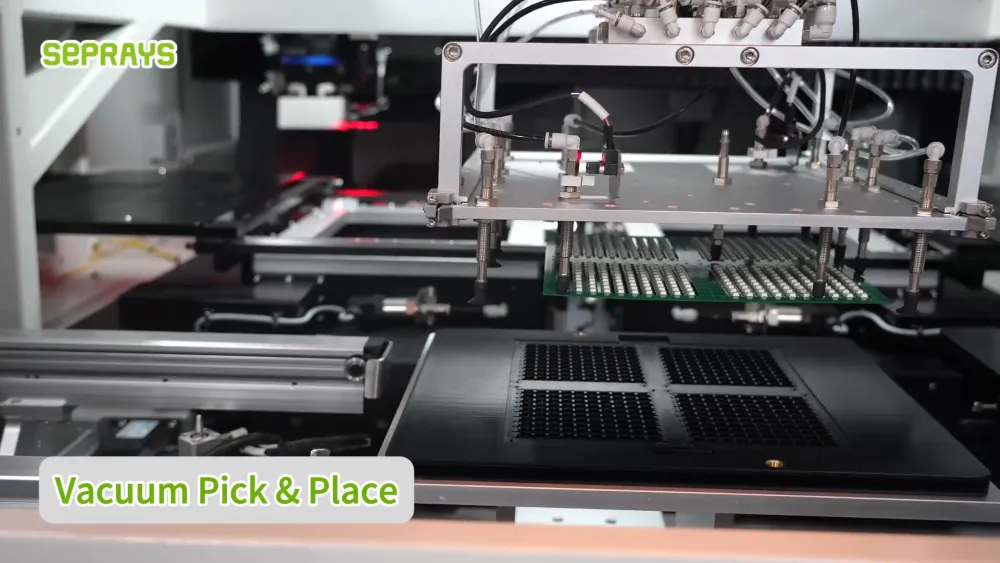
🎯 Step 2: Automatic Positioning and Recognition
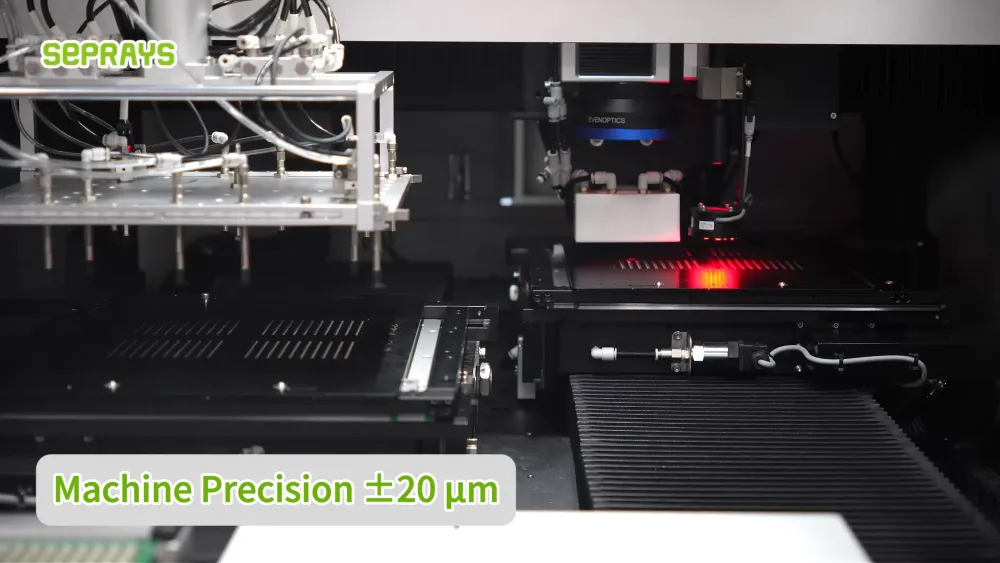
Once the PCB enters the working area, it needs to be positioned accurately.
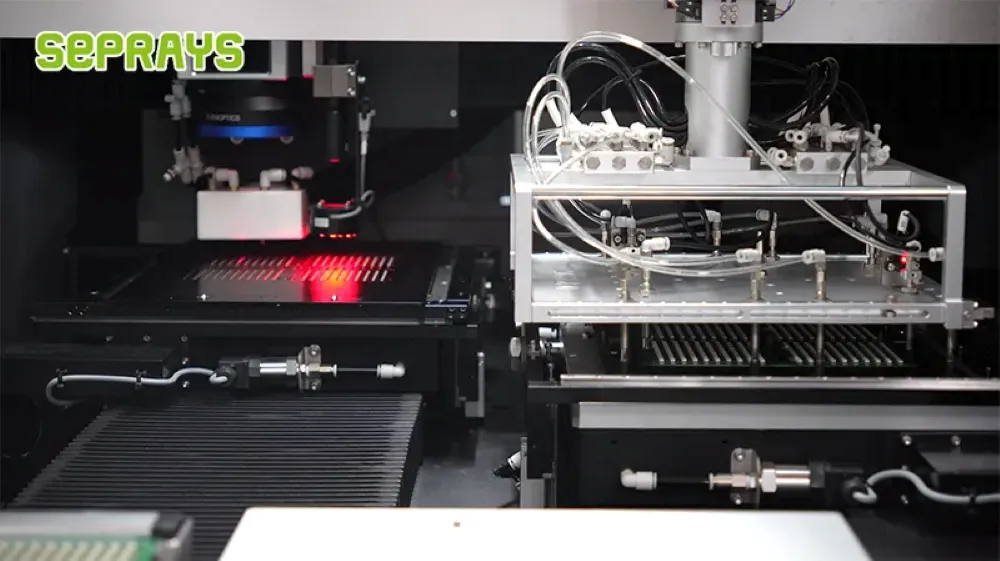
Depending on the configuration, vision systems can identify reference points and correct the cutting position.
This becomes particularly useful when panel positioning has small variations.
The machine does not simply assume that every incoming PCB is perfectly aligned.
It checks.
Then the cutting program can compensate within the designed operating range.
That small difference can matter in production.
Automation is not about assuming everything is perfect.
It is about designing the process so normal production variation can be controlled.
⚡ Step 3: Laser Depaneling
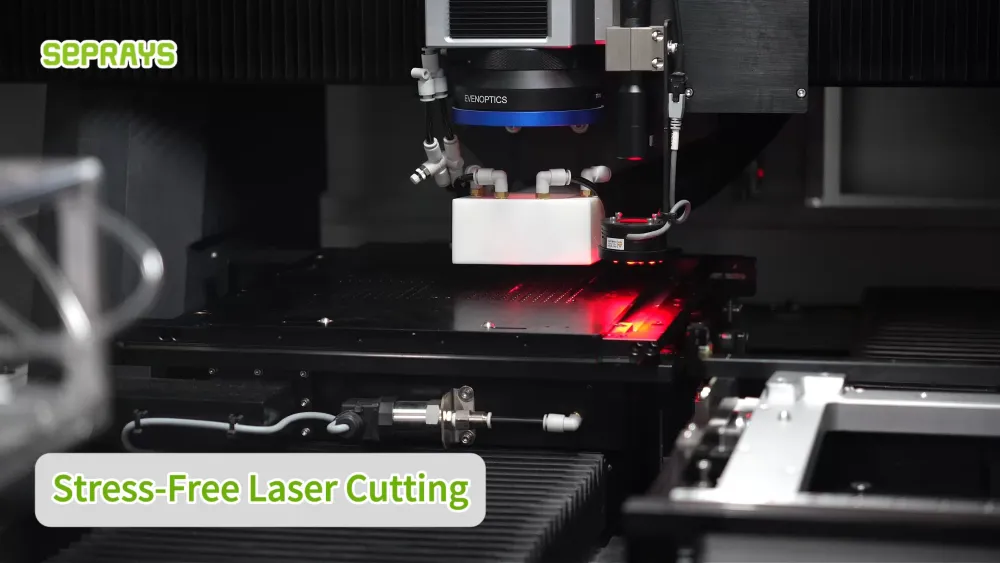
The laser then follows the programmed cutting path.
Unlike mechanical routing, there is no physical milling cutter contacting the PCB.
This can help reduce mechanical stress during separation.
For sensitive electronics, that can be an important consideration.
But laser processing introduces its own requirements.
The engineering team needs to consider:
- Laser power
- La velocidad de corte
- Number of passes
- PCB material
- Copper distribution
- Espesor de la junta
- Heat-affected area
- Fume extraction
- Required edge quality
A higher laser power does not automatically mean a better process.
Too much energy can increase thermal effects.
Too little energy can require slower processing or additional passes.
The practical target is a stable processing window.
🧹 Step 4: Fume and Process Residue Management
Laser processing changes the type of process residue that needs to be managed.
Instead of primarily dealing with mechanical cutting dust, laser processing can generate fumes and fine particles.
The extraction system therefore becomes part of the production solution.
This is sometimes overlooked when factories compare laser equipment.
A laser machine should not be evaluated only by its laser source.
The complete process includes:
Laser + optics + motion system + extraction + software + PCB handling
If extraction is poorly matched to the process, cleanliness and maintenance can become production concerns later.
📤 Step 5: Automated Board Transfer
After separation, the individual PCBs need to leave the cutting area.
This is where many supposedly “automated” processes become partially manual.
If an operator still needs to pick every separated PCB from the machine, the production line has only automated the cutting step.
The customer therefore looked at board transfer as part of the same workflow.
Separated boards were transferred automatically toward the tray-loading section.
The objective was straightforward:
Keep the PCB moving without unnecessary manual handling.
This also helps reduce the number of times an operator physically touches the finished board.
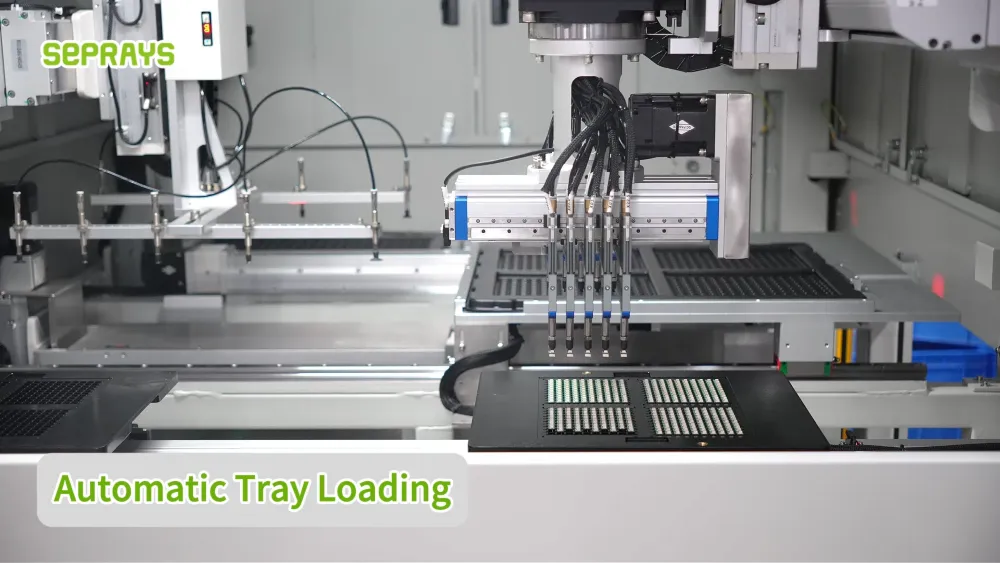
📦 Step 6: Automatic Tray Loading
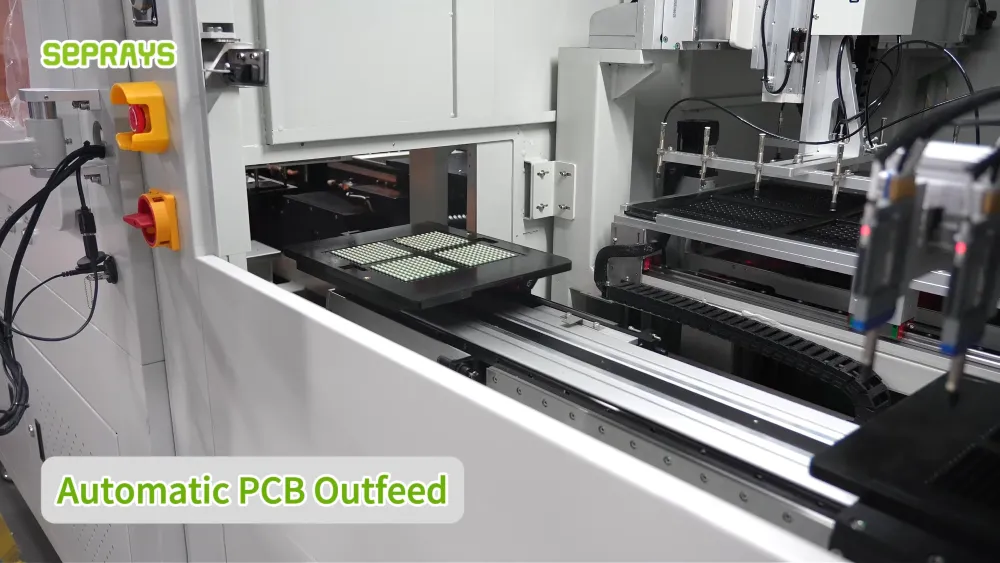
The final stage is tray loading.
Instead of asking an operator to collect individual boards and arrange them into trays, the system manages the loading sequence automatically.
A typical workflow looks like this:
PCB separation → board transfer → positioning → tray loading → tray full detection → empty tray replacement
The exact mechanism depends on PCB dimensions, weight, tray design, production volume, and required cycle time.
This is also where automation can produce a less obvious benefit.
It can prevent the laser depaneling process from having to wait for an operator to catch up.
In other words, the goal is not only to automate labor.
It is to remove interruptions between processes.
💰 Looking at the Real Production Cost
When evaluating a fully automated line, machine price is only one part of the calculation.
A better comparison includes:
| Cost Factor | Manual Process | Automated Process |
|---|---|---|
| PCB handling labor | Higher | Lower |
| Manual tray loading | Required | Reduced |
| Machine waiting time | Potentially higher | Potentially lower |
| Board handling consistency | Operator-dependent | More standardized |
| Changeover | Flexible but manual | Program-dependent |
| Maintenance | Lower system complexity | Higher automation complexity |
| Initial investment | Lower | Higher |
| Long-term scalability | Limited by labor | Better suited to higher volume |
This does not mean automation always produces a faster payback.
For low-volume production, manual handling may remain more economical.
But when thousands of boards move through a line every month, repetitive handling becomes a measurable operating cost.
The surprising part is that the biggest saving may not come from labor.
It may come from reducing waiting time between machines.
🔬 A Semiconductor Customer Application
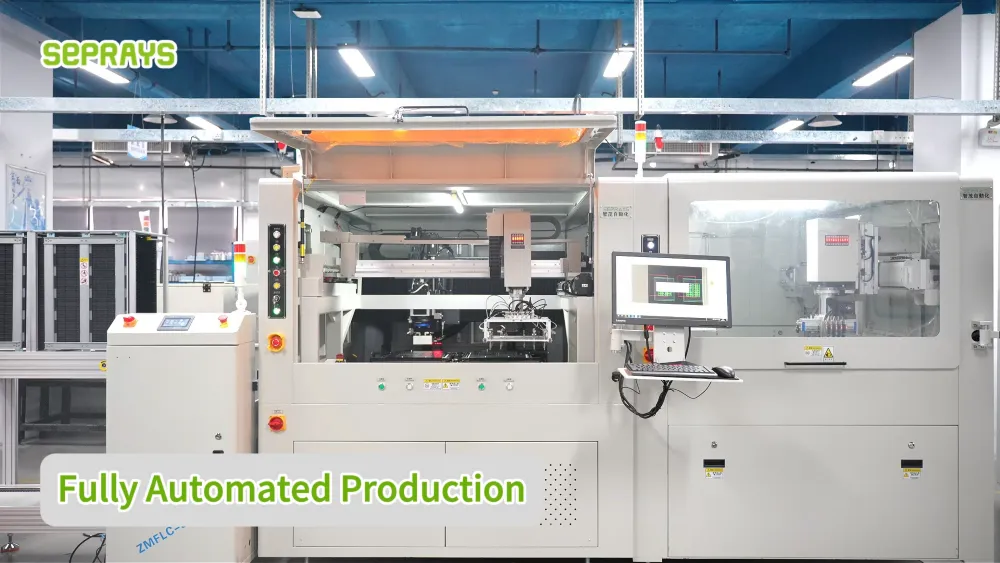
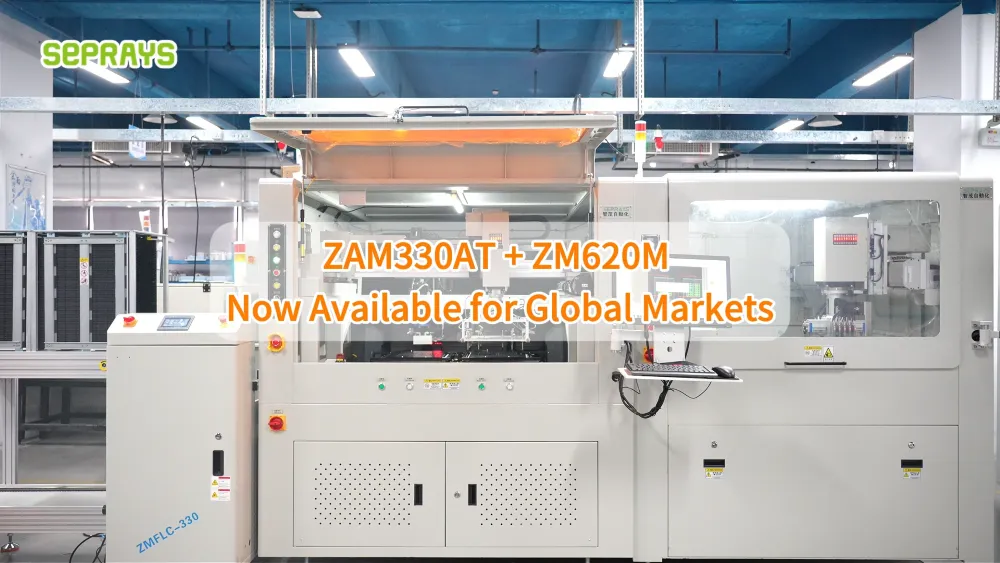
For this overseas semiconductor-related electronics manufacturer, Seprays Group evaluated the complete workflow rather than treating the laser separator as an isolated machine.
The production team looked at the PCB infeed, positioning, laser processing, transfer method, tray capacity, operator involvement, and downstream material flow.
The final approach connected these stages into one automated process.
The operator’s role shifted from repeatedly moving PCBs to monitoring the line and handling exceptions.
That change sounds simple.
But in a busy factory, removing thousands of repetitive movements can have a meaningful effect on daily production.
More importantly, it makes the process easier to measure.
Engineers can monitor where the line stops.
They can identify whether the bottleneck comes from laser processing, board transfer, tray capacity, or another stage.
That is much more useful than simply knowing the laser’s cycle time.
📊 What Should You Check Before Automating?
Before investing in a complete automated depaneling line, it is worth checking the following:
PCB: dimensions, thickness, material, weight, and component layout.
Cutting: required contour, edge quality, tolerance, and laser processing window.
Handling: board orientation, transfer method, and gripping requirements.
Tray: dimensions, capacity, stacking method, and replacement frequency.
Production: daily volume, shift pattern, and product mix.
Integration: upstream equipment, downstream equipment, communication, and factory space.
These details determine whether a fully automated system will actually improve the production process.
🧠 The Counterintuitive Conclusion
A fully automated depaneling line does not necessarily need to maximize the speed of every individual machine.
That can actually create problems.
If the laser runs extremely fast but the tray loader cannot keep up, the line still stops.
If the tray loader is faster than the upstream process, it simply waits.
The better objective is balanced throughput.
Every stage should work within a compatible production window.
That is why successful automation is often less about buying the fastest machine and more about removing the slowest connection between machines.
🌎 Why Choose Seprays Group?
With more than 30 years of experience, Seprays Group has been dedicated to PCB/FPC depaneling technology, providing a full range of solutions—including milling-cutter depanelers, laser depanelers, V-Groove depanelers, punching depanelers, and automated handling systems.
Our equipment is trusted by leading manufacturers, including Foxconn, Flextronics, State Grid, Luxshare, Compal, Wistron, China Electronics, Quanta, CRRC, China Aerospace, OPPO, ZTE, and Bosch. Our equipment and solutions are used in factories across China and manufacturing facilities worldwide.
With more than three decades of experience, Seprays Group focuses not only on the separation method, but also on how that process fits into the customer’s production line.
For automated laser depaneling, this can include PCB infeed, positioning, laser processing, fume extraction, board transfer, tray loading, and communication with surrounding equipment.
The right configuration depends on the actual PCB and production environment.
A PCB drawing, Gerber file, panel layout, production volume, tray specification, and current production workflow can provide a much better starting point than simply selecting equipment from a catalog.
If you are planning an automated laser depaneling project, please get in touch with us to discuss your application.
WhatsApp: +8618929266433
Correo electrónico: sales@seprays.com
❓ FAQ
1. What is an automated laser depaneling solution?
It is a production system that combines laser PCB separation with automated functions such as PCB infeed, positioning, transfer, and tray loading. The exact configuration depends on the production requirements.
2. Does laser depaneling eliminate mechanical stress completely?
No process should be described as completely stress-free. Laser processing avoids direct mechanical cutting contact, which can reduce mechanical loading, but thermal effects and other process conditions still need to be evaluated for the specific PCB.
3. Why is automatic PCB positioning important?
Positioning determines where the programmed cutting path is applied. Consistent positioning helps the system maintain the intended cutting location and can reduce errors caused by variations in incoming panels.
4. Is a fully automated line always more economical?
No. Automation usually requires higher initial investment and additional integration and maintenance. It becomes more attractive when production volume, repetitive handling, machine waiting time, and labor requirements justify the investment.
5. What information is needed to design an automated laser depaneling line?
Useful information includes PCB dimensions, thickness, material, Gerber files, panel layout, cutting requirements, production volume, tray dimensions, board weight, current handling process, and the equipment connected before and after the depaneling station.