.png)
 Spanish
  English
  Japanese
  Korean
  Russian
  Chinese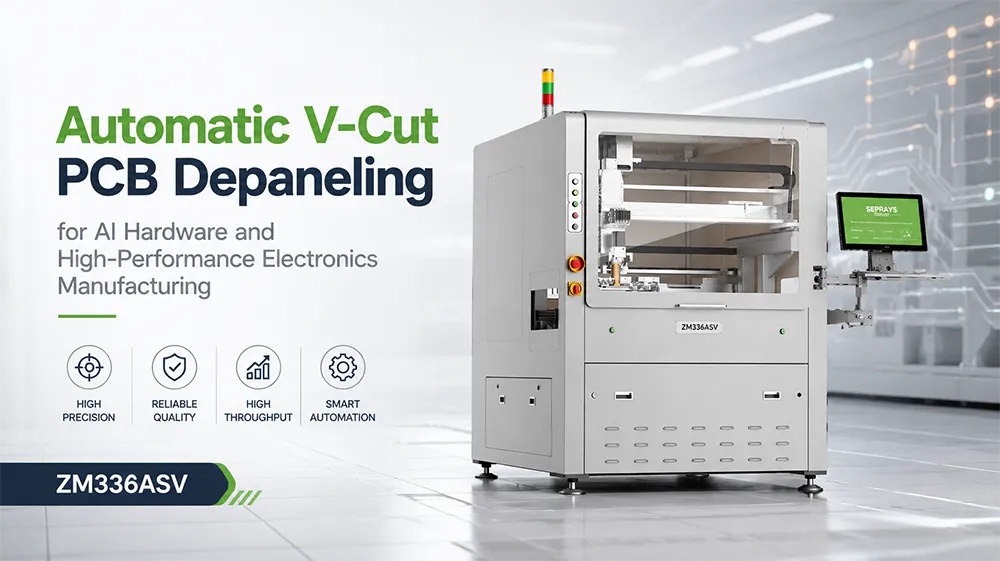
Automatic V-Cut PCB depaneling becomes much more interesting when PCB production moves into AI servers, edge computing equipment, accelerator systems, and other high-performance electronics.
The cutting operation itself is not complicated. The challenge is keeping the process consistent, clean, repeatable, and economical when production volumes increase.
For manufacturers, the real question is not simply, “How fast can the boards be separated?”
It is:
Can the depaneling process keep up with production without creating quality or labor problems?
🤖 Why AI Hardware Changes the Production Equation
AI hardware is putting more pressure on electronics manufacturers.
High-performance computing systems can contain dense PCB assemblies, power-management boards, control boards, communication modules, and other electronic assemblies.
These products often bring several manufacturing requirements together:
- Higher component density
- More demanding thermal designs
- Higher production consistency
- Shorter product cycles
- Greater demand for automation
- Stronger traceability requirements
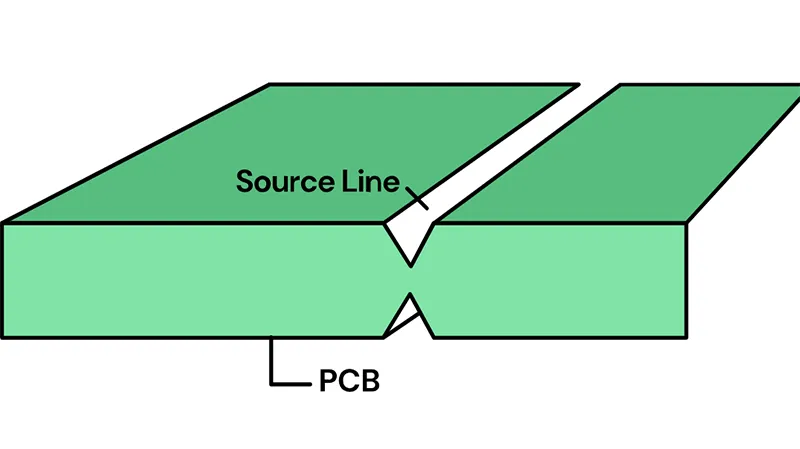
A PCB may already have a V-groove design, making V-Cut separation a practical option.
But when production reaches several shifts per day, manually separating those panels can become a bottleneck.
That is where automation starts to make economic sense.
🔍 Start With the PCB Design
Not every PCB should use V-Cut separation.
Before choosing equipment, check:
Panel size
Can the machine accommodate the complete panel?
PCB thickness
Different materials and thicknesses can behave differently during separation.
V-groove design
Confirm the groove position, depth, direction, and consistency.
Component clearance
Pay special attention to components close to the separation line.
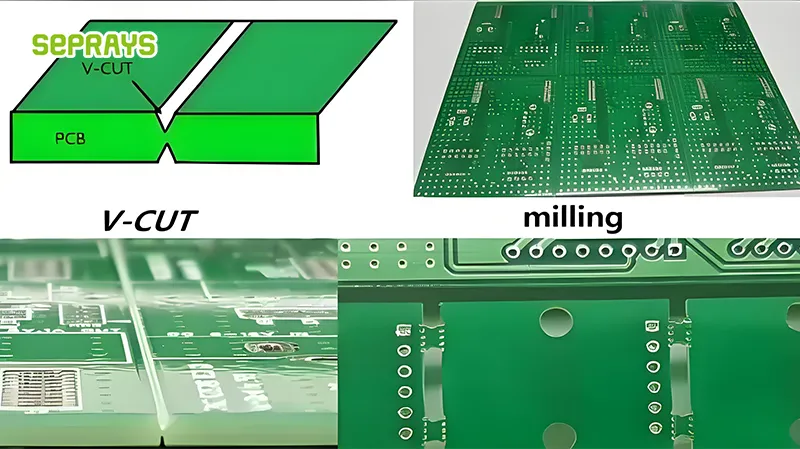
Board geometry
Straight V-grooves are generally more suitable than complex internal contours.
This last point is important.
If the PCB contains irregular outlines or internal cutouts, a routing solution may be more appropriate.
The best machine is therefore not necessarily the most advanced machine. It is the machine that fits the actual board.
⚙️ Look Beyond Cutting Speed
A machine specification may highlight cutting speed.
That is useful, but it does not tell the whole story.
A real production cycle can include:
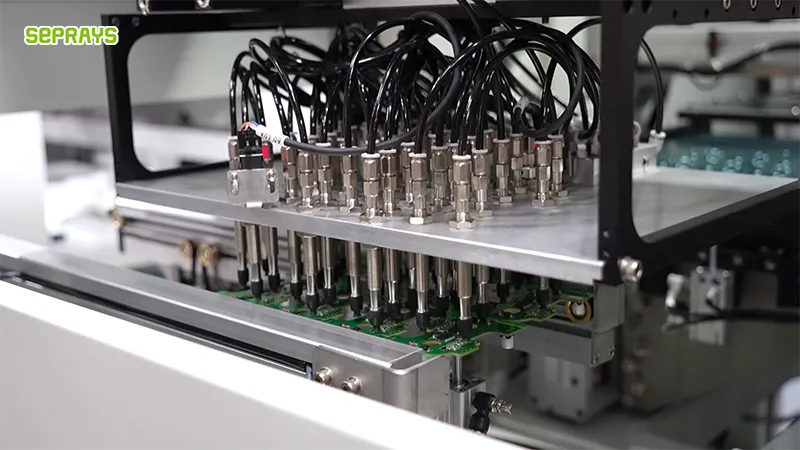
Loading → positioning → V-groove separation → transfer → unloading → waste collection
If an operator still needs to intervene after every panel, the theoretical cutting speed may have little impact on total output.
For high-volume production, ask suppliers to measure the complete cycle time.
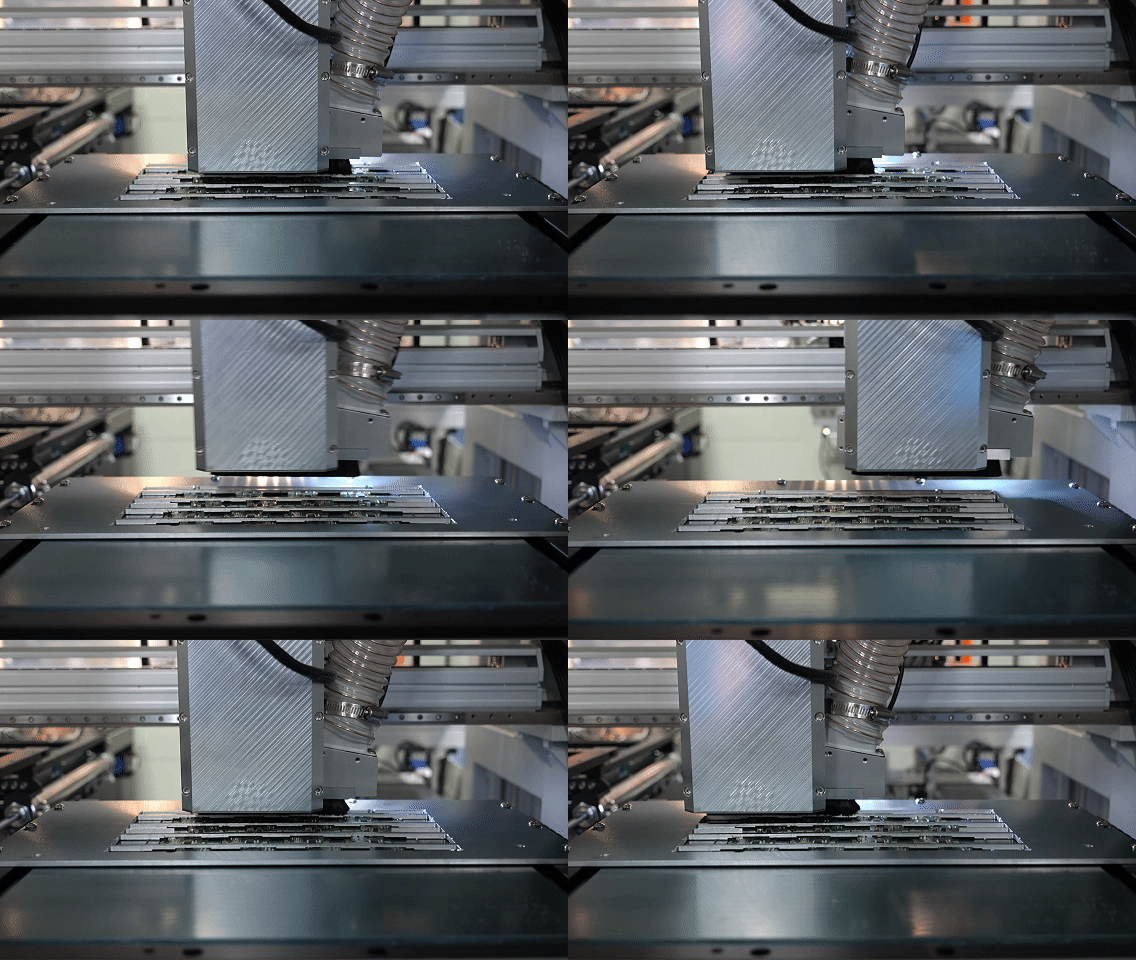
El ZM336ASV/ZM336ASVL is designed around automated V-Cut and V-Groove separation, with automatic feeding, separation, unloading, and waste handling. The system also supports X/Y-axis processing for applicable panel configurations.
📊 Match Automation With Production Volume
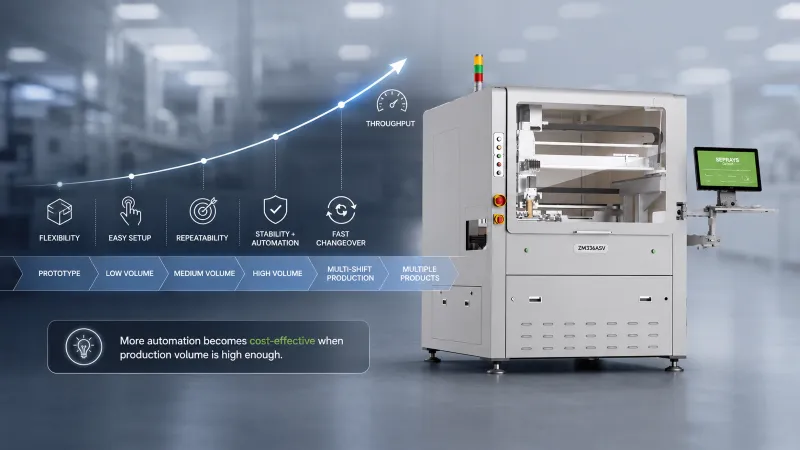
Automation should follow production volume.
| Production Situation | What Usually Matters Most |
|---|---|
| Prototype | Flexibility |
| Low volume | Easy setup |
| Medium volume | Repeatability |
| High volume | Rendimiento |
| Multi-shift production | Stability + automation |
| Multiple products | Fast changeover |
For a small workshop, manual loading may still be perfectly reasonable.
For a factory producing AI-related electronics around the clock, the calculation changes.
Labor availability, repetitive handling, production consistency, and downstream integration become much more important.
The counterintuitive conclusion: buying more automation is not always the economical decision. It becomes economical when the equipment is used enough to recover its additional investment.
💰 Calculate the Cost Per Board
The machine price is only the beginning.
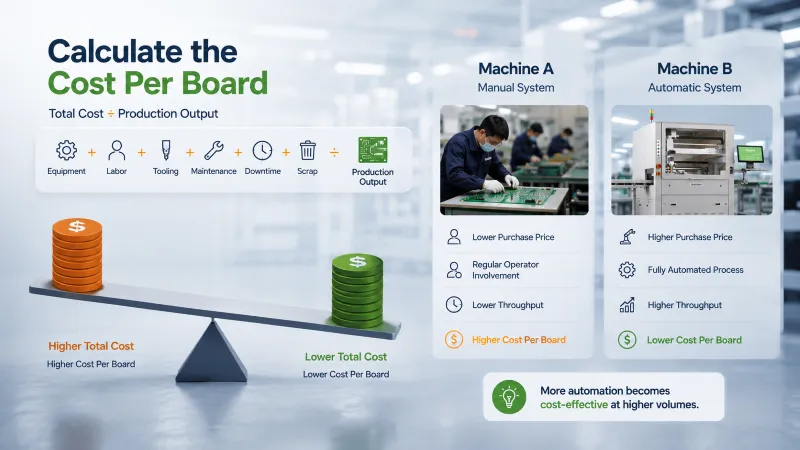
A more useful calculation is:
Cost per board = equipment + labor + tooling + maintenance + downtime + scrap ÷ production output
Imagine two systems.
Machine A has a lower purchase price but requires regular operator intervention.
Machine B costs more but automatically feeds panels, separates boards, transfers finished products, and collects waste.
For low-volume production, Machine A could be the better choice.
For a three-shift high-performance electronics factory, Machine B could eventually produce a lower cost per board.
This is why procurement teams should compare total operating cost, not quotations alone.
🧪 Test the Process With Real Production Panels
A supplier demonstration is useful.
Your own PCB is better.
Before purchasing, test representative panels and record:
- Separation quality
- Edge condition
- Component condition
- Repeatability
- Complete cycle time
- Changeover time
- Operator involvement
- Waste handling
- Maintenance requirements
Do not judge the machine after only five or ten panels.
A process that performs well during a short demonstration may behave differently after thousands of cycles.
For AI hardware and high-value electronics, process validation is particularly important because the cost of a damaged assembled board can be much higher than the cost of the separation operation itself.
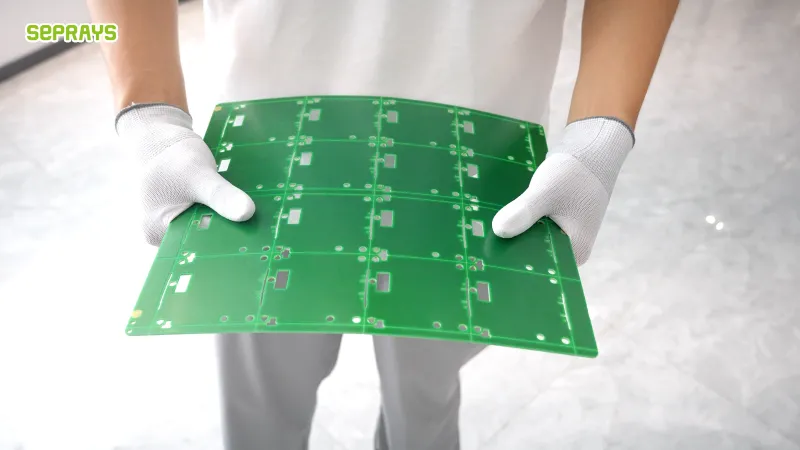
🏭 An Illustrative Semiconductor Manufacturing Case
Consider an overseas semiconductor equipment manufacturer supplying control electronics for AI computing systems.
The company initially uses manual V-groove separation.
At low volume, the process works.
As demand grows, however, production supervisors notice several problems:
- Operators spend more time on repetitive handling.
- Output varies between shifts.
- Product changeovers interrupt production.
- Finished boards require additional handling.
- Production planning becomes more difficult.
The engineering team evaluates an automated solution.
Instead of looking only at machine speed, they compare labor requirements, cycle time, board quality, changeover, and downstream transfer.
A Seprays V-groove solution could be evaluated for this type of application, depending on the actual panel design and production requirements.
The important point is that this is not simply a machine upgrade.
It is a process-flow decision.
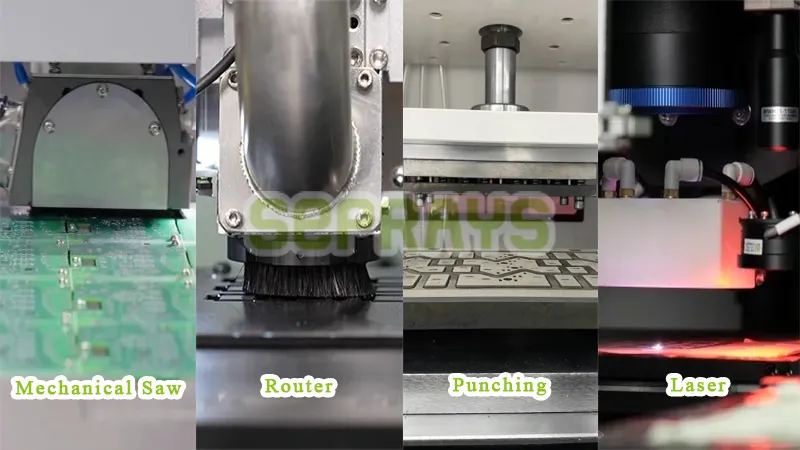
🔄 V-Cut vs. Other Depaneling Methods
A useful comparison should consider the PCB rather than the marketing specification.
| Method | Best Suited For | Main Consideration |
|---|---|---|
| V-Groove | Straight pre-scored panels | Requires suitable V-groove design |
| Milling | Irregular outlines | Tooling and dust management |
| Laser | Sensitive/high-precision applications | Higher equipment investment |
| Punching | Stable dedicated geometries | Tooling flexibility |
| Manual | Small batches | Labor and consistency |
Seprays provides multiple depaneling technologies rather than limiting manufacturers to one method, including milling-cutter, laser, V-groove, and punching solutions.
For some factories, a mixed strategy may actually be more practical.
Standardized high-volume boards can use automatic V-groove separation, while complex products can move through routing or another suitable process.
🧠 A Practical Selection Checklist
Before requesting a final quotation, answer these questions:
1. What is the PCB thickness?
2. Does the panel already use V-grooves?
3. How many panels are produced per shift?
4. How many product models need to be processed?
5. How much manual handling is currently required?
6. What edge quality is acceptable?
7. Does the machine need to connect with upstream or downstream equipment?
8. What happens if production doubles next year?
These questions usually produce a better equipment decision than asking, “Which machine has the highest speed?”
🌍 Why Choose Seprays Group?
Seprays Group has been dedicated to PCB/FPC depaneling technology for more than 30 years, since its establishment in 1993. Its portfolio covers milling-cutter depanelers, laser depanelers, V-groove depanelers, punching depanelers, and automated loading, unloading, and handling systems.
Seprays equipment is trusted by leading manufacturers and organizations, including Foxconn, Flextronics, State Grid, Luxshare, Compal, Wistron, China Electronics, Quanta, CRRC, China Aerospace, OPPO, ZTE, and Bosch. Its equipment is used in factories across China and worldwide.
With more than three decades of experience, Seprays focuses on matching the depaneling method with the customer’s PCB design, production volume, quality requirements, and automation goals.
For manufacturers evaluating V-Cut separation for AI hardware or high-performance electronics, the practical starting point is simple:
Share your PCB drawing, panel dimensions, thickness, V-groove structure, production volume, and automation requirements.
The right solution should be validated against the actual production process—not selected solely from a specification sheet.
If you need help evaluating your application, please get in touch with Seprays Group.
WhatsApp: +8618929266433
Correo electrónico: sales@seprays.com
❓ FAQ
1. Is V-Cut depaneling suitable for AI hardware PCBs?
It can be, especially when the panels use suitable straight V-grooves and production volumes are high. The PCB design and component clearance should always be evaluated first.
2. Why automate V-Cut separation for high-volume electronics?
Automation can reduce repetitive manual handling, improve process consistency, and connect depaneling with upstream and downstream production equipment.
3. Is automatic V-Cut separation always better than milling?
No. V-Cut works well for suitable pre-scored panels, while milling is generally more flexible for irregular outlines and internal cutouts.
4. What should I provide when requesting a machine evaluation?
Provide the PCB drawing, panel layout, board thickness, V-groove information, production volume, product mix, and desired automation level. Actual samples are also highly useful for process validation.
5. Can the ZM336ASV/ZM336ASVL be integrated into an automated production line?
The system is designed around automated feeding, V-groove separation, unloading, and handling. The exact integration configuration should be confirmed according to the customer’s production line and PCB requirements.