.png)
 Korean
  English
  Spanish
  Japanese
  Russian
  Chinese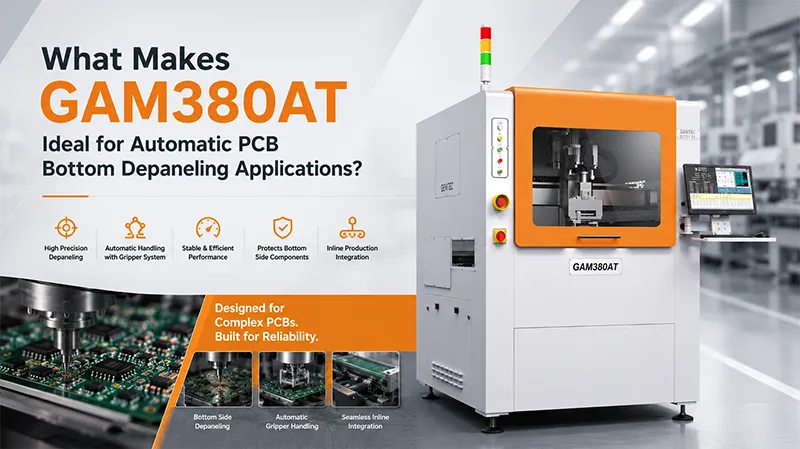
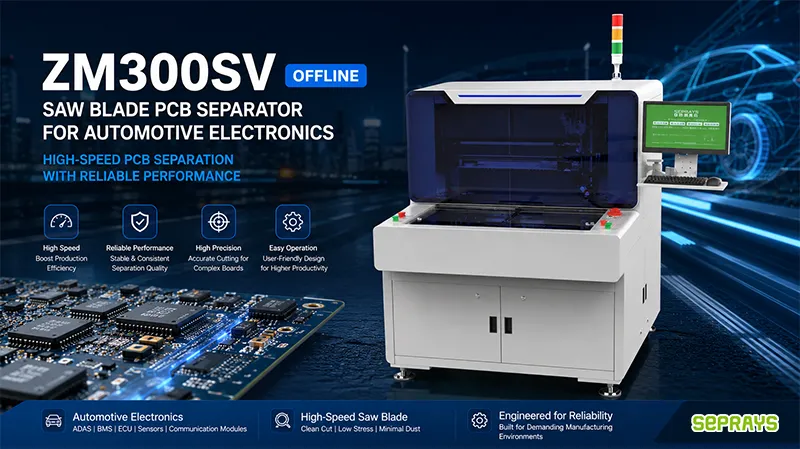
Automatic PCB Bottom Depaneling Applications are becoming a much bigger topic in electronics manufacturing than they were just a few years ago. Walk into an automotive electronics factory today, and the discussion often moves beyond simple cutting speed. Engineers are asking different questions:
Can we reduce stress on sensitive components?
Can we maintain a stable yield during high-volume production?
Can we automate material handling without sacrificing precision?
Can depaneling become part of a connected production process instead of remaining an isolated machine?
Those questions did not appear by accident.
Modern PCBs have changed. Manufacturing expectations have changed as well.
And this shift explains why solutions like the GAM380AT were developed.
🔍 Why Traditional PCB Separation Started Reaching Its Limits
Several years ago, many depaneling applications were relatively straightforward.
Boards were thicker.
Components had more spacing.
Product cycles moved more slowly.
But modern automotive electronics introduced different requirements.
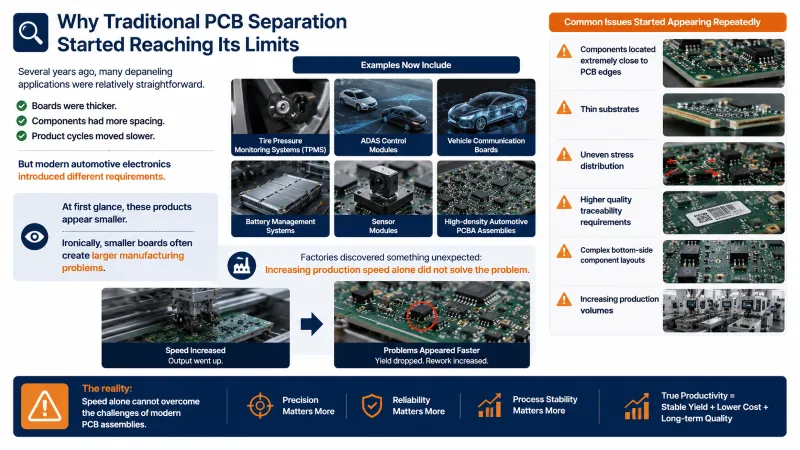
Examples now include:
- Tire pressure monitoring systems (TPMS)
- ADAS control modules
- Vehicle communication boards
- Battery management systems
- Sensor modules
- High-density automotive PCBA assemblies
At first glance, these products appear smaller.
Ironically, smaller boards often create larger manufacturing problems.
Common issues started appearing repeatedly:
- Components located extremely close to PCB edges
- Thin substrates
- Uneven stress distribution
- Higher quality traceability requirements
- Complex bottom-side component layouts
- Increasing production volumes
Factories discovered something unexpected:
Increasing production speed alone did not solve the problem.
Sometimes it made problems appear faster.
⚠️ A Story Behind Why GAM380AT Was Developed
More than thirty years of working with PCB depaneling projects taught Seprays Group an important lesson.
Machines are rarely developed because someone simply wants a faster spindle.
Machines are usually developed because factories repeatedly encounter the same pain point.
Several years ago, project discussions with automotive manufacturers showed similar concerns.
One example came from a production facility in Suzhou, Jiangsu, China.
The factory was producing automotive sensor modules with bottom-side-mounted components.
Their existing depaneling process created several challenges:
Manual loading slowed production.
Support fixtures required frequent adjustment.
Stress around component edges created inconsistent results.
Production output increased, but quality variation increased as well.
Initially, engineers believed routing speed was the problem.
After further analysis, they discovered something else:
The real issue involved handling stability, board positioning consistency, and support during separation.
That experience influenced later development thinking.
The goal became larger than cutting boards.
The goal became protecting products.
⚙️ What Makes GAM380AT Different?
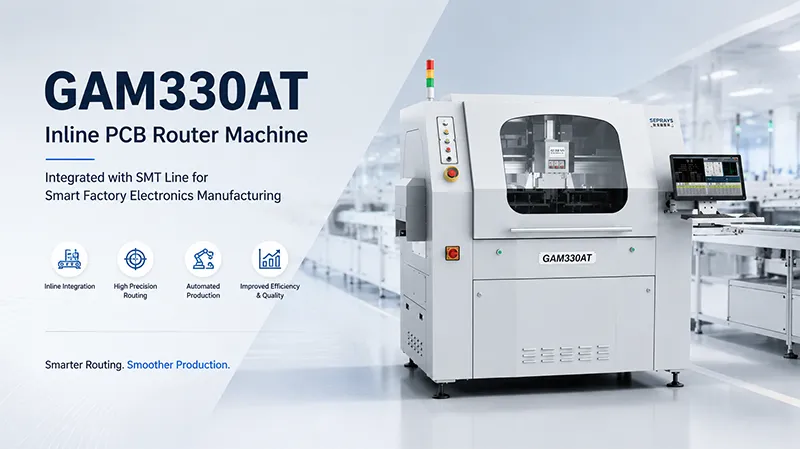
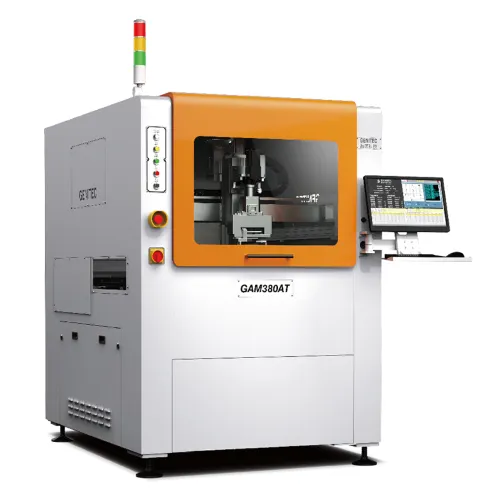
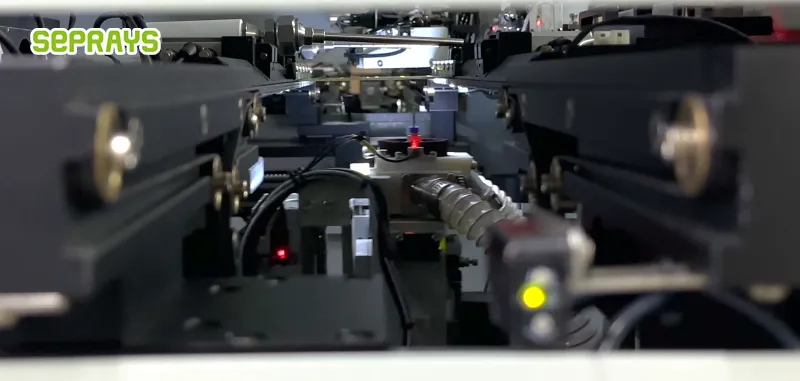
GAM380AT was designed specifically for automated bottom depaneling environments.
Several features directly address real production conditions.
Key capabilities include:
- Bottom-up routing process
- Gripper handling design
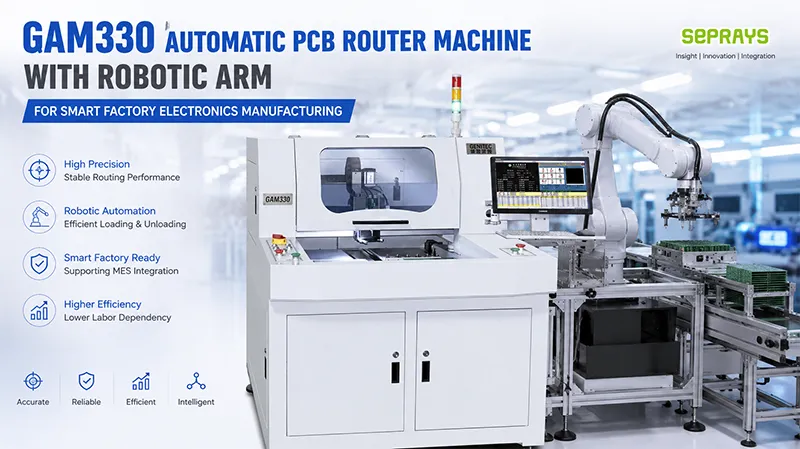
- Inline automation compatibility
- High-speed spindle operation
- Stable board positioning
- Automatic material handling integration
- Reduced mechanical stress during cutting
Instead of treating cutting as an isolated operation, the system becomes part of an entire manufacturing workflow.
📊 Comparing Traditional Routing and GAM380AT Solutions
| Factor | Conventional Separation | GAM380AT Solution |
|---|---|---|
| Board support consistency | 당 | High |
| Manual handling | Higher | Lower |
| Component protection | Variable | Stable |
| Production integration | Limited | Better |
| Yield consistency | Fluctuating | More stable |
| Scalability | Difficult | Easier |
| Long-term operating efficiency | 당 | Higher |
The difference becomes increasingly visible in high-volume environments.
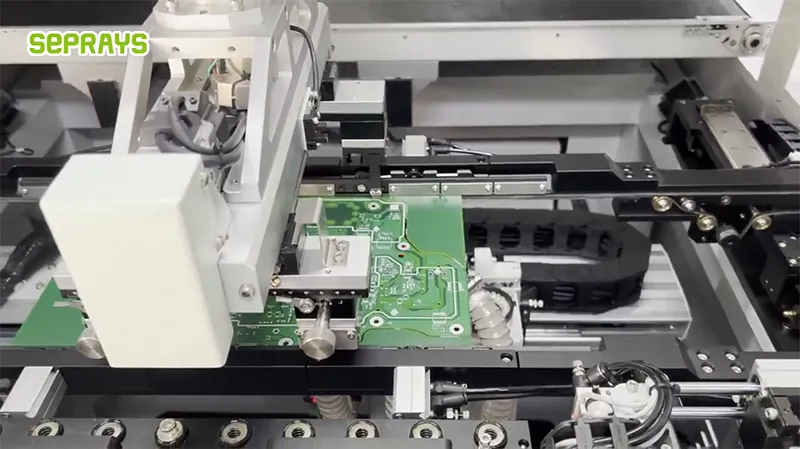
💡 A Counterintuitive Reality: Faster Isn’t Always Better
Many people assume productivity simply means producing more boards per hour.
Real production often tells a different story.
Imagine this situation:
A factory increases routing speed by 12%.
During the first week:
Output improves.
Everyone feels satisfied.
Three weeks later:
Inspection volume increases.
Yield drops slightly.
Random component failures begin appearing.
Additional labor becomes necessary.
The original productivity gain slowly disappears.
The hidden costs become larger than the visible gains.
Real productivity often includes:
- Stable yield
- Lower rework
- Reduced stress damage
- Long-term reliability
- Predictable production flow
Not only pieces per hour.
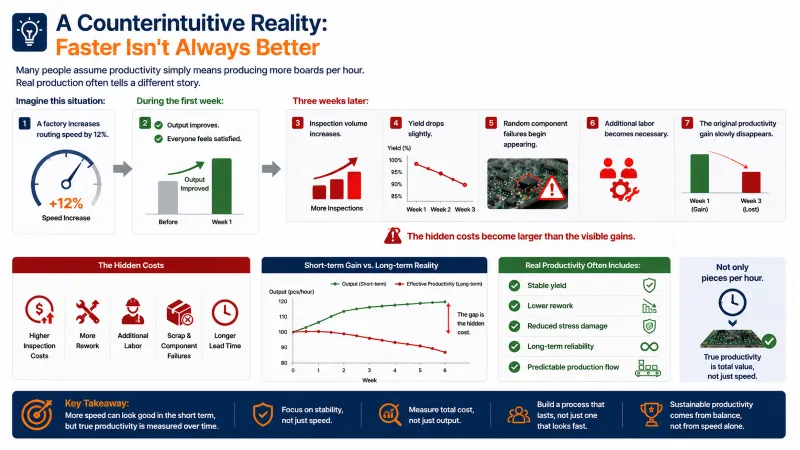
🏭 Real Production Experience: A More Practical View
During automotive manufacturing projects, engineers frequently discover something interesting.
Many process improvements do not come from changing the cutter itself.
They come from improving system behavior around the cutter.
Examples include:
Board support
Material transfer
Positioning consistency
Process automation
Handling stability
Because depaneling happens late in production, it often becomes the last process teams investigate.
Sometimes it should be examined much earlier.
🚀 Looking Beyond Cutting Performance
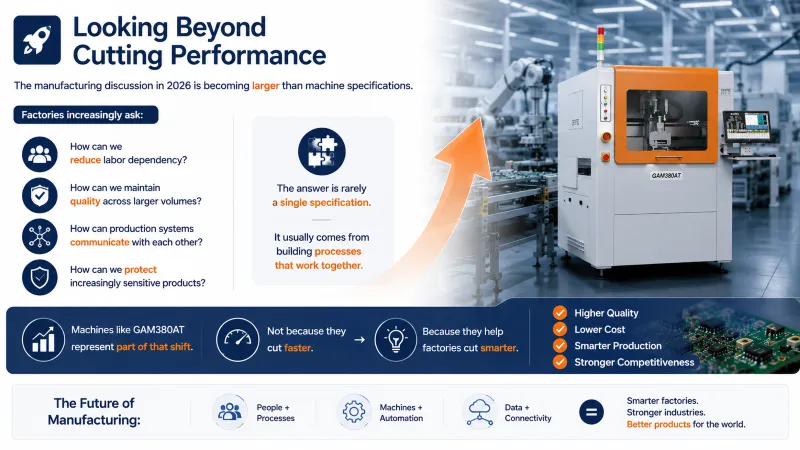
The manufacturing discussion in 2026 is becoming larger than machine specifications.
Factories increasingly ask:
How can we reduce labor dependency?
How can we maintain quality across larger volumes?
How can production systems communicate with each other?
How can we protect increasingly sensitive products?
The answer is rarely a single specification.
It usually comes from building processes that work together.
Machines like GAM380AT represent part of that shift.
Not because they cut faster.
Because they help factories cut smarter.
Why Choose Seprays Group?
For more than 30 years, Seprays Group has continuously focused on PCB and FPC depaneling technology development and practical manufacturing applications.
Seprays Group has been dedicated to PCB/FPC depaneling technology, providing a full range of solutions—including milling-cutter depanelers, laser depanelers, V-groove depanelers, punching depanelers, and automated handling systems.
Our equipment has earned trust from leading global manufacturers, including Foxconn, Flextronics, State Grid, Luxshare, Compal, Wistron, China Electronics, Quanta, CRRC, China Aerospace, OPPO, ZTE, and Bosch.
Across automotive, industrial electronics, telecommunications, consumer electronics, and high-reliability applications, Seprays equipment supports factories throughout China and around the world.
We understand that every production line faces different challenges.
- Some focus on throughput.
- Some focus on component protection.
- Some focus on automation integration.
Our approach starts with understanding the process first and then matching the right technology.
If you would like to discuss your PCB depaneling requirements, please feel free to contact us.
WhatsApp: +8618929266433
이메일: sales@seprays.com
FAQ
1. Why is bottom depaneling important for automotive PCBA?
Bottom depaneling helps reduce stress on sensitive components located near board surfaces and improves cutting consistency in complex assemblies.
2. What applications are suitable for GAM380AT?
GAM380AT is commonly used for automotive electronics, sensor modules, communication products, industrial control systems, and high-density PCBA products.
3. Can GAM380AT support inline production?
Yes. The system is designed for inline integration and supports automated material handling and connected workflows.
4. Does higher routing speed always improve productivity?
Not necessarily. Excessive speed may introduce stress, increase inspection workload, and create long-term quality issues.
5. How can manufacturers reduce PCB damage during depaneling?
Improving board support, maintaining tool conditions, optimizing routing paths, and using stable automated systems can significantly reduce damage risk.