.png)
 Korean
  English
  Spanish
  Japanese
  Russian
  Chinese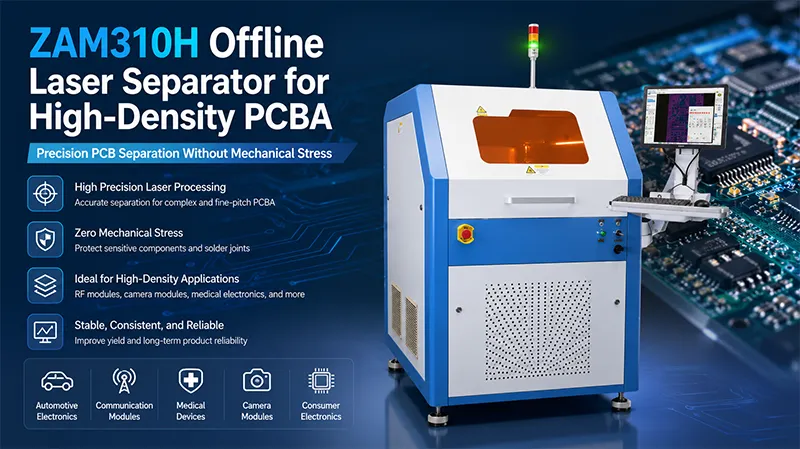
ZAM310H Offline Laser Separator for High-Density PCBA is becoming a more practical topic inside electronics manufacturing discussions in 2026. A few years ago, engineers could tolerate small process variation because PCB layouts were less crowded and component spacing was more forgiving.
That situation changed.
Today’s products continue to become smaller while expectations for reliability continue to rise.
Consumer devices are thinner. Automotive modules contain more functions. Medical electronics require greater stability. RF communication boards integrate more sensitive structures into smaller spaces.
Interestingly, the challenge is not simply cutting a PCB anymore.
The larger challenge is preventing invisible damage that appears weeks later.
Many engineers discover this only after unexpected field failures start appearing.
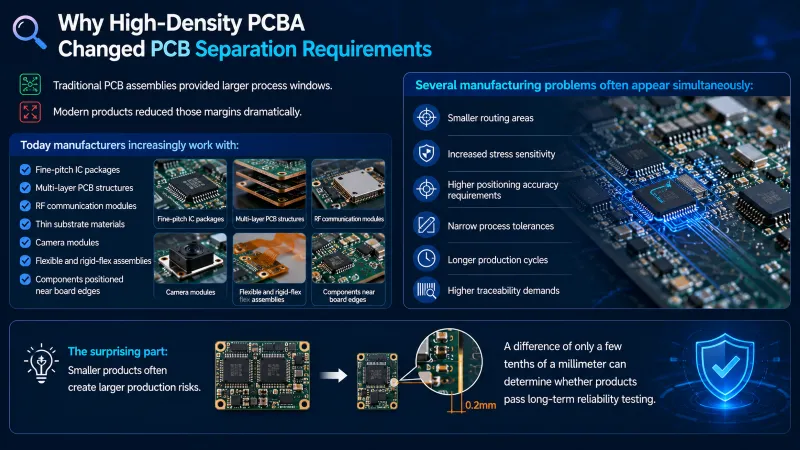
🔍 Why High-Density PCBA Changed PCB Separation Requirements
Traditional PCB assemblies provided larger process windows.
Modern products have reduced those margins dramatically.
Today, manufacturers increasingly work with:
- Fine-pitch IC packages
- Multi-layer PCB structures
- RF communication modules
- Thin substrate materials
- Camera modules
- Flexible and rigid-flex assemblies
- Components positioned near board edges
Several manufacturing problems often appear simultaneously:
- Smaller routing areas
- Increased stress sensitivity
- Higher positioning accuracy requirements
- Narrow process tolerances
- Longer production cycles
- Higher traceability demands
The surprising part:
Smaller products often create larger production risks.
A difference of only a few tenths of a millimeter can determine whether products pass long-term reliability testing.
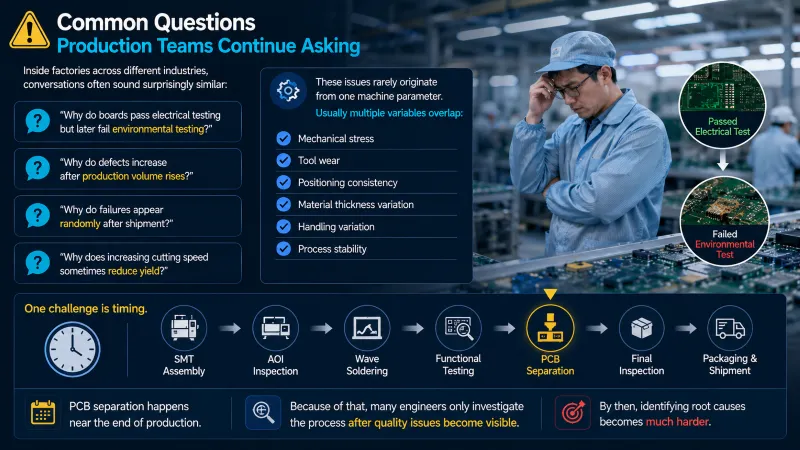
⚠️ Common Questions Production Teams Continue Asking
Inside factories across different industries, conversations often sound surprisingly similar:
“Why do boards pass electrical testing but later fail environmental testing?”
“Why do defects increase after production volume rises?”
“Why do failures appear randomly after shipment?”
“Why does increasing cutting speed sometimes reduce yield?”
These issues rarely originate from one machine parameter.
Usually, multiple variables overlap:
- Mechanical stress
- Tool wear
- Positioning consistency
- Material thickness variation
- Handling variation
- Process stability
One challenge is timing.
PCB separation happens near the end of production.
Because of that, many engineers only investigate the process after quality issues become visible.
By then, identifying root causes becomes much harder.
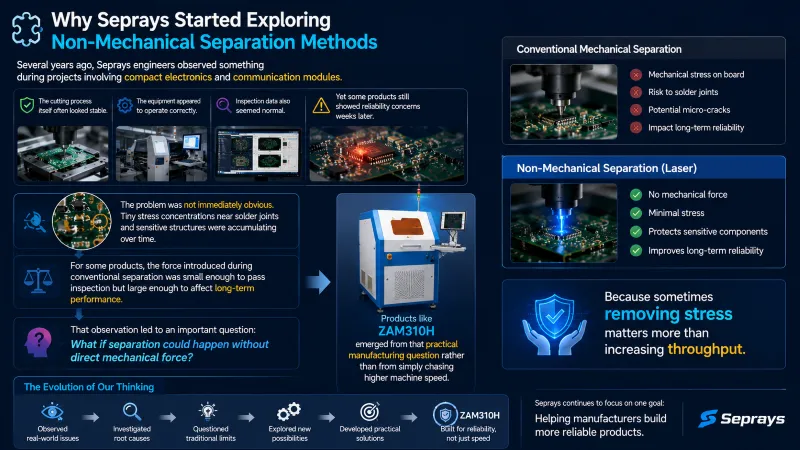
🧩 Why Seprays Started Exploring Non-Mechanical Separation Methods
Several years ago, Seprays engineers observed something during projects involving compact electronics and communication modules.
The cutting process itself often looked stable.
The equipment appeared to operate correctly.
Inspection data also seemed normal.
Yet some products still showed reliability concerns weeks later.
The problem was not immediately obvious.
Tiny stress concentrations near solder joints and sensitive structures were accumulating over time.
For some products, the force introduced during conventional separation was small enough to pass inspection but large enough to affect long-term performance.
That observation led to an important question:
What if separation could happen without direct mechanical force?
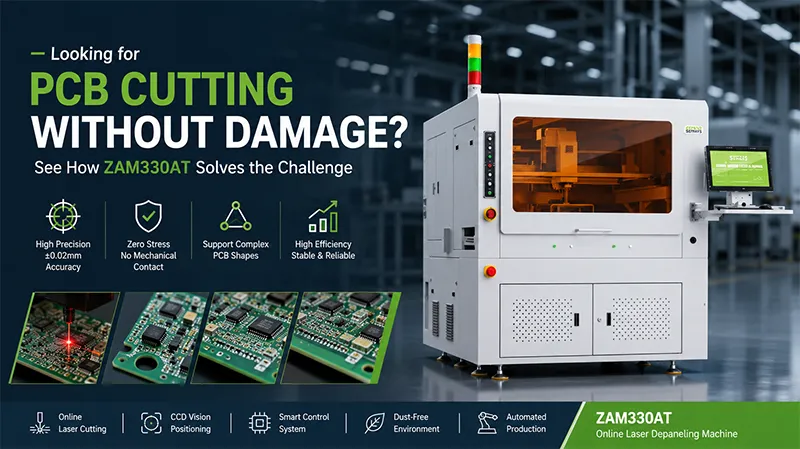
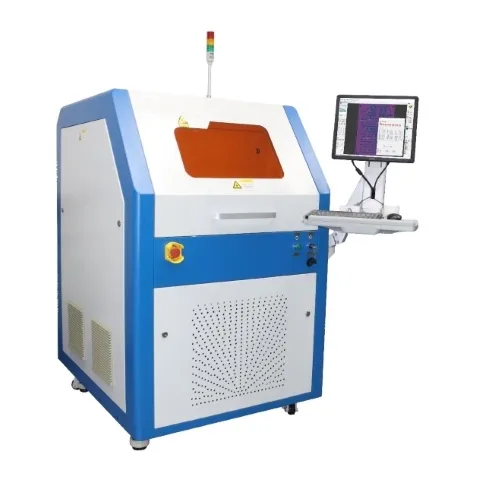
Products like ZAM310H emerged from that practical manufacturing question rather than from simply chasing higher machine speed.
Because sometimes removing stress matters more than increasing throughput.
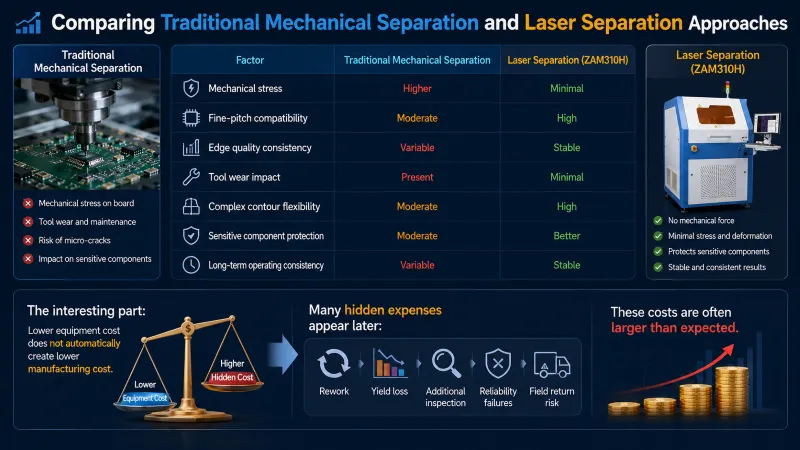
📊 Comparing Traditional Separation and Laser Separation Approaches
| Factor | Traditional Mechanical Separation | Laser Separation (ZAM310H) |
|---|---|---|
| Mechanical stress | Higher | Minimal |
| Fine-pitch compatibility | 당 | High |
| Edge quality consistency | Variable | Stable |
| Tool wear impact | Present | Minimal |
| Complex contour flexibility | 당 | High |
| Sensitive component protection | 당 | Better |
| Long-term operating consistency | Variable | Stable |
The interesting part:
Lower equipment cost does not automatically create lower manufacturing cost.
Many hidden expenses appear later:
- Rework
- Yield loss
- Additional inspection
- Reliability failures
- Field return risk
These costs are often higher than expected.
🌍 Real Production Experience: A Project in Penang, Malaysia
During a project involving communication modules in Penang, Malaysia, engineers faced an unusual challenge.
Their boards passed standard electrical testing.
Production parameters remained relatively stable.
However, environmental testing occasionally produced inconsistent results.
Initial investigation focused on material suppliers.
Then attention shifted toward solder quality.
Neither explained the issue.
Engineers later discovered that component structures near PCB edges were experiencing small amounts of stress during separation.
The effect was difficult to detect immediately.
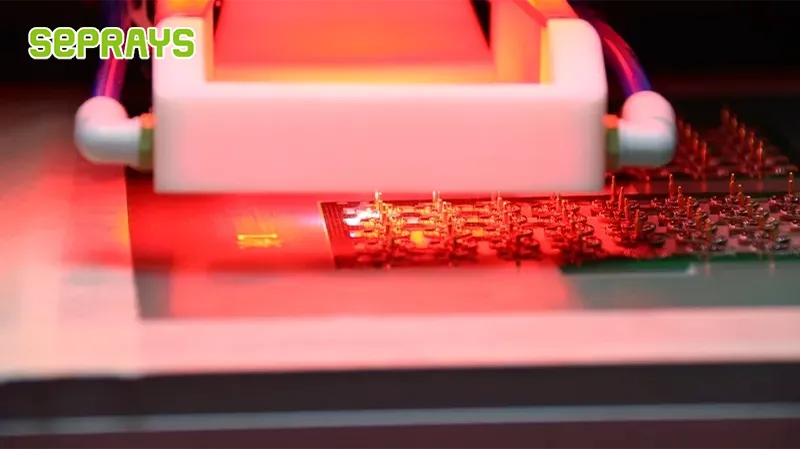
After process analysis and implementation of a laser separation approach supported by Seprays engineering teams, several changes became visible:
- Reduced rework requirements
- More stable yield trends
- Improved process consistency
- Lower handling variation
No dramatic overnight miracle happened.
But stability gradually improved.
Real factories usually value predictable results more than temporary improvements.
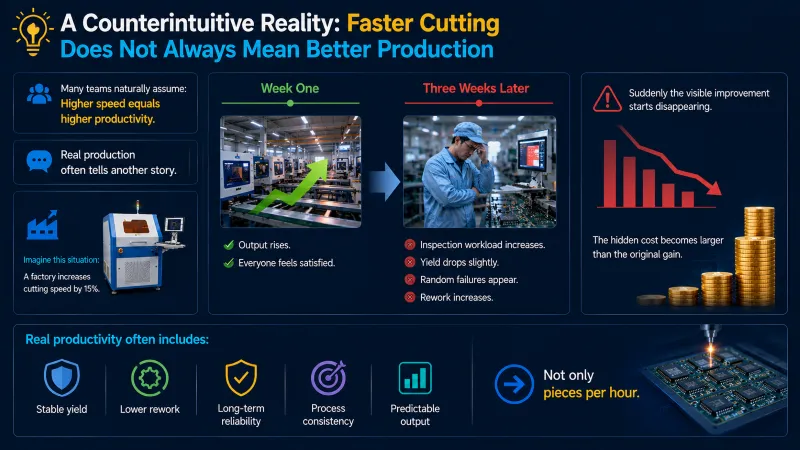
💡 A Counterintuitive Reality: Faster Cutting Does Not Always Mean Better Production
Many teams naturally assume:
Higher speed equals higher productivity.
Real production often tells another story.
Imagine this situation:
A factory increases cutting speed by 15%.
Week one:
Output rises.
Everyone feels satisfied.
Three weeks later:
Inspection workload increases.
Yield drops slightly.
Random failures appear.
Rework increases.
Suddenly, the visible improvement starts disappearing.
The hidden cost becomes larger than the original gain.
Real productivity often includes:
- Stable yield
- Lower rework
- Long-term reliability
- Process consistency
- Predictable output
Not only pieces per hour.
🚀 Looking Beyond Machine Specifications in 2026
Manufacturing discussions in 2026 increasingly focus on larger questions:
- How can factories reduce labor dependency?
- How can quality remain stable at larger volumes?
- How can increasingly sensitive products receive better protection?
- How can production systems become more connected?
The answer usually does not come from one specification.
It comes from building processes that work together.
Solutions such as ZAM310H represent part of that direction.
Not simply because they separate boards differently.
Because they help manufacturers build more stable production environments.
Sometimes, smarter manufacturing means introducing less force rather than more speed.
Why Choose Seprays Group?
For more than 30 years, Seprays Group has focused on PCB and FPC depaneling technologies and practical manufacturing challenges faced by global electronics producers.
Seprays Group has been dedicated to PCB/FPC depaneling technology, providing a complete portfolio of solutions, including milling-cutter depanelers, laser depanelers, V-groove depanelers, punching depanelers, and automated handling systems.
Our equipment has earned the trust of leading manufacturers, including Foxconn, Flextronics, State Grid, Luxshare, Compal, Wistron, China Electronics, Quanta, CRRC, China Aerospace, OPPO, ZTE, and Bosch, supporting production environments across China and worldwide.
More importantly, our approach goes beyond equipment supply.
We focus on:
- Application-based engineering support
- Process optimization recommendations
- Automation integration
- Stable long-term operation
- Global service capability
Every production environment is different.
If you are exploring PCB depaneling solutions for high-density applications, please contact us.
WhatsApp: +8618929266433
이메일: sales@seprays.com
FAQ
1. What types of PCB products are suitable for ZAM310H?
ZAM310H is suitable for high-density PCBA applications, including RF modules, camera modules, medical electronics, automotive electronics, semiconductor-related products, and compact consumer electronics.
2. Why does laser separation reduce mechanical stress?
Laser processing removes the need for direct physical cutting force. This helps reduce stress transfer to solder joints, ceramic components, and sensitive structures.
3. Can ZAM310H handle complex PCB shapes?
Yes. Laser separation is highly suitable for irregular contours, curved edges, fine structures, and complex routing geometries.
4. Does laser depaneling eliminate defects?
No manufacturing method eliminates all risks. Material properties, design structure, process setup, and handling conditions still influence results.
5. Is laser depaneling suitable for large-volume production?
For many high-value and high-density applications, laser depaneling can provide stable consistency and reduced process variation, making it practical for volume manufacturing environments.