.png)
 Korean
  English
  Spanish
  Japanese
  Russian
  Chinese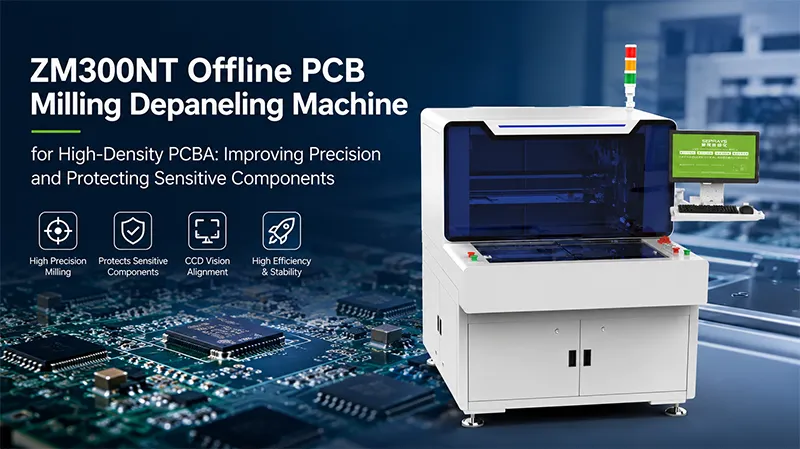
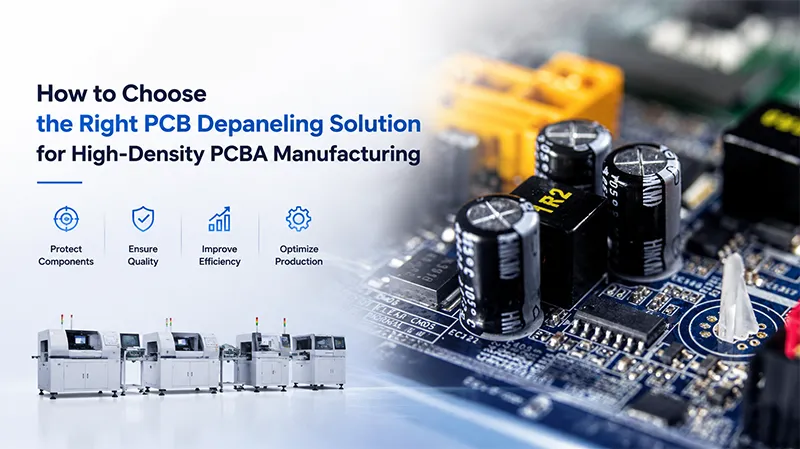
PCB milling depaneling machine selection has become much more important as PCB assemblies continue to shrink while component density keeps increasing. Many manufacturers discover that a depaneling process that worked well three years ago now causes hidden problems—micro-cracks, solder joint stress, damaged edge components, or inconsistent cutting quality.
If your production involves automotive electronics, communication modules, industrial controllers, medical devices, or consumer electronics, the depaneling stage deserves as much attention as SMT placement or reflow soldering.
This article shares practical observations from production environments, discusses common mistakes, compares different depaneling methods, and explains why many factories are moving toward high-speed milling solutions such as the ZM300NT.
🔍 Why High-Density PCBA Changes the Depaneling Standard
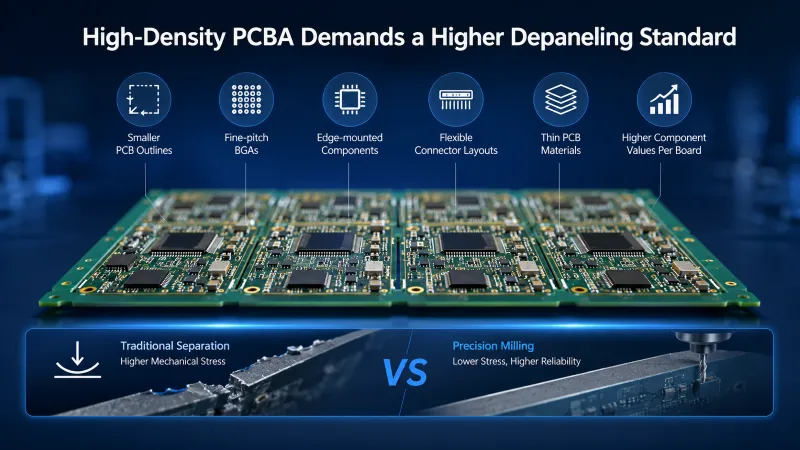
A growing number of electronic products now feature:
- Smaller PCB outlines
- Fine-pitch BGAs
- Edge-mounted components
- Flexible connector layouts
- Thin PCB materials
- Higher component values per board
These improvements make products lighter and more powerful.
They also make traditional separation methods much less forgiving.
A tiny amount of mechanical stress that once had little impact may now create invisible damage inside multilayer boards.
The result?
Products pass factory testing but fail months later in the customer’s hands.
That hidden cost is often far greater than the cost of upgrading the depaneling process.
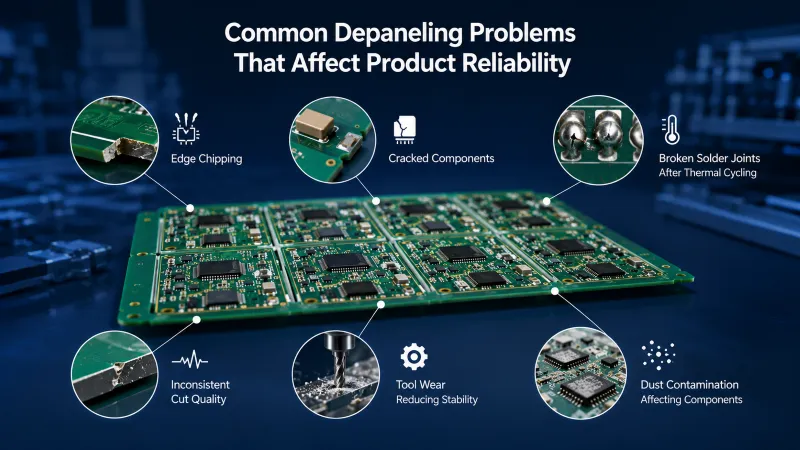
⚠️ Common Problems Manufacturers Still Face
Many production teams notice similar symptoms:
- Random PCB edge chipping
- Cracked ceramic capacitors near board edges
- Broken solder joints after thermal cycling
- Inconsistent cut quality
- Tool wear reduces production stability
- Dust affecting sensitive electronic components
Interestingly, these issues rarely appear immediately.
Instead, they become warranty claims, field failures, or unexpected maintenance costs.
From an engineering perspective, depaneling quality directly affects long-term product reliability.
🏭 Why Milling Has Become the Preferred Choice
Not every PCB requires milling.
Simple V-cut boards with generous component clearance can still be separated efficiently using other methods.
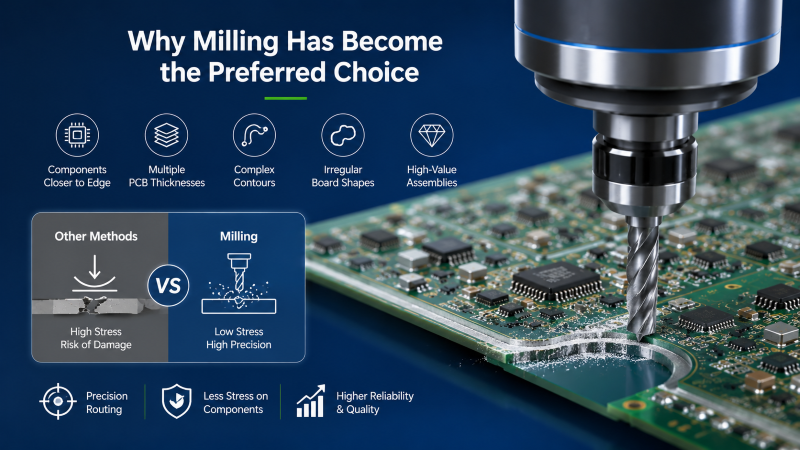
However, today’s high-density PCBA often introduces several constraints:
- Components are only millimeters from the routing paths
- Multiple PCB thicknesses
- Complex contours
- Irregular board shapes
- High-value assemblies
Under these conditions, precision routing offers better process control.
Rather than breaking panels through mechanical force, the cutting tool removes material gradually, reducing stress transferred to nearby components.
This approach is especially valuable for products with expensive ICs or sensitive sensors.
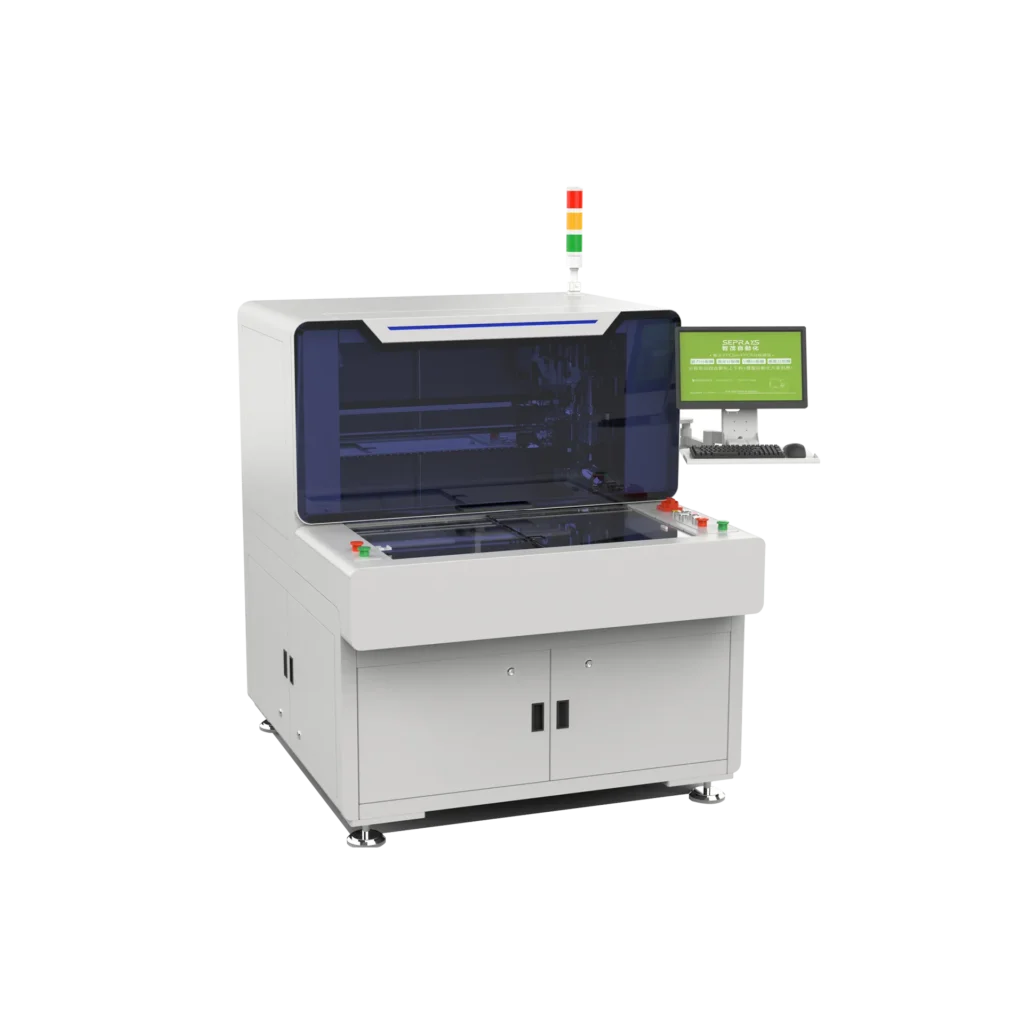
⚙️ Where the ZM300NT Fits
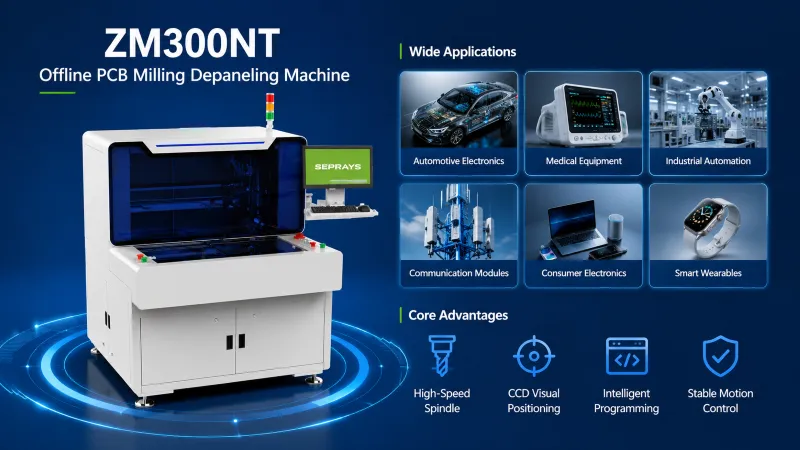
The ZM300NT Offline PCB Milling Depaneling Machine is designed for manufacturers that require stable routing accuracy while protecting delicate PCB assemblies.
Typical application scenarios include:
- Automotive electronic control units
- Medical monitoring equipment
- Industrial automation boards
- Communication modules
- Consumer electronics
- Smart wearable devices
Its combination of high-speed spindle technology, CCD visual positioning, intelligent programming, and stable motion control helps maintain consistent cutting quality across different production batches.
For manufacturers handling multiple product models, offline programming also reduces changeover time and improves equipment utilization.
📊 Comparing Common PCB Depaneling Methods
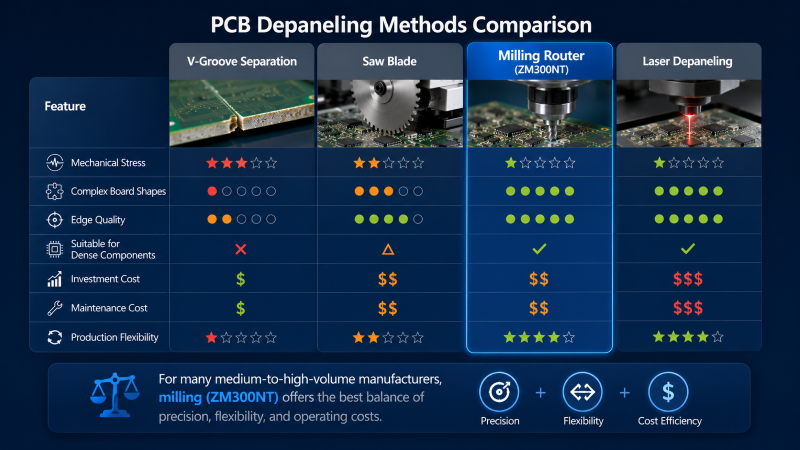
| 기능 | V-Groove Separation | Saw Blade | Milling Router (ZM300NT) | 레이저 구분 |
|---|---|---|---|---|
| Mechanical Stress | High | 중소 | Low | Very Low |
| Complex Board Shapes | Limited | 당 | Excellent | Excellent |
| Edge 품질 | Fair | Good | Excellent | Excellent |
| Suitable for Dense Components | No | Limited | 네 | 네 |
| Investment Cost | Low | 중소 | 중소 | High |
| Maintenance Cost | Low | 중소 | 당 | High |
| Production Flexibility | Low | 중소 | High | High |
There is no universal winner.
The right solution depends on PCB design, production volume, and reliability requirements.
For many medium-to-high-volume manufacturers, milling provides an effective balance among precision, flexibility, and operating costs.
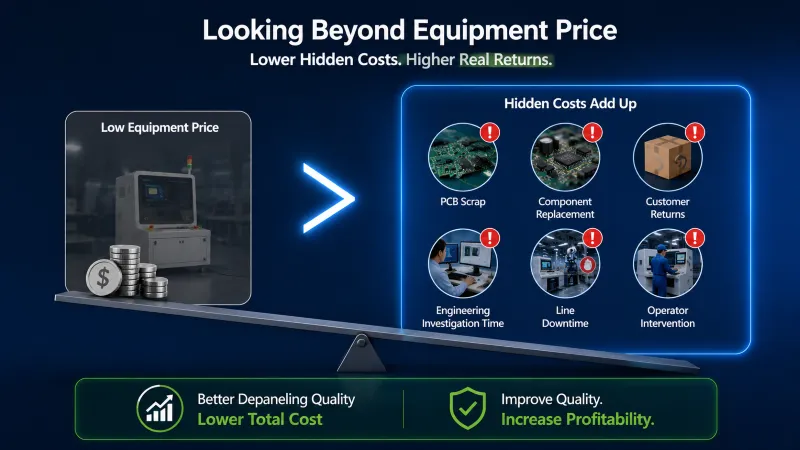
💰 Looking Beyond Equipment Price
One common misconception is that cheaper equipment always lowers production costs.
In reality, the opposite can happen.
Consider the hidden expenses:
- PCB scrap
- Component replacement
- Customer returns
- Engineering investigation time
- Line downtime
- Operator intervention
When these costs are added together, improving depaneling quality often delivers a faster return than expected.
Several manufacturers report that reducing board damage by only a small percentage significantly lowers annual quality costs.
This is particularly true for products with expensive electronic components.
🧩 Practical Experience from Real Production
An electronics manufacturer producing industrial communication controllers experienced recurring failures during functional testing.
Initial investigations focused on SMT placement accuracy and solder paste quality.
Neither was responsible.
Engineers eventually traced the issue to excessive mechanical stress during PCB separation.
The factory evaluated multiple routing solutions before introducing a Seprays ZM300NT into a pilot production line.
After optimizing routing paths and cutting parameters:
- PCB edge quality became more consistent.
- Visible stress marks were reduced.
- Manual rework decreased noticeably.
- Production stability improved over several weeks of monitoring.
Although every factory has different products and process conditions, the project demonstrated how depaneling can directly influence downstream quality.
📈 What Engineers Often Overlook
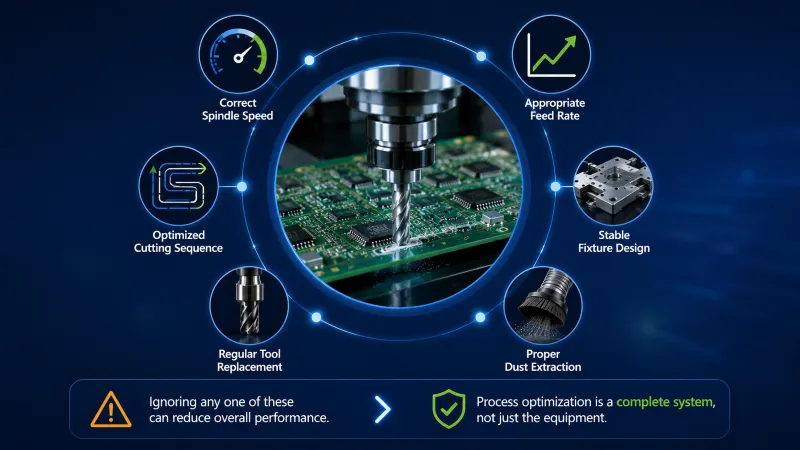
An interesting observation from recent manufacturing projects is that routing accuracy alone does not guarantee good results.
Several additional factors matter:
- Correct spindle speed
- Appropriate feed rate
- Stable fixture design
- Proper dust extraction
- Regular tool replacement
- Optimized cutting sequence
Ignoring any one of these can reduce overall performance.
Process optimization should therefore be viewed as a complete system rather than only selecting better equipment.
🛡️ Dust Control Is More Important Than Many Expect
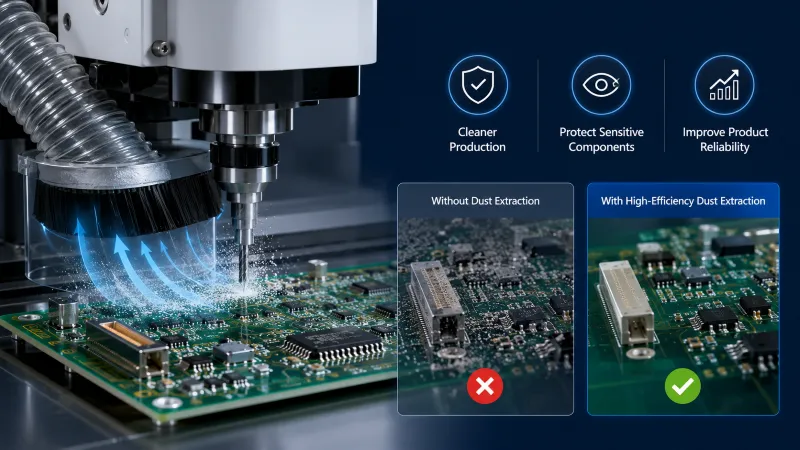
Modern PCB assemblies often include exposed connectors, optical modules, sensors, and miniature components.
Routing naturally generates dust.
Without effective extraction, particles may settle on sensitive assemblies or enter downstream processes.
High-efficiency dust collection, therefore, contributes not only to cleaner production but also to more reliable electronic products.
Many factories now evaluate depaneling equipment partly based on dust management rather than cutting speed alone.
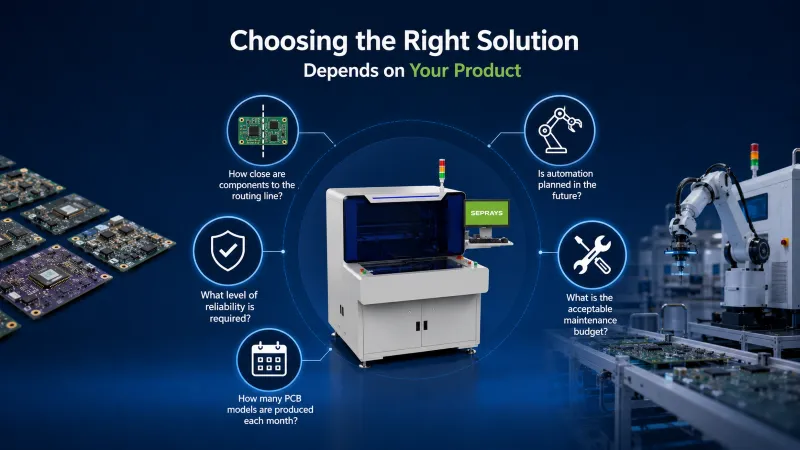
🌍 Choosing the Right Solution Depends on Your Product
There is no perfect depaneling technology.
Instead, manufacturers should evaluate several practical questions:
- How close are components to the routing line?
- What level of reliability is required?
- How many PCB models are produced each month?
- Is automation planned for the future?
- What is the acceptable maintenance budget?
Answering these questions usually leads to a much better equipment decision than comparing purchase prices alone.
💡 Final Thoughts
High-density PCBAs continue to push manufacturing processes toward higher precision and lower mechanical stress.
Depaneling is no longer a simple finishing step.
It directly influences product quality, customer satisfaction, and long-term manufacturing costs.
For manufacturers seeking a balance between routing precision, production flexibility, and operational efficiency, the ZM300NT Offline PCB Milling Depaneling Machine represents a practical solution that aligns with today’s increasingly demanding PCB assembly requirements.
Why Choose Seprays Group?
For more than 30 years, Seprays Group has focused exclusively on PCB/FPC depaneling technology, continuously developing solutions that meet the evolving demands of electronics manufacturing. Rather than offering a single machine type, we provide complete depaneling solutions covering different production requirements and automation levels.
Seprays Group has been dedicated to PCB/FPC depaneling technology for over 30 years, providing a full range of solutions—including milling-cutter depanelers, laser depanelers, V-groove depanelers, punching depanelers, and automated handling systems. Our equipment is trusted by globally recognized manufacturers, including Foxconn, Flextronics, State Grid, Luxshare, Compal, Wistron, China Electronics, Quanta, CRRC, China Aerospace, OPPO, ZTE, and Bosch. Today, Seprays solutions are running in factories throughout China and across international manufacturing markets, helping customers improve precision, efficiency, and production consistency.
Whether you are upgrading an existing SMT line or planning a new PCB manufacturing project, our engineering team can recommend the most suitable depaneling solution based on your products, production capacity, and quality objectives.
If you would like to discuss your application or evaluate the ZM300NT for your production line, please feel free to contact us.
WhatsApp: +8618929266433
이메일: sales@seprays.com
FAQ
1. Is the ZM300NT suitable for high-density PCB assemblies?
Yes. The ZM300NT is designed for high-density PCBA applications where components are located close to the board edge. Its high-speed milling technology helps minimize mechanical stress while maintaining excellent cutting accuracy.
2. Which industries typically use the ZM300NT?
It is widely used in automotive electronics, medical devices, industrial automation, communication equipment, consumer electronics, smart wearables, and other applications requiring precise PCB separation.
3. How does milling compare with V-groove depaneling?
Milling removes material gradually, generating significantly less mechanical stress than V-groove separation. This makes it more suitable for complex PCB shapes and boards with sensitive edge-mounted components.
4. Can the ZM300NT handle different PCB designs?
Yes. With offline programming, CCD vision positioning, and flexible routing capabilities, the ZM300NT can efficiently process multiple PCB models with reduced setup time.
5. What factors should be considered before choosing a PCB depaneling machine?
Key considerations include PCB thickness, board material, component clearance, production volume, required cutting accuracy, automation requirements, maintenance costs, and long-term product reliability. Evaluating these factors together helps identify the most suitable depaneling solution.