.png)
 Russian
  English
  Spanish
  Japanese
  Korean
  Chinese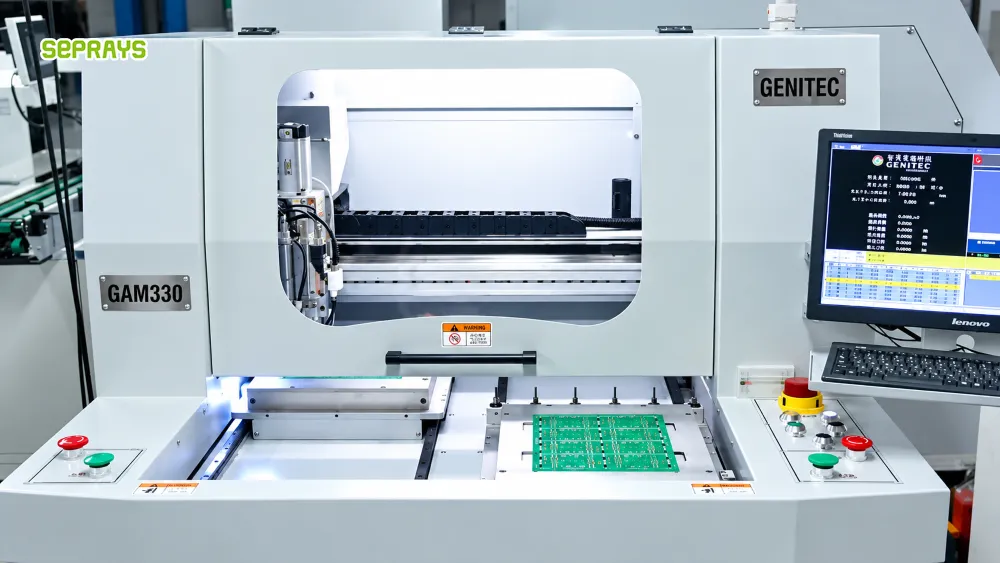
PCB routing sounds simple until it becomes part of a real production line.
A semiconductor electronics manufacturer was facing a familiar problem: the PCB panels were changing, production volume was increasing, and manual separation was becoming harder to control.
The team did not simply need a faster cutter.
They needed a process that could load the panel, locate it correctly, follow the programmed contour, and separate the boards with consistent edge quality.
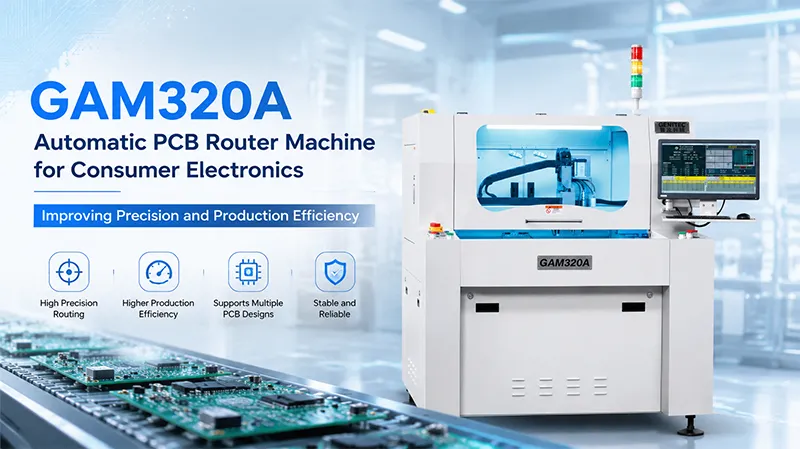
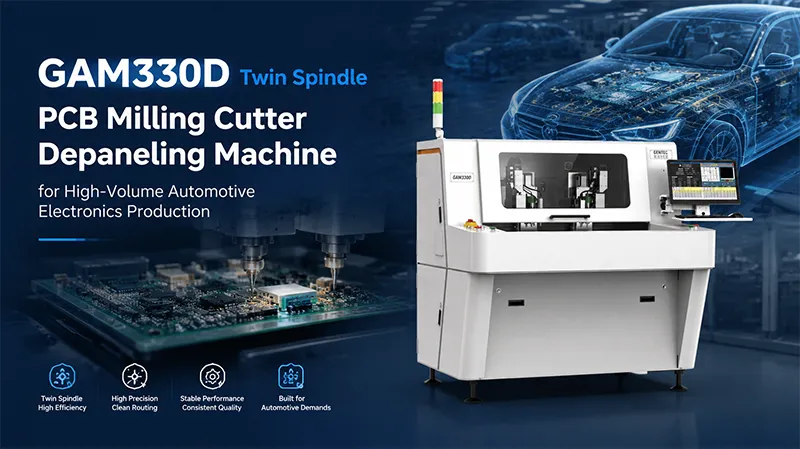
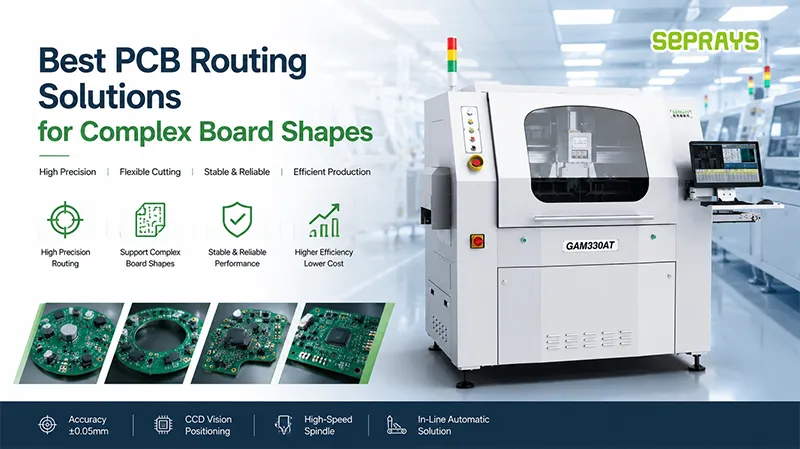
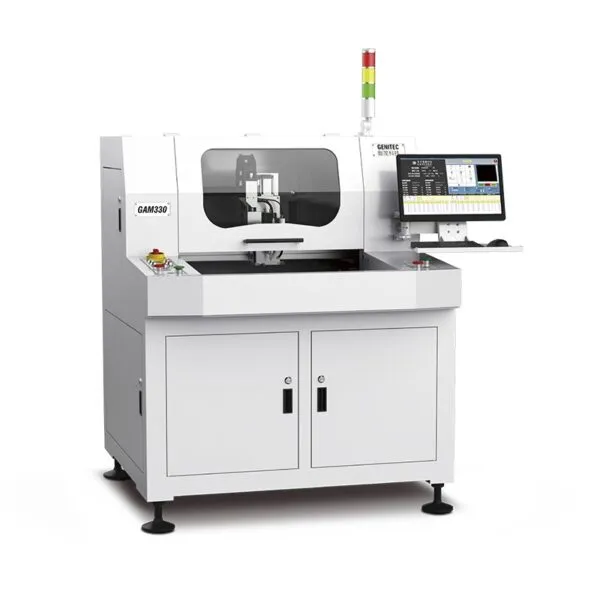
This is where a GAM330 automatic PCB router machine from Seprays Group was evaluated for the production application.
🏭 Customer Production Challenge
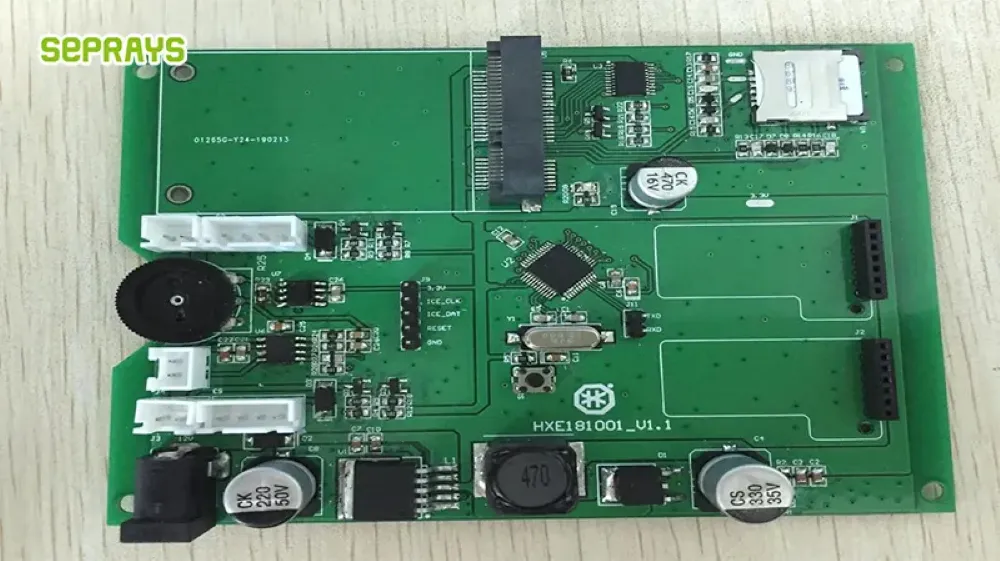
The customer manufactures electronic assemblies used in a semiconductor-related application.
At first, the depaneling process looked manageable.
But several small problems started adding up.
Operators had to position panels manually. Different PCB models required repeated adjustments. Cutting consistency depended partly on operator experience.
There was also another concern.
The closer components move toward the PCB edge, the less room there is for uncontrolled mechanical stress, vibration, or an inaccurate cutting path.
For production engineers, these issues are rarely isolated.
A few seconds saved during cutting may mean little if operators spend extra time positioning panels or checking every separated board.
So the customer started looking at the complete depaneling cycle, rather than the cutting action alone.
🎯 Why PCB Routing Was Selected
The first question was not “Which machine is the fastest?”
It was:
“Which separation method fits this PCB design and production mix?”
The customer compared several common options.
| Requirement | PCB Routing | V-Groove | Laser | Punching |
|---|---|---|---|---|
| Irregular PCB contours | Strong | Limited | Strong | Limited |
| Straight-line separation | Good | Excellent | Good | Good |
| Programmable cutting path | Yes | Limited | Yes | Limited |
| Product changeover | Flexible | Flexible | Flexible | Tool-dependent |
| Mechanical cutting | Yes | Yes | No | Yes |
| Process debris | Requires extraction | Low | Fume control required | Low |
| High-mix production | Suitable | Suitable for suitable designs | Suitable | Less flexible |
For this application, the ability to program the cutting route was important.
The customer had different PCB outlines and did not want every design change to become a tooling project.
That does not mean routing is automatically the right answer.
For a simple, high-volume PCB with a straight V-score, V-Groove separation can remain very efficient.
The important point is to match the process to the board.
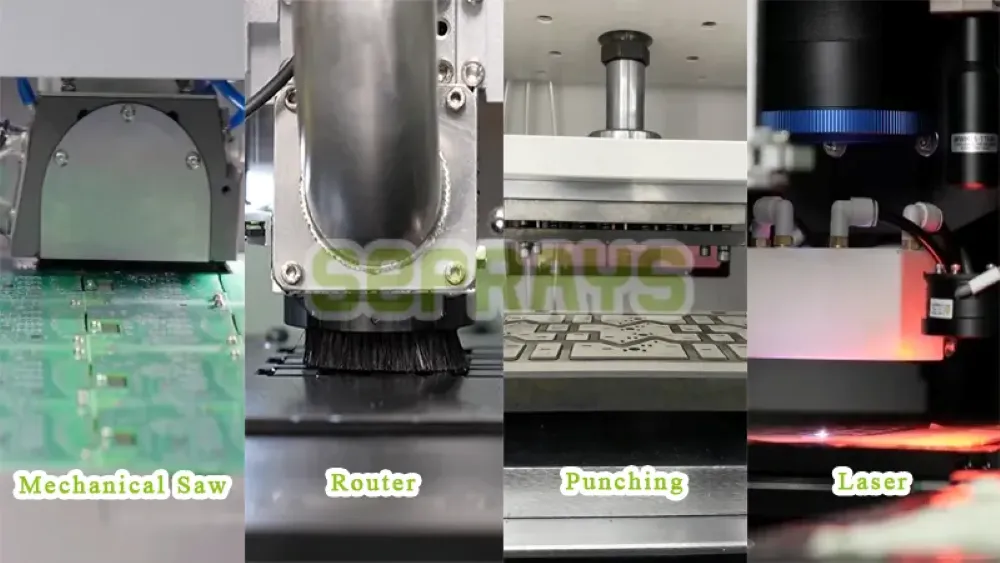
📥 Automatic PCB Loading & Positioning
One practical difference became obvious during the evaluation.
Positioning is part of cutting accuracy.
A precise cutter cannot produce a precise result if the panel starts from an inconsistent position.
The GAM330 uses an automated loading and positioning process to reduce unnecessary manual handling.
The panel is transferred into the working area and positioned before the programmed cutting operation begins.
For the operator, this changes the job.
Instead of manually aligning every panel and concentrating on the cutting position, the operator can focus more on material flow, machine status, and production monitoring.
This also creates a more repeatable starting point for the cutting program.
That matters when the same PCB design runs for hundreds or thousands of cycles.
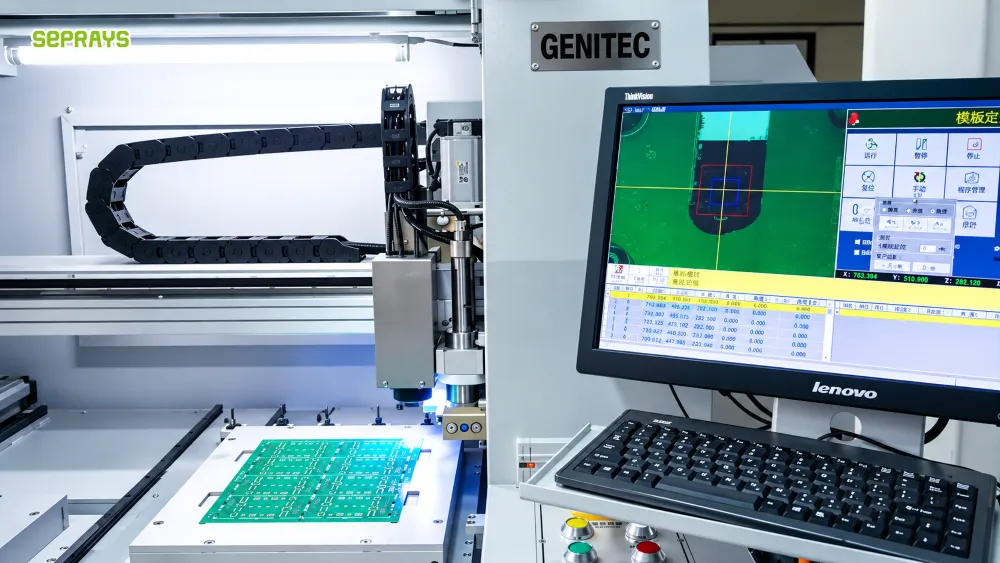
⚙️ Milling Cutter Depaneling Process
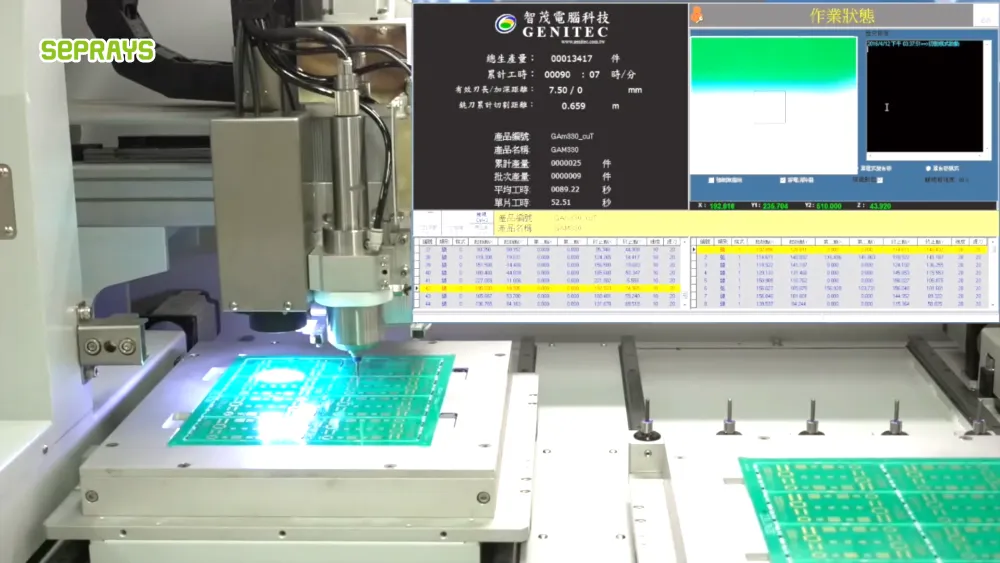
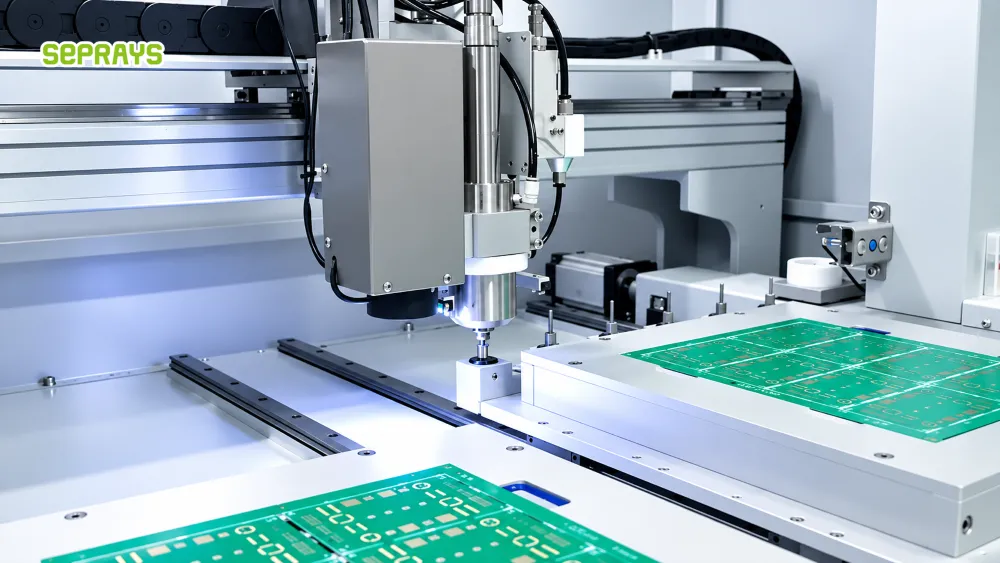
Once the PCB panel is positioned, the programmed routing path controls the separation process.
The milling cutter follows the defined contour and removes material along the cutting line.
This is particularly useful when the PCB outline is not simply a straight line.
Curves, corners, slots, and other routed contours can be handled within the programmed path, provided the PCB design and fixture allow sufficient clearance.
The process also gives engineers room to adjust cutting parameters.
Feed rate, spindle speed, cutter selection, cutting depth, and fixture support all influence the final result.
This is one reason production trials are important.
A parameter that works well for one PCB thickness or material may not produce the same result on another.
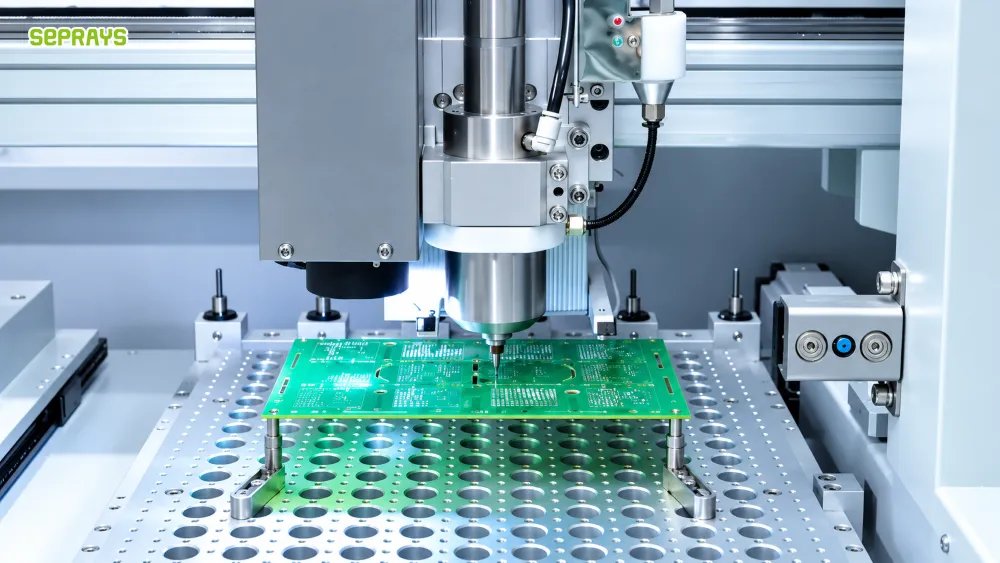
📏 Cutting Accuracy & PCB Edge Quality
For the customer, edge quality was not judged only by looking at the first few boards.
The real question was:
Does the result remain stable during production?
Several factors were checked:
- Cutting path accuracy
- PCB positioning repeatability
- Edge appearance
- Burr formation
- Component clearance
- Cutter wear
- Dust and debris
- Repeatability after continuous operation
The cutting path itself is only one part of the equation.
Fixture stability matters.
So does the cutter condition.
So does PCB material.
This leads to a useful production lesson:
Higher spindle speed does not automatically mean better routing.
If the feed rate, cutter geometry, material, and fixture are not balanced, increasing speed can create vibration or accelerate tool wear.
In other words, the target should be a stable process window, not the highest possible machine setting.
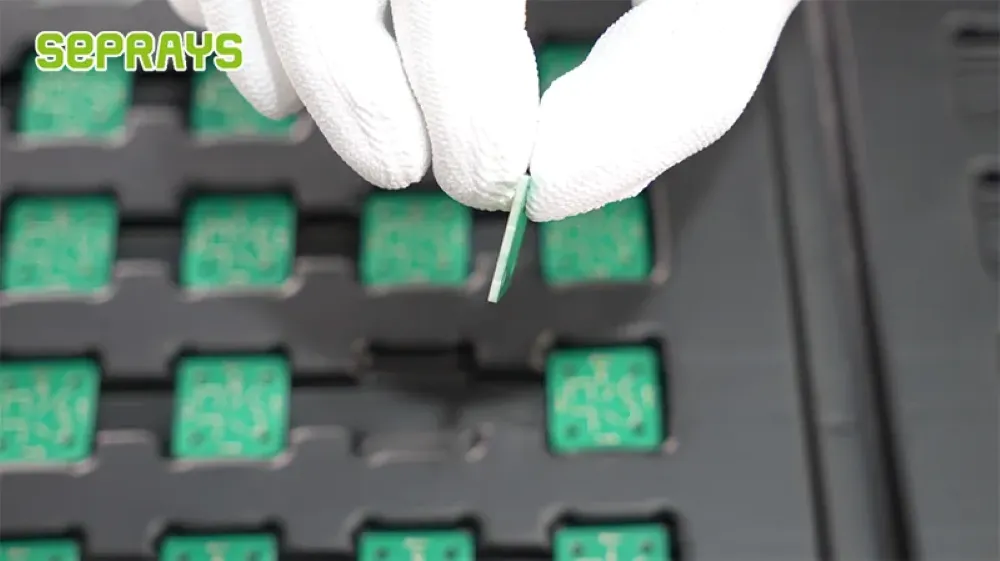
🔬 GAM330 in Real Production
For this semiconductor-related application, the Seprays GAM330 was integrated around the customer’s actual PCB production requirements.
The focus was not simply on demonstrating the machine.
The production team needed to see how the system behaved during normal operation.
A typical cycle involved:
Panel loading → positioning → programmed routing → PCB separation → dust extraction → unloading
This workflow reduced several manual steps.
It also made the separation process easier to standardize between operators.
The machine’s value therefore came from the complete workflow, rather than from the cutter alone.
For factories considering automation, this distinction is worth remembering.
Replacing one manual cutting step with an automated cutter does not necessarily create a fully automated process.
The loading, positioning, extraction, unloading, inspection, and material flow also need to be considered.
📊 Application Results / Production Benefits
After reviewing the application as a complete process, several practical benefits became clear.
Less operator-dependent positioning
Automated positioning reduced the variation that can occur when panels are aligned manually.
More consistent routing
The programmed path gave operators a repeatable cutting process instead of relying on manual cutting judgment.
Easier product changeover
Different PCB programs can be prepared for different designs, reducing dependence on dedicated mechanical tooling.
Better production visibility
An automated process makes it easier to track machine cycles, material flow, maintenance, and production interruptions.
More predictable operating costs
The customer could consider cutter consumption, labor, maintenance, and scrap together rather than looking only at the machine purchase price.
That last point is important.
A machine with a higher initial price can sometimes make more sense if it reduces repetitive labor or improves process consistency.
Conversely, automation may not be economical for a very low-volume PCB.
The ROI depends on the production pattern.
💰 A Practical Cost Question for Engineers
Before purchasing a router, it is useful to calculate the current cost per panel.
Consider:
Labor + cutting time + positioning time + tooling + cutter consumption + cleaning + scrap + rework
Then compare that with the expected automated process.
For example, if an operator spends only a few seconds positioning each panel, the labor savings may appear small.
But at several thousand panels per month, those seconds accumulate.
On the other hand, if production volume is only a few hundred panels per year, automation may take much longer to justify.
This is where real production data is more useful than a generic ROI claim.
🌎 Why Choose Seprays Group?
Seprays Group has been dedicated to PCB/FPC depaneling technology for more than 30 years, providing a complete range of solutions, including milling-cutter depanelers, laser depanelers, V-Groove depanelers, punching depanelers, and automated PCB handling systems.
Our equipment is trusted by leading manufacturers, including Foxconn, Flextronics, State Grid, Luxshare, Compal, Wistron, China Electronics, Quanta, CRRC, China Aerospace, OPPO, ZTE, and Bosch. These solutions are used in factories across China and in manufacturing operations worldwide.
For Seprays Group, the machine is only one part of the discussion.
The more useful question is how the equipment fits the customer’s PCB design, production volume, operator workflow, quality requirements, and future product changes.
That is why application evaluation matters.
A PCB drawing, panel layout, Gerber file, production volume, and current separation method can provide a much clearer starting point than a machine specification sheet alone.
For customers evaluating GAM330 automatic PCB routing, a sample test can help determine whether the cutting path, fixture, tooling, loading method, and process parameters are appropriate for the actual PCB.
If you have a similar production challenge, please get in touch with us to discuss your application.
WhatsApp: +8618929266433
Электронная почта: sales@seprays.com
❓ FAQ
1. What type of PCB is suitable for a routing process?
Routing is commonly considered for PCBs with irregular contours, curved edges, slots, or designs that are difficult to separate using straight-line methods. The actual suitability depends on PCB material, thickness, layout, and component clearance.
2. Does the GAM330 support automatic PCB positioning?
Yes. The GAM330 is designed around an automated routing workflow that includes PCB loading and positioning before the programmed cutting operation.
3. How does PCB routing affect PCB edge quality?
Edge quality depends on several variables, including cutter type, feed rate, spindle speed, PCB material, fixture stability, and tool condition. Production testing is recommended before fixing final parameters.
4. Is routing better than V-Groove depaneling?
Neither method is universally better. V-Groove can be highly efficient for suitable straight-line PCB separation, while routing provides greater flexibility for irregular contours and different cutting paths.
5. What information should I provide when evaluating a routing machine?
Useful information includes the PCB drawing or Gerber file, panel layout, PCB thickness and material, production volume, required edge quality, component clearance, current depaneling method, and expected automation level.