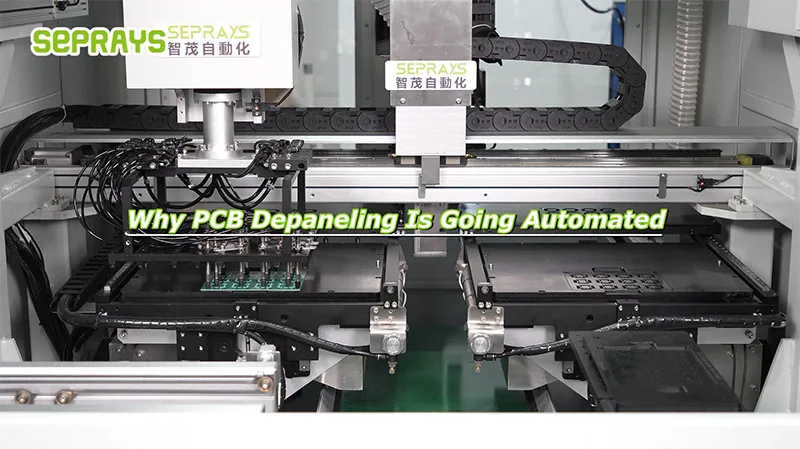
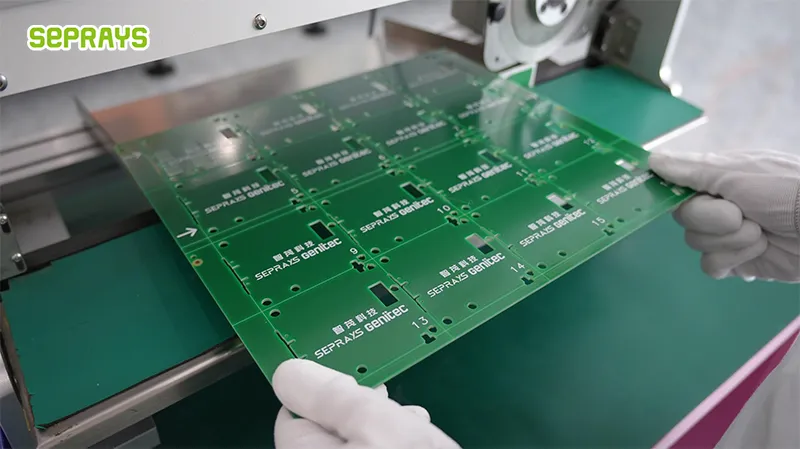
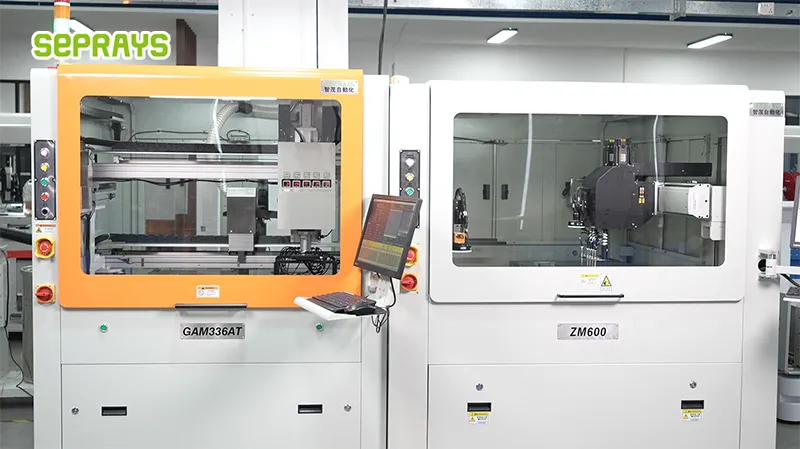
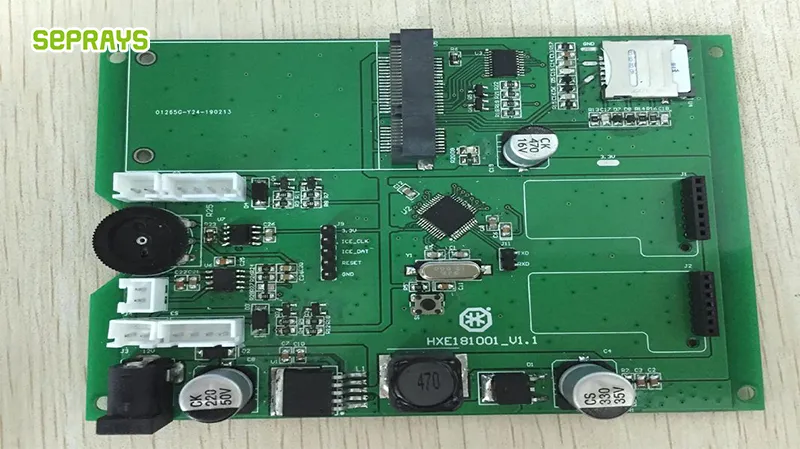
Automated PCB depaneling is becoming a serious topic in electronics manufacturing circles in 2026. Not because it is “new,” but because production realities have changed.
Labor costs are rising. PCB designs are getting denser. SMT lines are running faster. And manual separation methods are starting to create bottlenecks.
Many factories that once relied on manual routing or standalone cutting stations are now rethinking the entire depaneling process. Especially in automotive electronics, communication devices, medical PCBA, and consumer electronics production.
The shift is not only about speed. It is about consistency, yield, and long-term manufacturing stability.
A common issue in many SMT factories looks like this:
Orders increase. Placement machines run continuously. But depaneling still depends on operators loading and unloading boards manually.
That creates several hidden costs.
Typical production problems:
Inconsistent cutting quality
PCB stress damage
Labor dependency
Slow changeovers
Production interruptions
Higher rework rates
Operator fatigue during long shifts
These problems become more obvious in:
High-density PCBA
Flexible PCB production
Automotive control boards
BMS systems
Smart device manufacturing
One factory manager described it simply:
“Our SMT line was automated. Depaneling was not. That became the weakest point.”
⚙️ What Automated PCB Depaneling Actually Changes
Fully automated systems do more than replace manual loading.
They connect the depaneling directly into the production flow.
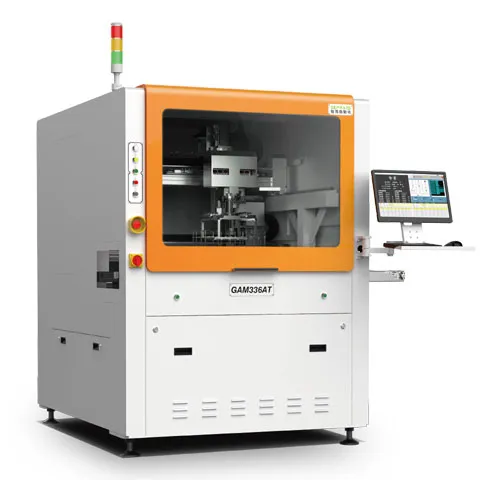
Modern inline depaneling systems can include:
Conveyor integration
CCD vision alignment
Automatic positioning
Offline programming
MES communication
Barcode scanning
Robotic handling
Dust collection systems
The result is not just fewer operators.
It is a more stable production.
📉 The Hidden Cost of Semi-Manual Processing
Many factories compare equipment prices only.
That is often a mistake.
A lower-cost manual machine may create higher total operating costs over time.
Hidden expenses include:
Production Factor
Manual Process
Automated Process
Labor dependency
High
Low
Setup consistency
Operator-based
Program-controlled
Changeover time
Longer
Faster
PCB handling risk
Higher
Lower
Yield stability
Variable
Stable
SMT line interruption
Frequent
Reduced
Scalability
Limited
Easier
This becomes important in high-volume production.
Especially when factories run:
2 or 3 shifts
mixed-model production
24/7 automotive projects
high-value PCBA assemblies
🧩 Why High-Density PCBA Pushes Automation Faster
In 2026, PCB layouts continue shrinking.
Components are placed closer to the edges. Board thickness varies more. Sensitive ICs become easier to damage during cutting.
Traditional depaneling methods may create:
micro-cracks
solder joint stress
edge burrs
vibration damage
This is one reason automated router and laser systems are growing quickly.
CCD vision systems help compensate for board tolerances. Precision motion systems reduce mechanical stress. Automated handling minimizes unnecessary contact.
Ironically, faster production today often requires gentler processing.
🏭 Real Factory Scenario: Why One Automotive Supplier Upgraded
An EV electronics supplier producing BMS control boards faced several issues:
inconsistent output
operator shortages
rising defect rates
slow fixture changes
Their original setup used standalone routing with manual transfer.
One interesting lesson: The biggest improvement was not cutting speed.
It was production continuity.
That is something many factories underestimate during equipment evaluation.
In this project, the manufacturer worked with Seprays’ engineers to optimize routing paths, dust extraction, and inline handling based on actual SMT workflow conditions rather than only machine specifications.
🚀 Why Automation Fits High-Mix Production Better Than Before
A few years ago, many people believed automation only made sense for massive production volumes.
That is no longer always true.
Modern depaneling systems now support:
quick recipe switching
offline programming
fixture-less processing
flexible conveyor widths
vision-guided positioning
This matters for EMS factories handling multiple customer projects.
Especially when production changes daily.
Example:
A factory producing:
consumer electronics in the morning
automotive modules in the afternoon
industrial PCBA at night
…cannot afford long setup delays anymore.
Flexible automation becomes valuable even for medium production runs.
🛠️ Choosing the Right Automation Level
Not every factory needs a fully unmanned line.
That is another common misunderstanding.
The best solution depends on:
board design
production volume
available floor space
labor availability
stress requirements
future expansion plans
General recommendation:
Production Type
Suggested Solution
Low-volume prototype
Offline router
Medium-volume mixed production
Semi-automatic inline router
High-volume SMT line
Fully automatic inline depaneling
Ultra-sensitive PCBA
Laser depaneling system
V-cut panel production
Saw/V-groove depaneling
Sometimes hybrid systems provide the best balance.
Especially when factories process both V-cut and mouse-bite boards.
📊 What Engineers Are Prioritizing in 2026
Conversations with manufacturers show several priorities becoming more important:
Engineers now care more about:
Low-stress cutting
Automation compatibility
MES integration
Fast product switching
Traceability
Dust management
Stable repeatability
Reduced labor risk
Interestingly, raw cutting speed alone is no longer the top concern.
Reliable uptime matters more.
🔧 Practical Advice Before Buying Automated Equipment
Before investing, manufacturers should test:
real production boards
actual cycle time
stress performance
fixture requirements
maintenance access
software usability
A machine that performs well in demos may behave differently inside a real SMT environment.
This is why experienced suppliers often request sample boards and full production information before recommending a solution.
That step can prevent expensive mistakes later.
Why Choose Seprays Group?
With more than 30 years of experience in PCB/FPC depaneling technology, Seprays Group continues to support manufacturers facing increasingly complex production demands in 2026.
Seprays Group provides a full range of depaneling solutions, including:
milling-cutter depanelers
laser depanelers
V-groove depanelers
punching depanelers
fully automated inline systems
robotic handling solutions
Our equipment is trusted by globally recognized manufacturers such as Foxconn, Flextronics, State Grid, Luxshare, Compal, Wistron, China Electronics, Quanta, CRRC, China Aerospace, OPPO, ZTE, and Bosch.
These systems are used across automotive, semiconductor, consumer electronics, industrial control, telecommunications, and medical electronics factories worldwide.
What many customers value most is not only the machine itself, but practical engineering support:
process evaluation
stress analysis
automation integration
inline production optimization
customized depaneling solutions
If you are evaluating automated PCB depaneling for your SMT line, Seprays Group can help you identify the most suitable solution for your specific production requirements.
Please feel free to contact us to discuss or request a sample evaluation.
Automated PCB depaneling uses inline or robotic systems to separate PCB panels with minimal manual operation, improving consistency and production efficiency.
2. Is automated depaneling suitable for small factories?
Yes. Many medium-sized factories now adopt semi-automatic or modular inline systems because labor savings and production stability can justify the investment.
3. Which depaneling method creates the least PCB stress?
Laser depaneling generally creates the lowest mechanical stress, making it suitable for sensitive or high-density PCBA applications.
4. Can automated depaneling systems support high-mix production?
Yes. Modern systems with CCD vision alignment and offline programming are designed for fast changeovers and flexible manufacturing environments.
5. How do I know if my SMT line needs inline depaneling?
If manual loading creates bottlenecks, inconsistent output, or rising labor dependency, inline depaneling may significantly improve production flow and stability.
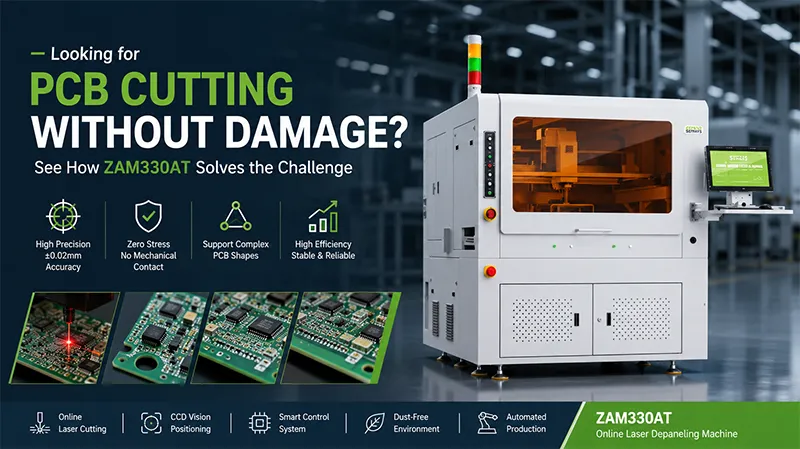
PCB cutting without damage has become a bigger discussion point in electronics manufacturing in 2026. Many production teams are discovering that achieving a clean separation
Happy Dragon Boat Festival from SEPRAYS · Genitec! The Dragon Boat Festival is a meaningful tradition celebrated by many people around the world. It is
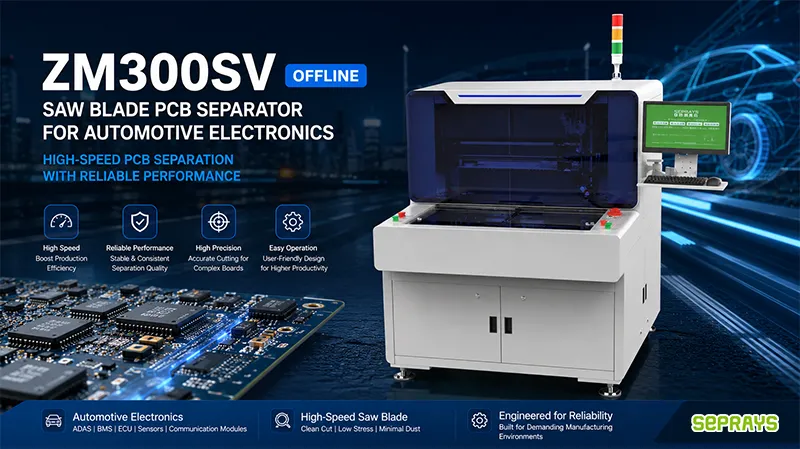
ZM300SV Offline Saw Blade PCB Separator for Automotive Electronics is becoming a more common discussion point among production engineers dealing with compact automotive electronics. A
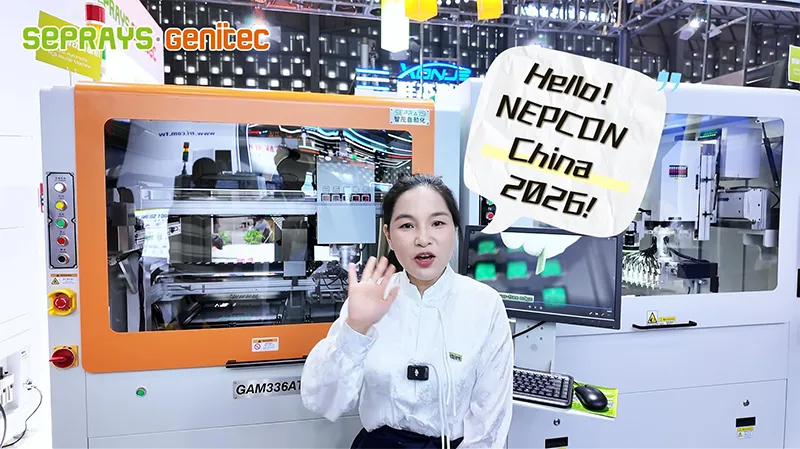
Seprays & Genitec is exhibiting at NEPCON Shanghai 2026. Visitors can experience our fully automated Inline PCB Depaneling Solution running live on-site. The system automates
Automated Laser PCB Depaneling becomes much more interesting when the PCB is no longer a simple board. AI servers, semiconductor equipment, automotive electronics, and high-performance
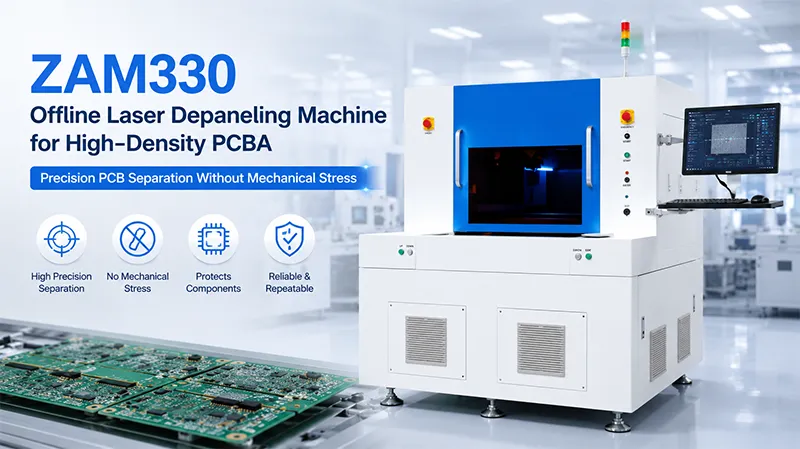
ZAM330 Offline Laser Depaneling Machine is becoming a practical choice for manufacturers producing high-density PCBAs where even slight mechanical stress can affect long-term product reliability.
We use cookies
We use cookies to improve your browsing experience, analyze website traffic, and optimize our services. By accepting cookies, you agree to our use of cookies. You can manage your preferences at any time.
Functional
Always active
The technical storage or access is strictly necessary for the legitimate purpose of enabling the use of a specific service explicitly requested by the subscriber or user, or for the sole purpose of carrying out the transmission of a communication over an electronic communications network.
Preferences
The technical storage or access is necessary for the legitimate purpose of storing preferences that are not requested by the subscriber or user.
Statistics
The technical storage or access that is used exclusively for statistical purposes.The technical storage or access that is used exclusively for anonymous statistical purposes. Without a subpoena, voluntary compliance on the part of your Internet Service Provider, or additional records from a third party, information stored or retrieved for this purpose alone cannot usually be used to identify you.
Marketing
The technical storage or access is required to create user profiles to send advertising, or to track the user on a website or across several websites for similar marketing purposes.
Hi, welcome to Seprays! 👋
Need help selecting a PCB depaneling machine?
Tell us about your PCB type and production requirements, and our engineers will recommend a suitable solution.
.png)
 English
  Spanish
  Japanese
  Korean
  Russian
  Chinese