.png)
 Korean
  English
  Spanish
  Japanese
  Russian
  Chinese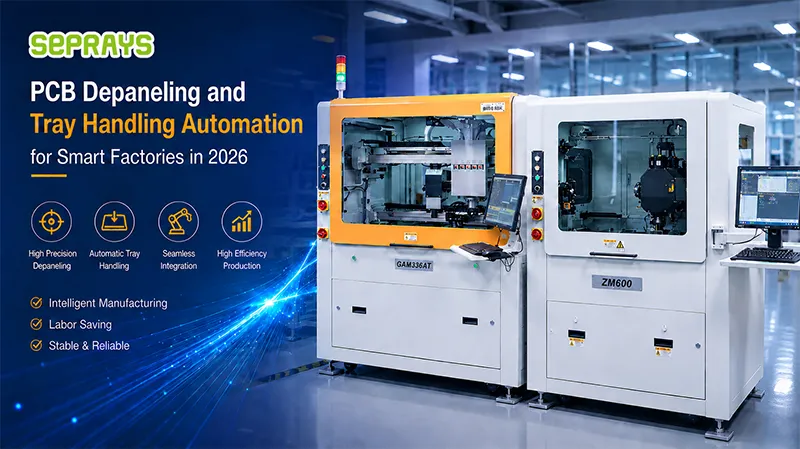
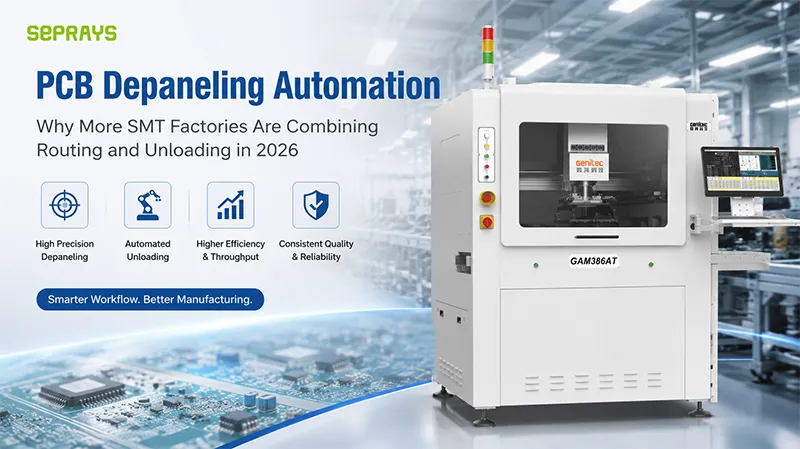
PCB depaneling and tray handling automation is becoming a critical topic for electronics manufacturers in 2026. As production volumes increase and product designs become more complex, manual depaneling and tray management are creating bottlenecks that many factories can no longer ignore.
For SMT manufacturers, the challenge is no longer just cutting PCBs accurately. It is about maintaining continuous production flow, reducing labor dependency, ensuring traceability, and improving consistency from panel separation to final product collection.
Many factories are now asking a different question:
“How can we automate the entire post-SMT process instead of optimizing only the depaneling step?”
The answer increasingly lies in integrated depaneling and tray handling systems.
🚀 Why Traditional PCB Depaneling Processes Are Becoming a Bottleneck
A common scenario in many SMT factories looks like this:
- PCB panels leave the reflow oven.
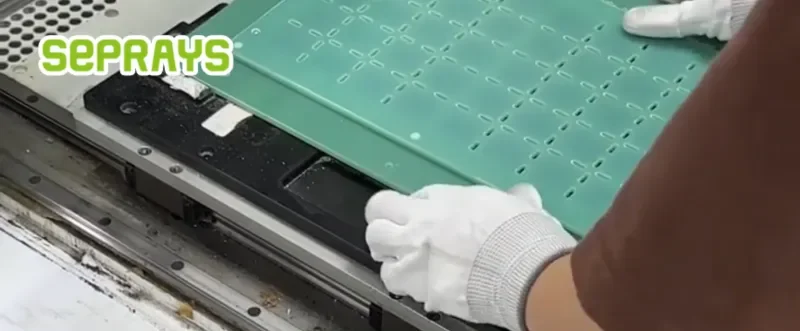
- Operators manually load panels into a depaneling machine.
- Finished boards are collected by hand.
- Operators place boards into trays.
- Filled trays are transported to the next process.
This workflow may appear manageable.
However, problems quickly emerge when production scales.
Common issues include:
- Labor shortages
- Inconsistent handling quality
- PCB scratches during transfer
- Mixed product batches
- Production interruptions
- High operator fatigue
- Limited traceability
In high-volume environments, manual handling often creates more downtime than the depaneling machine itself.
🔍 What Smart Factories Are Prioritizing in 2026
Industry 4.0 initiatives are pushing manufacturers to connect isolated processes into intelligent production cells.
For PCB separation processes, manufacturers are increasingly focusing on:
Key Requirements
| Requirement | 왜 중요한지 |
|---|---|
| Continuous operation | Minimize production interruptions |
| Automated material flow | Reduce manual handling |
| Real-time production monitoring | Improve decision-making |
| Consistent quality | Reduce variation between shifts |
| Labor reduction | Lower operating costs |
| MES integration | Enable traceability |
| Flexible product changeover | Support high-mix production |
Interestingly, many engineers discover that the biggest efficiency gains come not from faster cutting speeds, but from eliminating waiting time between processes.
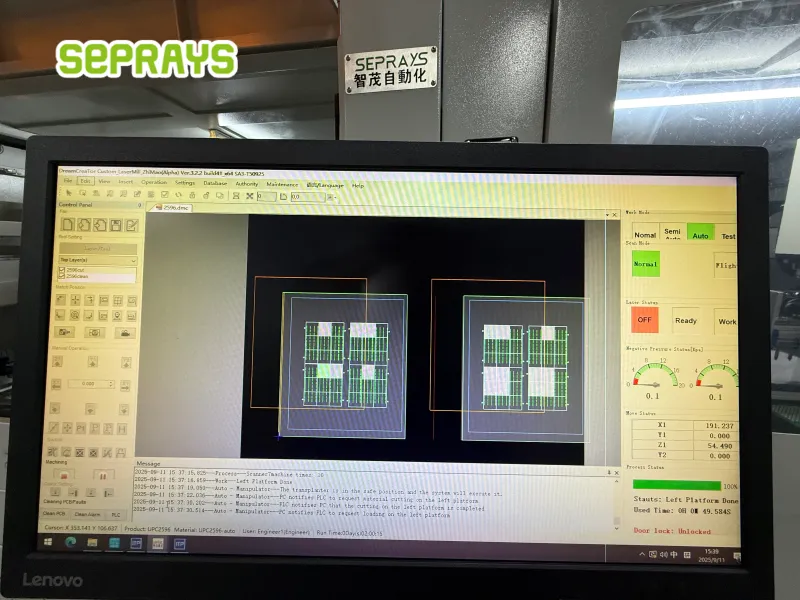
⚙️ What Does PCB Depaneling and Tray Handling Automation Include?
Modern systems combine multiple functions into one automated workflow.
A typical automated cell may include:
Process Flow
- Automatic PCB loading
- Vision alignment
- Precision depaneling
- Scrap edge removal
- Product inspection
- Tray loading
- Tray transportation
- Tray stacking
- Data collection
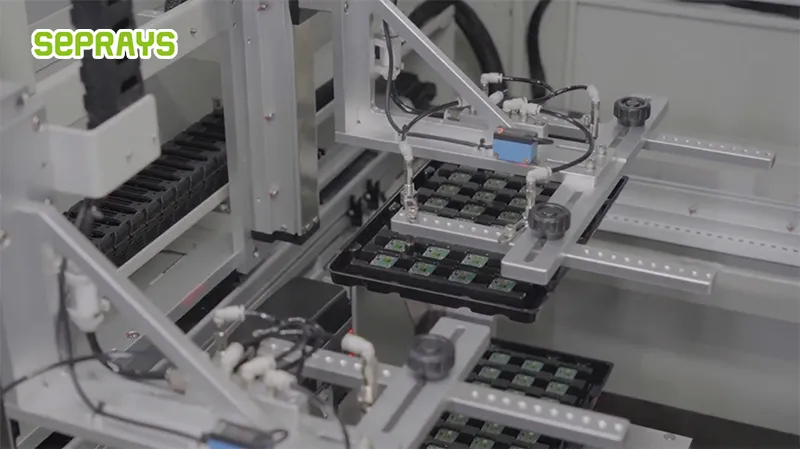
Instead of relying on operators to move boards manually, the system automatically transfers products from one stage to the next.
The result is a smoother and more predictable production flow.
📈 Real Production Challenges That Automation Solves
Many manufacturers initially evaluate automation because of labor costs.
However, after implementation, they often discover additional benefits.
Challenge 1: Inconsistent Output
Different operators handle products differently.
Some may stack boards incorrectly.
Others may accidentally damage sensitive assemblies.
Automation standardizes the process.
Every board follows the same workflow.
Challenge 2: Production Delays
A depaneling machine can only work as fast as material is supplied and removed.
If operators are busy elsewhere, the machine sits idle.
Automated tray handling eliminates this waiting time.
Challenge 3: Product Traceability
Automotive, medical, and industrial electronics increasingly require production records.
Automated systems can record:
- Production quantity
- Batch information
- Process status
- Inspection results
- Equipment parameters
This supports quality audits and customer requirements.
🏭 Case Study: Automotive Sensor Production
One automotive electronics manufacturer faced a common challenge.
Their tire pressure monitoring sensor (TPMS) production line was growing rapidly.
The existing workflow required operators to:
- Load PCB panels
- Remove scrap edges
- Collect finished boards
- Load boards into trays
- Transfer trays manually
As production volume increased, labor costs and handling errors rose significantly.
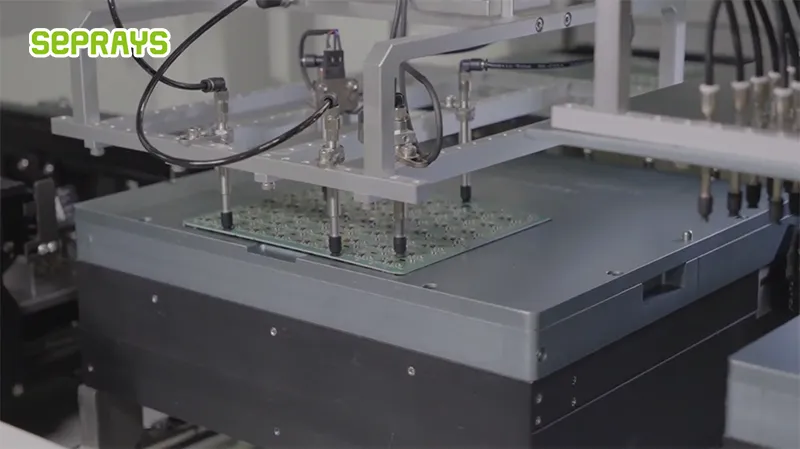
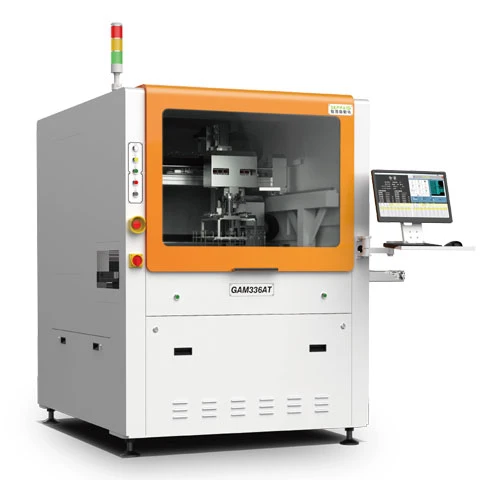
To improve efficiency, the manufacturer adopted a fully automated solution that combines the Seprays GAM336AT router depaneling system with an automatic tray-stacking system.
Automated Process
- Automatic feeding track
- Dual working platforms for continuous cutting
- Automatic scrap edge removal
- PCB loading into pallets
- Automatic pallet transfer via guide rail
- Automatic pallet collection and stacking
- Continuous material circulation
The result was not simply faster depaneling.
The real improvement came from eliminating non-value-added handling operations.
Machine utilization increased while labor requirements decreased.
💡 A Counterintuitive Lesson from Smart Factory Projects
Many manufacturers assume:
Faster cutting equals higher productivity.
In reality, that is often not true.
A machine that cuts 20% faster may deliver little improvement if operators spend significant time loading and unloading products.
In many automation projects, tray handling and logistics optimization generate larger gains than increasing spindle speed.
This is one reason integrated automation solutions are gaining popularity in 2026.
📊 Manual vs Automated PCB Handling
| Factor | Manual Process | Automated Process |
| Labor Requirement | High | Low |
| Product Consistency | Variable | Stable |
| Production Flow | Interrupted | Continuous |
| Traceability | Limited | Comprehensive |
| Product Damage Risk | Higher | Lower |
| Scalability | Limited | Excellent |
| Smart Factory Readiness | Low | High |
🔧 How to Evaluate Whether Automation Makes Sense
Automation is not always the right answer.
Several factors should be evaluated first.
Good Candidates
- ✔ High-volume production
- ✔ Automotive electronics
- ✔ Industrial control boards
- ✔ Medical electronics
- ✔ Multi-shift factories
- ✔ Labor-intensive processes
- ✔ Facilities pursuing Industry 4.0 initiatives
Cases Where Full Automation May Not Be Necessary
- ✖ Prototype production
- ✖ Very low-volume manufacturing
- ✖ Frequent engineering changes
- ✖ Small batch R&D environments
In these situations, semi-automatic systems may provide a better return on investment.
🌍 Looking Ahead: Smart Factories Beyond 2026
The trend is clear.
Manufacturers are moving from standalone machines toward connected production ecosystems.
Future depaneling cells are expected to include:
- AI-assisted optimization
- Predictive maintenance
- Automated quality feedback
- Digital twin integration
- Real-time production analytics
- Fully autonomous material handling
The goal is no longer just separating PCBs.
It is creating a seamless production flow from SMT assembly to final packaging.
✅ Conclusion
As electronics manufacturing continues to evolve, depaneling is becoming only one part of a much larger automation strategy.
Factories seeking higher throughput, lower labor dependency, better traceability, and consistent product quality are increasingly adopting integrated depaneling and tray handling systems.
For many manufacturers in 2026, the question is no longer whether automation is possible.
The question is how much efficiency is being lost without it.
Why Choose Seprays Group?
With more than 30 years of manufacturing experience, Seprays Group has become a trusted partner for electronics manufacturers seeking reliable PCB/FPC depaneling and automation solutions.
Seprays Group has been dedicated to PCB/FPC depaneling technology, providing a full range of solutions—including milling-cutter, laser, V-groove, and punching depanelers, hybrid depaneling systems, inline automation solutions, and automated handling systems.
Our equipment is trusted by globally recognized manufacturers and organizations, including Foxconn, Flextronics, State Grid, Luxshare, Compal, Wistron, China Electronics, Quanta, CRRC, China Aerospace, OPPO, ZTE, and Bosch. These successful partnerships demonstrate the reliability, precision, and scalability of Seprays solutions across automotive, telecommunications, industrial control, aerospace, consumer electronics, and smart manufacturing sectors.
Why customers choose Seprays:
- Over 30 years of industry expertise
- Complete depaneling technology portfolio
- Smart factory automation capabilities
- Customized production solutions
- Global installation experience
- Proven performance in high-volume manufacturing environments
- Responsive technical support and service
Whether you are upgrading an existing SMT line or building a new smart factory, Seprays can help you identify the most suitable depaneling and automation solution for your production goals.
If you would like to discuss your project requirements, please feel free to contact us.
WhatsApp: +8618929266433
이메일: sales@seprays.com
FAQs
1. What is PCB depaneling and tray handling automation?
It is an integrated production solution that combines PCB separation, material transfer, tray loading, tray stacking, and product handling into a continuous automated workflow.
2. Which industries benefit most from automated depaneling systems?
Automotive electronics, medical devices, industrial controls, telecommunications equipment, aerospace electronics, and high-volume consumer electronics manufacturing benefit significantly from automation.
3. Does tray handling automation improve product quality?
Yes. Automated handling reduces human contact, minimizes scratches and handling damage, and improves consistency throughout the production process.
4. Is full automation suitable for every factory?
Not necessarily. High-volume and labor-intensive production environments typically achieve the best return on investment. Smaller operations may prefer semi-automatic solutions.
5. How does automation support Industry 4.0 initiatives?
Automated systems can collect production data, connect with MES platforms, enable traceability, improve process visibility, and support smart factory digitalization goals.