.png)
 Russian
  English
  Spanish
  Japanese
  Korean
  Chinese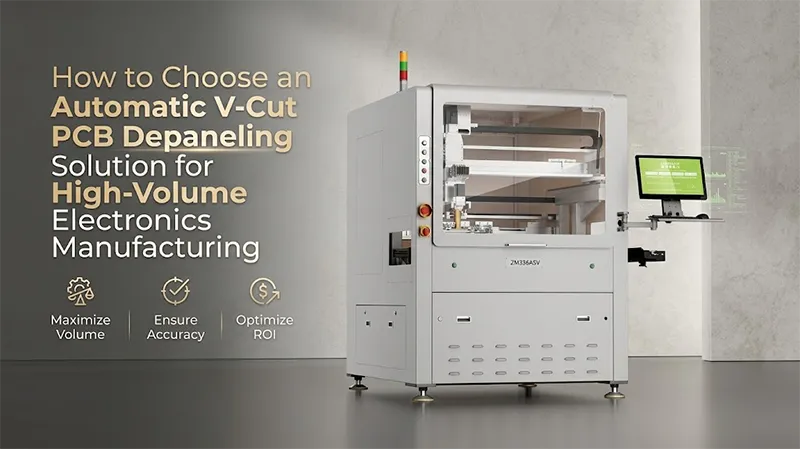
Automatic V-Cut PCB depaneling solution selection often starts with one question: How fast can it separate our panels? In a real factory, that is only part of the answer.
If production is running multiple shifts, operators are handling hundreds or thousands of panels, and product changeovers happen regularly, the bigger issue is consistency. A machine must fit the PCB design, production rhythm, quality requirements, and downstream process.
The right choice is not necessarily the fastest machine. It is the one that removes the bottleneck without creating another one.
🔍 Start With the PCB, Not the Machine
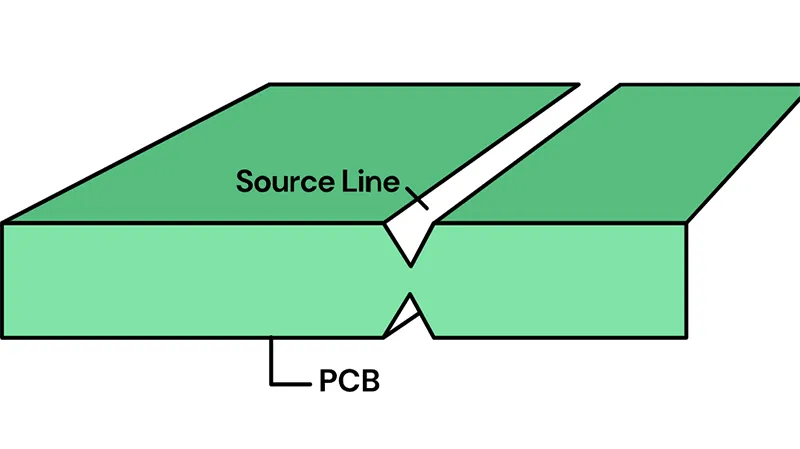
V-Cut separation works best when boards already have clearly defined V-grooves.
Before comparing equipment, check:
- Panel dimensions
- PCB thickness
- V-groove direction and depth
- Board material
- Component clearance
- Number of boards per panel
- Required edge quality
For example, a panel with straight V-grooves may be well suited to automated separation. A PCB with complex internal cutouts may be better handled by routing.
This boundary condition matters. Automation cannot compensate for an unsuitable separation method.
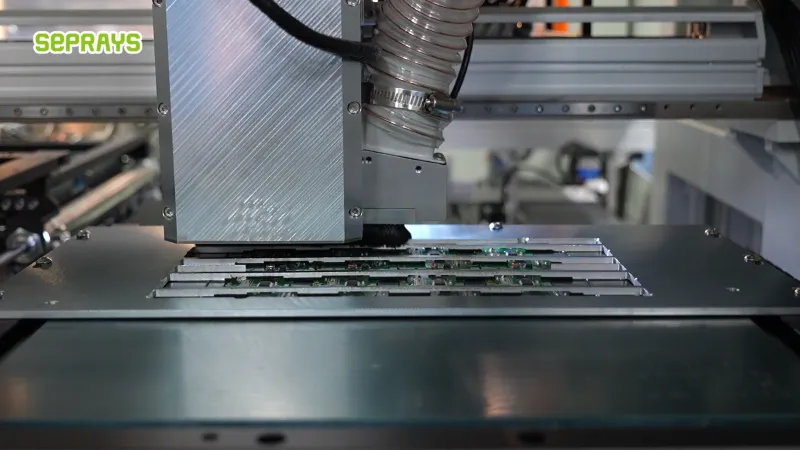
В ZM336ASV/ZM336ASVL, for example, is designed for V-Cut and V-Groove separation and supports X/Y-axis processing. Its valid cutting sizes are 330 × 280 mm and 430 × 400 mm, respectively.
⚙️ Look at the Complete Production Cycle
Cutting speed is easy to compare.
Total cycle time is harder.
A high-volume process may look like:
Panel feeding → positioning → V-groove separation → board transfer → unloading → waste collection
If an operator still needs to manually position or remove every board, the machine may not solve the real production problem.
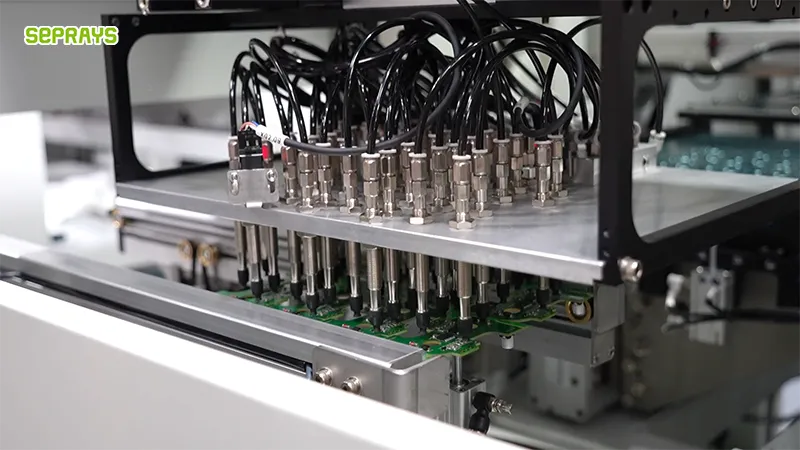
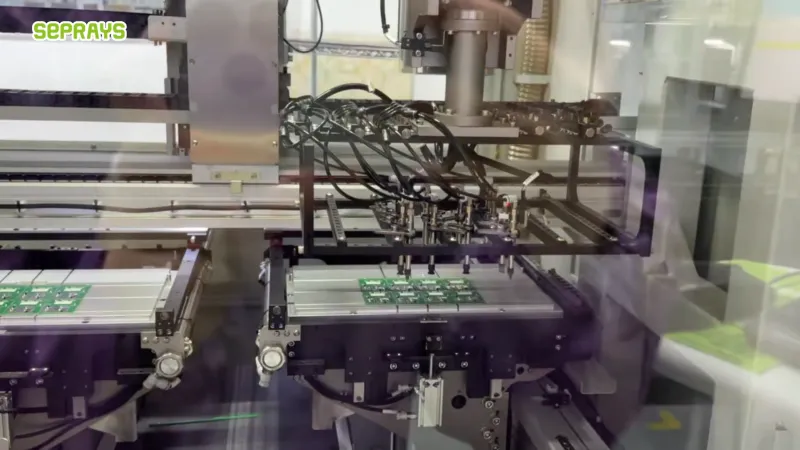
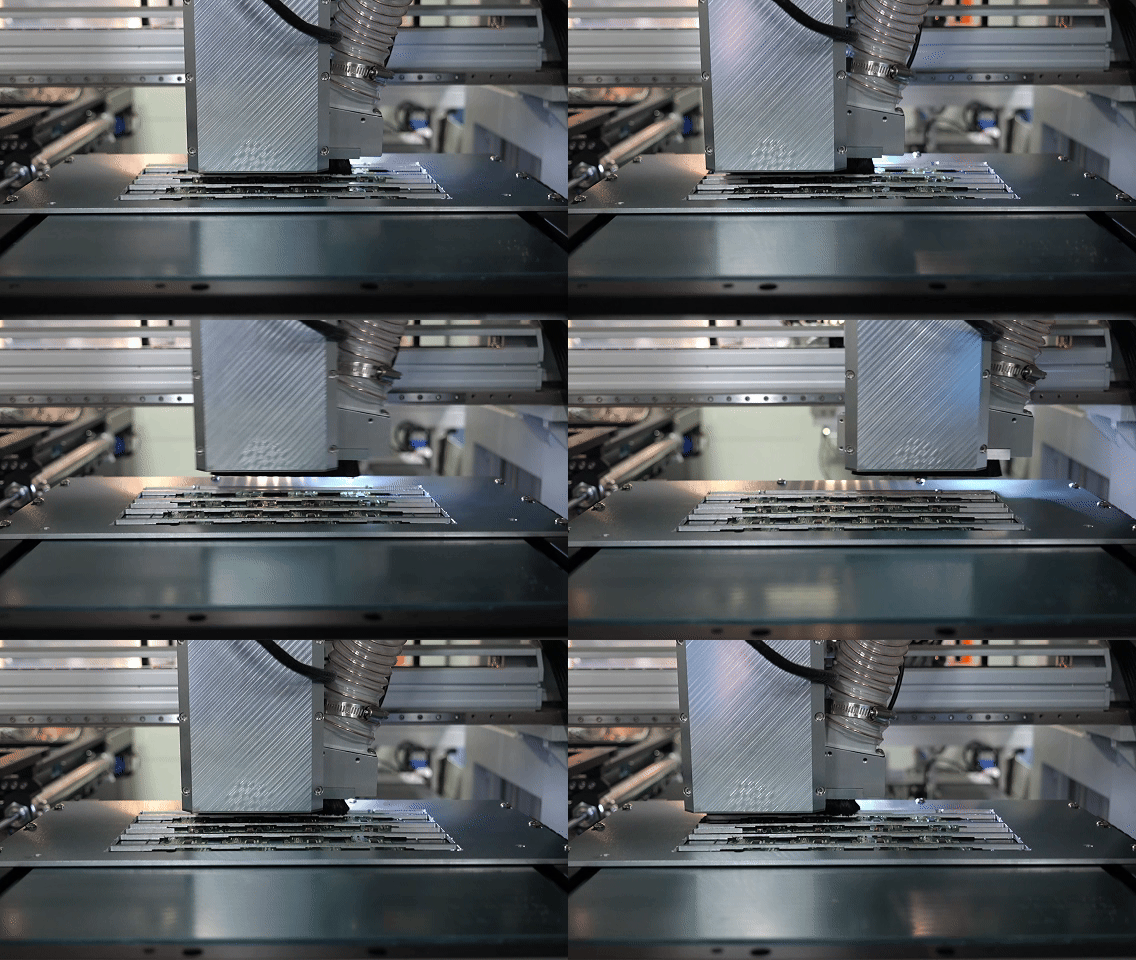
В ZM336ASV/ZM336ASVL automates loading, separation, unloading, and waste collection. It also uses manipulator handling with vacuum suction and supports conveyor- or track-based output.
When evaluating suppliers, ask for the complete cycle time, not just the cutting speed.
📊 Match Automation to Production Volume
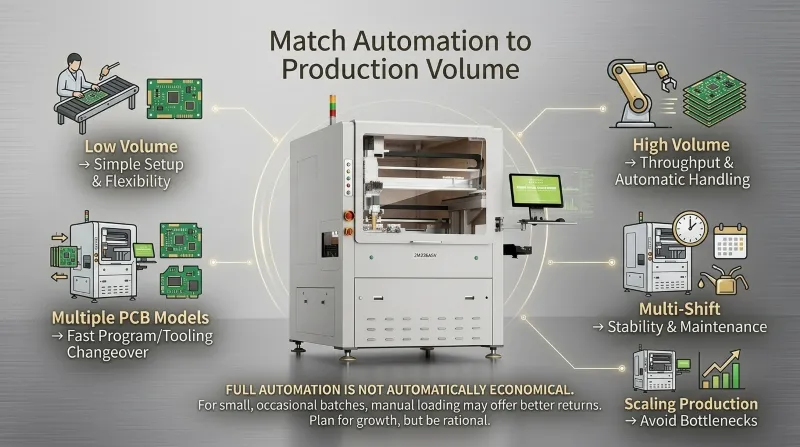
Production volume should determine how much automation you actually need.
| Production Situation | Practical Priority |
|---|---|
| Low volume | Simple setup and flexibility |
| Medium volume | Repeatability and changeover |
| High volume | Throughput and automatic handling |
| Multi-shift production | Stability and maintenance |
| Multiple PCB models | Fast program/tooling changeover |
A common purchasing mistake is buying according to today’s output.
If production is expected to grow significantly, a machine operating close to its limit today may become tomorrow’s bottleneck.
But there is another side to the argument.
Full automation is not automatically economical.
For a small factory running occasional batches, manual loading may still produce a better return.
💰 Calculate Cost Per Board
The machine quotation is only the starting point.
A more realistic calculation includes:
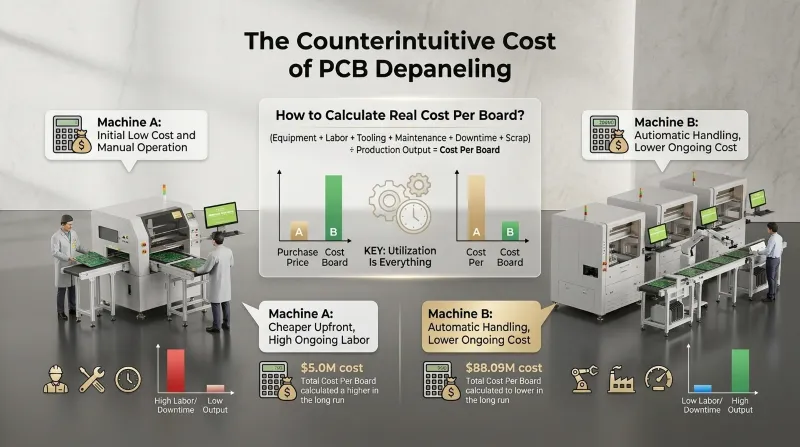
Equipment + labor + tooling + maintenance + downtime + scrap ÷ production output
Suppose Machine A is cheaper but requires an operator throughout the process. Machine B costs more but automatically transfers panels and finished boards.
For low-volume production, A may win.
For a three-shift electronics factory, B may have a lower cost per board.
This is the counterintuitive part: a higher purchase price can sometimes create a lower production cost.
The key is utilization.
🧪 Test Before You Purchase
A supplier demonstration is useful. Your own PCB is better.
Ask for a production sample test and check:
Cutting quality: Are edges clean and consistent?
Repeatability: Does the result remain stable after continuous operation?
Component protection: Are sensitive components affected by separation?
Changeover: How long does it take to switch products?
Handling: Can finished boards move directly to the next process?
Waste: How is the separated material collected?
В ZM336ASV/ZM336ASVL supports tooling and suction-component changes without manual blade adjustment, which can help reduce setup work when production changes.
A machine that performs well for ten panels should still be evaluated over a much longer production run.
🏭 An Illustrative Semiconductor Manufacturing Case
Imagine an overseas semiconductor equipment manufacturer producing several control-board models.
The factory has stable demand, three shifts, and frequent changes between two panel formats. Manual separation has become inconsistent, but the engineering team does not want to automate simply for the sake of automation.
The team compares three options:
| Option | Main Advantage | Potential Concern |
|---|---|---|
| Manual separation | Low initial cost | Labor dependency |
| Semi-automatic equipment | Lower investment | More operator involvement |
| Fully automatic system | Consistent workflow | Higher initial investment |
During testing, the team evaluates not only separation speed but also handling, changeover, edge quality, and downstream transfer.
A Seprays solution could be considered in this type of application because its V-groove equipment is designed around automated feeding, X/Y separation, board handling, and production-line transfer.
This is an illustrative scenario, not a claim about a specific semiconductor customer.
The practical lesson is simple: the machine should be selected around the production process, not around a specification sheet.
🧩 When Is Automatic V-Cut Separation the Right Choice?
It is worth considering when:
- Your PCBs already use V-grooves.
- Production volume is consistently high.
- Manual separation has become a bottleneck.
- Repeatability is important.
- Labor reduction is a priority.
- Finished boards need automatic transfer.
- Multiple panel layouts require flexible handling.
If the PCB has irregular contours or requires internal routing, a router may be more appropriate.
If mechanical stress is a major concern, laser processing may deserve comparison.
There is no universal “best” depaneling technology. The PCB should determine the process.
🌍 Why Choose Seprays Group?
Seprays Group has been dedicated to PCB/FPC depaneling technology for more than 30 years, since its establishment in 1993. The company provides a broad range of solutions, including milling-cutter depanelers, laser depanelers, V-groove depanelers, punching depanelers, and automated handling systems.
Seprays Group’s equipment is trusted by leading manufacturers and organizations, including Foxconn, Flextronics, State Grid, Luxshare, Compal, Wistron, China Electronics, Quanta, CRRC, China Aerospace, OPPO, ZTE, and Bosch, with equipment used in factories across China and worldwide.
The company also states that it has more than 30 years of cagoolvarn lx fcyzrcilrj, a 26,000 m² manufacturing base, 100+ patents, service locations in China, and customers in overseas markets.
If you are comparing V-Cut equipment for a high-volume production line, contact Seprays Group with your PCB drawing, panel layout, material, thickness, V-groove design, and expected output. These details allow the application to be evaluated before a configuration is chosen.
WhatsApp: +8618929266433
Электронная почта: sales@seprays.com
❓ FAQ
1. Is V-Cut separation suitable for high-volume PCB production?
Yes, when the PCB uses suitable pre-scored V-grooves and the separation process matches the board design. Automation becomes particularly useful when manual handling limits throughput.
2. What should I provide when requesting a machine evaluation?
Provide the PCB drawing, panel dimensions, material, thickness, V-groove design, production volume, and current separation method.
3. Can the machine handle different PCB panel layouts?
Yes. The ZM336ASV/ZM336ASVL supports automatic X/Y-axis V-groove separation, with configuration depending on the specific PCB products.
4. Is a fully automatic machine always better than a semi-automatic machine?
No. The best option depends on production volume, labor cost, utilization, product mix, and required automation. A smaller operation may achieve better ROI with a simpler system.
5. Should I test my PCB before purchasing?
Yes. Sample testing can verify cutting quality, repeatability, component protection, cycle time, changeover, and handling performance under actual production conditions.