.png)
 Russian
  English
  Spanish
  Japanese
  Korean
  Chinese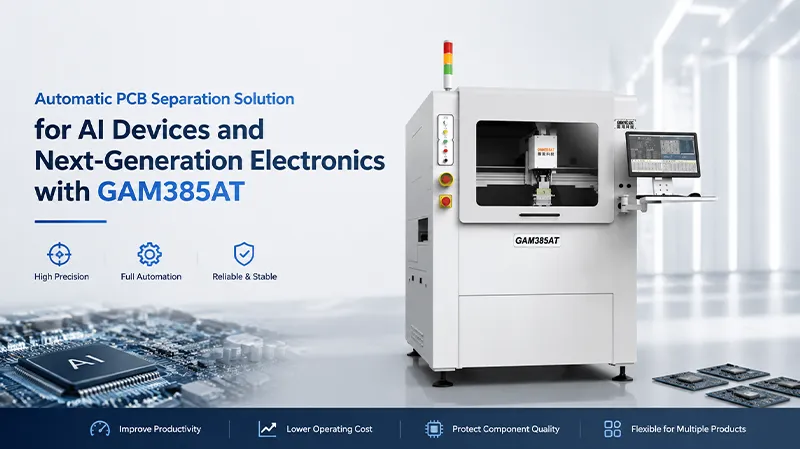
Automatic PCB Separation Solution for AI Devices and Next-Generation Electronics with GAM385AT
Automatic PCB Separation Solution is becoming increasingly important as AI devices and next-generation electronics continue to evolve. In the past, PCB separation was often treated as the final step after assembly. Today, many manufacturers see it differently. For AI hardware, smart devices, communication modules, and advanced electronic products, PCB separation directly influences: Modern electronic assemblies are becoming smaller while integrating more functions. AI devices, edge computing systems, and high-performance electronics often contain: This creates a new question for engineers: How can manufacturers efficiently separate PCBs without compromising product quality? The answer is not always choosing the fastest process. In many cases, the better solution is creating a stable and repeatable manufacturing workflow. ⚙️ Why AI Devices Require More Advanced PCB Separation Methods The development of AI hardware is changing PCB manufacturing requirements. Products are becoming more powerful, but the available space inside devices continues to decrease. Higher Component Density AI-related electronics often include: These components are expensive and sensitive. During PCB separation, manufacturers need to control: A process that works well for traditional electronics may not provide the same stability for advanced assemblies. More Complex PCB Designs Next-generation electronics frequently require customized PCB structures. Manufacturers may process: Challenge Production Impact
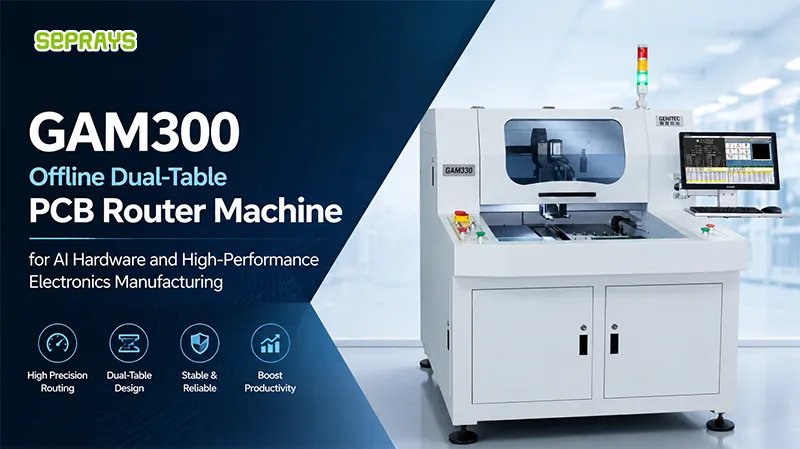
GAM300 Offline Dual-Table PCB Router Machine for AI Hardware and High-Performance Electronics Manufacturing
PCB Router Machine selection is becoming an increasingly important decision for manufacturers producing AI hardware and high-performance electronics. The rapid growth of AI computing, data center infrastructure, and advanced electronic systems is changing how PCBs are designed and manufactured. Compared with traditional electronic products, modern AI and server-related hardware often requires: For many electronics manufacturers, PCB assembly is no longer only about increasing production speed. The real challenge is maintaining stable quality while handling increasingly complex PCB designs. A typical manufacturing situation looks like this: A factory receives a new generation of AI hardware orders. The PCB design becomes smaller, but the number of components increases. High-value processors, memory modules, and communication components are placed closer together. The production line must achieve higher output while avoiding damage during PCB separation. At this stage, the depaneling process becomes a key factor affecting production stability. A reliable routing solution should not only accurately separate PCBs. It should also help manufacturers reduce process variation, improve production flexibility, and maintain consistent output over long production cycles. 🔍 Why AI Hardware Manufacturing Requires Advanced PCB Routing Solutions AI hardware and high-performance electronic products are driving PCB manufacturing toward increasingly precise requirements. In previous generations of
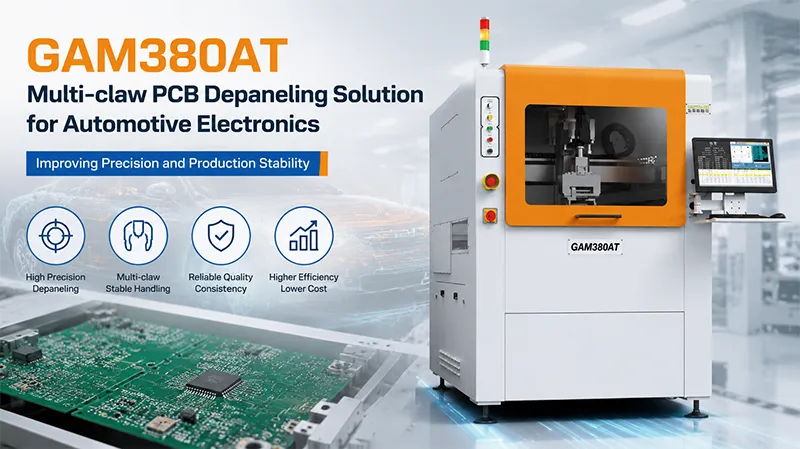
GAM380AT Multi-claw PCB Depaneling Solution for Automotive Electronics: Improving Precision and Production Stability
GAM380AT Multi-claw PCB Depaneling Solution is designed for automotive electronics manufacturers facing a common challenge: increasing PCB complexity while maintaining long-term production reliability. Automotive electronics are evolving quickly. Modern vehicles contain more electronic control units, sensors, communication modules, and intelligent systems than ever before. This change creates higher requirements for PCB manufacturing. Automotive PCB assemblies often include: Unlike consumer products that may be replaced within a few years, automotive electronic modules often need to operate reliably for a decade or longer. Because of this, PCB separation is no longer just a final production step. It has become an important factor affecting product quality. A small process variation during depaneling may not immediately appear during factory testing. However, it can become a reliability issue after months of field operation. ⚠️ Common Challenges in Automotive PCB Production Many automotive electronics manufacturers experience similar production problems. The challenge is not only cutting the PCB. The challenge is maintaining stable quality across thousands of production cycles. Component Stress Near Cutting Areas Automotive PCBs often have limited space. Components may be positioned close to routing paths. Traditional separation methods can introduce: For high-value automotive modules, even a small increase in defect rate can create high
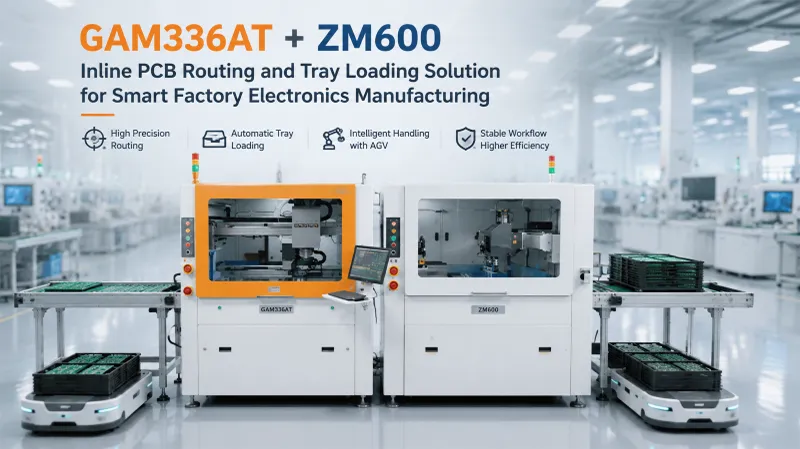
GAM336AT + ZM600 Inline PCB Routing and Tray Loading Solution for Smart Factory Electronics Manufacturing
GAM336AT + ZM600 Inline PCB Routing and Tray Loading Solution is becoming an important consideration for electronics manufacturers that are moving toward smarter and more automated production lines. In many factories, PCB routing itself is no longer the biggest challenge. The real challenge appears after cutting. How can manufacturers maintain stable production when panel loading, PCB transfer, sorting, and material handling all require human involvement? For high-volume electronics production, every manual step creates possible variation. Operators may need to adjust materials. Finished boards may wait for the next process. Production data becomes harder to track. This is why more manufacturers are exploring integrated solutions that combine PCB depaneling with automated handling. 🔍 Why Smart Factory Production Requires More Than Just PCB Cutting Electronics manufacturing has changed rapidly. Products such as: are becoming smaller, more functional, and produced in larger quantities. This creates new production requirements: A traditional standalone router machine can provide accurate PCB separation. However, when production volume increases, manufacturers often discover another limitation. The cutting process may be stable, but the surrounding handling process becomes the bottleneck. A smart factory does not only need faster machines. It needs a connected production workflow. ⚠️ Common Challenges in High-Volume PCB
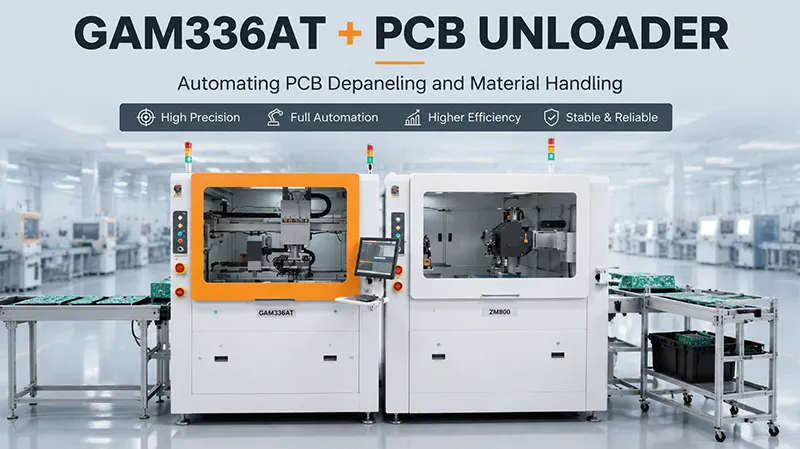
GAM336AT + PCB Unloader for Consumer Electronics Manufacturing: Automating PCB Depaneling and Material Handling
GAM336AT + PCB Unloader is designed for consumer electronics manufacturers that need more than just accurate PCB separation. In many modern factories, the real production challenge does not stop at cutting the PCB. It continues with: As consumer electronic products become smaller, smarter, and released faster, manufacturers are under increasing pressure to improve both quality and efficiency. A depaneling process that works well for small production volumes may become a bottleneck when demand increases. This is where automated PCB routing and material handling begin to create measurable value. 📱 Why Consumer Electronics Manufacturing Needs Smarter Depaneling Consumer electronics production has changed significantly in recent years. Products such as: are becoming smaller while containing more functions. This creates several manufacturing challenges. PCB designs now often include: A traditional manual loading and unloading process may still work for low-volume production. However, when monthly output increases, manufacturers often face new problems. Operators spend more time handling panels. Production lines become harder to balance. Quality consistency becomes more difficult to maintain. The challenge is no longer only cutting the PCB. It is creating a stable and repeatable production workflow. ⚠️ Common Problems in High-Volume PCB Production Many consumer electronics manufacturers experience similar issues when
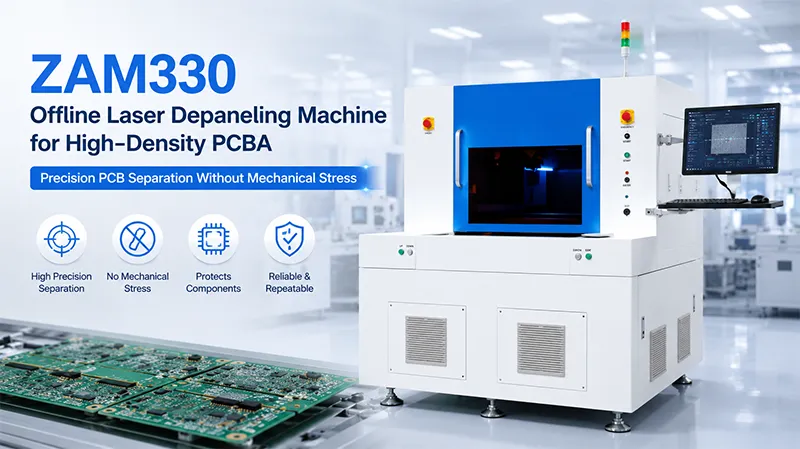
ZAM330 Offline Laser Depaneling Machine for High-Density PCBA: Precision PCB Separation Without Mechanical Stress
ZAM330 Offline Laser Depaneling Machine is becoming a practical choice for manufacturers producing high-density PCBAs where even slight mechanical stress can affect long-term product reliability. As electronic devices continue to shrink while integrating more functions, PCB layouts have become increasingly compact. Manufacturers place components closer to board edges, adopt more multilayer designs, and integrate expensive ICs or optical modules, leaving little room for processing errors. Many manufacturers have already invested in high-speed SMT lines and AOI systems. Yet, one production step still deserves more attention—PCB depaneling. The final separation process may only take seconds, but it can determine whether a finished product performs reliably for years. This article shares practical observations from modern electronics manufacturing, explains where laser depaneling fits, and discusses why more engineering teams are reconsidering traditional separation methods. 🔍 Why High-Density PCBA Changes the Rules Ten years ago, many PCB assemblies had generous spacing between routing lines and components. Today, the situation is very different. Modern PCBAs often feature: As component spacing decreases, manufacturing tolerance becomes increasingly critical. Mechanical force that once caused no visible issues may now create microscopic cracks inside solder joints or PCB layers. These defects rarely appear during production testing. Instead, they often